
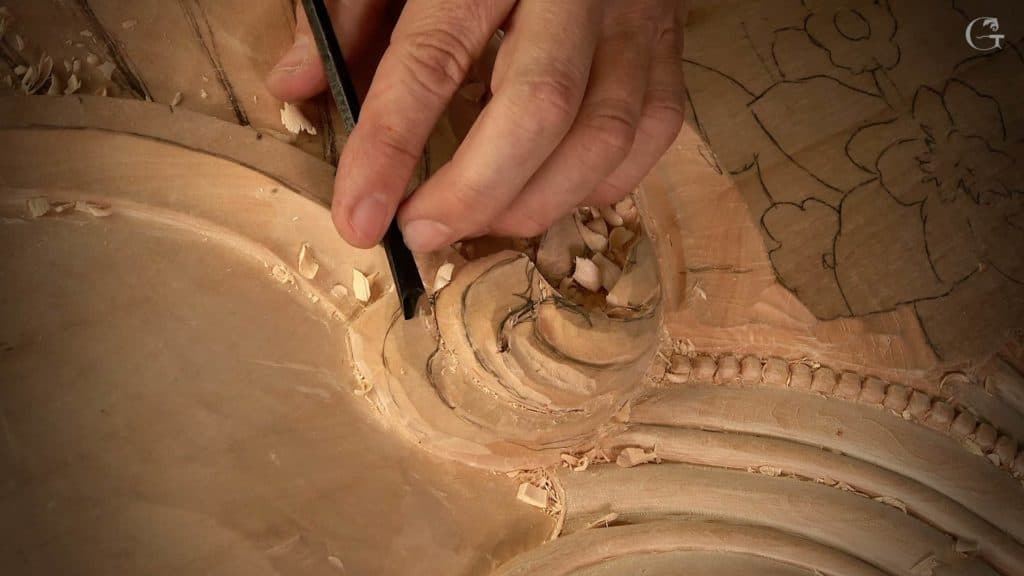
Alexander Grabovetskiy, woodcarver, School of Woodcarving · Published 2021
What does a wood carver mean by "the same movement"?
Quick answer: In Venice Room 144, video 2, I said a spot would get "the same movement" like the one on this side, and then named an eye and a pipe. Other lessons use those words for columns, slopes, pipes, walls, flips and lines, and each one is linked below.
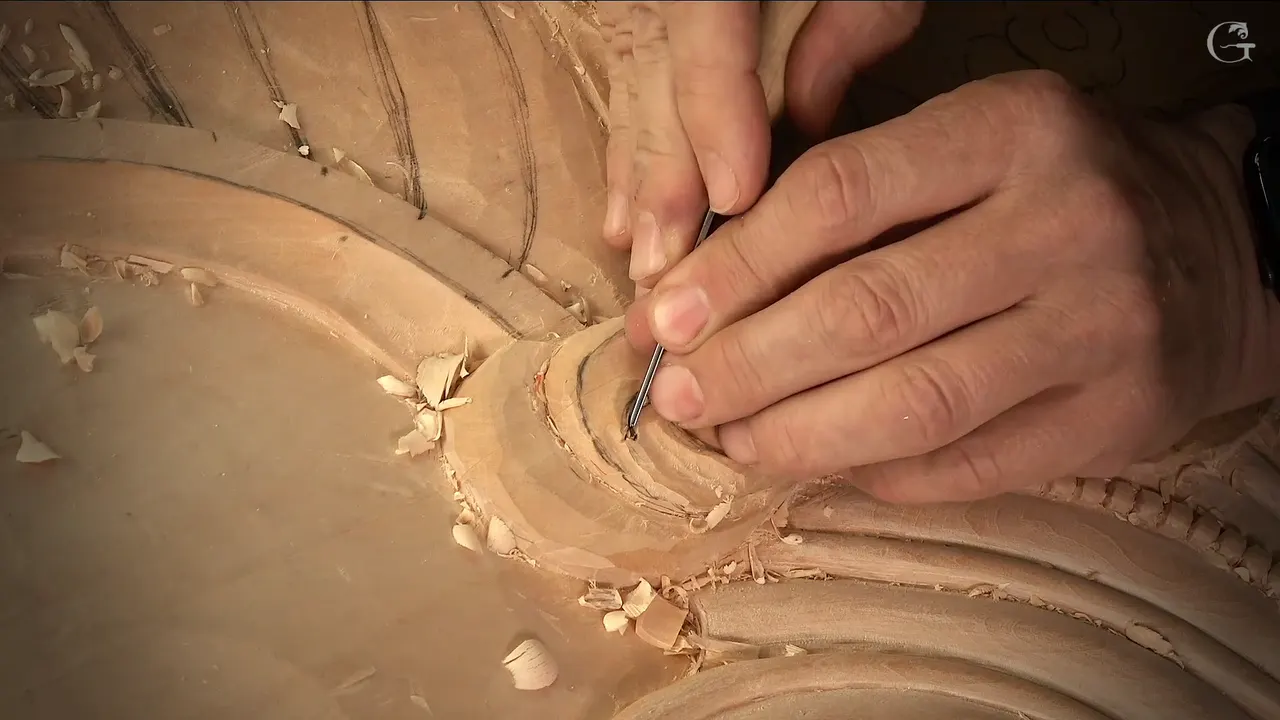

In the second video of Venice Room 144 I said "here's going to be the same movement, like on this side" and then I named an eye and a pipe. I use those words in lessons from the Venice Room panel, the Furniture Panel, Lily Box, Hashemi flowers and Grape Onlay. The second video of lesson 144 goes whole below, and the other lessons follow with their links.
Ever finished a curl on one side of a panel and then stood looking at the other side? Did your hand want to do it again, only a little different? Then you know what this page is about.
The lessons that use the words
- A move like one already there, with an eye.
- Columns on a smaller scale, with a law named.
- Two sides sloping alike.
- One wall, leaning downhill.
- A middle line drawn again, and a tangent.
- A repeat that is "absolutely okay," or a turn the other way.
What came before the words in lesson 144?
The video opens on "This pipe." What I could do, I said, was "make it look even more convincing" so that I could create that eye with a small tool. Then came a catch: "I just made the mistake, just too early, I guess. But it's okay, I'll fix it." The small tool was "just about 16th of an inch and half a millimeter" (a 16th of an inch is about 1.6 mm, and half a millimeter is about 1/50 in). Then: "That is good."

Did I decide on the next separation?
I left it open. There would be another separation, I said, and I could do a separation there, but "I'm not sure if I should or not." Maybe I could do "a big S curvature" instead, was my other thought. "So let me think about it, okay? But meantime, I can move on this side."
What was that point?
"That point should go somewhere inside, underneath of here," I said, and then came the words I opened this page with. Next: "There's going to be an eye, and the pipe going to go all the way this way. So this is a much more simple movement, I would say."

Why did I carve toward myself?
It was not the best idea, I called it, and I gave a reason. "3 millimeters, number 11, of course." I planned to cut toward myself, and I said it was "not advisable. So it's not the best idea, but I don't want to walk around and block the camera." Three millimeters (about 1/8 in) was the size. Then I called it the cut I'm after.
The convex waited, I said: "A little later, I'm going to create the convex, of course. But now I need to keep that shape." My tools came in a short run, "let me take number seven" for the concave, then "I'll take number three."
What did I say about the undercut?
The undercut could wait. "I have to undercut. Otherwise, it's not going to look as nice" and "I can always undercut little later." Then a lesson, my own: "So that is also one of the lessons for myself. Sometimes I'm rushing and create undercuts right away, and later on, I see I want to change something, but it's already too late because I already undercut."

What came after the undercut?
That order: edge, blend, then a smaller eye. I wanted to roll the edge a little, for "more organic movement" with "number three, small one, like 10 millimeters or so, 3/8 of an inch and something like that."
For the blend I said "let me think. I need to walk around, I guess. And maybe even use a back bent in this case because it's not too convenient for me." Then: "Going to use back bent."

The eye came back "to make it look lighter" with "1 millimeter again. Number 11, of course." One millimeter is about 1/25 in. And then: "so far, I like what I see."
The concaves were a plan. "Same idea," I said, and I would make some kind of concaves on each side, somewhat shallow at the beginning and "more pronounced little later." Along the pipe's opposite side: "Again, almost from nothing" and then "I really want to see that pipe."

Does the same movement mean an exact copy?
In my words, no. Video 6 of Venice Room 41 begins it. I loved the element I was using, I said. Below the corbels would sit columns, and "they're going to have about the same movement." My next line: "Not exactly the same." They would be a little smaller. Then the rule: "If you've got one part, some idea, you have to repeat that somewhere else." Otherwise, I added, the part is "not related to overall design."

Next, a slope, in Venice Room 62, video 10. My plan was number one, pretty much, and then "more pronounced sloping." A note followed: "I don't have to too much." After that came a result: "So now it slopes about the same degree."
The Tray of Blessing puts the idea on a smaller scale. In lesson 6, video 1, I said I would start on the tool's right hand side and go "really slowly for you." Then: "it's just like indication of the same movement, but on a lot less, you know, smaller scale."
The design lessons give it a name. Design principles for wood carving 4, video 2, has "We repeat the movement on a different scale." My main arc ran along a Baroque diagonal. A slip showed: "Logically, I've done wrong because actually it still has to be tapered from the same point." And then: "So it repeats but not parallel."
Which parts of a carving get the same movement?
Pipes and walls got those words from me, and so did flips, lines and one small piece. Video 6 of Venice Room 60 has the pipe: "Let me cut opposite side of the pipe." The pipe was supposed to go "to the same direction, to the same movement." An eye was still ahead, so I said to be careful.

That tool was "a little too big for me," so I said I would turn to either two millimeters (about 5/64 in), "or maybe let me try four millimeters first" (about 5/32 in).
A wall is the part in Furniture Panel 20, video 5. "So which means I have to leave some space and develop a wall." It would lean one way and go downhill, "that direction."
A flip is the part in Hashemi Flowers 13, video 1. "I'll make an inner flip also." It would flip toward one direction, and right there a concave cut would sit.

A line is the part in Grape Onlay 9, video 1. The subject was the main line of a leaf, and I wanted to "create the same movement going downhill." Then: "you don't really have to follow those rules if you feel like that's too much." And: "Just get the overall motion."
A small piece is the part in the Grinling Gibbons class in Maine, lesson 3, video 2. One line had to stay right there, I said, because "that part is going to become part of the outside." The little guy "is a part of that one."
A concave that is almost none had them in Venice Room 49, video 11. "It's almost no concave." A number 3 was "a little too big of a tool," used on the side. Then: "And of course, I can do same movement on the other side. I'm still not losing overall shape, the roundness, because almost no concave, but it's still concave."
Three of them are counted in Venice Room 26, video 7. "So I got those three main movements." All three belonged to the same movement, and they were supposed to go "from underneath."
A detail stays safe in Venice Room 56, video 5. "I also don't want to lose that detail, which is going to go also underneath of that same movement." The tool: "the same number nine."
A twist is the part in Furniture Panel 12, video 3. Of the work I said: "Now it looks more unified. This repeats that line." The words came next: "Since I have something like that, I have to repeat somewhere else and the only spot I can see it's probably right here." My plan: "And I can go repeat this, make a twist and go down here just like that." Then "And maybe a smaller one."

Did lesson 144 repeat anything in its other videos?
A pair of lines and a plan, in the first and third videos. The first has "a micro pipe going from this eye." Then: "let me also do on this side of the pipe some kind of movement, too. It's important for the eye. Otherwise, it's going to look like something missing."
The third video begins by repeating a plan I had just made: "So just get those spots." Further on, about some rasps: "It just expedited my work, made it little quicker, and I'm probably going to do the same thing from now on." My reason was a plain one, said right after the rasps: "it's a paint grade."
What if the same movement does not fit?
I doubted it in lesson 74. The Venice Room 74 video 6 has a leaf: "that leaf right here, it's much longer leaf than what I have right now right in this area." I said I was not sure how nice it would look. My fear was about the motion beside it, "how it's going to interact with this movement."

A limit shows in Venice Room 143, video 2. The move would match "this side," but not at the same level, "because logically, it has some movement." I had to move it "little bit away from this side." From above, "they're not at the same position."
I got lost in Venice Room 24, video 10. "The same movement" was my plan there, and then: "But somewhere I'm lost." My next job was the distance: I said I needed to check it.

Does the same movement have to be a tangent?
Here is Venice Room 53, video 5: "Again, everything is supposed to be tangent, okay? Tangent to the same movement, to the same three-dimensional world movement, if you wish to say it that way."
Two parts that grow in opposite directions can still share it, as in Venice Room 47, video 1: "I really like it when those two elements meeting together. They are growing opposite direction. This grows this way and that grows upward, but they meet together and still create the same movements. Okay? Which is really important, I believe."

Carving Lily Box 3, video 2, has a ridge I did not like. I drew another line for my middle line, and the idea is "everything has to flow." A second word followed: "There's another term for it" and I said "I have to just continue my tangency to this line."
Over in Carving Greek Acanthus Leaf 1, video 3, I said "Another eye" and spoke of "that movement I can repeat right here."
A separation to redraw shows in Furniture Panel 34, video 3. "Obviously, you know, it all has to be wavy." Maybe two parts, "this guy and that guy," would sit "in opposition movement."
Is a repeat required at all?
Carving Plate with Butterflies 12, video 2, gives a choice. Do the same movement, I said, and "that's absolutely okay." My own pick was the other way: "I decided to make the movement the opposite direction." And for anyone not comfortable with that type of movement: "just go ahead and just do whatever you feel like."

Its third video says "I don't need to explain you every movement because it's exactly the same movement." Then: "The main idea is just to keep the angle the same."

Where did each video say it?
The table gives one row for each lesson, with what got the same movement and what I did next.
| Lesson | Piece | Next |
|---|---|---|
| Workshop 144, part 2 | A pipe and an eye, like on this side | Number 11, 3 mm |
| Lesson 41, video 6 | Columns set beneath the corbels, a little smaller | The law named |
| Venice 62, video 10 | A slope that goes all the way in | A number one |
| Room 60, video 6 | A pipe with an eye still to come | Try number 11, 4 mm |
| Workshop 74, video 6 | A leaf much longer than the space | A fear |
| Panel 20, video 5 | The wall that leans and goes downhill | Some space |
| Hashemi Flowers 13, video 1 | An inner flip toward this direction, with a concave cut | A spoon gouge to take |
| Onlay 9, video 1 | The main line of a leaf, going downhill | Overall motion |
| Panel 12, video 3 | A twist somewhere else, maybe a smaller one | A repeated line |
| Tray of Blessing | A move on a smaller scale | Right side |
| Lily Box 3 | A ridge and a new middle line | A tangent |
| Plate with Butterflies | A step repeated all around, with one angle | Same angle |
| Gibbons Maine class | A little piece that is part of the outside | A line |

Which side of your own piece will you copy next? Every lesson named here sits inside access to the school, paid monthly or yearly and renewed automatically until you stop it. The Part 13 course page holds lesson 144 with all three of its videos. Wikipedia has plain pages on gouges, scrolls, spirals, furniture and wood carving.
How it's done
- Say where it goes. A point should go somewhere inside, I said, and the same movement came with the eye and the pipe.
- Choose the first tool. A 3 mm number 11 came first, and I called it the cut I'm after.
- Keep the shape first. The convex waited, and I said I needed to keep that shape for now.
- Leave the undercut for later. The undercut could wait, I said, and rushing undercuts can be too late.
- Roll the edge. Rolling this edge a little was my wish, with a number 3 of about 10 millimeters (3/8 in).
- Start shallow. The concaves would be somewhat shallow at the beginning, and more pronounced a little later.
Frequently asked questions
Which tools did I name in that second video?
A small tool of about 1.6 mm (1/16 in) and 0.5 mm, then number 11 at 3 mm, number seven, number three, a back bent, and number 11 at 1 mm again for an eye.
Why did I carve toward myself in lesson 144?
I called it not advisable. My reason was that I did not want to walk around and block the camera.
When did I say I could undercut?
Lesson 144 has me saying I had to undercut, or it would not look as nice, and that a little later was fine. I called that one of the lessons for myself.
Can the same movement be smaller?
What to carve next