
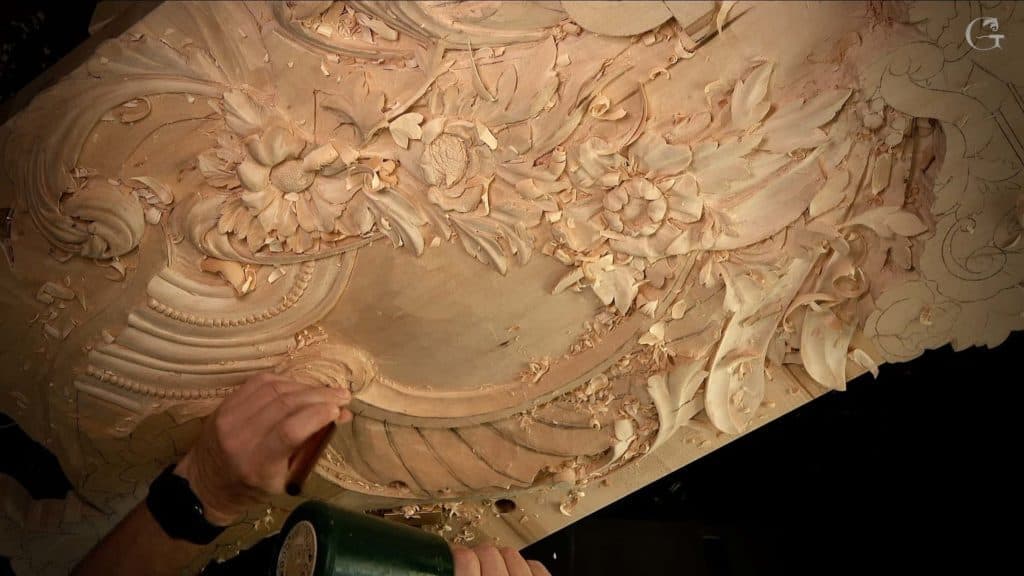
Alexander Grabovetskiy, woodcarver, School of Woodcarving · Published 2021
What does a wood carver mean by "good, except"?
Quick answer: Video 3 of lesson 144 has me approving a spot, and the "except" brings one shadow I still wanted. Right after it I said I can use the half millimeter again. The same pair of words turns up in other lessons, each time with a spot and a next job named beside them.
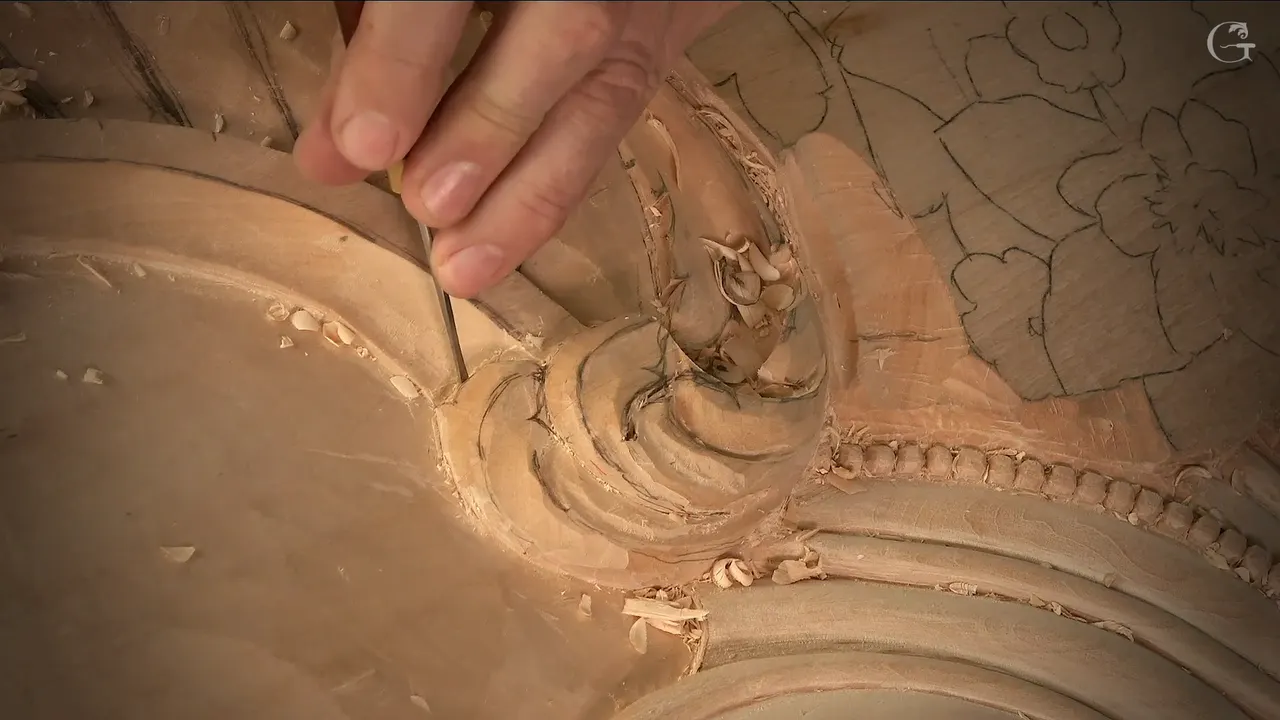

In lesson 144, video 3 of the Venice Room, I said "That looks good, except I want to create a little deeper shadow in this area." Two words in that line, "good, except," turn up in other lessons of mine too, each time with a spot and a next job beside them. This Venice video comes first, and the other lessons follow, each one linked.
Ever looked at a carved hollow, liked it, and still seen one corner that was not done? Then you know the moment. Out loud, while I carve, I say it.
What did I say before the "except" in lesson 144?
The video opens on a plan, "exactly the same" and I think I will do what I just planned to do. I name the spots: "those spots" and "maybe even this spot here." One reason for the detail is that it will be visible from that point anyway. Next I check myself. "I hope, I should say, it's going to be good detail."

I'll take a small detailing tool, "which is one-eighth of an inch, three millimeters, number 3." The plan is to create some excavation carefully. I really have to get a little closer to it before I will see it better, I tell you, but I'll try my best. A fallback follows. "Worst case scenario, I can finish it off camera and make it look really nice and finished."
Then the molding comes up. I need to take care of how it hits that point, and that side will be undercut too. What I want is for it to look like it's rolling from underneath as well. Two millimeters (about 5/64 in) is the tool I'm using, and one millimeter (about 1/25 in) is another I can use.

"I kind of like the idea," I say, and I tell you what I did with some rasps. They made the work a little quicker. From now on I'm probably going to do the same, because "it's a paint grade." I really don't have to worry about those tool marks. And the deadline is coming sooner than I wanted to, "but it's okay."
Next I fix my own words. First the tool is a micro tool, and then it is "actually not micro tool, it's a detailing tool." With it I can make somewhat deep shadow, then really deep shadow, in that area. I'm undercutting a little, not much, "But I am undercutting." Then a hook. I need to hook all the junk out, and I'll take 0.5 mm or so (about 1/50 in), a number 11 micro tool.

How far should it go? My words are "And get that to the extreme. But I really don't need to, because it's going to be painted." Some paint will get in and some dust will too, so it will not be too visible, and I can at least get a really deep shadow. I'll attack it from both sides. "I created beautiful hole," I say. It is "a really dark spot" and "I like it, I should say."
The edges come next. I'm going to take, let me think, maybe a detailing tool, maybe number 5, "6 millimeters or so" (a little under 1/4 in), to clean the edges. Again I'll need a smaller one. What I'm doing there is "not really necessary," I tell you, though I think the result will look better. The junk inside can come out with that half millimeter tool.

What comes right after "except" in lesson 144?
"All right. That looks good, except I want to create a little deeper shadow in this area." The next sentence is "And I can use half a millimeter again," a size I named earlier for the hook. My last words in this video are "straight half a millimeter" (about 1/50 in).

Where else do I say "good, except" in my lessons?
Lessons from the Lily Box, from the Moldings course and from the Venice Room carry the same shape. First comes the approval of a spot, and the job follows. The lines below are mine.
How did the Lily Box lessons use it?
In video 12 of Lily Box lesson 8, I clean a mess out with number 4, 1/8 of an inch (about 3 mm). It looks good to me at that point, and the next words are "except I still need to clean the previous one." I mean the one below, where I see a kind of messy area. It needs a final form on the edge, and I'll use number three again to outline it nicely.

Then I explain my pace. I'm willing to spend a long time at one spot, because I want to make sure it looks good, and I don't want to forget the mess I left there. Sometimes I jump to another area if I'm tired of this one. That works on a larger project. "But on a small project like that, there's no reason."
Over in lesson 9 of that course, video 3, the carving looks really good, and then again, "It does look really good." Here is the line. "Except it's still not blending with the upper." I add "Maybe I should give a better concave right here." The overall movement is not as smooth as I wish to see it. A little later I say I'm "really not too happy" with how that spot looks, and that it doesn't look "a smooth transition."

I bring in a marker so you can see exactly what I mean, and I say the line is not flowing now. I'll take a 1 millimeter number 11 (about 1/25 in) and start creating my relief cut first.
Video 8 of Lily Box lesson 12 has me not really happy about one spot. Again, I'll hit with the knife. The next words are "Now it looks good" and then "except right here. Right here. Not so good." Next I'll do a 4,000, and it's sandpaper, a 4,000 grit. When that is done, I say "that is wonderful" and I need to probably check that right in place.

Which job followed in the Moldings course?
The third video of lesson 8 has a leaf, and I call it somewhat good before "except I don't like overall shape." The line is the problem, and I say "It's too straight." Let me create that movement, I say, and then I tell you it's "really looking much better."
What came up in the early Venice Room lessons?
A good spot with one more job sits in video 12 of Venice Room 10, "Except I need to probably remove a little more on this side." I'd rather not remove too much material, I say, because a shell is coming, and I don't want to dig in this wall. For the tool I say "the smaller number nine."
Venice Room 11 has a rasp in video 4. "I think it looks good," I say, "except I can actually go from all the way here." One side could take a little more concave. Afterward I say I think I missed something right there, so I need a rasp, probably, to find the high spots.

Another sits in video 4 of Venice Room 13. I get rid of a triangle, and it looks much better, "Except I don't like how choppy this area looks." My words are "I don't worry about the tool marks I left because I can always take care of them." Maybe a small separation cut right there. It is "just preliminary separation cut," but it looks like it's asking me to do it. "Just begging me."
In the second video of Venice Room 14, I say a part could end up too weak, and I don't want that. Nobody will touch it or force it, because it sits closer to the ceiling. I still want that beautiful shadow. The spot is good, and "Except I need to make a really nice transition on this side." For that I should use a small number three, I would say, and I probably have to switch to the back bend, a small one, like number five, only 3 millimeters (1/8 in).
The seventh video of that same lesson has another. "Okay. Now it's good. Except it needs to be a cleaner cut. So it's not too clean yet." I make a little cleaner cut, and then "now it's much better." I know you don't see that from this perspective. From below, though, it will be visible, and I call it "a really nice sweep." Probably a smaller number nine is next, "like eighth of an inch" (about 3 mm).

Video 11 of Venice Room 16 has it. "Let me see from the bottom how it looks," I say. It does look good, "Except just one spot kind of still bugs me a little." I'll excavate there with 4 millimeters, number 11 (about 5/32 in), going inside little by little. The edge sets the limit: "right now it becomes really weak."
More follows. "I can't go really close to this edge, or else you're going to create some mushy look." Right here I can excavate really deep. Later I say "It still bugs me, this area" and "It still doesn't look how I think it should look." What I can do is "create kind of deeper concave right here."

One doubt fills video 2 of Venice Room 19. It should look "very good" and I add "Except I still kind of have doubts about the position of the eye." I still want to see it somewhere, because I really like the idea. I ask myself if I have to do it, and my answer is, of course, no, because the flower will cover it.
Workshop 21 opens video 2 with "except I've got a lot of mess going on inside right there." I clean it with a number 11 at two millimeters (about 0.08 in). A bigger one would be quicker. I say "let me use four millimeters" (5/32 in), and then "I can swoop a lot more right away." After it I say "really nice and deep excavation" and I'm happy.

How did lessons 27, 28 and 30 use it?
In video 7 of Venice Room 27, I need to see the carving from below again. It does look good, though I probably need to round it a little more. From all the sides, I need to look from different points of view and make the decision if it's rolling good enough or not.

The pipe is the job in video 4 of Venice Room 28. I call the spot good, and the "except" is the pipe. It "doesn't look too good, and I'm almost losing the detail right here," so its movement needs a fix. Maybe a little deeper concave, I say. I'm not sure if I should or not, but let me try with number nine.
Two come up in video 10 of Venice Room 30, and each one names a small job. The first is "except I can also just clean that point." The second comes later: "Except now I do have a beautiful, beautiful concave on this side" and I can give a subdivision there too. Of the small work I say "they add up." I'm not taking too much from the piece, since I can carry it inside even more if I need to.

Which jobs showed up in lessons 118, 123 and 128?
A pass in video 1 of Venice Room 118 worked "really good," I say, "except I have to attack that from two sides." The reason I give is "the grain of the wood and the property of a tool." One side is always clean, I say, and the other side is always somewhat messy. I hope you already know that by now. The ridge comes first, because it has to look like it's rolling and now it doesn't. The words are "I need to chamfer it or fillet that." Number three is next, and I'll blend that this way.
Venice Room 123, video 2, gives me "except I messed up little bit, just a slight area." I apologize for "I didn't see. There is a mallet in the way." I can take number seven, 14 millimeters (about 0.55 in), and create some corners.

In the first video of lesson 128, I really like the result, and I have to clean a bit inside, but overall I am happy. "Except, what I could do, I could create an eye in this section and kind of pipe it." I think that will give me an even more interesting look. I'll reach for a number 11 at 4 millimeters. Then I say I don't really have to do that pipe, but I think extra shadow will help me.
Which spot and which job, side by side?
The table keeps one row for each of these videos, with the spot or tool I named and the job I set after the "except."
| Spot | Lesson | Job |
|---|---|---|
| Half millimeter tool | The Venice Room, workshop 144, video three | Deeper shadow |
| A number three | Lily Box course, lesson 8, video twelve | Clean below |
| The leaf outline | Acanthus over Moldings, lesson 8, video three | Better shape |
| Concave and flow | Lesson 9 in Lily Box, video three | Smoother blend |
| Rasp in hand | Early Venice Room, lesson 11, video four | High spots |
| Four millimeter scoop | The Venice Room, workshop 21, video two | Mess inside |
| A number nine | Lesson 28 in Venice Room, video four | Pipe movement |
| Number seven tool | Workshop 123 of Venice Room, video two | Some corners |
| Number 11 tool | Again in Venice Room, lesson 128, video one | An eye |
What looks good on your bench right now, except for one place? Every lesson named here opens with access to the school, paid monthly or yearly and renewed automatically until you stop it. This third video belongs to the Part 13 course page, in lesson 144, and lesson 145 comes next. The wood carving I do here also sits in Acanthus over Moldings and the Lily Box course.
How it's done
- Call the spot good. The spot gets called good, as in lesson 144, video 3.
- Name the one thing left. After that comes "except," and then a deeper shadow there.
- Name the tool. I name the same tool as before, "again," and then "straight."
- Look from below. Before a final call, the check is from below, as in lesson 16, video 11.
- Say what you are leaving. On lesson 30, video 10, I leave a part alone: "I'm not taking too much right now from this piece because I can carry that piece inside even more if I need to."
Frequently asked questions
Which line in lesson 144 carries the words?
Video 3 puts the approval first, then "except," and then a deeper shadow.
Which tool did I name for that deeper shadow?
The half millimeter (about 0.02 in), I said, "again," and then "straight."
Do I say the same words in other lessons?
Yes. They sit in the Lily Box, Moldings and Venice Room lessons named above, each with its own spot and its own next job.
How do I check a spot I call good?
What to carve next