
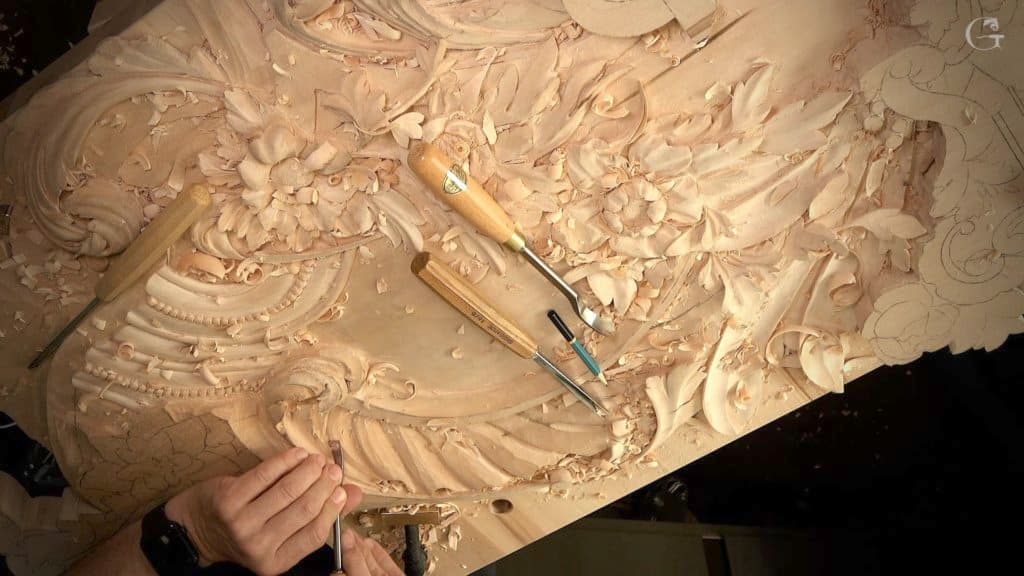
Alexander Grabovetskiy, woodcarver, School of Woodcarving · Published 2021
What does a wood carver mean by "awkward"?
Quick answer: In the first video of Venice Room 146 I was not done with one side, and I called one area on it little awkward. In my other lessons the word sits beside a look I did not like, or beside the position I was working from.
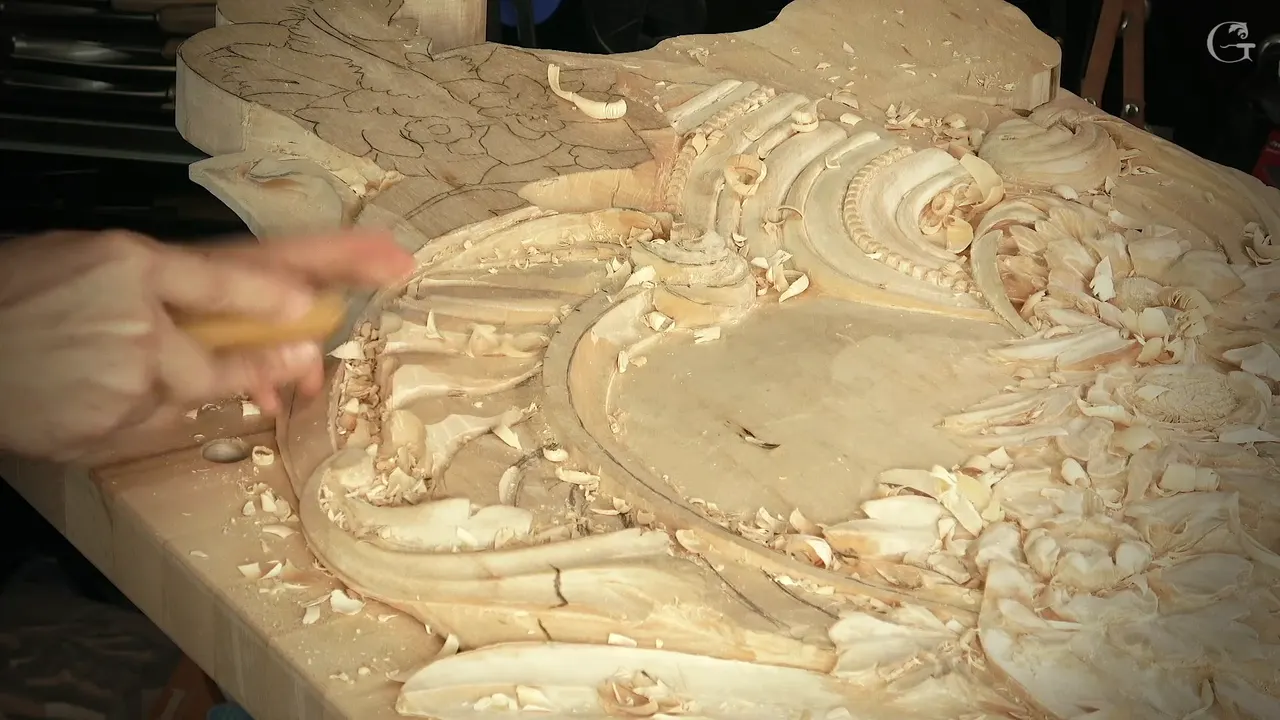

In the first video of Venice Room 146 I had a side I still had not finished, and I said that for me "this area look little awkward." The same word comes back in my other lessons, in workshops 27, 32 and 76 and in three Grape Onlay lessons, and each time it sits beside something I did not like, or beside the position I was working from.
Ever carved a spot that looked fine up close and wrong from a step back? Did you turn the board, then your head, and still not know what bothered you? The lesson 146 video comes first here. Then come the other lessons where I used the word.
What was I carving before I said awkward in lesson 146?
The video starts with a short note. "This tool needs to be sharpened, obviously, but that's okay," I said, and moved to the opposite side. On that side I wanted to "roll it this way with the more convincing convex" and number 7 was "what I'm going to use." And "that is the big idea."
Next was a plan. I needed to use "maybe a number seven again" to get "that excavation deeper and cleaner," but "not too deep," because "I don't want to overdo it." The shadow was "already giving me beautiful shadow." Maybe 5 mm (0.2 in) would "create slightly deeper shadow and little more convincing folding effect," while "leaning toward my left, toward upper part."

"See how deep that shadow is?" I asked, and I said it looked really good. Then: "Actually," I said, "I could use a four millimeters," 4 mm (0.16 in), for "even deeper shadow." "Why not?" I was "still leaning toward my left" and "yes, I will need to undercut also right here."
I said "I think it is good." I could take a back bend, number 7, I said, to "create much cleaner cut," one "much more consistent." Back bends return two videos later in lesson 146, for a convex that is wider at one end than the other. The lesson 146 page holds all three videos.

Which section did I say I would fix?
"Although I'm not too happy about one of the sections right here," I said, and then, "this part, that's what I'm not happy." My reason was "I did not move far enough, I guess." It was something "which I have to fix somehow," either "with a bigger movement" or, "maybe actually," by lowering it down "and just create something." I added, "But I'll take care of it. But that is the idea."

I called it a simple one, "just a rolling shelf." The whole thing I would "take care of" off camera, and once I used a rasp to blend everything, it would look "really nice." About the part to fix: "I going to undercut and clean it and you'll see." Of another part I said it would be "just convex" and "later I'll show it to you."
Video 2 of lesson 146 opens on a plan: "I'll just rasp majority of it and create the shape I'm after." Then: "I've done my homework, almost done" and "yes, I did use some small rasps." Paint was the reason it would be fine, I said, and I had said so "many times, maybe too many times."

Which area looked awkward to me?
Then: "You know what I also want to do probably? I still didn't finish this side, but you get an idea." And the line this page is named for: "But for me, this area look little awkward." Right after it, "it looks like I need to do something like that" and "just repeat what I have."

"I've got couple ways I can attack that," I said. One was to "create another acanthus movement," a "legit movement, just going from underneath." The other was "an extra concave," made "a part of whatever the main shelf." Either one would work. Then: "I think maybe just that" and a moment later, "I don't know, just kind of little awkward for me." A third idea followed, "maybe just to double it" and get a small acanthus leaf.
The video ends on a question I left open. "We'll see what you think when I take out this ridge," I said, and "I'll let you know what I decided little later." My last lines were that "maybe acanthus" would "make more sense in this case," "visually, at least" and that "all I need is just a visual line." The next video opens with "maybe small separation" and a test: I would keep it if I liked it and get rid of it if I did not.

Where else did I use awkward for how a spot looked?
In Venice Room 32, video 11, I was using "just number seven" and I could go "really deep in those areas," I said, because "that can give me really good dimension." I also had to keep in mind that it would be "visible from the bottom" and "only partially." At about 20 millimeters in, "about three-quarter of an inch deep," came "I think it's deep enough."
Earlier in that video I wanted one part left alone. I could go down "right here, but not here because it has to be above, and I still have to have a space for undercutting." Then came "some limitations I'm facing right away pretty much" and one was a side "in my way."
Further on, a spot stopped me. I would go no deeper in that area, because "I need to make sure that is a little raised up." And then the word: "I don't want to make it look awkward. So it has to be a more organic look."

Venice Room 27 has the word as a warning, in video 4. With a number 11, "maybe about seven millimeters" (0.28 in), I said, "Let me excavate this section" and "then start my divisions." Next: "I also don't like the distance right here, so I need to make sure I excavate inside kind of deep, because I need that material." Otherwise, I said, it would look awkward.
The trouble was one division. "See the thickness of this division, how wide it is. And that is a lot smaller." A leaf had to go "underneath, inside of this upper part" and "the only way to do that, just excavate a really deep undercut."

Where did awkward mean my own position?
Workshop 76 starts, in video 6, with "almost good, but not so good" and a plan to use a skew and "knock down a little bit that ridge." Later I said I was going to do "the right direction, not against the grain," which was just a little awkward, I said, from that position, with "3 millimeters, number 11" (0.12 in).
About depth: "I have to be careful how deep" I go underneath, I said, and not "too deep right now" because "that part is not developed also." I had "uneven spots" with "a little raised part, like a hill, and I don't like that." Next, a plan: "before I forget about that spot, let me use number four" and "I could use a long bent."

The Grape Onlay lessons give a reason: the camera. In Grape Onlay 2, video 2, I said, "Please forgive me if I'm gonna cover with my shoulder sometimes, because I'm kind of in awkward position just because of the camera." "Not concentrating on detailing," I said, just "blocking in" the grapes.

It was "all about just the roughing in, overall idea" and "you don't have to concentrate right away on the details." Later I jumped to another side. "The reason why, because it's a really awkward for me not to cover the camera, and work from this position." The plan was to "just change the camera position" and work on the new side. When I came back, I could "concentrate on this one again." Then: "if you notice, I'm still using the same number five, exactly the same tool."

Grape Onlay 3, video 2, has an elbow in the way: "if I gonna have a elbow, if I don't cover, just forgive me, 'cause right now it's kind of awkward position of the camera." A grape that comes out "little too big" at the start "shouldn't be a problem," I said, "because you can always chop a little more and clean." And "keep an eye": if you dig too deep, "you're gonna damage the neighboring" grape, "and then you have to spend a lot more time cleaning up."
Later: "I'm gonna start undercutting right away, pretty much, and not carving inside of my work bench." And then: "I am holding my tool in awkward position. Reason why, 'cause the camera."

In Grape Onlay 10, video 2, the position cost me a piece. My tool was a number 11 at 2 mm (0.08 in), and I called it awkward to attack that from the wrong direction, "but it's okay." The piece was fragile: "See, it's moving." I added, "My apologies if I'm covering with my head." Then, with a half a millimeter: "Oops." I "just broke that thing" and that "means change of design."
The reason I gave was that I "attacked from the wrong side" and that I did not wish to move my work bench for the cameras. Without cameras, I said, "I would obviously just rotate the piece." After that I said "I'm not gonna tell no one" and in the next breath, "I mean, I told you." The idea stayed: "I'm still gonna keep my idea."

Which other word did I use for a look that was wrong?
Awkward has a neighbor in my lessons: unnatural. Venice Room 35 has it in video 4. Too much twist, I said, would be "unnatural, I would say." Then: "Everything is unnatural anyway, but it's going to be little too unnatural." I said that was probably the movement I wanted to leave like that, and next I was going to take a number 11 at 4 mm (0.16 in).

Video 8 of workshop 34 has the word the other way round. A concave went "closer and closer to the edge" and it "doesn't feel like it's unnatural. It's still organic and feels good." In video 9 I said of a division, "If it's going to be too long going all the way underneath, it's not going to look good. That's going to look unnatural."
Over in video 4 of workshop 76, I said that if you asked why I did not carry it straight through, "which I could. Yes, I could, but it would look unnatural toward the ceiling, the overall movement." And: "You're still going to detect that there's something just wrong. That's why I didn't."

Hashemi 43, video 2, put it to a flower. The first ring of the flower "grows from inside and curls downhill" and the peony petals "grow uphill like this." Then: "It would be unnatural if I would just use just the one ring and only one ring going to go downhill."

What came before each line?
The table keeps one row for each lesson. It names what sat right before the word and one detail from the same stretch of video.
| Lesson and video | What came right before the word | Detail |
|---|---|---|
| Lesson 146, video 1 | A side I had not finished, with acanthus or an extra concave in mind | A visual line |
| Venice 27, video 4 | One division of a much smaller thickness, and a leaf that had to go under the upper part | Number eleven |
| Room 32, video 11 | A part I wanted left a little raised, about 20 mm deep in another place | Number seven |
| Part 76, video 6 | Going in the right direction, not against the grain | Three millimeters |
| Grape Onlay 2, video 2 | My shoulder over the camera while I was blocking in the grapes | Blocking in |
| Lesson 3 of Grape Onlay | A grape that starts a little too big, and an elbow in the way | Undercutting |
| Carving Grape Onlay 10, video 2 | A fragile spot that moved, and then broke under half a millimeter | Number eleven |
| Room 35, video 4 | Too much twist, which I did not want to push too far | Four millimeters |
| Workshop 34, video 8 | A concave that still felt organic and good | Convex center |
| Venice 34, video 9 | A division that should not run too long underneath | A small excavation |
| Part 76, video 4 | A cut I could have carried straight through | Overall movement |
| Hashemi 43, video 2 | Only one ring going downhill, when petals grow uphill | Peony petals |
Which spot of your carving still has no name? Every lesson named here opens with access to the school, paid monthly or yearly and renewed automatically until you stop it. The Part 13 course page holds lesson 146 with its three videos, and lesson 145 comes right before it and lesson 147 right after. The Grape Onlay course page lists the other lessons. Wikipedia has plain pages on wood carving, the gouge, the chisel, relief, wood grain, the mallet, the arch and the cornice.
How it's done
- Roll the side. Number 7 was my pick for the opposite side, rolled with a convincing convex.
- Go deeper with care. A number 7 again for a deeper, cleaner excavation was my plan, and overdoing it was the worry.
- Name a smaller tool. Maybe 5 mm (0.2 in) for slightly deeper shadow, and a 4 mm (about 5/32 in) as the next idea.
- Say what is wrong. One section made me unhappy, and my reason was that I did not move far enough, I guess.
- List the ways. An acanthus movement from underneath, an extra concave, or a small leaf: either of the first two would work, I said.
- Draw the visual line. All I needed, in my words, was just a visual line, and what I decided would come later.
Frequently asked questions
Which tool did I name first in video 1 of lesson 146?
A number 7, for the opposite side. I wanted a convincing convex there, and later in the video I named a number 7 again for the excavation. A 5 mm tool and a 4 mm tool came up after that, for deeper shadow.
What were my two ways for the awkward area?
Carve an acanthus movement rising from underneath, or add an extra concave and make it part of the main shelf. Either would work, I said, and I even floated a small acanthus leaf. By the end I said acanthus is going to make more sense.
Why did I move to the other side in the Grape Onlay lesson about blocking in?
Working from that position meant covering the camera, and I called that really awkward. Earlier in the same video I had asked you to forgive me if my shoulder covered it. The plan was to change the camera position, work the other side, and later concentrate on the first side again.
What to carve next