
Alexander Grabovetskiy, woodcarver, School of Woodcarving · Published 2022
What does a wood carver mean by "those guys"?
Quick answer: In Venice Room 147, video 1, the words come after a remark on my line, then spots to hit and a word about machines. Other lessons use them for people of other times and for shapes in a carving, and each one is linked below.
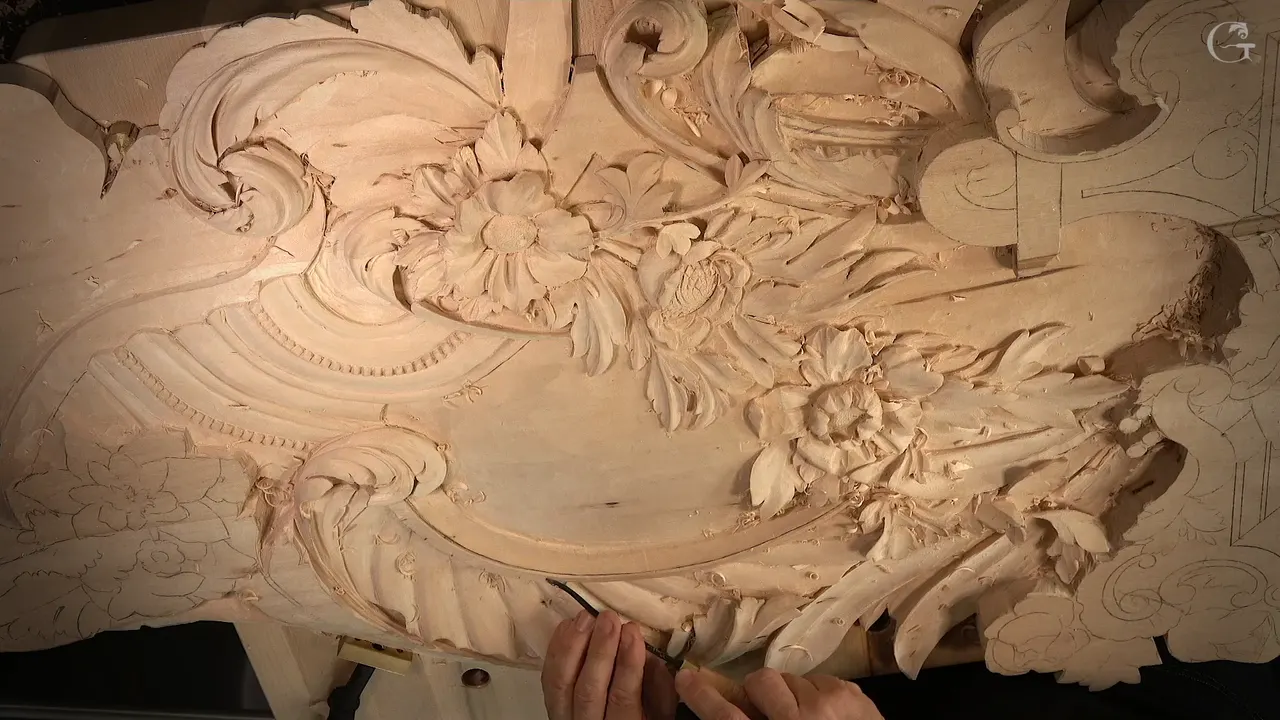

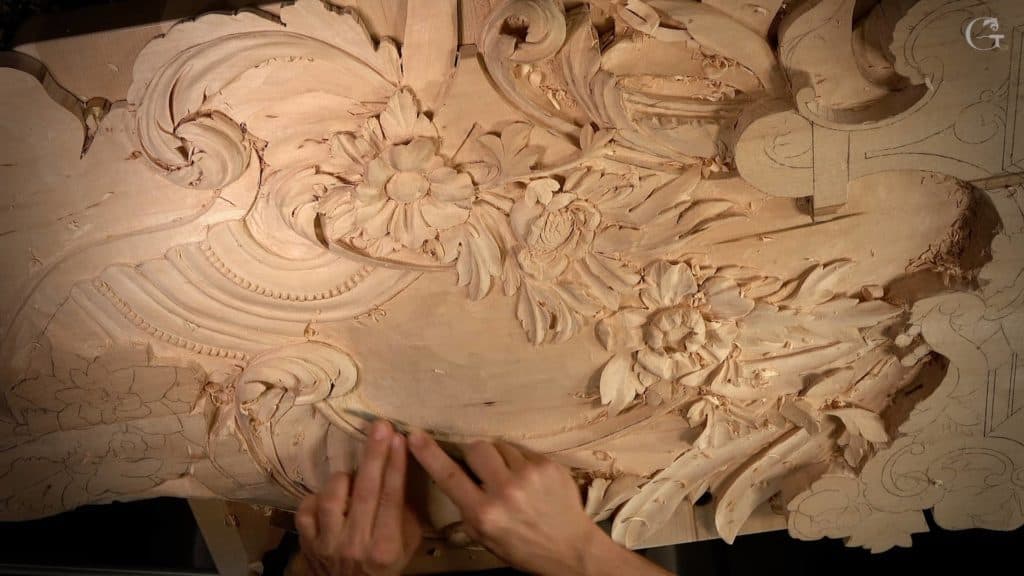
In the first video of Venice Room 147 I said "But what I have, I have those little guys now" and a little later "with those guys, I can actually make it even nicer." I say "those guys" across lessons from the Venice Room panel, Hazelnuts, Grape Onlay, the Furniture Panel, the Plate with Butterflies, the Dining Table Apron and a design lesson. In some of them the words point at parts of a carving, or at a tool. In others they point at carvers from other times. Every lesson is linked below.
Ever pointed at a few small shapes on a board and said "those guys" before you gave them a name? Did your next sentence tell the listener which ones? Then you know what the words do, and this page follows them through the lessons.
The lessons that have the words
- A wavy pencil line, a pass at the high spots, and a machine.
- The 15th century, and the lines that carvers added.
- House carvers, furniture carvers, and a countryside in Northern Europe.
- Hazelnut and grape lessons, with a count, a knife or a facet beside the words.
- Volutes and a main guy.
- A tiny spoon gouge that most of you probably do not have.
What came with the little guys in lesson 147?
Right before them I called my line "a little wavy" and then said it was just my pencil mark.
I did not name them. My next words were "I can make it look really nice. Just run and hit some of the spots and make it perfect." Then: "Okay. So I'll take care of it a little later, so you don't need to watch it, but that's the idea. So I've got convex and concave."

Which words came with the helpers?
A little more perfect, if you wish, was my plan. Then: "And yes, I will work a little bit on inside with those whatever helpers I have right now, even if it's smooth enough, but with those guys, I can actually make it even nicer." Then what I could do: "I can just take all the high spots and make it almost like it's done by router."
A machine came into it too. "By the way, I don't need to make it look like it's done by a machine." Next: "But it's going to look like I ran with some kind of machining, which is not the case because it tapers." "And there's no molding machine can do that yet." One exception: "Except some of the CNC, which is more like a carving process."
Where did video 1 begin?
On a switch: "Now I need to switch direction and just go that way." My first back bend was "obviously too small for that area," I said, and I needed "a slightly bigger back bend." My plan: "I'll use maybe 12 millimeters or so" (about 1/2 in). Then: "And really blend those two cuts with the small one, with the big one. Small back bend with the big back bend. Just blend them." My verdict: "And that looks good, except I can probably start blending somewhere right here."

The inside came next, and I said I needed to attack it. "Let me use the same small back bend, and I'll attack from that point, this direction." The grain mattered: "And maybe I have to go against the grain, and then here in this area, I can use a bigger one. Just try to be careful when I'm working against the grain. It's not the best idea, but it works."

Another switch, with a reason. "Now I need to switch and attack from the opposite side. Otherwise, it's going to be a big mistake if I'm going to do from the same side. Again, because of the grain."

What came up about stone?
I was watching one of the documentary "about professions when people working by hand" and they said wood carving is easier than stone carving. My answer: "And that's not true. It's not necessarily true. It depends what kind of stone you carve."
Stone is different, though. "Stone doesn't have a pronounced grain, except if you carving marble, then you have some difficulty. But if it's just a limestone, I think it's a little easier than wood carving because it doesn't have a grain. You don't have to just calculate the directions." Look up marble and limestone if the words are new. I added: "In this case was really easy, but sometimes it's not that easy."

Did the next video of lesson 147 use the words too?
In video 2 of lesson 147, these words came back: "I also want to outline right away those guys." Flowers were coming, I said, and all of it would sit a little lower. "Not much lower, but still" and then "Maybe about five millimeters or so." Next: "I still have to outline it. Like maybe 3/16 of an inch." Five millimeters comes to about 3/16 in, which is close to 0.2 in.
Who are "those guys" when I mean carvers?
People from other times, in lessons from other courses. Venice Room 9, video 2, has "So the main difference probably when those guys did in 15th century, so they exaggerated a lot. Okay. They did exaggeration a lot. So all those lines, they would put extra lines and so on."

Venice Room 14, video 1, has a plan before the words. "Now I'm going to create the cut underneath," I said, with "the number 11 and 3 millimeters" (about 1/8 in). I called it extra separation: "which like I said, not necessarily makes sense sometimes why they would do that, but that is a original to those guys. So they did it. Okay? They did those extra separations in the spots where you normally don't see."

Tools come into Venice Room 32, video 5. "I use a lot of number 11 in this project. Because I want to feel like those guys who did originally, what they felt." Their kit, as I put it: "They had pretty much gouges and veiners, and they did a lot of work with those." About one tool: "And I not even once touched V tool, because they didn't have it back then." It did not stop me. "I still could, but I don't think I need it, because you can do a lot of stuff with just the veiners and the gouges. And a knife and a chisel. That's it."

Four kinds of carvers are named in the Dining Table Apron lesson, workshop 17: "boat or ship carvers," "coach or vehicle carvers," "house or architectural wood carvers" and "furniture carvers." Work on shipbuilding and carriages comes with the first two kinds. Of the house carvers: "So those guys are really detailed carvers. They worked inside of the houses. They carved picture frames. They carved egg and darts, all other ornaments, architectural details, rosettes." And of the furniture carvers, which is "exactly what we're doing in this piece": "Those guys, they were really detailed-oriented guys."

A northern setting turns up in Butterflies lesson 11, video 2. I had just given a starting point from the golden ratio: divide in 10 parts, find your center, "offset slightly." Then: "I doubt those guys in ninth century and 10th century in Northern Europe even knew about the golden ratio too much. Especially the guys who used to carve in the countryside, they really didn't worry about it. They just did that naturally, whatever felt like natural and so on."

Which shapes and tools are "those guys"?
Sometimes parts, sometimes tools. Carving Hazelnuts 2, video 1, has the first one. That first bunch was "the highest one," I said, and then: "those guys are going to be really the highest spots. We're going to remove a lot of material, but don't worry about it." A caution followed. "I can safely remove all that extra excess material. But again, double-check, double-check. I don't want to remove too much." The lesson is Carving Hazelnuts 2.

A count came with them in Carving Hazelnuts 4, video 1. I said those guys would lay pretty much right on the floor, and there were two of them. One would sit higher than the other, so "I still have to keep some meat." The tool I would get was my trusty skew chisel, I said.

Grape Onlay 12, video 3, opens on them: "And let's concentrate on those guys." Slowly, I said, "see those facets. I just exaggerated them." Later, about the triangles: "You can get a knife. Any knife will do." Then I added that I meant those guys, and that "Doesn't matter, you know what shape you're gonna use."

Over in Grape Onlay 3, video 1: "But let me jump on those guys. Same tool. What I used previously is exactly the same." My choice: "it's probably gonna be number three or number two" and the size was "about half an inch or so" (about 13 mm). Then "let me do those guys first" and later "I am after those triangles first."

The one after it is short. Grape Onlay 13, video 3, has a small grape first: "another grape also kinda small. I can probably clean this one in." Then: "that is the idea. I mean, those little guys, I mean, I can take it to the extreme a little later probably."
Tools are the subject of Grape Onlay 11, video 3. Most of you probably do not have the specialty tool for that area, I said, and "nobody sells that." Then: "Those guys really tiny, small" and I named spoon gouges. "You can get right on the side and excavate all day long because it's just such a wonderful tool but you don't have it."

One line before the words, Venice Room 157, video 2, names them. "I'm talking about the volutes. Those guys, they have to be higher." My plan was "I'll take my number two again, just get upside down."
A volute is a spiral, scroll-shaped ornament, says Wikipedia on volute.

After a flower, in Venice Room 148, video 1: "So, I've done just the flower, and I showed already how I do my flowers. Pretty much, it's little different from those guys. Those guys done just from solid piece." This one I did not do from a solid piece. I carved just the first layer from a solid and then inserted the middle part, "exactly the same what I've done in Hashemi flowers."

A depth sits beside them in Venice Room 124, video 3. They would be really low, I said, so I could chop them out right away. Later: "about a quarter inch to the surface at the end." A quarter inch is about 6 mm.
Furniture Panel 31, video 2, has "those three little guys." My tool for them: "I need to outline them first with the number 11." The size was a choice: "either two and a half millimeters or two millimeters will do, or even three millimeters will work. I'll use two and a half millimeters." That last size is about 0.1 in, a bit under 1/8 in.

Even a design lesson has them. In Principles of Design, lesson 2, video 3, I was talking about shapes that are "not the main idea, but they're still important." Then: "They fight each other, but they support those guys, the main guys. So which means they have to be much lesser. But they're still important."

And a blade turns up in Plate with Butterflies 10, video 3: "If you don't have a professional scraper, you can always use just blade. I'm talking about those guys, okay? Just like that utility blade. Just make sure you just follow the direction of the grain."
Which words came with which lesson?
The table gives one row for each lesson. It holds the words I used and what came after them.
| Lesson | What the words pointed at | Next |
|---|---|---|
| Lesson 147, video 1 | Little guys beside a wavy pencil line, then spots to hit | Hit some spots |
| Lesson 147, video 2 | Guys to outline right away, with flowers going lower | About five millimeters |
| Room 9, video 2 | People of the 15th century who exaggerated a lot | Extra lines added |
| Room 14, video 1 | Extra separations I called original, in spots you normally don't see | Number 11 gouge |
| Workshop 32, video 5 | Carvers who did the originals, and the tools they had | No V tool |
| Dining Apron, workshop 17 | House carvers and furniture carvers, both called detailed | Picture frames, rosettes |
| Plate 11, video 2 | People of the ninth century, who did it naturally | Whatever felt natural |
| Hazelnuts 2, video 1 | The highest spots, with a lot of material to remove | A double-check |
| Hazelnuts 4, video 1 | Guys on the floor, with one higher than the other | Keep some meat |
| Onlay 12, video 3 | Concentrate on those guys, then facets and a knife | Use the point |
| Onlay 3, video 1 | Jump on those guys, then the triangles first | Same tool again |
| Workshop 157, video 2 | The volutes, which need more height than their neighbors | Number two, upside down |
| Panel 31, video 2 | Three little guys to outline first with a number 11 | A size choice |
Which small parts of your own piece are your "those guys"? Every lesson named here sits inside access to the school, paid monthly or yearly and renewed automatically until you stop it. The Part 13 course page holds lesson 147 with all four of its videos. Wikipedia has plain pages on gouges, wood carving, rasp, furniture, hazelnut and chisel.
How it's done
- Switch direction. My first words in the video were about a change of direction. After that I said the first back bend was too small.
- Blend two passes. The small pass and the big pass were to be blended into one.
- Come from the other side. Because of the grain, I said I needed to attack from the opposite side.
- Run over a few spots. Running over some spots would make it perfect, I said.
- Take the high spots. The high spots could all come off, which would look almost like router work.
- Leave it for later. Some of this was for later, and nobody had to watch it.
Frequently asked questions
Did I name the little guys in lesson 147?
No. I said I had them now, and that I could make the line look really nice. Spots came next, and then a note that I would take care of it a little later, with no need for you to watch.
Did I want the molding to look machined?
No, I said I did not need it to look machine-made. It would look like some kind of machining, I said, though that was not the case, because it tapers.
Which back bend did I name in video 1?
A small one first. It was too small for that area, and a slightly bigger one was what I needed. Maybe 12 mm (about 1/2 in).
What to carve next