
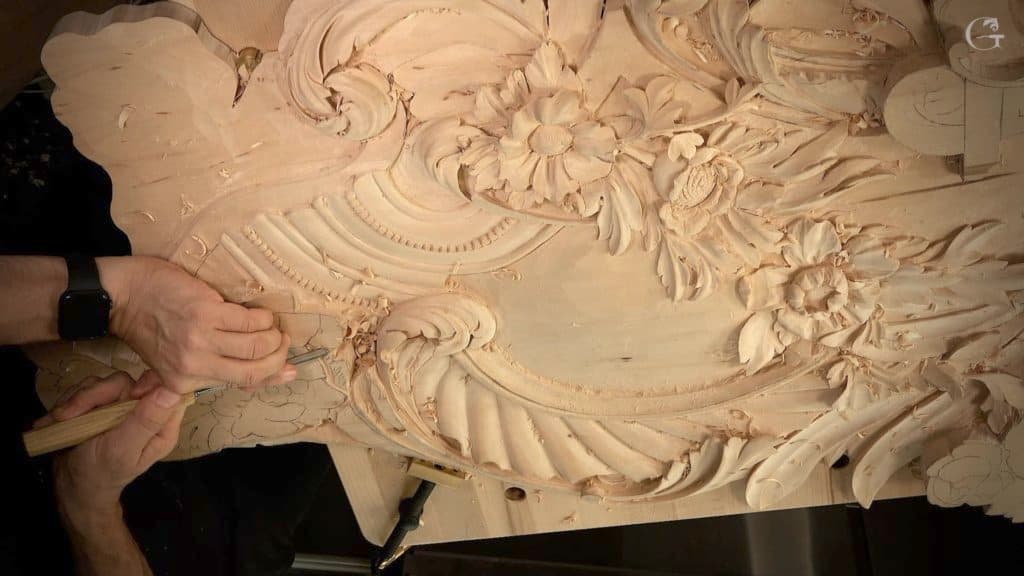
Alexander Grabovetskiy, woodcarver, School of Woodcarving · Published 2022
What does a wood carver mean by "work a miracle"?
Quick answer: In Venice Room 147, video 2, I said the word miracle about a long pipe on a simple acanthus leaf, next to the word complement. Other lessons use the same word for a knife, vices, a router plane, micro tools, an oil and a machine.
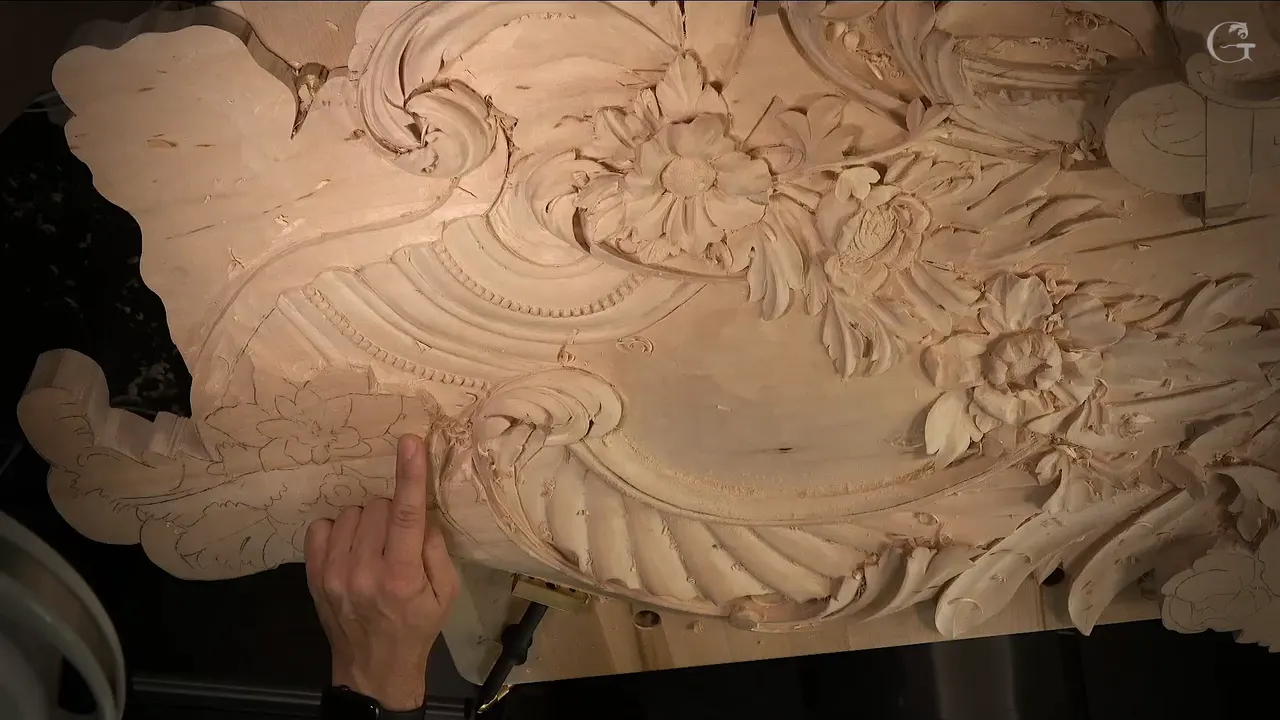

In the second video of Venice Room 147 I said "that pipe will work a miracle," about one long ridge on an acanthus leaf. Lessons from other courses use the word too, for a knife, carver's vices, a router plane, micro tools, an oil and a sharpening machine. Each one is linked below.
Ever called one tool or one cut a miracle before it had done a thing? Did the words come first, and the proof second? Then you know where I stood in this video, and this page follows the word through the lessons.
How did I describe a simple acanthus?
The video opens with "This is actually a simple acanthus movement." Nothing complicated, I said, but it divides in two parts. One part goes underneath a flower, and the other "is just ending up right here."

Simple, but still, I thought it would look beautiful, and the reason I gave was a long pipe.
How would the pipe help the leaf?
A problem came next. "If you look at that pipe, you don't see that." I tried to show it, and I said sorry if the focus was not good. The pipe, I said, would play along with the movement and "is going to just complement that movement."

A molding came into it too. The detail from the edge to the pipe would "work exactly the same like what you see on that piece of molding." For the eyes it would be "pleasant, I would say."
Could the leaf have gone another route?
"I could go different route," I said. One part could slip under a little of the shape beside it, "or the opposite." My thought was that moving that part lower would look much better.

How did the first hollow begin?
I planned to take "probably 12 millimeters, obviously" (about 1/2 in), and I said it "will be number 11." A gouge with that number is the one I named.
The start was a plan as well. I would begin "somewhere really close to my volute," from "almost nothing." A volute is a spiral, scroll-shaped ornament. Care mattered, I said, in how I start that cut, and my hand moved "just slightly" to the right. All I wanted to see was "just a long pipe."

Why run the hollow so far?
For the hollow I planned to run the cut "all the way right here," not close to the pipe, so the pipe would be wide there. The purpose came next, "I want to raise up the part of separation right here." Then came "a little deeper excavation" and after that a "second pass."

Where did the flowers and the leaves fit?
A ridge needed a preliminary blend. "I don't want to see that ridge," I said. For that I needed "somewhat like a flat gouge, like maybe number three."
Flowers were next, and they would sit lower, "maybe about five millimeters or so" (about 0.2 in). I still had to outline them, "like maybe 3/16 of an inch" (about 5 mm). That lowering would "make a little lower this area of the pipe."

The figure moved around. Maybe even less, I said, "maybe about four millimeters or so" (about 5/32 in). Then came "Oh, no. It's actually a full 3/16" (close to 5 mm).
The leaves by the flowers needed "a blending cut" and "some kind of flatter gouge," maybe a number four or a number three. The last line of the video is "Obviously, that's going to be little lower to this edge. Hope you understand that."

Did the next videos keep the miracle?
Video 3 of lesson 147 has the word exaggerate. "I want to exaggerate that pipe." About the side of the pipe: "I really worry about a clean cut on the side of the pipe. That is really important for me." And "that pipe is going to make a huge impact on design and overall movement."
Still in video 3 I said "I've got big pipe" and "So I've got that pipe, which I'm really happy." In video 4, "here's my pipe" and I said I would have no "really sharp ridge" in that area, just "an indication of movement."

Where else does a tool work miracles?
- A knife, named a miracle tool.
- Carver's vices, and a bench instead of a post.
- A tool in a Byzantine Acanthus lesson, with a caution right after.
- A router plane for relief carving.
- Micro tools, and a habit of putting tools back.
- An oil on a slip stone, and a sharpening machine.
- The number 11 gouge in a wiggle.
Does a knife work miracles?
Hashemi Flowers 11, video 8, has the words. Just before them I said "Take a small half a millimeter again" (about 0.02 in). Then "Clean it. Knife." After that, "the knife, by the way, is a miracle tool. You can do a lot of things with just a knife."

A bit of history followed, "the first woodcarving tool for the ancient people, just a knife."
What do two carver's vices do?
Hashemi Flowers 21, video 1, shows a setup I called "more professional, for me at least." A couple of vices sat on my workbench. "I can work from different directions, rotate." On height, "if it's too low, I can make it higher."
The line itself is "it just absolutely limitless what you could do with just the two vices." And "Any carver's vice, if you have a couple of them, will do miracles."
About a carver's post, "that post is always at the front of you, and I kind of don't like that idea to having post at the front of my face." For my tools, "I use a shelf system, so all my tools are on the shelves, and I know all the numbers and everything, and the position."
Which tool did I mention in Byzantine Acanthus?
The same words sit in Byzantine Acanthus 4, video 3, and in Byzantine Acanthus 5, video 1. Just before them came "I didn't relieve it enough, so I should relieve it more." As for the board, "because I'm digging in the board" and better, I said, is "just either plywood or basswood, whatever."

On the other hand, "authentic Byzantine carving, they didn't have V tools." Then I used the word miracle about "that tool." Right away came a caution, "But carefully. Don't think that you stab once and it's going to create a beautiful shape. Take your time, okay? And walk around."
Lesson 5, video 1, also has a note on the grain, "just because of the grain, you break the points. So that's no good. So relief cut is really, really important." For a space like a letter S, "you can take number 7 and 14 millimeters and create the S curvature" (about 9/16 in). Last, "we're going to have to undercut later on."
Why is a router plane a must-have for relief?
Flower Rosette 5, video 2, brings a router plane in to remove the background. Earlier workshops showed "just gouge and kind of remove it" and "that's a good approach, but I found much quicker way," I said. Of the tool, "which is actually works miracles for me." And "I think if you are trying to do really nice results with the relief carving, that tool is must-have." Also "this small thing is actually really a friend of yours."

A ring sits in the setup, and "this ring is actually going to be my stopper." It marks the final depth. Setting it comes first, "so that's really important to set that ring and a router plane at the beginning." "It doesn't really matter how you place it against the grain or with the grain right now," I said. The first pass would take "maybe about a 16th of an inch" (about 1.6 mm).
One more thought, about hand work, "that's better not to use any machines if you're carving by hand, like a router, just a powered one. So router plane would be the true hand done."
Do micro tools work miracles too?
Greek Acroterion 4, video 6, has a short passage. "Let me get my micro tools, and I'll use those micro tools for cleaning." "Really nice tools. I love them." And, about their work, "They work miracles for me." My first move would be "just a number one double bevel and kind of work my way in and clean it." I thought I needed "some sharpening done or just buffing the edges."
A habit sits in the same video, "to put all the tools back if you don't use it." The metal gets a word too, "really easy to use, really nice metal." And "for the micro tools or mini tools, you can call them, those are my favorite."
Which oil and which machine did I name for sharpening?
The Sharpening Large Gouge lesson has an oil in video 4. The aim was "a small micro bevel on the inside," a bevel made on a slip stone. The stone I would take was "my Arkansas soft stone." Oil could be "mechanical oil." I named another oil and said it works miracles in this case, and "I don't know, I just like to use it."

On the stroke, "I'm usually moving this out, away from myself, toward the edge." Some wood carvers "move the stone both directions, and I kind of don't feel comfortable doing it." All I need is "just a micro bevel."
The machine is in video 1. "I really like to see consistency on my bevel right here on this side." A nick sat on the gouge, "I just hit some spot with the nail, I believe, and just got my nick on this gouge." The machine is "one of the main machines I'm using right now for a few years already." Then "For me, it works miracles. It's just fast, it's quick, and I can do any tool with that."
Does a wiggle count as a miracle?
Venice Room 23, video 11, has the words too. The plan was "5 millimeters, number 11, 3/16 of an inch" "and remove all whatever I just created." Then my hand: "I am wiggling a little bit. It gives me much better control without creating lots of stress on the wood. And on the hands also."

"It doesn't give you a clean cut, though." So I go back and "create a slicing cut, just like that." Chips were everywhere, "in the business of making chips." The line comes next, "as a preliminary cut, it works miracles, I think." And "It is really helpful."
When does the word turn into wonders or magic?
Plate with Butterflies 10, video 1, brings a knife back. "This baby going to work wonders," I said, and "awesome knife to use." I gave the cause: "I can hold it much more comfortable and I can just remove exactly how much I would like to remove." The depth is "only one millimeter" (about 0.04 in). And "you're going to feel the grain changes direction," I said.

Byzantine Acanthus 1, video 1, names a marker. "I'm talking about the smartest way to create the carving." The plan was to "take one of the plastic pieces, get the magic tool, which I call marker, draw that." After that, "flip it, flip it," so you can "do the cover of the whole church if you wish to."

Which words came with which lesson?
The table has a row for each lesson, with the thing I named as a miracle and my words after it.
| Lesson | What I called the miracle | What came after |
|---|---|---|
| Part 13, lesson 147, video 2 | A long pipe on a simple acanthus leaf | Complement |
| Hashemi 11, video 8 | Knife | The first woodcarving tool for the ancient people |
| Hashemi 21 | Any carver's vice, if you have a couple of them | Rotate |
| Byzantine 4, video 3 | That tool | But carefully, and walk around |
| Rosette | A router plane | Must-have, and really a friend of yours |
| Greek Acroterion 4, video 6 | Micro tools | Number one double bevel, and clean it |
| Large Gouge 4 | Another oil | Just a micro bevel on the inside |
| Large Gouge 1 | A sharpening machine | Fast, quick, and I can do any tool |
| Room 23, video 11 | The wiggle | A slicing cut, after going back |
| Plate with Butterflies 10, video 1 | The knife | Comfortable |
| Byzantine 1, video 1 | The magic tool, which I call marker | Flip it |

Which tool of yours has earned the word, and which one has not yet? Every lesson named here sits inside access to the school, paid monthly or yearly and renewed automatically until you stop it. The Part 13 course page holds lesson 147 with all four of its videos, with lesson 146 before it and lesson 148 after it. Wikipedia has plain pages on wood carving, chisel, marker, vices, basswood and plywood.

How it's done
- Call the leaf simple. One acanthus movement, one part going under the flower and the other ending right there.
- Plan a long pipe. A long pipe that would complement the movement, in my words.
- Start close to the volute. My plan was a number 11, beginning near the volute.
- Run the hollow wide. A wide pipe, with the part of separation raised up, was my plan.
- Blend the ridge. A flat gouge, like maybe number three, was the tool I named for that ridge.
- Lower the flowers. They would sit lower by maybe five millimeters (about 0.2 in), and I planned a blending cut to the leaves with a flatter gouge.
Frequently asked questions
Is the leaf in lesson 147 complicated?
No. I said it was a simple acanthus with nothing complicated in it, split in two parts. I thought it would look beautiful because of a long pipe.
How would the pipe work with the movement?
It would complement the movement, I said. If you look at that pipe, you do not see that, and sorry if the focus was not good.
Which gouge did I plan for the first hollow?
A number 11, I said, at probably 12 mm (about half an inch). I would begin by the volute.
How far lower would the flowers sit?
What to carve next