
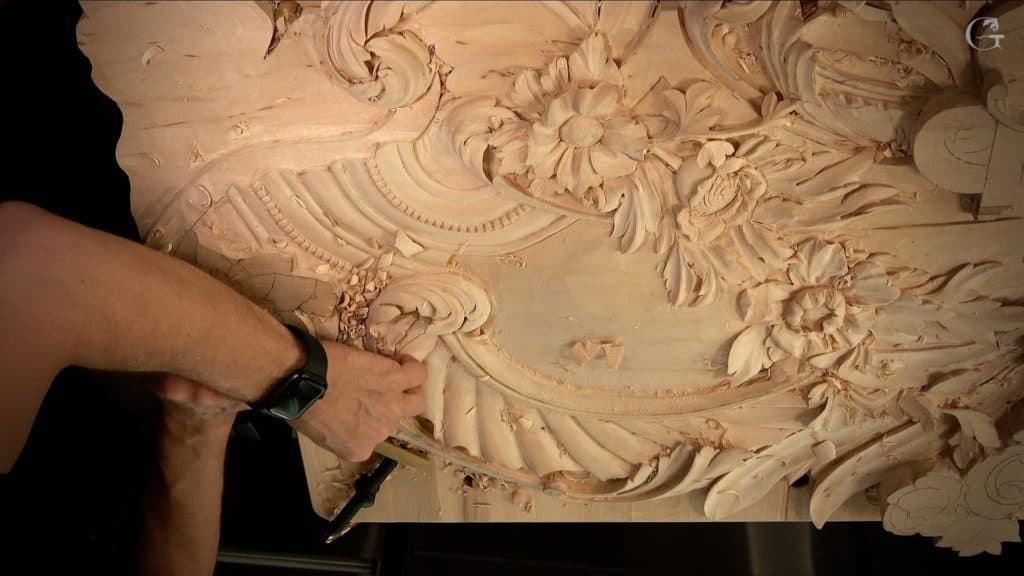
Alexander Grabovetskiy, woodcarver, School of Woodcarving · Published 2022
What does a wood carver mean by "previously"?
Quick answer: In Venice Room 147, video 3, I said I could excavate on the inside as I had done previously, then said I was not sure I would. Other lessons use the word for a pass I would repeat, a mistake I wanted to avoid, or a ridge and an eye I wanted gone. Each lesson is linked below.
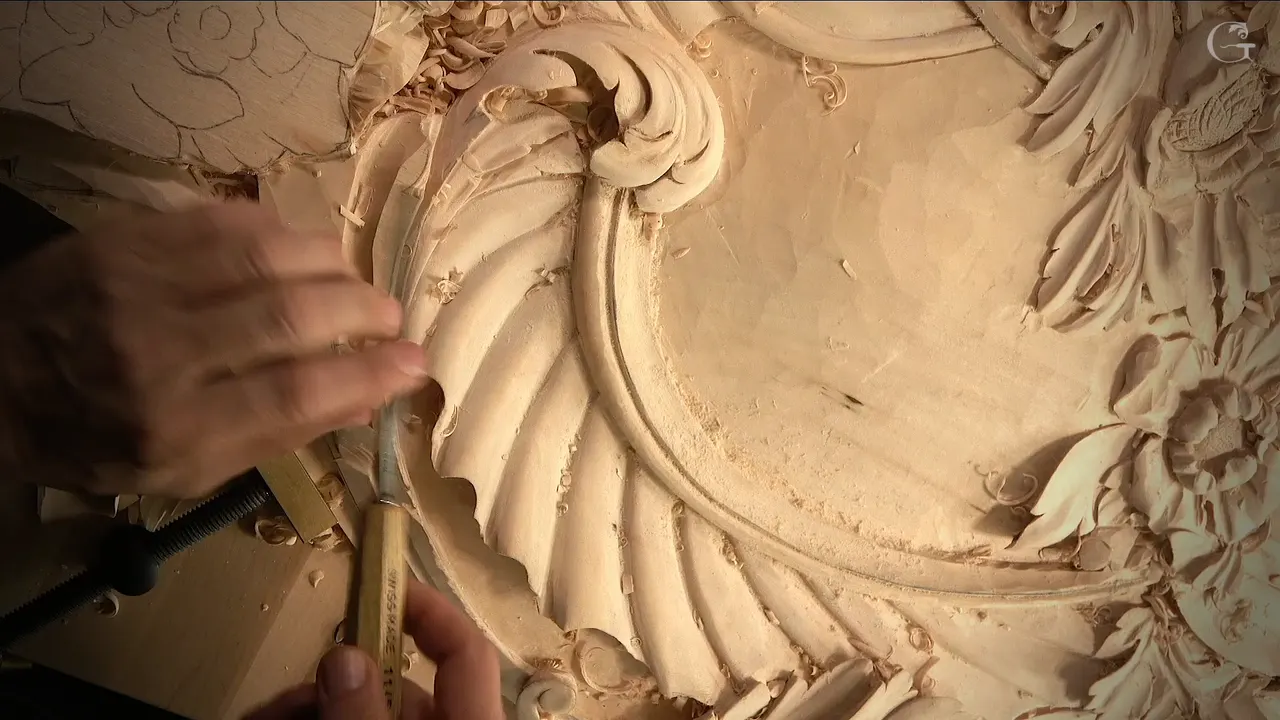

Near the end of video 3 of Venice Room 147, I said "I could excavate on inside like I've done previously" and a breath later, "I'm not sure if I will or not." After that, I said a ridge needed to go. The same word turns up in lessons from the Venice Room panel, Hazelnuts, Chamomile and Bow Rosette, the Floral Molding panel, a vase and a flower rosette. Each lesson is linked below.
Ever stopped in the middle of a cut and thought about the one you made last week? Did you ask yourself if you would do it the same way again? Then you know what the word does, and this page follows it through wood carving lessons.
Lessons that point back at earlier work
- An inside I might excavate again, with a ridge in the way.
- Passes I would repeat.
- Slips I did not want to make twice, one in a husk and one in a molding.
- Two things made earlier, an eye and a ridge.
- A rosette prototype, a black stain, and some oak leaves from another lesson.
What did the word sit next to in lesson 147?
Right before it came "So I've got that pipe, which I'm really happy." Right after it came "now I need to get rid of this ridge." Just before that I had said, "Okay, so now I need to take care of this ridge. It just doesn't look too good." The line names no earlier lesson, and it does not say what the inside was.

How did video 3 get to that line?
The video opens on a size, "about five millimeters approximately." I added, "Of course, I'm just eyeballing it" and then, "3/16 of an inch." Five millimeters is about 0.2 inch, close to 3/16 in.
Next came the eye. First "let me get the position of the eye" then "somewhere right here." A change of course followed. "Well, actually, no, I'll just get that eye much farther, otherwise it's not going to be even visible."

A second hollow was needed "on that side" with "same number 11" at "12 millimeters, about half an inch." I planned to "really push it right here." My reason was "I want to exaggerate that pipe." Obviously, "it's going to be a lot less pressure at the beginning."
One worry stood out. "I really worry about a clean cut on the side of the pipe. That is really important for me." The pipe, I said, "is going to make a huge impact on design and overall movement." Next I planned to "walk around" and "attack from this side" and maybe to "attack from opposite side." "That way I can take care of how clean it is. And it does look clean now."

The eye got its turn. "Let me excavate this eye," I said, and I named "four millimeters," about 0.16 in. My plan for the tool was "approximately 14 o'clock, like 2:00 PM" with an apology about the clock: "I'm sorry to say that, 14, because it's afternoon for me." Smaller sizes came next, "the two millimeters" and "you know what, I can go with the one millimeter and create that excavation." Those are about 0.08 in and 0.04 in.
My words on that spot: "I'm not sure if I like it or not, how it turned in this area, but I'll keep it for now."

A spoon was next. "Any spoon will work," I said, and number three would be my pick for blending. The hollow would stay a hollow there, only softer. Later I could use "number seven and ride right on top of those ridges and create even nicer convex." Then: "And everything matters. That convex going to work as complementary to this convex. Okay?" "No, doesn't work," I said next, and I would "just get flat and carefully blend that." Just before the number seven line came "There you go. I've got big pipe."

Why would I carve it the same way again?
The lessons below put the word next to "same."
Flowers over the main body show in Venice Room 74, video 4. I would show where they go, but "probably going to carve them not on the camera," since editing "takes long time" and it would be "just redundant." It was, I added, "the same thing what I've done previously."
A line to work from came first in Venice Room 79, video 1, "supposed to be like a 90 degrees movement." The big chunks of wood would come off the "same way" as before, probably with a gouge like "number seven."

The height of a volute is covered in Venice Room 87, video 5. I said "the same method" and "that's what I'm going to apply." It used a "piece of paper" to mark "the height of this volute from this point all the way there."
With the knife in Venice Room 93, video 8, I said it could be done again just as before. "Just create a straight-down cut like that. And bevel cut to my straight cut, just like that."
A "straight-down cut right on the line" appears in Venice Room 122, video 3, with "number three" and "three-quarters of an inch, about 20 millimeters or so." The idea, I said, was "exactly the same."
A reason comes with it in Venice Room 124, video 1, and it is "I don't want to lose a line." I would "establish the line first, and then I going to lower that."
Hesitation shows in Venice Room 90, video 9. A concave with the same number 11 at "10 millimeters" (about 3/8 in) comes first, and my plan was to do what I had done before. One little thing left me unsure. Doing it would break overall movement, I said, and "Maybe I'm not going to worry about it."

A live stream turns up in Venice Room 130, video 1, where I had removed "some of the material right here during the live stream" and said it was "pretty much the same idea." My aim was "to level it approximately the same level" with a "downhill movement" later.
Looking back at a whole project, I said "with all of my acanthuses in this project" in Venice Room 158, video 3. Then: "I can chop off this section a little more." A lesson of this same course, Venice Room 151, has number nine in video 3, to "create across the grain cut just like we did previously." For grain, see Wikipedia.
How does a mistake come back into it?
Being "mindful not to undercut" is the subject of Venice Room 69, video 12. "I kind of already started, and that's no good," I said, and I called it a mistake. Then: "just because I made the mistake before, previously, see, that's chipping out." My concave had to go "even below that." Later I said "I'll redo my concave" and later still, "Because I made damage previously, which is no good damage."
A milder case is Venice Room 39, video 6: "I've got a couple cuts I made previously too deep, and it's not so good, but it's also not too bad." Then came a tool: "Clean that with the number 11."

Two slips come up in the hazelnut lessons. In the first video of Carving Hazelnuts 3, I planned to "create that opening" and added, "I don't want to take too much material like I did previously." It mattered to me to connect that part of the husk with another. The third video of the same lesson names the slip: "I made the mistake previously, and mistake was I did not leave enough space right here." Then: "now looks like it should look okay."
A molding got a second look. In Carving Floral and Molding for the Panel 2, video 1, I said "I have to double-check" and "I made some mistakes previously" and I did not want to repeat them. The tool was a pointing machine, "my beautiful pointing machine," to "take a measurement again of that molding." My words: "Just want to make sure I am safe." Then: "looks like I am."
One line goes the other way, in Venice Room 64, video 8, after I had connected two cuts: "I said previously I don't have to, but anyway, I already did it."
Where did I remove something I made before?
One eye has to go in Venice Room 19, video 7: "So I need to get rid of this eye I created previously."

A ridge is the target in Venice Room 53, video 8. I planned to move right "to make it blending" and to "blend it with the previous cut." The ridge was one "I created previously" and "this ridge going to disappear." A "much sharper ridge on the side of the pipe" was different, "which is I'm after."

One lesson goes the opposite way. In Chamomile and Bow Rosette 2, video 3, I said I really wanted to "stay in the boundary of my previous" and that the distance had to match "like I've done on the previous one." Then: "in this case, I'm going to do a complete opposite." One part would sit above and the other below.

Which earlier pieces came up too?
Reference points come first in Carving Floral and Molding for the Panel 1, video 2: "to get some reference points." It was a repeat, I said, so "I don't have as much freedom." I meant "how deep I can go" and "my high spots, the low spots." I needed to "somehow transfer it," I said, and a pointing machine is one tool I really like, "a lifesaver for me."
The volute is the subject in Floral Molding lesson 3, video 1. It "doesn't look as nice when you look just on a block of wood," I said, but next to a piece I had made earlier, this volute had "a really interesting twist." It goes "almost flat, then rotates and goes that direction." For this one, "it's going to go opposite direction."

Carving Flower Rosette 1, video 1, is about returning customers and the prototype I keep. On small projects, I said, "it's a good practice for me to keep a prototype," because some customers "are returning customers, and they ask me to do some more" of earlier work, and that way "I do have a prototype." Look up the prototype.
Venetian Flowers Rosette 1, video 1, talks about the recording. I called the details "exactly the same" as before and said I would probably skip "the whole video recording of this detail," since the work had to get done.
A stain shows up in Carving Vase with Grape Leaves 3, video 11. "I could actually dip it in a black stain I created previously and get a little more stuff in it. And see, it blends really nicely." Wood stain has a page on Wikipedia.

Carving Modern Acanthus 5, video 2, is about a shape. "I really want to see the middle part also, like I did previously." My picture of it: "somewhat like a bulging in the middle." This time would be less extreme.
Last, Venice Room 96. In video 11, I said "I carved previously some oak leaves, and there's different types of oak, and you should know that." I had spent time studying "what they carved, how they imagined the oak leaves." Another video of that lesson has "number 11 and 12 millimeters" (about 0.47 in). "If you followed me previously in another segment, so the height of it is going to give me also a 12 millimeters. That would be really good measuring device." The oak has a longer page on Wikipedia than I could give you here.

Which lesson said what?
The table holds a row for most of the lessons above, with what I pointed back at and what I said about it.
| Lesson | The earlier work I pointed back at | My move |
|---|---|---|
| Lesson 147, video 3 | An inside I could excavate again, with a ridge still in the way | Maybe, maybe not |
| Workshop 74, video 4 | Flowers over the main body, to be carved off the camera | Corbels next |
| Room 79, video 1 | Taking the big chunks of wood off the same way as before | Big gouges |
| Venice 87, video 5 | The paper method for finding the height of a volute | Apply it |
| Lesson 93, video 8 | A straight-down cut with the knife, then a bevel cut | Repeat it |
| Workshop 122, video 3 | Idea for a straight-down cut right on the line | A number three |
| Room 69, video 12 | A mistake that chipped out, and damage I made earlier | Redo the concave |
| Venice 39, video 6 | A couple of cuts that went a little too deep before | Use number 11 |
| Hazelnuts 3, video 1 | Too much material taken from the husk, and later too little space | Take less |
| Floral Molding 2, video 1 | Some earlier mistakes with a molding, to be avoided | Measure again |
| Room 19, part 7 | An eye I created earlier that had to come out | Remove it |
| Room 53, part 8 | A ridge I created with an earlier cut, now to blend away | Blend it |
| Chamomile 2, video 3 | A previous one, and the distances I wanted to match | Go opposite |
| Flower Rosette lesson, video 1 | Work that returning customers ask me to do more of | Keep one |
Which cut of yours would you do again, or leave out? Every lesson named here sits inside tuition to the school, paid monthly or yearly and renewed automatically until you stop it. The Part 13 course page holds lesson 147 with all four of its videos. Wikipedia has plain pages on chisel and rasp.

How it's done
- Size it by eye. Five millimeters, near enough, and 3/16 of an inch, by my own eye.
- Move the eye farther along. My first spot would not even be visible, so I chose a place much farther.
- Hollow the second side. Number 11 again at 12 mm (about 1/2 in), with a plan to really push it in one spot and exaggerate the pipe.
- Watch the pipe's side. Walking around the piece, I could attack from the opposite side, and I said the side looked clean now.
- Excavate the eye in sizes. 4 mm (0.16 in) first, then 2 mm (0.08 in), and maybe 1 mm (0.04 in).
- Blend with a spoon. I said any spoon will work. Number three was my choice, and I would carefully start blending.
Frequently asked questions
Did I name the lesson I meant by that word?
No. The line in video 3 comes with doubt about doing it at all, and a ridge is the next thing on my mind. It names no earlier lesson, and it does not say which inside I meant. Some other lessons name the earlier pass.
Which lessons mention repeating something?
Workshops 74, 79, 87, 93, 122, 124, 130 and 158 of the Venice Room all do, and so do the Floral Molding panel and a Venetian rosette. Each puts the word beside a cut, a method or a detail I would use again.
Where did I say I made a mistake before?
In the third Hazelnuts video the slip was too little space on one spot, and in the first one I said I would take less material. Damage and a chipped spot come up in Venice Room 69, and cuts that went too deep in Venice Room 39.
What to carve next