
Alexander Grabovetskiy, woodcarver, School of Woodcarving · Published 2022
What does "live project" mean in wood carving?
Quick answer: A live project is the phrase I used in video 2 of lesson 154, right before I said I could not redo it. The section sat beside a molding and a shell. I had stopped to check. Lesson 96 has the same two words, said just before a line about re-watching my videos.
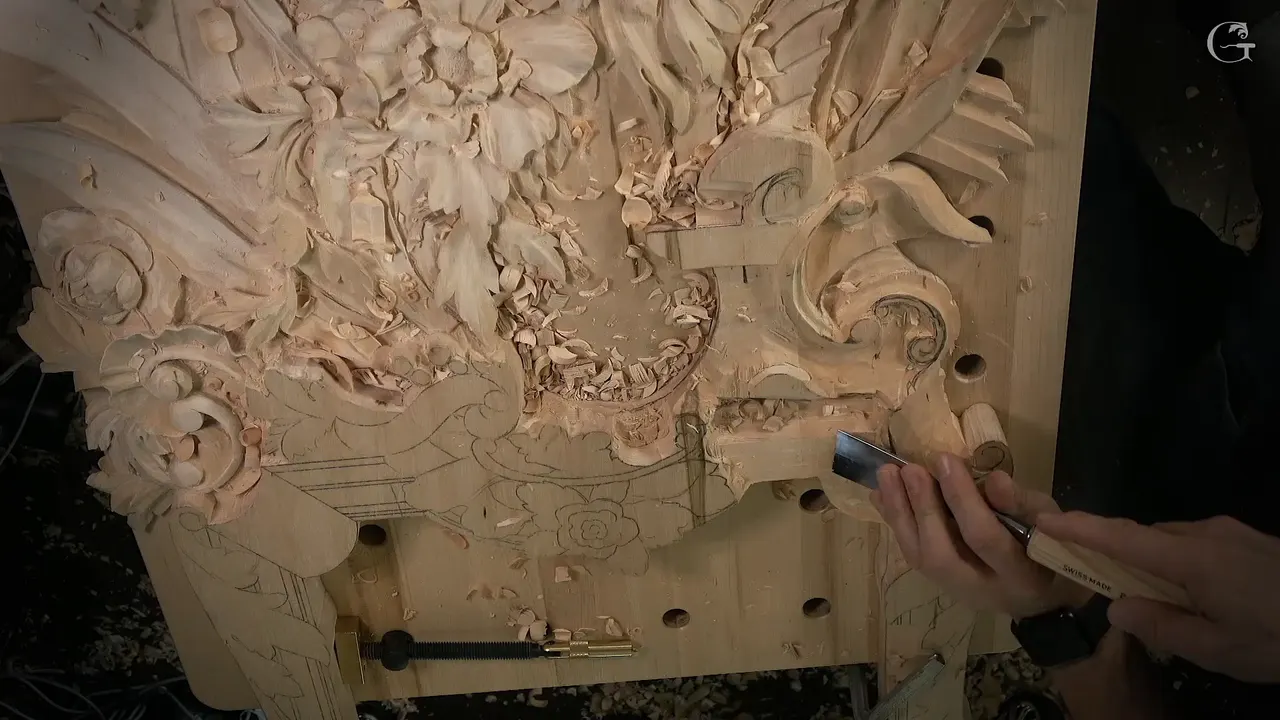

In Venice Room 154, video 2, I said, "Remember, I'm working on a live project, and I can't redo that." The section I was lowering sat by a molding and a shell. I had stopped to check. Lesson 96 has "That is the live project," said just before a line about my videos. Other lessons use "real project" and a longer phrase.
Ever stopped over a line because the wood would not give you a second try? Ever checked twice, with the tool already in your hand? Both questions sit inside this video. This page follows my words through the lessons where I used them.
What this page covers
- A section lowered next to a shell, checked first, with a number nine going about 1/4 inch (6 mm) down to start.
- The two words "live project" in lessons 154 and 96, and what I said around them.
- The phrase "real project" in lesson 77, and a longer one in the panel course, each beside a date.
- A panel with no client and no deadline in two panel lessons.
- Slips I owned, and lines on what you can't undo or can't fix.
What did I check before the section came down?
Video 2 opens on a line. "And right on the line," I said, and then, "let me get 3 millimeters" (about 1/8 inch). A number 11 cleaned "all that mess" out, maybe with 2 millimeters again (about 5/64 inch). The result "looks a little messy, but it's okay," I said, and "this part's going to go all the way here."

Next came a plan: redraw the boundary of the acanthus and clean up that section a little. A molding had to be exposed in that spot, and a shell was coming as well. That shell I did not want to lose, I said, so I stopped to double-check where my shell was going. I wondered aloud, "Maybe I made a mistake, who knows, we'll see, just a second." A moment later: "No, I did not make mistake. Okay? Everything is good."
The plan was to outline "that little detail" and bring that whole section down "to the same level" as the spot beside it, "to create a better canvas for myself." The shell would be only a partial shell, one that goes "on the underneath of this flower."

How far did the number nine go, and where did I stop?
The easiest way to lower it, I said, was "a bunch of straight down cuts with the number nine." My plan was to "chop little by little," about a quarter inch deep at the beginning (about 6 mm). Then came "Although, let me check." Since the molding goes below, I was "actually safe to bring the whole section down."

And right there I said it. "Yes, I'm just double checking, people, okay? Remember, I'm working on a live project, and I can't redo that." After it came, "Just going to be a big mistake. It's going to be a huge mistake. Right?"
Then came "Little by little, I'm going to approach my depth." Later I was "about eighth of an inch above" it, I would say, which is close to 3 mm. Overdoing it was the thing to avoid. A second section also had to go all the way down. I needed to double-check what I had been thinking about it, then go around it and redraw the line. "It is easy to make mistake, but I really don't want to make mistakes," I said.

A pass across the grain came "closer to the design." I took a number 2 to clean it a little, then, "maybe actually a bigger one," about 35 millimeters (close to 1 3/8 inch). I was "still staying higher than my high spot, about 3 millimeters or so." At the end I was going to take a smaller number 2 and outline my acanthus a little better. "I hope you see it," I said.

Two more parts of lesson 154 fit here. In video 1 I checked whether I had messed up, and I still had "about 16th of an inch," roughly 1.6 mm, "so that's good." In video 3 I said the jigsaw is "not always accurate," so I can "probably just put the line with the pencil."
What does "live project" mean when I say it in Venice Room 96?
Venice Room 96, video 1, has "Also, please understand, that is the live project." I am not re-watching all the videos, I said, since it would take me too long, even editing. "All my editing done right on the fly." So if you have a question about how to find certain parts, I said, "I can't help you, you have to really watch and search."
That was the end of October 2020, and I said I had over 2000 videos at that moment. Next came a visual browser I had added. On a course's main picture you see thumbnails based on the workshops, and you can quickly find approximately what area I was working in. It is also where that video started: I had just kneeled down to show how big that corbel is, and I said not all of you will work on a huge project like this one.
I do not define the two words in either lesson. Lesson 154 puts them right before my line about not redoing it, and Room 96 has them before "I'm not re-watching all the videos." What I can give you is each set of lines around them, with a link to each lesson.

What do I say about a real project and a deadline?
Video 10 of Venice Room 77 has the line. I have to be mindful, I said, that "that is a real project." I also said "I need to deliver that project by a certain date." Then: "Not that I have to cut corners, but still, I'm going to just be really mindful how much time I'm spending in one area." My concave could reach the edge, I said, and later, "Got to be really careful again."
Two mistakes showed up in that same video. "I already got two mistakes on this one," I said, and "That's not good." I know it's still going to look good, I added, "but I don't know why I made those mistakes." That is on camera, in the same video as the real project line.

A longer phrase turns up in video 1 of Furniture Panel 25. The panel is "just taking so long," I said, and the reason I was not doing it for a customer or a client was that I was doing it just for school. If it's a real life project, I said, "I have to honor the deadlines and so on" and that day I would jump on one flower.
In Venice Room 68, video 9, I name who is on the other end. About a movement I was happy with, I said, "hopefully, you're going to like it, yes. But most important, my client will like it. The client who ordered and pays for it, okay?" After that I thought of a back bend to take off tool marks.
In Carving Byzantine Acanthus 5, video 2, there is this line from me: "I'm carving for living, and it just creates a lot of tension. So deadlines, and so on. And you can't expedite with carving. That's the difference."

Floral and Molding 2, video 2, ties the date to the hand. "I want to make sure I'm not making any mistakes," I said, and a number nine at 3 mm (about 1/8 inch) would start removing material before the router plane. I did not want to rush it. "There is no reason. Even if there is a deadline, rushing is not really a good thing." wood carving is, I said, "an art of deduction, art of subtraction" and "once you take too much, you can't put it back."
What changes on a panel with no client?
Furniture Panel 19, video 8, answers what some of you probably ask: why am I spending so much time on a small detail? "First of all, I don't have a deadline, okay?" I said. "And I can create and get to the perfection if I need to. So this panel is not for a client, no deadline, so I really don't have to rush it." And if I do not have to rush, "I can probably create much nicer project."

Furniture Panel 18, video 8, says it again while I tried a small blade: "There's no rush for me on this project, so I don't have any deadlines." A little later I could safely chop with a chisel, I said.
The first lesson of that panel, Furniture Panel 1, video 2, sets the goal. I wanted "to do like a piece of art," I said, "not just a practice piece, not just a next carving piece, but a real piece of art." In Furniture Panel 22, video 8, I said that if you ask why I spend so much time on small details, it would bug me, and "it's better for me to fix right now than it would bug me for many years."
In that same video I said the people who will look at the panel are furniture makers, and some of them are perfectionists. I did not mean production makers. I meant the ones who spend a lot of months on just one piece of furniture and pay attention to every detail. "People are not stupid, they will see all imperfections," I said, "especially if we're trying to be authentic to the techniques."

How do I talk about a slip I can't take back?
Lily Box 8, video 6, has a line that goes with the live project one. "Some of the decisions I know it's not reversible. There's no shortcut, Control Z or Command Z. You can't undo some stuff, so you really have to make the decision how it's supposed to look before you place your tool." And: "that's why when I'm carving, it takes sometimes a much longer time because I want to think before I make the cut."

Greek Acroterion 2, video 4, adds the rule of the craft. The main idea is "not to rush anything because I can make a mistake if I'm trying to do it too quickly." Wood carving is "an art of deduction," I said, which means "if you made a mistake, in some cases, it's fixable, but sometimes you can't fix it."

On a small piece, Flower Rosette 4, video 3, I said every cut and every ridge "makes a big difference." The rest, in my words: "Just one small mistake on a smaller scale work, and that's it. You can't fix it." In Vase with Grape Leaves 1, video 8, I was going about 1/16 inch deep (1.6 mm) on a stem, and I said I wanted no "problem that I can't fix later."

The last stop is video 7 of Furniture Panel 16. A number seven at 14 millimeters "fits just perfectly," I said (a little more than half an inch, since 14 mm is 0.55 inch). Be really careful near the side of the volute, I said, because it is better "not to make that mistake."

Which lessons said it, and what followed?
The table has one row per lesson. It holds a line about the piece, and what came next in the video.
| Lesson | What I said about the piece | Next |
|---|---|---|
| Workshop 154.2 | My words: a live project I can't redo | Number nine |
| Workshop 96.1 | The live project, with my editing done on the fly | Back to work |
| Venice 77.10 | A real project with a date to meet | Notches |
| Panel 25.1 | Honoring deadlines on a project in real life | Another flower |
| Venice 68.9 | My client ordered it, and my client pays | Back bend |
| Byzantine 5.2 | Carving for a living brings deadlines and tension | High relief |
| Floral 2.2 | A deadline does not make rushing good | Router plane |
| Panel 19.8 | This panel is for school, with no deadline | Sharp point |
| Furniture 18.8 | No rush on this project, and no deadlines | Chisel |
| Furniture 22.8 | Fix it right now, or it bugs me for years | Number 11 |
| Lily Box 8.6 | No undo and redo, so think before the cut | Thinking and cutting |
| Greek 2.4 | Sometimes you can't fix what you took off | Number seven |
Every lesson named here sits inside tuition to the school, paid monthly or yearly and renewed automatically until you stop it. The Part 13 course page holds lesson 154 with all three videos, and lesson 153 and lesson 155 sit on either side of it. Wikipedia has plain pages on gouge, the mallet, furniture, the bench, high relief, the inch and the millimeters, plus Venice.
How it's done
- Check where the shell goes. A molding had to be exposed, and a partial shell was coming under the flower. I double-checked where my shell was going before anything came down.
- Outline the little detail. I planned to outline that detail and bring the whole section to the same level as the spot beside it.
- Chop straight down with the number nine. A bunch of straight down chops, about 1/4 inch (6 mm) down, to start.
- Check the molding before you go lower. The molding goes below, so the section could come down. To the camera I said again that I was just double checking.
- Stay above your depth. I was about 3 mm above it, I would say, and my next job was to go around the section and redraw the line.
Frequently asked questions
Which words did I use about a live project in lesson 154?
Live project was my phrase, and in that video I told you the work could not be redone. Just before it I had checked the molding, which goes below, so the section could come down. A slip there, I said, would be a huge mistake.
How deep did the number nine go at the start?
About a quarter inch, or 6 mm, to begin with, using straight down chops. Later I was about an eighth of an inch above my depth, near 3 mm, I would say, with no wish to overdo it.
Do the words mean the same thing in lesson 96?
Video 1 of that lesson has them. I went on to say that watching every video again would take me too long, and that my editing is done on the fly. I do not explain the words in either lesson.
What to carve next