
Alexander Grabovetskiy, woodcarver, School of Woodcarving · Published 2022
Is using a macaroni tool cheating when you carve a historical molding?
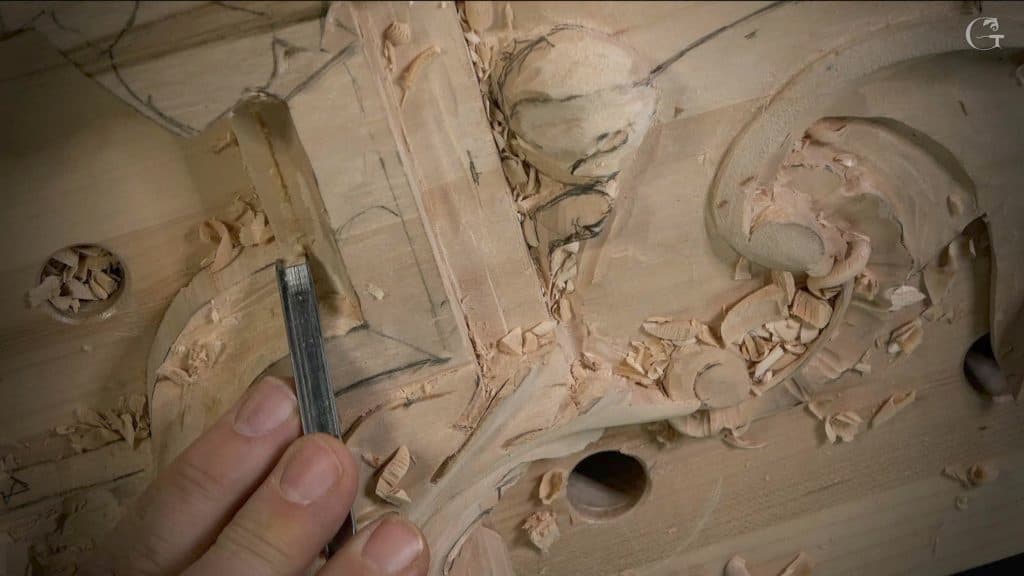
Quick answer: Using a macaroni tool on a historical molding is cheating in one sense only, the one I give in Venice Room 159-3: that tool wasn't available yet back then. I still call it a good idea for setting a bead's height, and in other lessons I say why I use it.
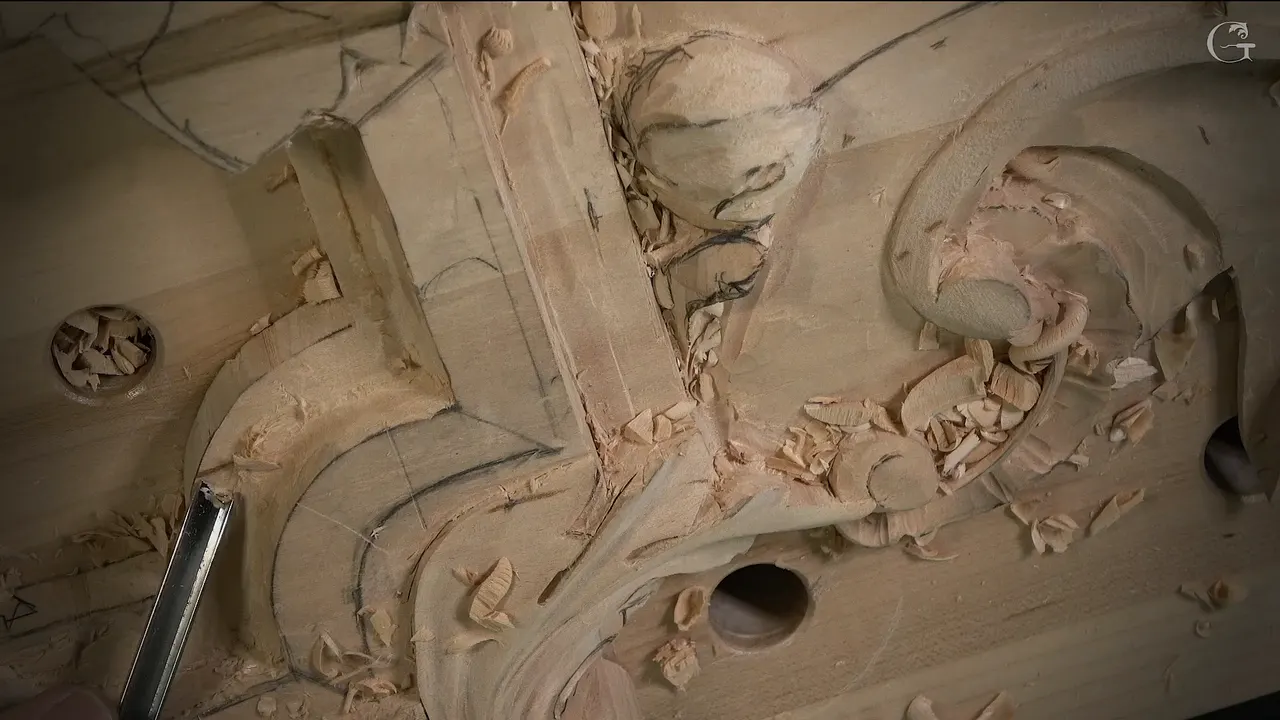
A macaroni tool is cheating on an old molding in one sense only, the one I give in Venice Room 159, and it is a reason about the date of the tool. I still call it a good idea. In other courses I tell you why I reach for it anyway.
The video is short, and the macaroni gets a few lines near its end. So I went through my other lessons and put the lines I have said about that tool, and about the word cheating, beside those few. Each line carries its cue time. A line from another course gets the course name and a link.
Ever picked up a tool the old carvers never held, and felt a little guilty? Did you wonder if the man who carved the original would shrug or frown? My answers come from many lessons, and they don't all agree.

What are the short answers about the macaroni?
- I called the macaroni cheating, and my one reason was the date of the tool (06:42).
- At the same moment it was a good idea for the height of a bead molding (06:13).
- Another lesson has me saying Italian furniture makers made it (15:15).
- Rasps, a jigsaw, a router and 80 grit sandpaper also got the word cheat from me.
- A hand plane did not, and I gave the ancient shops as my reason.
Is a macaroni tool cheating when you carve a Venetian molding?
Near the end of that workshop on a Venice room, I say that sometimes it is a good idea to use a macaroni tool and just get the right height, at least the midsection of my bead molding (06:13, 06:30). So it has to be the right height, I add (06:30, 06:40).
The line behind this page follows. "And just like that. But that would be cheating because that tool wasn't available yet back then" (06:42, 06:47). Seconds later I tell you, wonderful people, that I am ready to create the first bead (06:51, 06:58).
Two things sit side by side. A good idea, and cheating. I don't say one cancels the other, and the only reason I give is the age of the tool.

What was in my hands before the macaroni came up?
Ordinary gouges, and one slip caught out loud. The video opens on me saying number seven is perfect for that, and then I fix it right away: number 11 in 7 millimeters (0.28 in), that is what I was trying to say (00:04, 00:12). It gives me a really good result (00:17, 00:22).

Later I check which number 11 will be the best against the profile. I get a really close profile, and in this case I'm going to use 12 millimeters (0.47 in), number 11, to excavate a little deeper (02:06, 02:33). Next, I say, I will bring the side of my tool to the line (03:12, 03:16).

For one section a spoon gouge would be easier, I say, because I can reach it and get it right to the line (03:25, 03:33). I even check if 10 millimeters (0.39 in) will do in a curvature like that (04:27, 04:42). Not aggressive. Just carefully, carefully, I say, removing whatever I don't need (04:48, 04:54).

The macaroni comes up once in the words of this part, at 06:17.
Is my answer the same in my other lessons?
Not quite, and two of my own lines point in different directions, so here is where each one sits.
The first is in lesson 8 of the Floral and Molding for the Panel course. Just before that I say I'm using just the side of a tool, without digging in, and that it is so important for me not to dig in (13:27, 13:48). Then I pick up the macaroni tool, pretty much authentic to Italian carvers, I call it, and attack both sides with it (13:52, 13:59). Six millimeters (0.24 in) first, and if that is too big, four millimeters (0.16 in) (14:05, 14:13).

A little later I say the tool was made by furniture makers in Italy, so I'm okay with using it on this project (15:15, 15:22). I did not use any V tools here, because they didn't have one (15:26, 15:34).
And at 15:39 I say something else. I don't think they had the macaroni back then, but it's okay, I'll use it for the sake of showing it to you, and it's one of the really good tools to have (15:39, 15:53). Two lines, two moments, and I keep them apart.
Within a minute a slip follows. Cutting right on the side of that line, I undercut slightly underneath it, which is no bueno, I tell you, and I should be more careful (15:58, 16:11).

Over in lesson 3 of that course I show the tool in case you want to buy one. It has two sides, two cheeks, and a bottom (01:05, 01:24). It's the furniture maker's tool, I tell you, so if you are a furniture maker, it is the tool you probably have to invest in (01:30, 01:42). It cuts the sides and cleans the upper surface too (01:48, 01:54).
Why did I say the macaroni wasn't the tool of the late 18th century?
That line sits in lesson 20 of the Furniture Panel course. The number 23 is a specialty tool, I say, I used it a lot, and most of you probably don't have it (14:44, 14:48). A V tool at 90 degrees would do, and there is nothing wrong with that (15:10, 15:17).

Please understand, I say, I really want to be authentic, and the V tools were not invented for a long time. I add, well, also probably I should say macaroni tool: it wasn't the tool in the late 18th century in most of the countries (15:17, 15:39).
Some carvers made sophisticated tools, I add, tools which even some carvers don't have (15:43, 16:13). A favorite of mine comes next, Grinling Gibbons, one of two I really admire (16:14, 16:27). On that panel I used the number 23 a lot anyway.
How does the macaroni sit next to a 90 degree V tool?
More lines come from Venice Room 90. Part 6 of that lesson has me taking the number 23 macaroni in four millimeters (0.16 in), and that is its name, I say, same as what you eat (06:52, 07:06). For a furniture maker, I say in part 7, it is a really good tool to have (00:04, 00:10).

Why not a V tool with a 90 degree angle, I ask myself? Oh, absolutely you could, no problem. I just like that tool (part 7, 00:27, 00:41).
Later in part 7 I go back to the macaroni, and it is going to give me right away very much of all that I'm after (05:07, 05:18). A depth of about 3/16 of an inch, five millimeters, is plenty for me (06:32, 06:36).
Lesson 18 of the Furniture Panel course adds two more. I really love that tool just because it leaves me a 90 degrees wall, beautiful, I say in part 2 (01:27, 01:34). Then in part 10 comes an apology. It's not exactly 90, I tell you, there is a little taper, but it gives me 90 if I lean a little bit (02:48, 03:11).

I lay the tool the opposite way in part 6, for a higher wall (04:17, 04:31). I prefer to call it number 23, I say in lesson 16, and it cuts without digging underneath (part 7, 04:34, 05:07). The one in lesson 15 is six millimeters, and my goal is not to touch the edge (part 2, 14:02, 14:38).
What was my plan for the macaroni in Venice Room 160?
The next workshop of the course, 160, part 3, shows the flip side of that choice. I say I can lower a section approximately one-eighth of an inch, about three millimeters (01:57, 02:16). With the macaroni tool that would be much easier (02:20, 02:23).

Maybe I will, maybe just to save time. But on the other hand, I can use normal tools (02:23, 02:32). Like in this case, I say, I'm using just a 1.5 millimeter (0.06 in) veiner, along the side of my future bead (02:34, 02:51). A slightly bigger tool, maybe 2 millimeters (0.08 in), can follow (03:15, 03:19).
That macaroni is a plan with a hedge on it, and normal tools follow.
What else do I call cheating at the bench?
The word comes out of me often, and it does not always mean the same thing. Each one gets its own cue.
Rasps come first. Looking from above at a double movement in Venice Room 145, I tell you I'm going to cheat. Cheating or not, I don't know, but the rasps should expedite my process, I hope (part 2, 06:02, 06:23). The rest of that smoothing I plan to do off camera (06:41, 06:58).

Workshop 147 repeats it in part 4. Again I say I will cheat with my new helpers, which is going to save me a lots of time, and I will blend everything with the rasps (05:55, 06:10). A cheat code is what I call it in part 4 of Venice Room 17, like my children would say when they played games on a computer (01:22, 01:34). It comes back in part 9: let me cheat again with the rasp, and see, it just blends nicely (05:25, 05:46).

Other tools got the word too. In workshop 75 I open by saying this time I'll probably just cheat. On another side I removed that section with gouges, I say, but this time I think I can use a normal jigsaw and cut it roughly, because I don't need to be exactly on the outline (00:08, 00:41).


On the Venetian Flowers Rosette I tell you the molding on the outside is just a normal Roman ogee, and I used a router. Yes, I cheated a little bit, because I need to finish this project and I can't afford losing time (part 1-2, 00:55, 01:13).
Roman Acanthus lesson 16 has a quieter case. I told you I don't like to use sandpaper, but here I cheated, and used a little 80 grit to see what rough marks it would leave. It didn't look right, so I had to clean it (part 5, 38:26, 38:48).

One cheat is small. It sits in part 4 of workshop 67, where I say I'll just cheat a little bit and use half a millimeter (0.02 in). I had said half a millimeter, I add, but grabbed one millimeter (0.04 in) (00:28, 00:44).
The fluteroni comes up in part 3 of workshop 153. I say I should maybe cheat and use a more modern tool. Italian also got fluteroni. A few seconds later I tell you I'm just going to cheat slightly (07:11, 07:33).

Which tool did I say was fine?
The Carving Greek Acroterion course has the clearest no. My plan in part 2 is probably a shoulder hand plane placed against my wall (05:37, 05:49). Somebody would call that cheating, I say, but I don't think so (06:34, 06:40).

My reason is short. It's still a hand plane, and it's still hand tools, and they used hand planes in ancient times (06:37, 06:47). The same thought opens part 3, that I can't say I am cheating when I'm using my hand plane (00:05, 00:14). I actually like my hand planes a lot (00:59, 01:03). A little later I take my marking gauge again and clean that line (01:21, 01:28).
Put side by side, my lines give two reasons. Time is one, with the rasps and the router: it expedites my process, and I can't afford losing time. The date is the other, with the macaroni and the fluteroni, a tool not available yet or a more modern one. The plane goes the other way, for the reason you just read.
Where does my cheating line fall, lesson by lesson?
Here are the lines in one place. Each one came on a different day, so I give the lesson and the word I used.
| Lesson | Line | Word | Reason |
|---|---|---|---|
| Venice workshop 159 | Macaroni for the bead height, said aloud | Called cheating | A reason about the tool's date |
| Floral Panel 8 | Macaroni at six millimeters, four if needed | Pretty authentic | Made in Italy by furniture makers |
| Furniture Panel 20 | Number 23 used a lot on walls | Want authentic | Not the tool of that time |
| Workshop 153 Venice | Fluteroni for one cut, I said maybe | Cheat slightly | A more modern tool, I said |
| Venice workshop 147 | I blend it all using the rasps | Said cheat | Saves me a lot of time |
| Greek Acroterion 1 | A shoulder plane planned against the wall | Not cheating | Ancient carvers used planes as well |
Two rows deserve a second look. The Floral Panel row holds two lines from two moments, and the Greek row is the only one where I say outright that I don't think the word fits.
What does this mean for the next molding you carve?
I can only tell you what I did on camera. In 159-3 I checked a profile before I cut, said my tool's side would go to the line, said a spoon gouge would reach one section better, and named the macaroni out loud as a shortcut I would count as cheating (02:06, 06:42).
Do you have a chisel that can reach the line in your wood carving kit? Is there a tool in it that the old carvers never held? Say so plainly, the way I do, and then carve the first bead.
How it's done
- Fit the gouge to the profile first. Against the profile, I said I would check which number 11 would be the best, and that I was going to use 12 millimeters (0.47 in) to excavate a little deeper (02:06, 02:33).
- Take the tool's side to the line. With the tool's side, I planned to bring it to the line and carefully remove whatever I don't need (03:12, 04:54).
- Name the shortcut out loud. A macaroni could set the bead's height, I said, and then I called that cheating and gave my reason in the same breath (06:30, 06:47).
- Take the waste to one level. All of it has to go to about the same level, and I say I am safe if I go all the way to that surface, and probably should do it right away (07:12, 07:30).
Frequently asked questions
Why did I call the macaroni cheating in 159-3?
I gave one reason, and it was about the date. The macaroni could set the right height for the middle of my bead molding, I said, and then I said it would be cheating, because the tool wasn't there yet (06:17, 06:42). Next I got ready for the first bead.
Did Italian carvers use a macaroni tool?
Two things came up in the Floral Panel course, lesson 8, at different moments. First I called it pretty much authentic to Italian carvers, and said furniture makers in Italy made it (13:52, 15:15). Later I said I don't think they had it back then (15:41).
Could a V tool replace the macaroni?
Yes, I said so in two courses. I told you, oh, absolutely, you could, in Venice Room 90, and that I just like the macaroni (part 7, 00:27, 00:41). The Furniture Panel lessons have me saying there is nothing wrong with a V tool at 90 degrees, but I want to be authentic (15:14, 15:25).
What to carve next