
Alexander Grabovetskiy, woodcarver, School of Woodcarving · Published 2022
What does it mean for a cut in a wood carving to be logical?
Quick answer: A logical cut is one I can give a reason for. It answers which part sits underneath, where a curve ends, and which way a movement runs. In Venice Room 162-1 I kept my undercut small and gave that reason on camera.
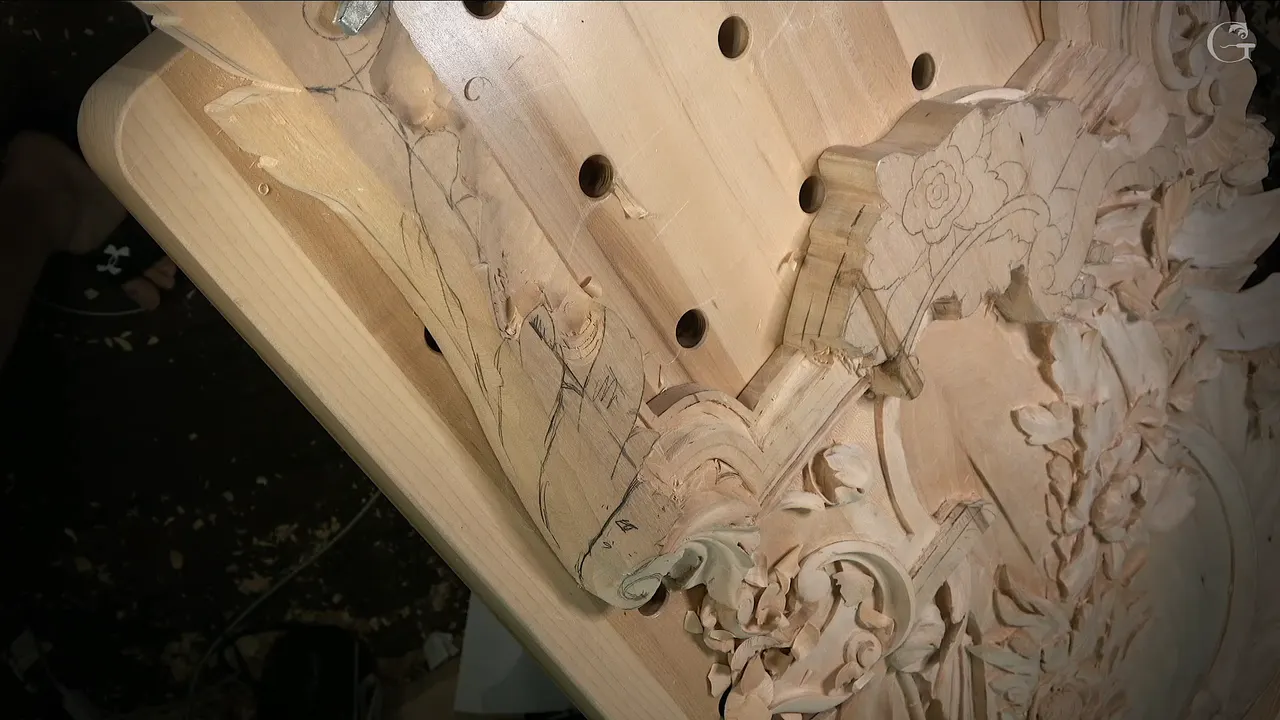
Logical is the word I use on camera when I pick which part of a carving goes under another, where a shape stops, and which way a movement runs. It sounds like a small word. In Venice Room 162, first video, it is the reason I give for a decision, so I went looking for the other places where I say it.
My own video here runs about 628 words, just over seven minutes. The words logic, logical and logically turn up in at least 361 of my transcript files, across 36 courses and series. I picked the passages where a decision sits right beside the word, and each one comes with its lesson so you can watch it happen.
Ever stood over a carving with two ways to go, and both of them looked fine? Did you pick one and hope? Watch how I pick.
What was the logical choice in Venice Room 162-1?
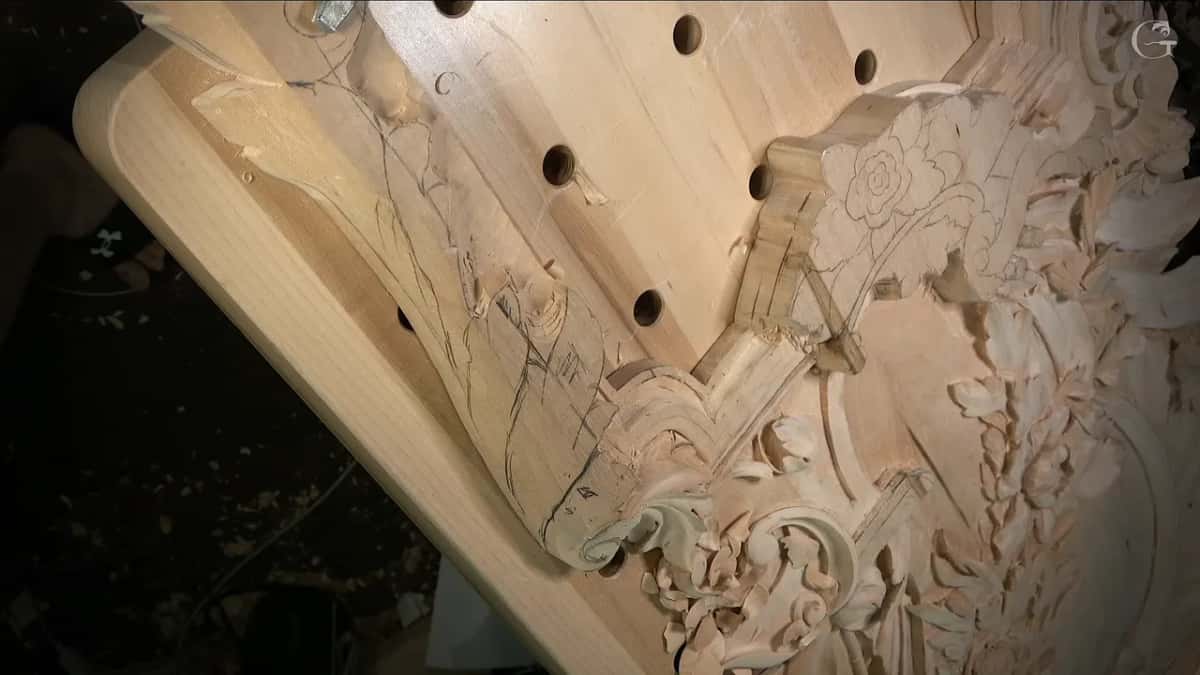
I started by counting. One movement, two, three, four, five. Number five was pretty much what I wanted to work on, or it could be a part of the same movement (00:10-00:29). Next came a decision about how to go at that part. It was not a hard one for me, because this part could go right underneath that part (00:31-00:45).
Where the viewer stands decided it. The point of view would be from this side, so my undercut had to be as clean as possible, and a flaw would show less to the human eye. "So that's why I going to follow that logic," I said (00:48-01:18).
Carefully, I started the cut with a 7 millimeter number 11 (about 9/32 in) (01:21-01:44). Close by sat a molding. Going too low was the mistake to avoid (02:19-02:31). For the next pass I took a number two or three, 18 millimeters, which I called almost three-quarters of an inch, and lowered the part toward that molding (02:35-03:12).
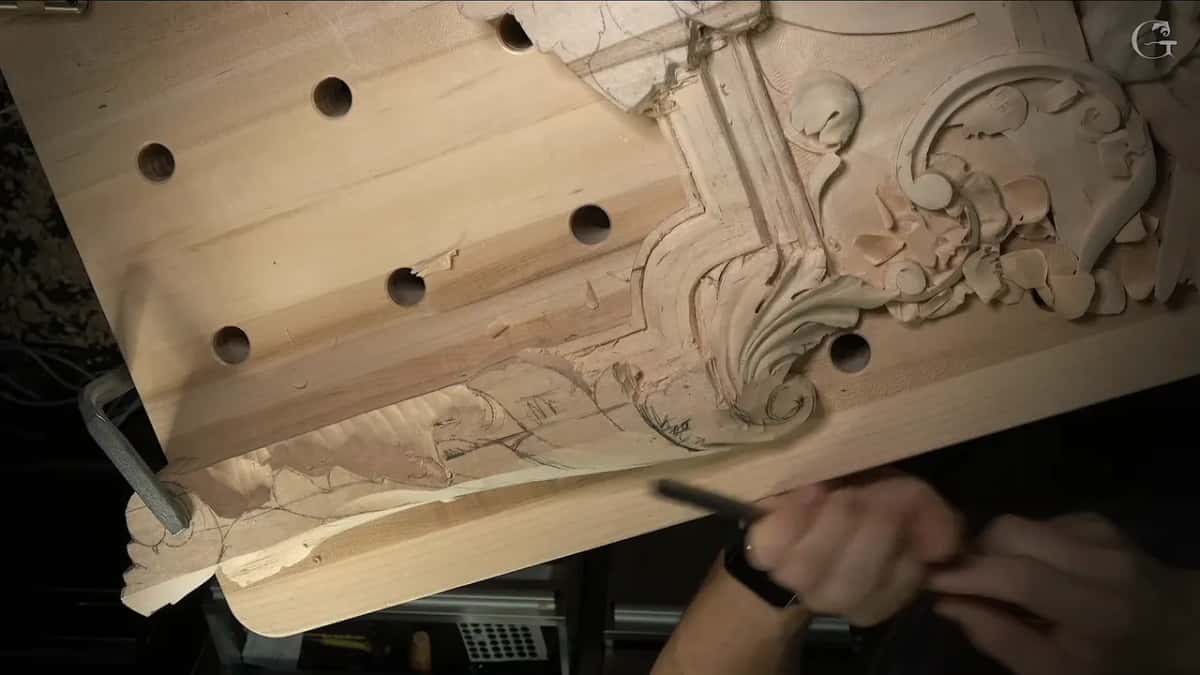
Then comes the sentence this page is built on. Too much undercut would create extra labor I did not need. "As much as I love undercutting, that would be a big mistake just to create extra labor I don't need to." And right after it: "Just blend it" (03:12-03:31).
Section two got the same plan, right underneath the volute, with the same tool and the same idea as the first (03:53-04:20). Going extreme there was possible too, but a lot of undercutting was just not what I wanted. "As much as I love it, I have to be logical" (04:38-05:02).
The part ends on an eye. It would be visible only from the side, there were equal parts, and a wide pipe would run off it (06:00-06:28). A straight down cut might do the job, but I stopped short of all the way. Standing where I was, I could not detect that surface, and I wanted to avoid overdoing it (06:49-07:21). That moment has its own page in the lesson 162 teaser.
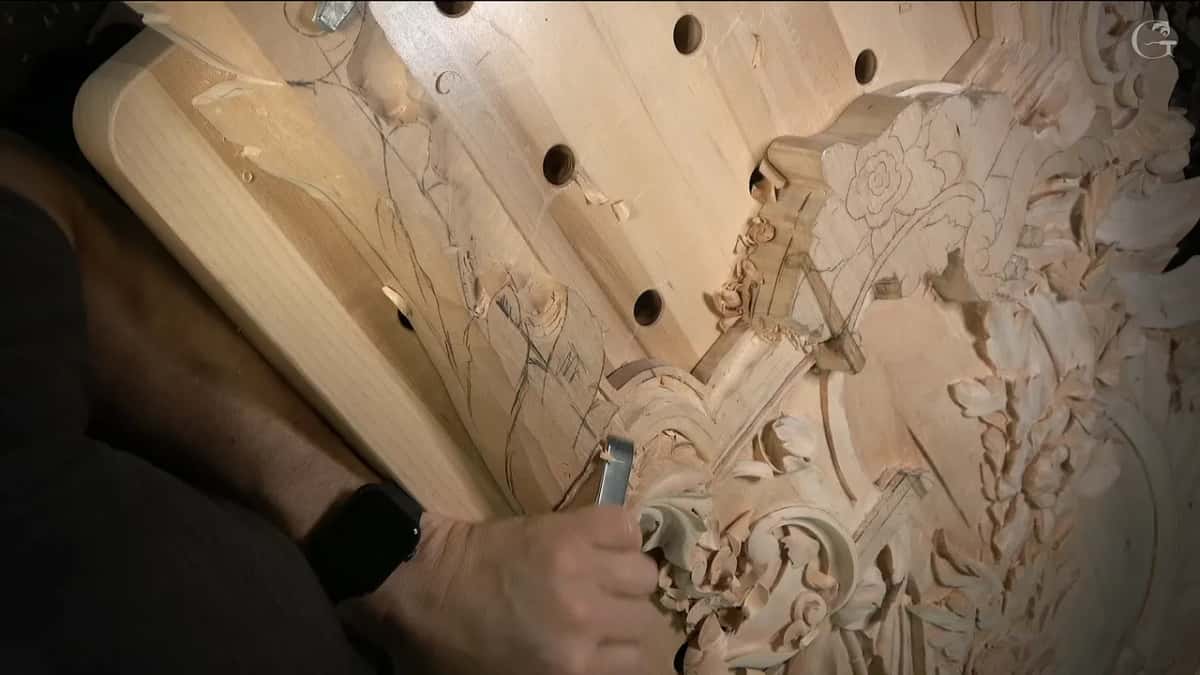
Which part goes under which?
This is the question I ask most. Look first at lesson 62, first video: "Logically, this line is supposed to go somewhere underneath" (00:04-00:08). Its neighbor looked wrong to me, so the ridge went higher and this part went under it (00:17-00:34). It was "logically better" that way, since the section beside it could then come down a little, close to the two inches (51 mm) (01:36-01:49).
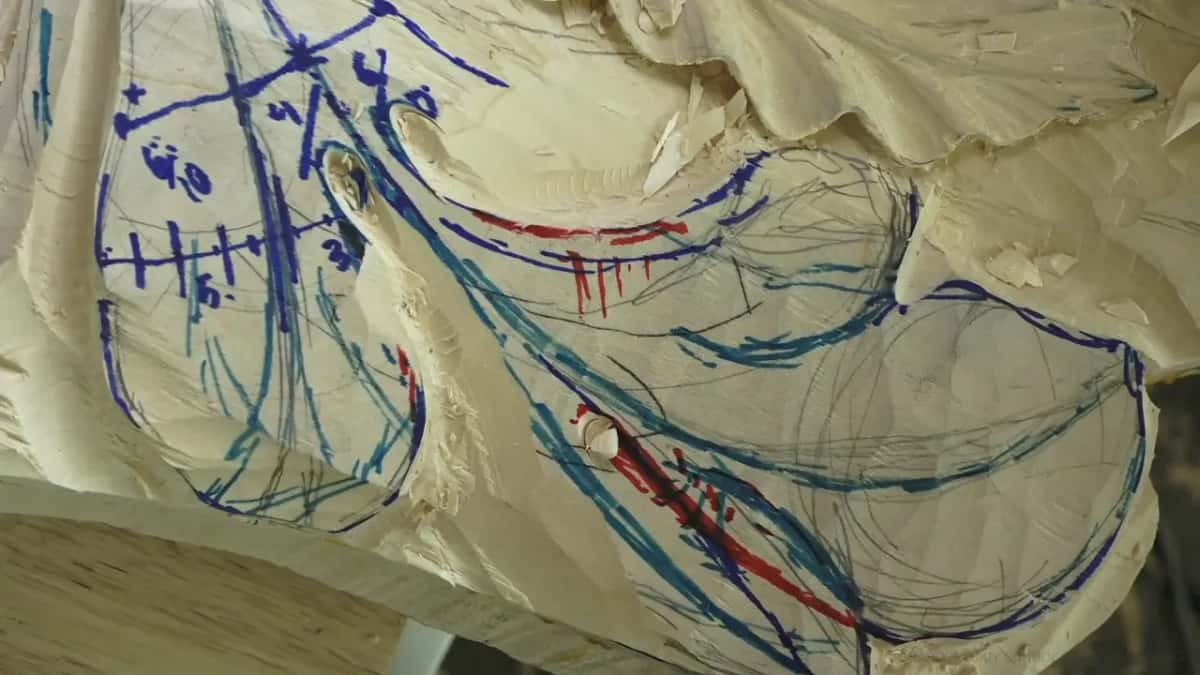
lesson 71 handed me a real choice in its second video. Should this part overlap that one, or the other way around? "It's actually both ways going to look good." Then: "But logically, I think I should overlap." A number 11 of 5 millimeters (0.2 in) did it, the same move I had made multiple times already (02:05-02:52).
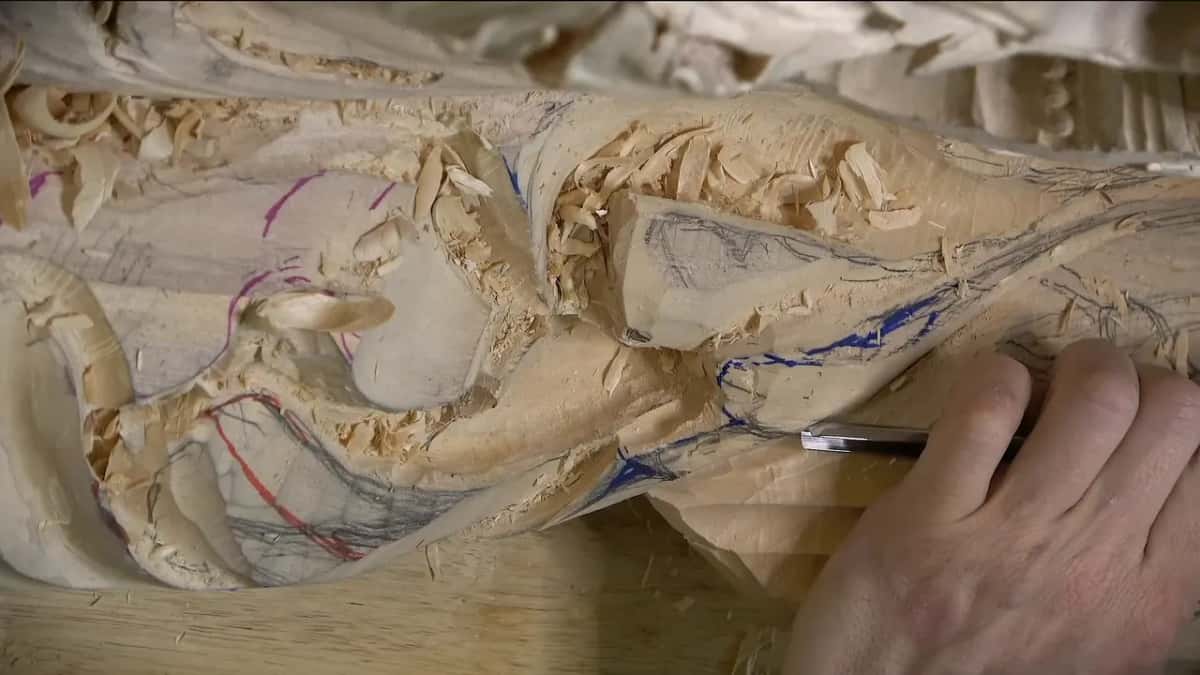
Over in lesson 81, eighth video, the plan was to go underneath a line. That meant starting a movement, and I did not want to lose too much material. "I want to make it logical and looking good." A 14 millimeter (0.55 in) number 9 ran across the grain, and a little more undercut let the shape wrap (00:04-01:29).
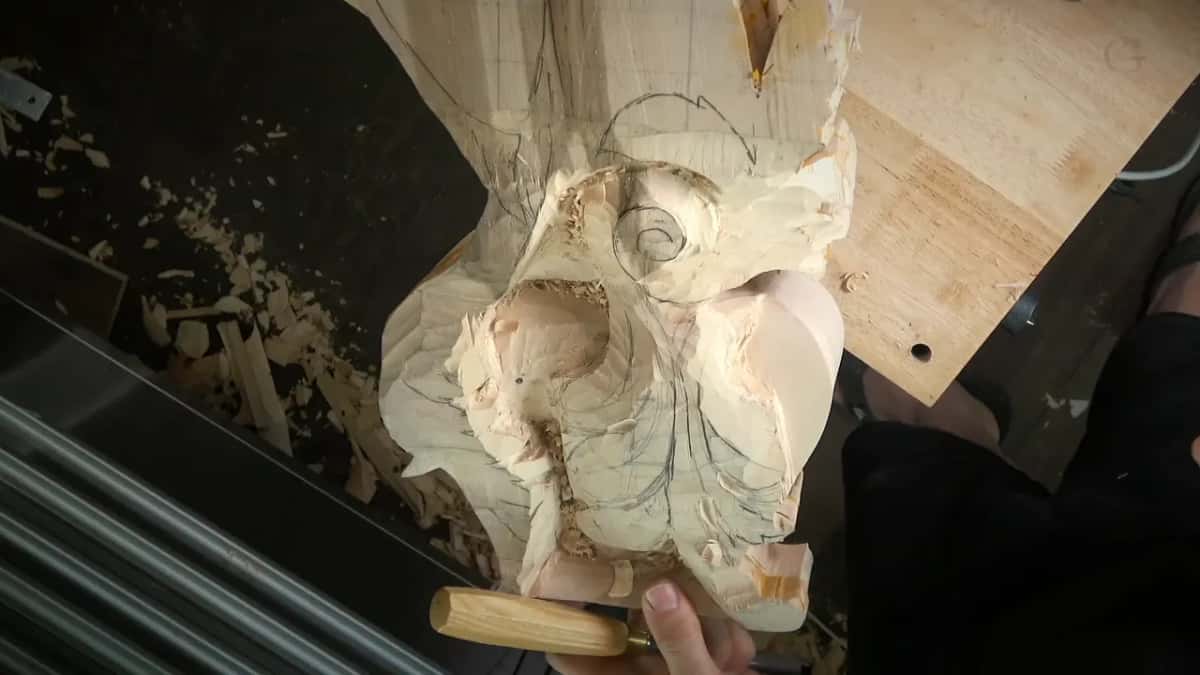
Rules bend in lesson 66, ninth video, where I admit that logically I was not supposed to have such a long separation piece, "but that's okay. I hope it's okay" (01:47-01:54). Then a number 11 in the 3 millimeter size (0.12 in) went to the triangle, since too much was going on inside, and I did not want to mess up an inner movement that shows from below (02:32-02:58).
Eyes follow the same thinking. One more was needed somewhere in lesson 84, sixth video. Maybe yes, maybe no, maybe a small move that way, and then: "I think it's going to be a little more logical" (04:27-04:54). The eye came from a 7 millimeter number 11 (0.28 inch). I went deeper right away, which I usually am afraid to do, since a wrong eye position is always a chance (05:01-05:55).
Convex or concave, which one is the logical one?
Two options sit on the table in lesson 71, sixth video. A big convex, not really big but still convex, or leave it as a concave? "That's the question." Both ways were okay, "but one is logical and another one is not" (00:29-00:54). The clip does not name the winner. I said, let me try, and if I did not like it, that would be a really big problem (00:56-01:08). The first concave started right on the side with number 11 in 7 millimeters (about 9/32 in), and I told myself to stay really mindful (01:09-01:35).
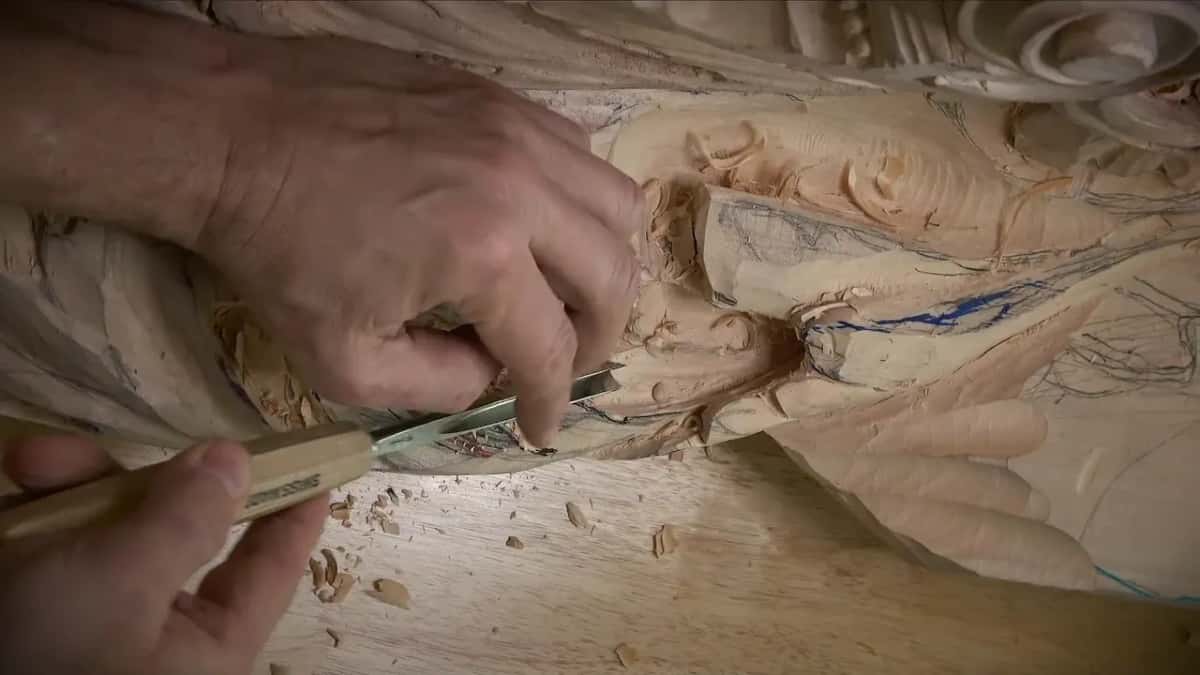
The logic runs the other way in lesson 73. "For me, it's logical if I'm going to start creating another convex." One part became concave and the next convex, for a big convex overall feel (01:45-02:04). A piece nearby had real dimension while this one was "little too dull," so it needed something three-dimensional. Softening the area and removing a section for the curl was "also logical to do" (02:09-03:02).
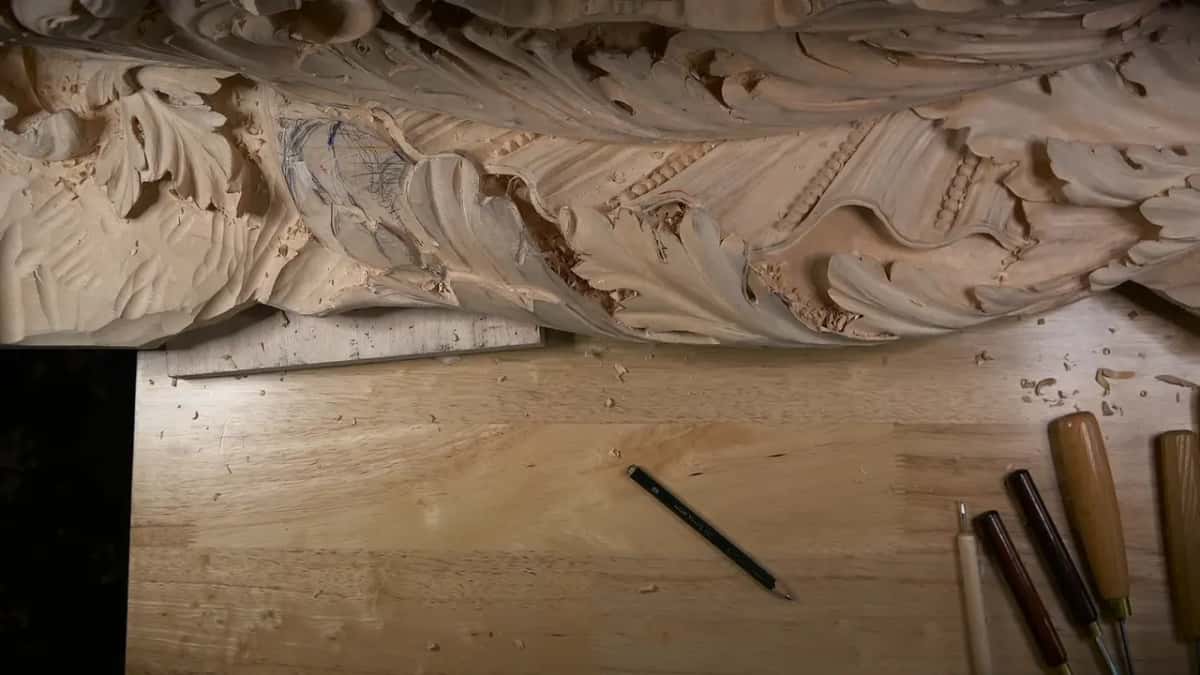
Where is the logical place to stop?
Every deepening raises it. Seventh video, lesson 69, holding a 20 millimeter (0.79 in) number 11: should I go even deeper with that curve, or stop right there? "And I think logically I should stop right there," I said, since the curve would hardly show from this side. From below you cannot detect it either, so it stayed (06:23-06:57).
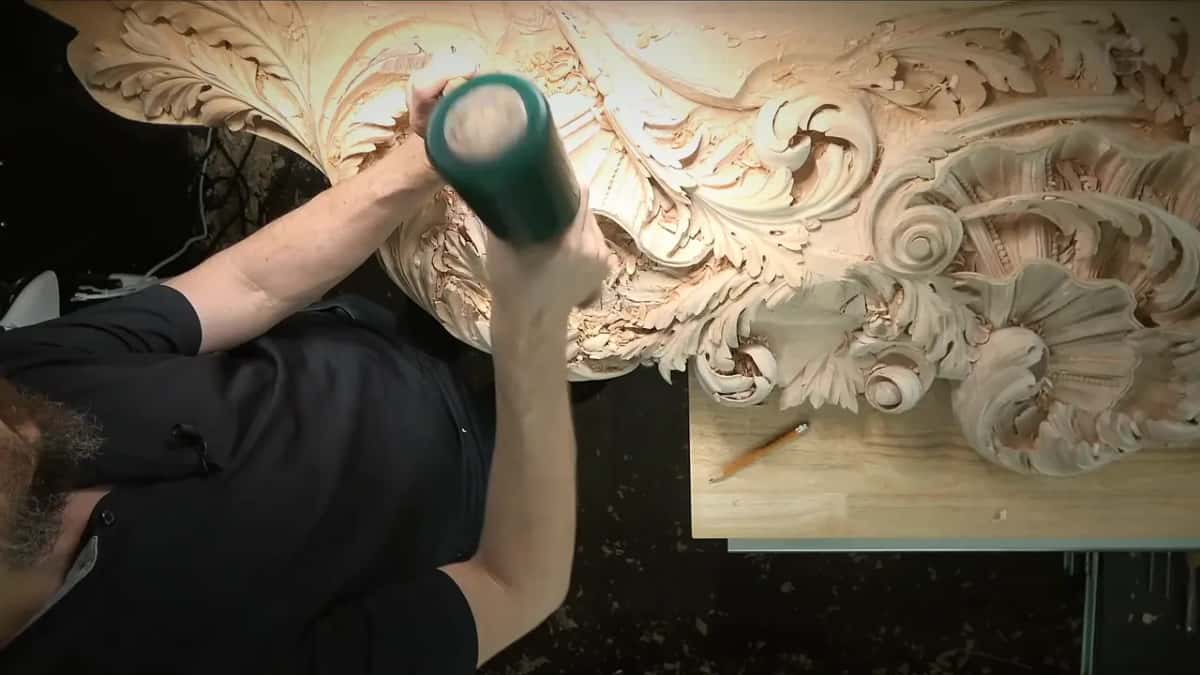
A smaller version of the same call sits in lesson 64, sixth video. A deeper pass was not required. "I don't have to, but I think it's going to be looking better if I just follow the logic of this movement" (03:52-04:13). A number 11 of a millimeter and a half, the 16th of an inch, did the job, and I called a halt, since I can get carried away (04:32-05:08). Divisions came after that, because without them nothing made sense (05:19-05:37).
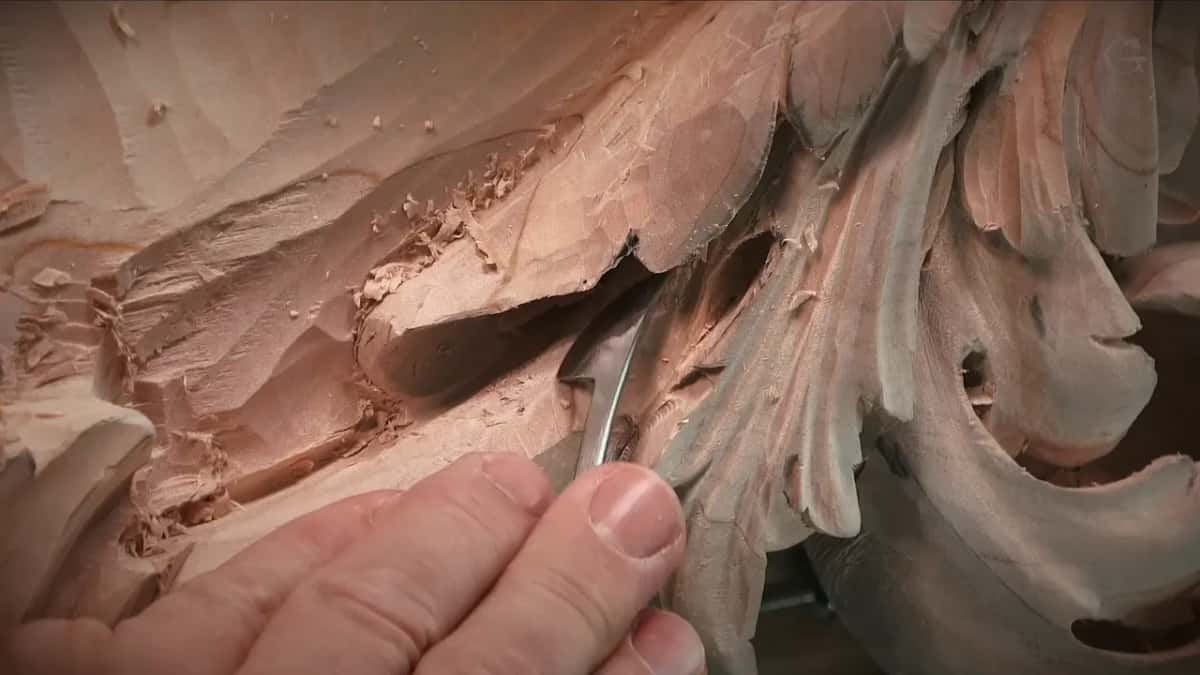
Fourth video, lesson 70: I was working out where an end should go. "So logically, I should stop somewhere," I said, and tried a spot that looked good (05:50-06:09). The same back bend took off the main chunk, and the shape started revealing itself. An extra separation could wait (06:19-06:49).
Set that beside my own part, where I said I could undercut more in the second section and chose not to (04:38-05:02). Lesson 162 holds the rest of it.

Which way should the movement run?
Loose copies come up in lesson 83, eleventh video: my design, approximate and not exact. "They supposed to follow logic" (04:12-04:45). Then came a count of how many big parts the movement would split into, same as on the other side (05:14-05:44). One chunk stood in my way, and a number 9 removed it with no problem (06:03-06:14).
Once an eye was done in lesson 81, twelfth video, the section beside it also needed to be logical in how it got developed. The center line was the movement, and the center point, somewhere right here, bounded the section. Not sure I liked what I saw, I thought of making the overlapping piece a little shorter, and of doing the opposite side exactly the same (04:06-05:25).
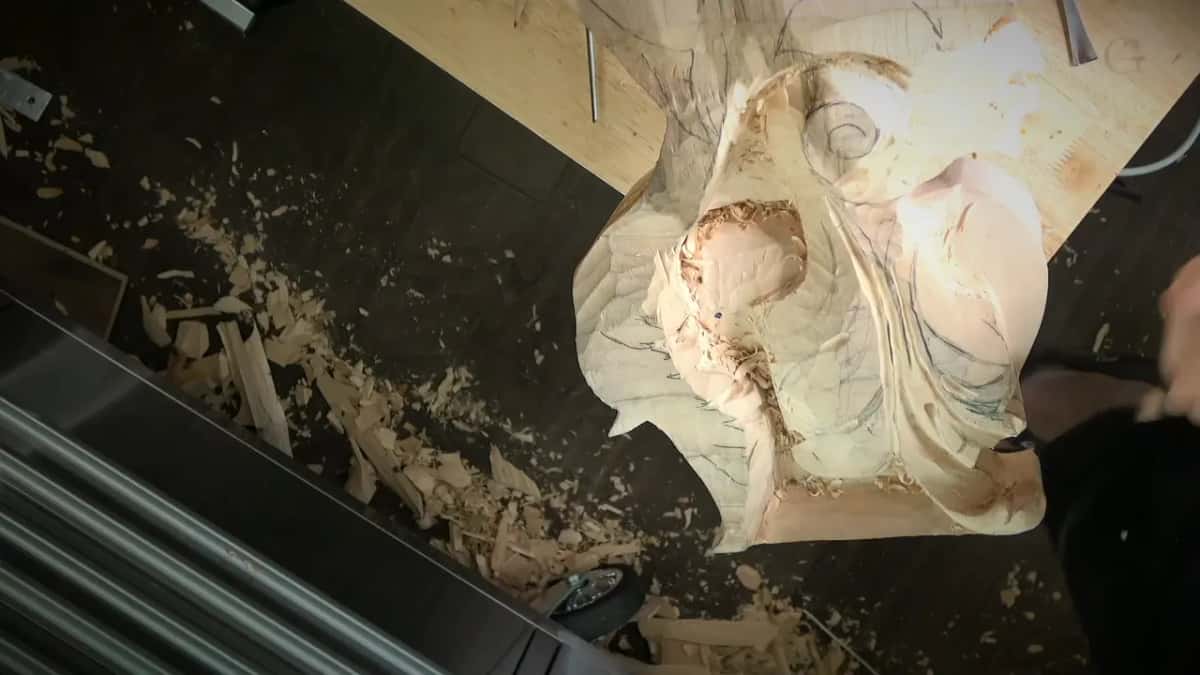
Furniture panel work opens with the same words. With the flowers settled in Designing Furniture Panel 12, second video, leaves came next. "Again, I have to follow the logic of movement," and see the main flow. Leaves would follow that direction, "although not all of them" (00:17-00:47). I also wanted to keep the center line, because it repeats the center movement (01:54-02:01).
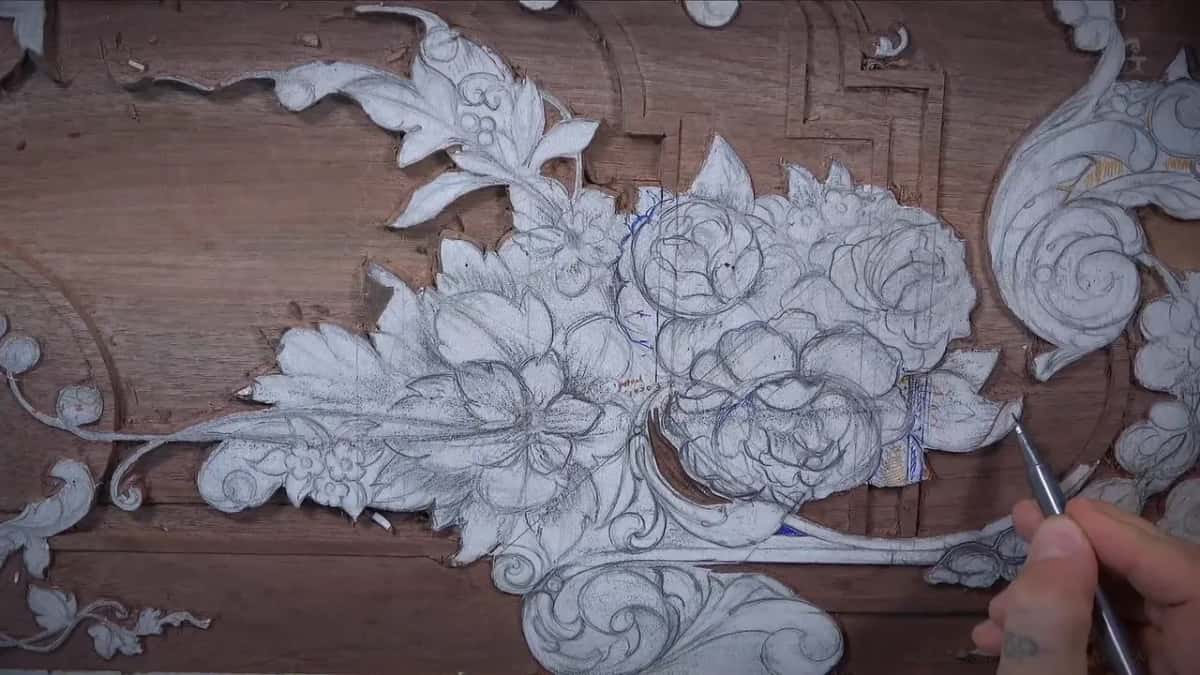
In Designing Furniture Panel 11 the word was about order of work. "Let me think what's the next logical thing." The bottom of the panel came first, for the big idea, and the smallest details after (00:04-00:26). A few seconds of looking for the overall feel came after (00:30-00:39).
On a leaf in Hashemi Flowers 5, fifth video, I turned the piece and said, "logically, the movement goes this way, so the higher point should be on my right-hand side" (01:15-01:26). It might not make sense right then, but the final work would look organic and more pleasing to the eye (02:00-02:20). "I know you can't explain to everyone about those laws of movements and rhythm," I added, "but it's really important in the composition" (02:22-02:35).
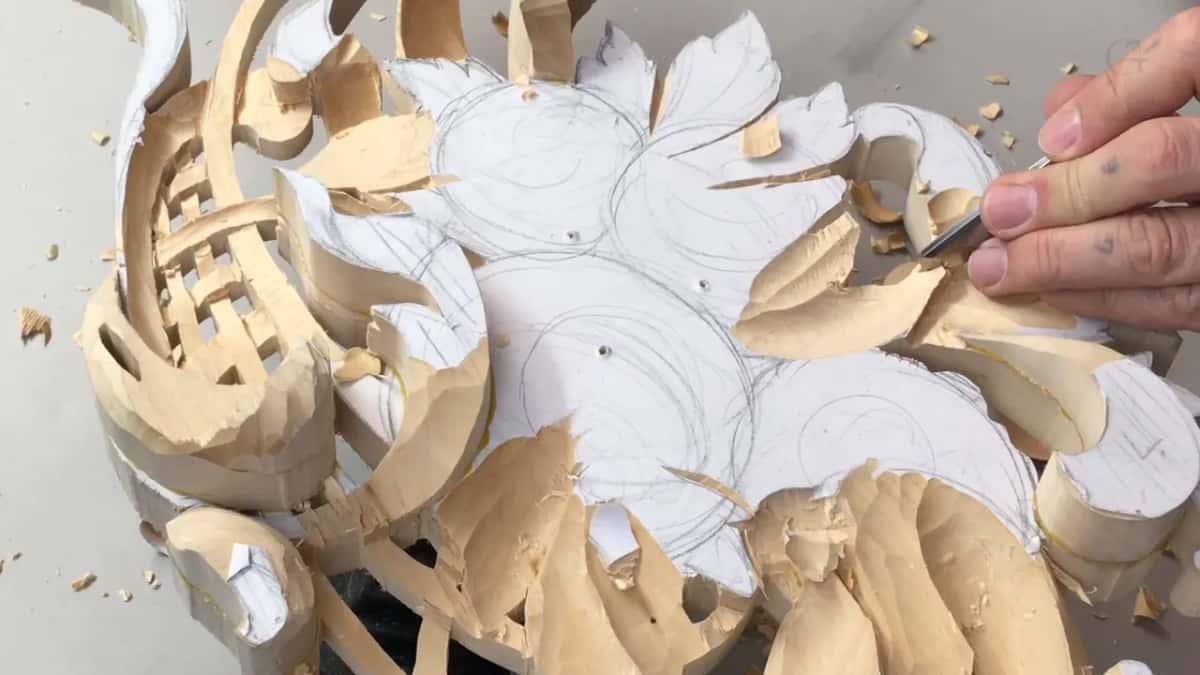
Logic also fixes things. Something changed in lesson 84, third video, and I called it actually okay, since a concave was still coming. It made "a lot more logical movement this way" (03:32-03:52). Farther in, an edge you cannot see on camera still had a line I knew, and a small number 11, about 3 millimeters (1/8 in), stayed on it, outlining with care (04:50-05:24).
And logic sets a floor. In Furniture Panel 19, fifth video, a molding along an invisible line sat much higher. "I cannot, logically, I can't go lower than that in those areas" (03:06-03:33). Marker colors helped. Red marks the high spot for me, and another color the low ones (04:48-04:56).
Does the logic come with numbers?
Sometimes. Lesson 72 opens with: "When I establish my middle line, I'm also trying to be authentic to golden ratio" (01:55-02:03). Take an invisible line, divide it in ten, five parts on each side, then move six parts out of ten one way or the other. I moved mine toward a slope in the movement, "because it makes sense" (02:07-02:43). The golden ratio itself, I said, would be 62 parts out of 100 (03:03-03:20). Then a line aimed at you: "I know by now you probably already should know my logic behind why I'm doing what I'm doing" (03:27-03:35). The page for it is lesson 72.
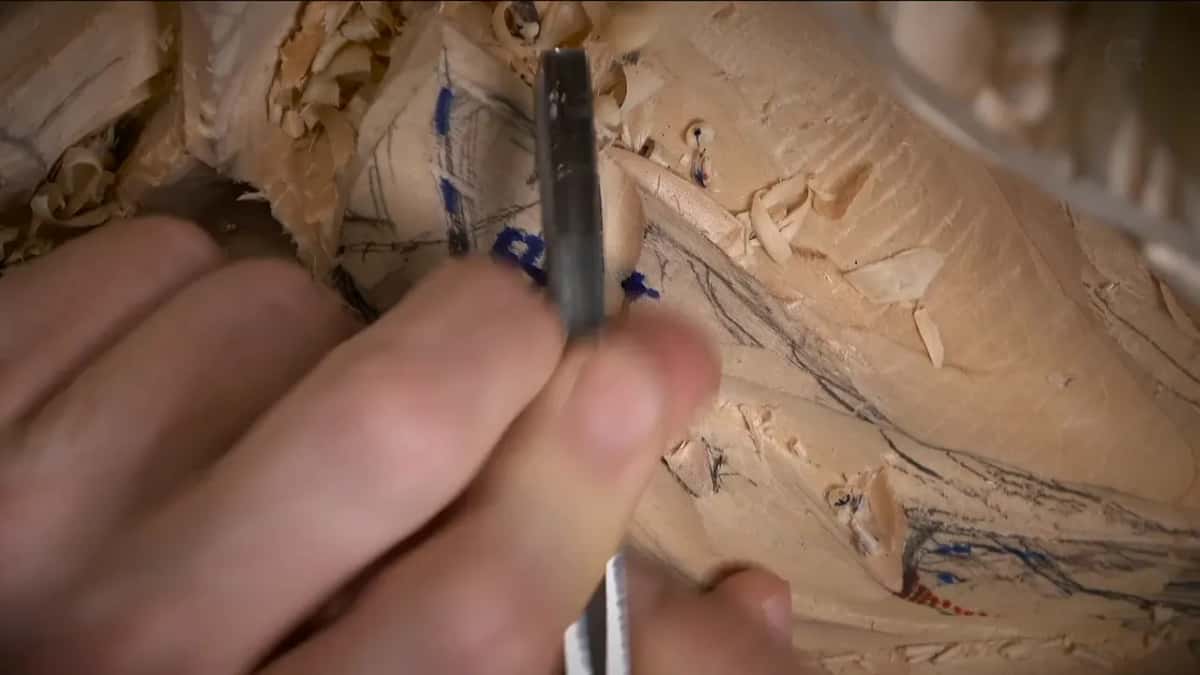
Pipes call for eyes. With the pipe in place in lesson 75, eighth video, the logic was to add some kind of eyes, and the question was where. Bringing them in gave a more attractive look, "followed by 60/40 rule, golden ratio," and I was just eyeballing it (01:05-02:03). Then one part had to sit above, and the red of my color scheme marked the high spot (02:35-03:00).
What do I do when the logic does not show on screen?
Ninth video, lesson 82: "I know logically it doesn't make sense," because that part comes in from one side and then turns another way. "But it will make sense. It will" (03:15-03:31). The pass stayed shallow, since a deep undercut was the thing to skip in that section, "but it still has to be a logical blending together somehow area" (03:56-04:08). I checked the triangle too. Not too big at all, and it needed exaggerating (04:41-05:04).
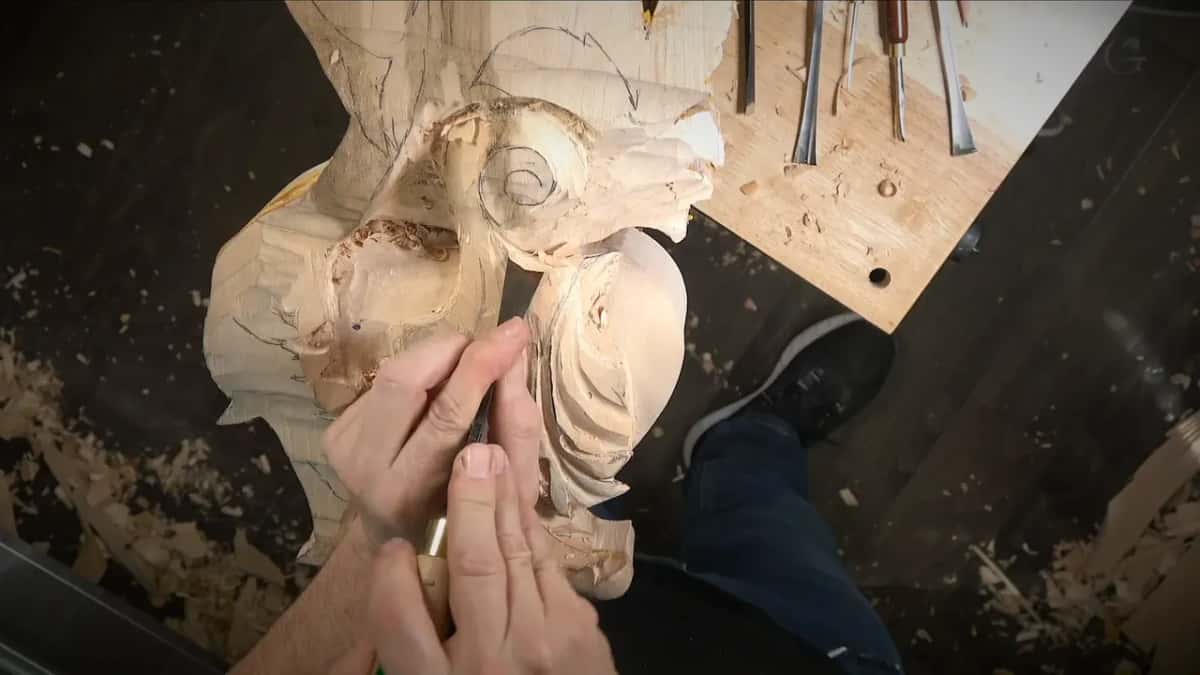
Underneath, where you cannot see, is the work in lesson 66, tenth video (07:01-07:04). A middle line ran through it, and I said I had to be logical about it. That made a nicer transition possible (07:15-07:34).

Sometimes the camera wins. Furniture Panel 18, second video: "logically, I'm supposed to attack that from opposite side, but because of my camera, I don't want to make that rotation. So I should be okay" (01:46-01:56). You can break the rules, I added, as long as the tool is really sharp (02:23-02:58).
Is logic all there is to it?
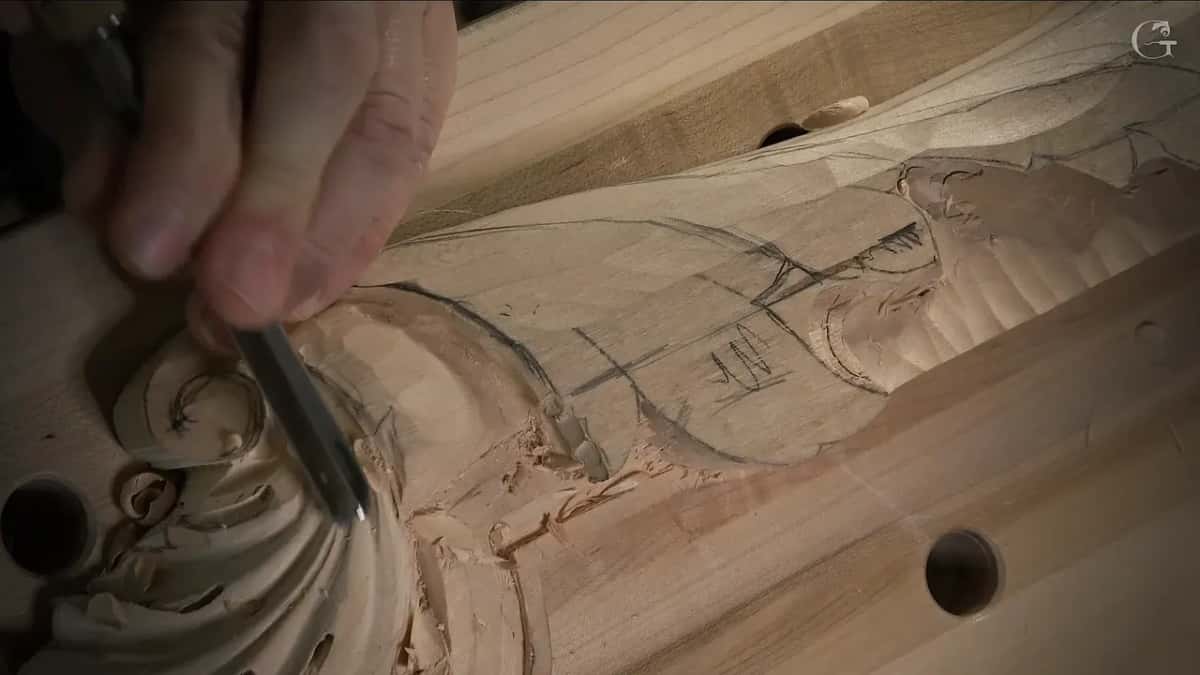
No, and I say so. The third video of Hashemi Flowers 47 has me admitting that sometimes I don't know what to talk about, it's just pure work. "Work and feel and logic, that's it. What logically is good and what logically is not so good" (01:26-01:50). A small petal added right then "just creates beautiful thing" (01:54-02:04). A gouge of about 3/32 of an inch (2.4 mm) went toward the drilled hole, really carefully and without cranking (02:13-02:47).
Where do these videos sit in the school?
The first video of lesson 162 belongs to Advanced Carving: Venice Room, Part 14, Workshops 156 to 163. Its other two videos carry their own work, so I left them alone. The craft is wood carving, a branch of woodworking, and my main tool in these clips is a gouge.
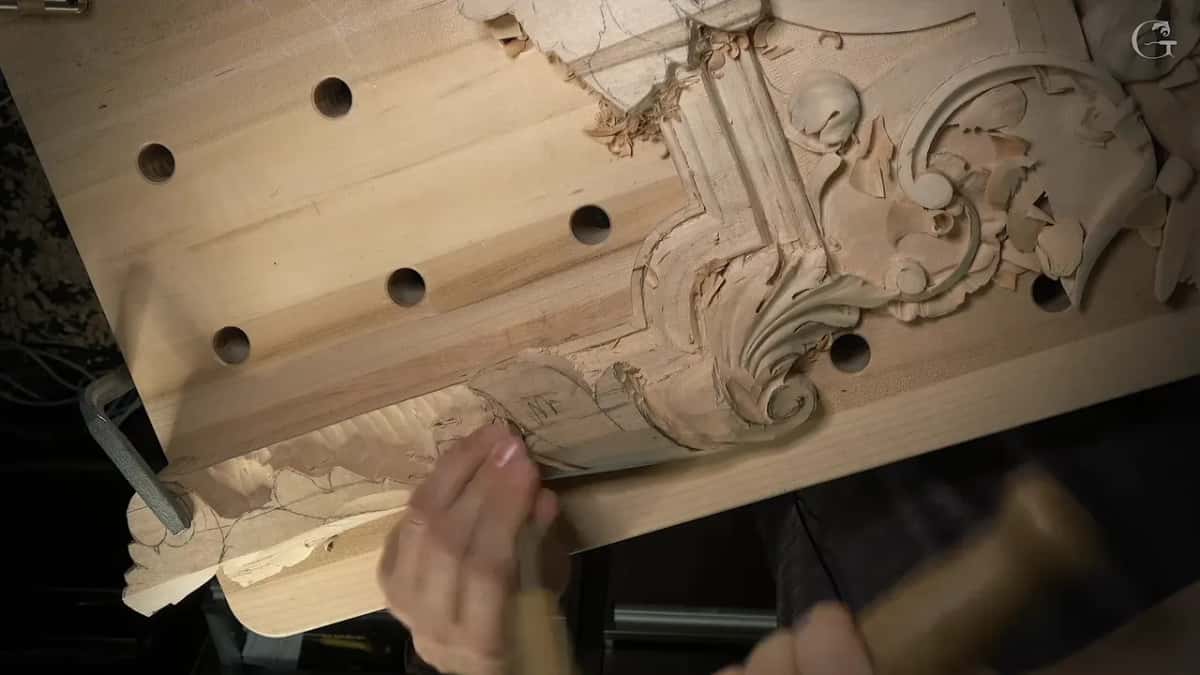
Some clips show a volute or a molding. One has a mallet in it, and one talks about the grain, negative space and composition. A triangle shows up in lesson 82, and my sizes come in millimeters and inches.
| Where | What I called logical | Result |
|---|---|---|
| This part, 162-1 | Part going underneath, kept clean for viewers | I held back on the undercut |
| Sixty-two, Venice Room | Line goes underneath, so ridge comes up | Then I shaved beside it lower |
| Overlap in 71 | Two overlaps looked good, I picked one | That part overlapped the other part |
| Lesson 73, Venice | Next convex, so the other turns concave | I wanted more dimension in it |
| Curve in 69 | Stop the curve, since nobody sees more | I left it just like that |
| Logic, Venice 82 | Logic looked wrong, but I trusted it | Then I checked the triangle size |
| Hashemi lesson 5 | Movement runs right, so higher point right | I said it would look organic |
| Hashemi lesson 47 | Work, feel, and logic, that is all | A small petal made it beautiful |
Which cut is in front of you right now? Ask the question I ask, and then pick up your gouge.
How it's done
- Count the movements. I counted one to five and picked number five, which could be part of the same movement.
- Decide which part goes under. I made the decision: this part goes right underneath that part.
- Think of the viewer. The point of view decided it, so my undercut needed to be as clean as possible, and a flaw would show less.
- Pick the tool. I started with a number 11 gouge, 7 millimeters wide (a bit over a quarter inch), carefully.
- Keep the undercut small. A molding sat close, so I stayed above it and blended instead of undercutting too much.
- Repeat the plan. Section two went underneath the volute, using that tool and idea again.
Frequently asked questions
How would you define a logical cut?
A cut with a reason attached, in my videos. The reason names the part that goes underneath, the place a curve ends, or the direction a movement runs. In 162-1 mine was what the eye can see, which made a clean undercut matter more than a deep one.
Can two choices both look good?
Yes, and I say it out loud. Lesson 71 had two overlaps that were both fine, so I took the one I found more logical. A convex and a concave were also both okay in another clip, though only one was logical.
Does the logic ever lose to something else?
Yes, in the clips I picked. In furniture panel lesson 18 I said I should come from the opposite side, but my camera kept me where I was. In lesson 64 I said a deeper cut was not required, and then I made it to follow the movement.
What to carve next