
Alexander Grabovetskiy, woodcarver, School of Woodcarving · Published 2022
What does a wood carver mean by "2D"?
Quick answer: 2D is how I name a flat drawing before the form is carved. In lesson 163 I said a drawing looks less appealing when it is only drawn on paper. Once the form is carved, I said, the drawing starts making sense, and I keep the final look in mind while I draw.

2D is how I name a flat drawing, and in Venice Room lesson 163 I told the camera that a drawing looked less appealing until the form was carved. I used the word, or its long form two-dimensional, in my Furniture Panel, Lily Box, Modern Acanthus and Venice Room videos.
Ever held a drawing that looked right, then carved it? Did a high spot land somewhere the paper never showed? Below, each passage comes with what I held in my hands and what I did next, in the order of my lessons.
2D in seven short lines
- Placing the real point of a spot is out of reach for a flat drawing.
- The form first, then the drawing begins to read.
- One look from above hides the waves on a small flower.
- The flow lines run in 3D too.
- Some carving is flat on purpose, like tracing a pattern.
- Clay answers what paper cannot.
- A pencil line can be redrawn on the wood.
What did I say about 2D in lesson 163, part 2?
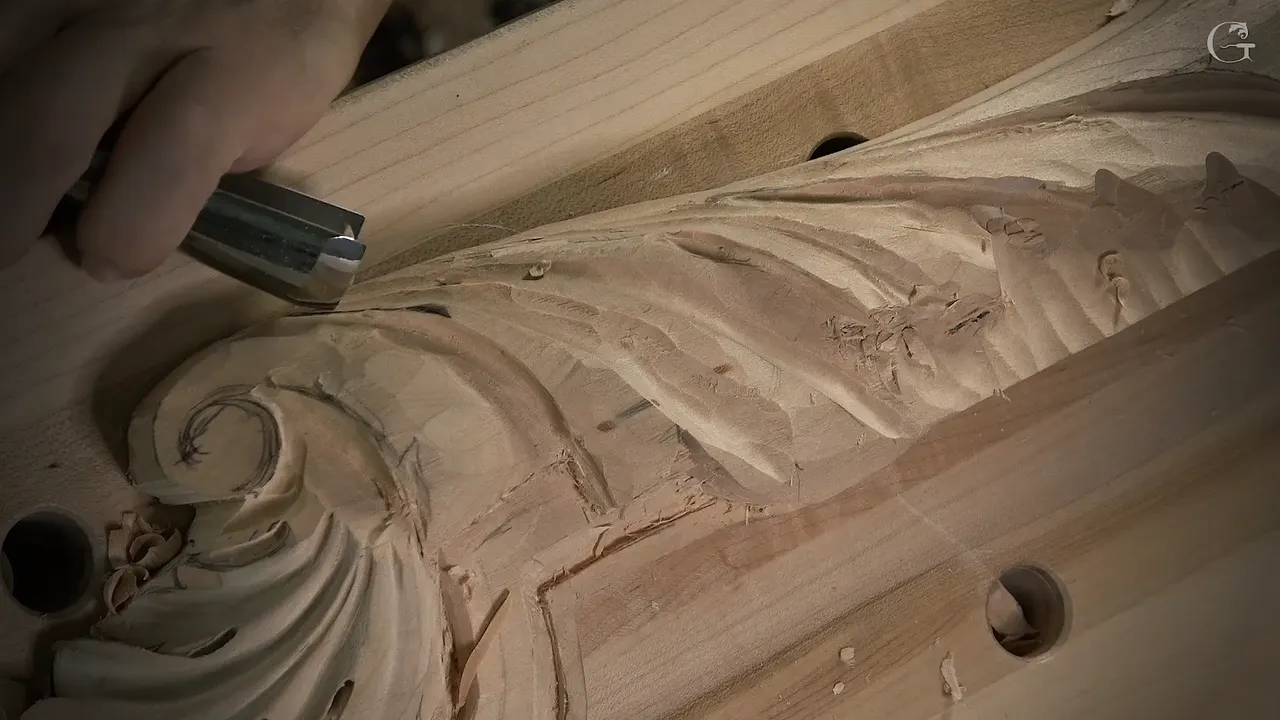
It came while I was dividing a leaf. The video opens on a tool size. "I can actually use even bigger than 15," I said, and I picked 20 millimeters (0.79 in). A little blending came next. I told you I love the overall shape: "See? Overall shape is beautiful."
With the same big number 11 I began working my way toward my volute. Not convenient, I told you, because of the camera positions. Next came a promise: "Yes, I will make the details, but you should be able to get the idea."

My next plan was "So now I need to lower that down and start my divisions." A side thought followed. "By the way, I could just rasp it if I wanted to." That is just paint grade, I said, so I could probably get rid of those ridges pretty much right away, or a little later.
One part I wanted to wrap somewhat lower, "almost to the level of that future molding" and I'd probably develop it later. One piece could get a division, and another I would leave untouched. It would be the same pretty much everywhere, I said, and not too detailed in this case. "I really don't need to."
The wrapping would happen off camera. I really needed to turn it this way, and from that position it would be hard for me not to cover the cameras.

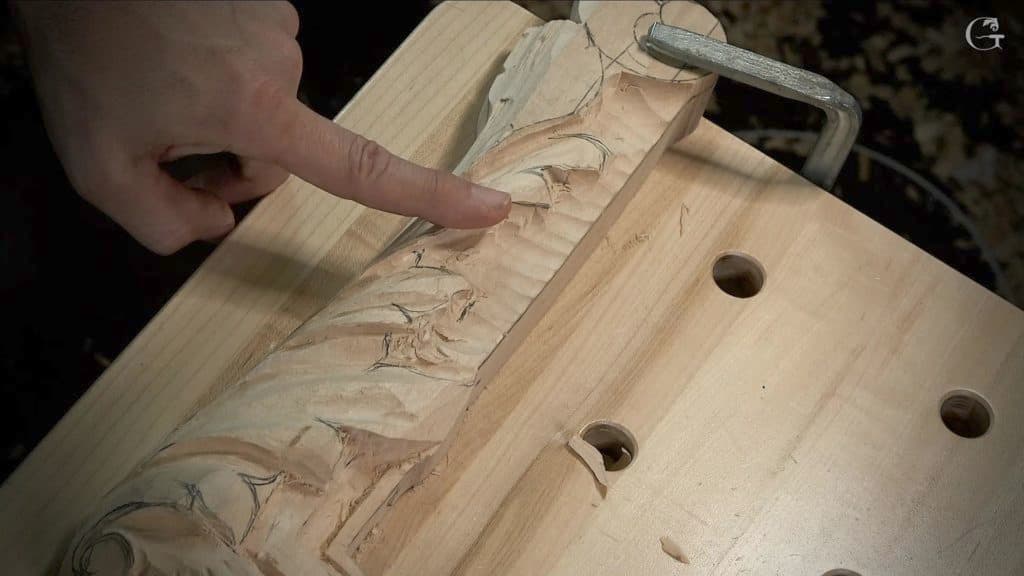
The drawing came next, and this is where the word shows up. A big division was coming, I told you, and a division going right on the side. "As you can see, when you're looking at just the drawing, it doesn't look as appealing. It's just when it's drawn just on a 2D. But once you establish the form, then it's starting to make sense."

I said more about the drawing. "When I'm drawing, I really have to keep in mind what's going to be the final look. And the final look sometimes not the same." Soon I counted three divisions. A long one was coming too, and one spot looked a little too high to me. I could lower it, add a division, or "maybe just lower that down because it's just a little too high."
The close of part 3 in lesson 163 runs on the same thought. The inner acanthus leaf has three main divisions, I said, and inside of them I may subdivide into smaller ones to make it more curly. "Sometimes it's just overkill also."
Why does a flat drawing look different from the carved form?
Paper holds one view, and wood holds all of them. Take the first Furniture Panel video. A photo, a drawing, oil paint or acrylic paint on a canvas sits on one side, and carving takes the other: "you're working two-dimensional world versus three-dimensional world." How deep your chisel goes, how you make the shadow and how the light hits all count in wood. My board there is 27 1/4 inches by 15 1/2 inches (692 by 394 mm), and the lesson is Furniture Panel video 1.

Workshop 44, part 3, adds a smaller one. Something was "really tiny and small when you looked at it from 2D perspective drawing, but now it's bigger." My next line was about exaggerating this eye if I wanted to. Find it on the Venice Room 44 page.

A sharper one sits in workshop 43. "I know it looked kind of small at the beginning," I said, and "you always have to think in three-dimensional world how it's going to look." I draw it from the look it will have from the top. "There's no way to show that in 2D drawing where is going to be the real point." Mine would be about an inch and a quarter (32 mm) lower than another point on the piece. See the Venice Room 43 page.
My Modern Acanthus course gave you the order I follow. Carve in real life and you see "from all the points of view from different angles" and you may decide a small change is better. So my first stage is overall shape. I look at it from every side, and only then do I go to stage two, somewhat bigger details. Clean up is last. Look for it on the Modern Acanthus 3 page.

What does a flat drawing leave out on a small flower?
Waviness, for one. In Lily Box 12, part 1, I said I needed to dig out from the opposite side and remove all that waste. What I drew there was "not really visible in two-dimensional world," I said. Multiple drawings, each from another angle, could show it. But with one angle from above, those little things are "almost impossible to create."
Those small flowers are filler flowers, I said, which wood carvers put in to fill a space, and they are common in furniture making, especially in France in the 18th and 19th century. Above, a flower still looks like an oval. From the side, "a really nice, interesting movement" shows up. The whole talk about waviness on small, tiny flowers is on that lesson page.

In part 7 of Lily Box 5 I said it harder. "Sometimes you really can't justify from just a drawing what exactly is going on from 2D drawing." Some people would love to get patterns, I said, but a pattern is usually flat, and "you really have to think in three dimensions." I took one part downhill, and it was "actually starting to make sense."
I was not done. "I'm kind of happy, but not quite." Sometimes it is impossible to see from above, I said, so it is a good idea to look from the side view and reestablish your lines. Then I said, "Now it makes more sense to me." Watch it on the second layer lesson page, where the pattern talk sits.

Touch mattered in Lily Box 4, part 11. I could feel a ridge and didn't like how it transitioned. The flow line has to go on in 3D as well as on the page, I said, and sometimes even your eye can't see it. Rub the surface with a finger and you can detect the high spots. Next I planned a good concave for the overall shape with those two divisions, a micro concave on the two subdivisions and a micro pipe between them. A number seven, I said, probably, and I would try 5/8 inch (16 mm).

The pencil mattered in part 9 of that lesson. "When you look at the paper, it's different," I said, "because you look at the two-dimensional world." In three-dimensional world, I said, you have a lot more space. So I picked a pencil, since a pencil line can be redrawn, and I redrew the lines so they flow. Both videos belong to Lily Box workshop 4.
The same thing happened in Furniture Panel 21, part 9. "Remember, the movement has to be like a flowing, not just in two-dimensional world." A curve can flow nicely, I said, but it also has to go downhill nicely, so it cannot be choppy. It has to move down gradually. All of it is on that Furniture Panel lesson page.

Another one comes from Lily Box 10, part 9. I said I would move one line slightly, and another a little bit inside from the edge, because I wanted enough wideness there. "That's sometimes the decision I have to make on the fly. It's one thing when you draw that on a piece of paper in two-dimensional world, and another thing when you actually work in a three-dimensional world." Find it at Lily Box 10.

Who works in 2D, and who works in 3D?
Venice Room 55, part 5, is where I drew that line for you, between artists and sculptors. "There's a lot of artists who can draw in two-dimensional world." Almost every classroom has a child who can draw something nice, and I was one of them. I made big informational posts for my class. "Millions of artists and only maybe thousands of sculptors," I said, and sculptors work in three-dimensional world. Carvers are sculptors too.
A modern sculptor adds clay or other media, adds some more, then chops out. In wood or stone, you don't add stuff on. "You chop, chop, chop." You remove what is not supposed to be in that piece. This matches the Michelangelo example I told before: a big marble stone, and the form revealed from inside. The talk is on the Venice Room 55 page.

In part 4 of that lesson a viewer asked about the two approaches, "2D parting from a drawing and 3D parting from the form," craft against art. I told them I had done both. You draw on paper, place it on a piece of wood or stone, and carve. "I don't see anything wrong with both of those approaches." Last I told you about my huge lion heads, like 48 inches (1.2 m), which I started from plastilina, a clay.
Two other talks say it short. In a questions and answers lesson I said carving adds a lot more than digging inside of the wood. That ability, I said, means seeing "what two-dimensional people don't see" and every person can grow it, because we have the same brains. See my questions and answers lesson. At an October 2020 livestream, I said digging with a gouge is easy, so you can learn to carve wood quickly. "But the design part is much harder because you are designing not a two-dimensional world, but for the three-dimensional world." Hear it in the October 2020 livestream.

When is carving 2D on purpose?
On the apron for a dining table I called that type of carving probably somewhat the easiest. "It's more or less 2D carving. It does not require you to think in 3D." All I did was trace the pattern of the design. The biggest limit is your imagination, I said, but here I could not use mine, because I had to do what the original furniture maker did. My drawing sat in front of me, and I kept checking it. Start on the apron lesson page.
A trick came up in Venice Room 87, part 11. "It was a common design trick to trick the eye." Almost a flat surface, I said, but the whole idea is 3D, and in some spots it is "a 2D relief carving." We fake the eye and make it look much deeper than that area really is. Later that video I was about an inch (25 mm) deep from one point down, and I said it didn't look clean yet. Open that lesson page.

A curly kitchen cutting board gave me a knife exercise. That type of carving, I said, is the best practice for three-dimensional world, though "it's more like a 2D, two-dimensional world." You still feel how deep your knife travels, and you control the pressure. And "it really trains you." Carve a little at a time, I said, with barely any pressure and multiple passes. The cutting board lesson is here.

How do you draw for carving if paper stays flat?
I use a program for the flat part. In my Flower Rosette course I said SketchUp is the easiest and quickest way I found for any type of drawings, "3D or 2D drawings" and I scaled the picture to exactly two and a half inches (64 mm). That course sits at Flower Rosette.
My Venice Room 93 lesson, part 1, covers the drawing process. For carving, I said, it "is not the same as you would work in the 2D world like on a canvas." Different? "Absolutely different." I was planning a course on design only, then one on how to draw what you intend to carve, and I asked you to comment if you liked the idea. See Venice Room 93.
Artists who used to work just in 2D would ask why my pencil takes so many short strokes, I said in Venice Room 101, part 6. On paper it is a lot more forgiving. But I have more control with shorter strokes, and the older pictures used a bunch of small strokes that were then connected. "I'm not making this stuff up." You can watch my pencil move on the Venice Room 101 page, all those short strokes.

Does a model answer what paper cannot?
My April 2020 clay modeling livestream gave a customer as one reason. Before I touched my gouge on a lion, I modeled it. When I present an idea, "not everyone gets that on a paper because paper is just a 2D." A model is sometimes a lot quicker than drawing multiple angles. Most drawings you find online are taken from above, I said, and the question is how it looks on the side. With a model you can check the sides, the front and the back. Hear it in that livestream.
As a young boy I could draw beautiful designs, and I knew the laws and the rhythm. "But the problem was drawing, it limits you to two-dimensional world." My teacher would look at what I drew and say, "Think. How are you going to carve it?" Clay solves that, I said, since you can put your gouge in the cavity you modeled.
The model comes back in Venice Room 86, part 6. My second piece, I said, would go much quicker "because I'm not working from 2D." A real model would make it easier to measure everything. Open the Venice Room 86 page for it.

| Lesson and video | What the word sat beside in my lesson | Detail |
|---|---|---|
| Venice 163, video 2 | A big division, and a drawing not yet appealing | Three divisions |
| Venice 44, video 3 | Something tiny from a 2D perspective, now much bigger | An eye |
| Room 43, video 10 | No way to show the real point in a drawing | Lower point |
| Furniture Panel 1, video 2 | Photo, canvas and carving, two worlds against three | Board size |
| Modern Acanthus 3, video 2 | Draw in 2D, then look from every point | Overall shape |
| Lily Box 12, video 1 | Tiny flowers, one angle from above, so impossible | Waviness |
| Lily Box 5, video 7 | Patterns stay flat and you must think in three | Side view |
| Lily 4, video 11 | A flow line must continue in both, found by finger | High spots |
| Furniture Panel 21, video 9 | A movement flowing and also going downhill, not choppy | Gradual drop |
| Room 55, video 5 | Millions of artists draw, only thousands of sculptors | Chopping out |
| Dining Table Apron 6 | Tracing a pattern, close to flat carving | Original maker |
| Lesson 87, video 11 | Almost flat surface, made to look much deeper | 2D relief |
| Lesson 101, video 6 | Artists used to flat drawing, and my short strokes | Control |
| April 2020 livestream | Not everyone gets a drawing, so I model in clay | Customer |
Each row is one thing I said, where I said it, and the detail beside it.
Where do you go from here?
The room around lesson 163 is close by. Lesson 156 asks which wood is waste, and the other lessons of Part 14 follow it. Start on the Part 14 course page or the lesson 163 page. Both open with tuition to the school, monthly or yearly, renewing automatically until you stop it.
Would you like to watch the divisions go in? Do you want to see a drawing turn into a form? Shall we carve?
How it's done
- Mark the big divisions. Draw the big divisions on the wood, as I did with three in lesson 163. Alone, I said, the drawing doesn't look as appealing.
- Get the form first. Judge the drawing after the form is in the wood, since that is when it starts reading.
- Check the side view. Turn the piece and check the side view, since I said sometimes it is impossible to see from above.
- Reestablish your lines. Redraw the flowing lines with a pencil on the carved form, so each one carries on in 3D.
- Rub your finger over it. Rub your finger over the surface to detect high spots your eye misses, as I said in Lily Box 4.
- Model what paper hides. When a pattern cannot show a side, model it in clay and check it from every direction.
Frequently asked questions
What did you mean by 2D in lesson 163?
A drawing seen only on paper. I marked a big division on the side, counted three, and told you the drawing looks less appealing alone. The form is what changes that, and I said the final look is sometimes different from the drawing.
Can one drawing show every part of a flower?
Not from one angle. In the Lily Box flower lesson I said several drawings from different angles can do it, so it is possible. With a single look from above, the little waves on a small flower were almost impossible to draw.
Is any carving really flat?
Some is. On the apron lesson I called a pattern-tracing job more or less 2D carving. In lesson 87 a spot can be a 2D relief carving, and the design trick fools the eye into seeing more depth.
What to carve next