

Alexander Grabovetskiy, woodcarver, School of Woodcarving · Published 2020
What does a wood carver mean by "I shouldn't even bother"?
Quick answer: In my lessons, saying I may not bother is how I weigh a cut out loud. Near the end of workshop 26 it was a flip on a leaf, weighed against the overall movement of the whole leaf. Other lessons give other reasons, such as a hidden spot.
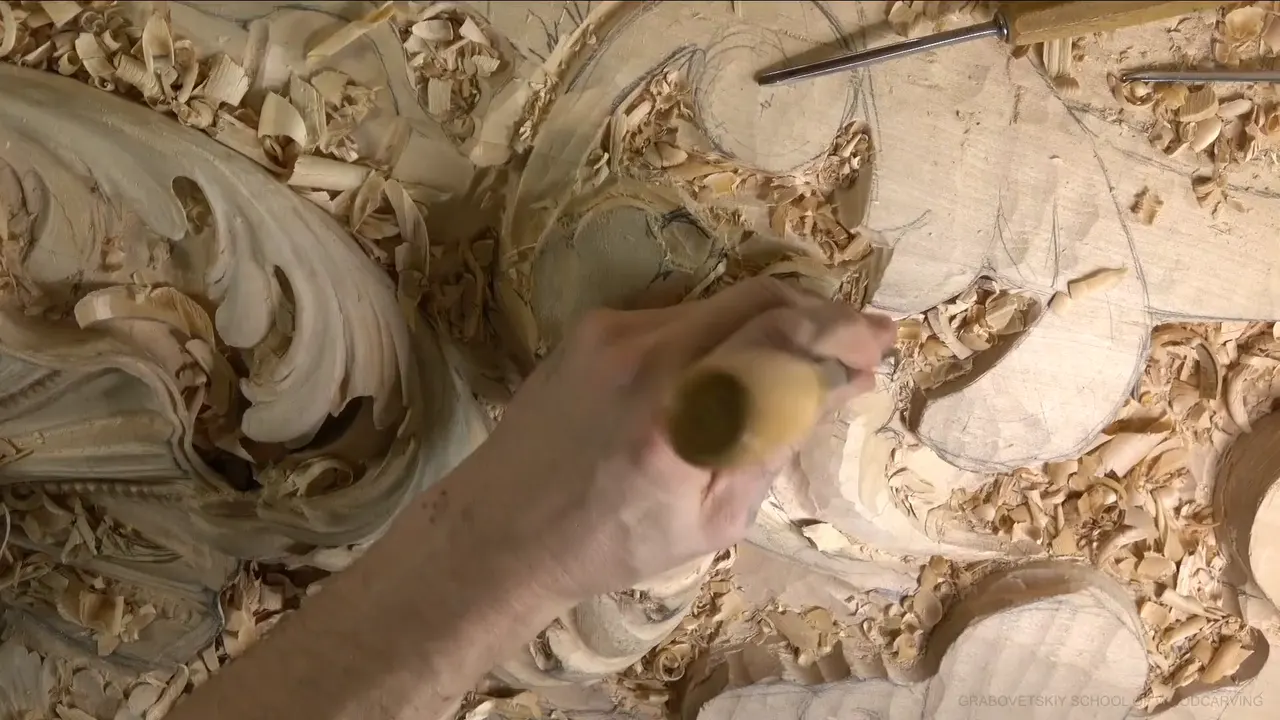

When I say I may not bother with a cut, I mean I have weighed it and might skip it. It came near the end of Venice Room part 26.10, over a flip I could have added to a leaf. Those few words turn up in several of my videos. Have you ever stood over a piece and wondered if one more cut was worth your afternoon? Every line below is mine, from a video where I said it aloud, and the reason I gave changes each time.
What happened in this part?
The first words are a plain order. Clean that. Soon after, I told you it would still look nice, still beautiful, even gorgeous, although maybe not as I was planning, but it's okay. Part 26.9 ends with me calling my tool too big, so the two parts sit next to each other. What the plan was, 26.10 does not say, and I will not guess.

Next I wanted that S shape in the acanthus leaf. A small separation sat on the inside, and my first pick was three millimeters (0.12 in), number 11, and then four millimeters (0.16 in), number 11, right here. A correction came a few seconds on. Well, actually, this one is also three, I said, and I thought that was four. The right gouge, I said, would give a movement in that direction.
A mess was waiting. Lots of junk inside, and I needed to take care of it pretty much right away. How, though? Care was the word, because the movement still needed work and I did not want to damage my future piece. That stays a need and a worry on this page.

Next came a tool change. Not the right tool, I told you. Just the flat number nine would do, 14 millimeters (0.55 in), which I called half an inch. Can you see what I see, I asked. A number five followed, and I thought I could probably attack the spot from the side.
Which cut did I weigh at the end?
First came a rule about the S. If you carve the S letter shape, they are all supposed to go outside, and one on the other side would not look good. All pointing the same direction is logical, I said. Once in a while, where you return, one goes the other way. Pointing out just like that doesn't make sense.

Then came the waste. Let me get rid of this extra material, I said, the part I don't need anymore. Beautiful. A possibility followed. I could do a lot more nicer movements, flip it going like that, and flip all the way, but maybe I shouldn't even bother with that. The next breath gave my reason. It has to be logical to the overall movement, and it has to flow together. Just before, I admitted I could not judge yet how the leaf looked overall.
A flip, then, was the cut in question. That is all this part tells us about that cut, and I will stay with it.
The tool talk comes last. My number 11 was 10 millimeters (0.39 in), three-eighths of an inch, at least by the mark. It feels much bigger, I told you, more like half an inch. Near the edge it is three-eighths, and a little wider on the outside. One more separation could go right there with the same tool, and maybe I would just relieve it. So many chips lay around me.
Did part 26.6 say the same thing, four parts earlier?
Yes, in a gentler way. I said I could excavate a little on one side, probably with a number 11 at 10 millimeters (0.39 in), and I could do it right away, inside, like undercutting. I kind of liked what it gave me, even if little of it would show from the bottom. And who knows, I added, maybe they somehow reach it.

The leaf itself gave the reason there. It works logically with how a leaf is built in real life: a subdivision right there calls for a subdivision right here too. Next I said I was on 7 millimeters (0.28 in), a little bigger than a quarter inch, using just the side of the tool to get a little cleaner inside and a little deeper.
Time to think, I said. Overall I was happy. More subdivisions would be nice, though, since even more movement would look even nicer. Not sure, I said. Maybe skip the bother and leave it for now, and see later what I can do. A rasp was my other idea, my new addition to the overall shape, for a really nice smooth movement. Which details to put in could wait until after that.
That one is a delay. The video decides whether rasp or cut came first, and my line says only that I would look again.
What if the spot stays out of sight?
Venice Room 19, part 2, has a question I put to myself on camera. I wanted a number nine, a quarter inch (6 mm), to set in the idea, and I still had doubts about the position of an eye. I liked the idea and wanted it somewhere. Do I have to do it or not? That's the question. And the answer, of course, is not, because a flower is going to cover it.

Maybe skip it altogether, I said, and I said it again a moment later. I also told you why I had not developed that shell completely on this side: I knew something else was coming there. The movement still had to repeat the overall curvature.
Workshop 18, part 2, asks it in other words. A separation was waiting, and I could try it right away with a knife, or maybe with the skew, held upside down and going from both directions, so that I clean right away underneath. Then came the decision. Should I do this part or not? Also consider this, I said: if it's not going to be visible, why even bother? Next, a ridge I did not like. Maybe just knock it out, I said, and let me use a bigger back bend.

Set the three lessons beside one another. In 19.2 a flower hides the spot, in 18.2 I asked about visibility, and in 26.6 I only hoped that somebody might reach the spot. Who would look was the question each time.
And when the tool cannot get in?
Venice Room 39, part 1, finds me making small separations with one more to go. In this case I could go almost down if I wanted, and I asked if a number five would do. Then I said yes, it was giving me a beautiful detail. A slight movement might follow, maybe slight. But a snag showed up: I can't really use any tools in this area.

So I weighed leaving it. Maybe just leave it like that, I said, because almost no tools fit. For now, I added. I was kind of tired of that area. The shell still needed developing, yet I said I could probably jump. Here the reason is the tools, since almost none of them fit in that spot.
What did I do with a cut I doubted?
Doubt came mid-section in Venice Room 78, part 10. A little too much was going on, so my plan was a number five at a quarter inch (about 6 mm), going to whatever I had just created, to that small section. I wanted to outline it better with the same five, and from here too. I was after something more than the plain leaves.

I'm not sure I'm doing the right thing, I said, and maybe I would leave it. A little more light would help me a lot, since I could not see what was going on. Soon there was little material left, and care mattered now. The doubt was spoken aloud, and the work went on.
Can the cut wait?
Two ways to handle a division show up in Venice Room 30, part 1. Logically I needed some kind of division. On the other hand, I could go this other way and go all the way. I think it's going to be better that way, I said. Carefully knock down this side, and I thought it would look really good.

Here the phrase takes a new shape. I probably won't even bother with a sharper separation there, I said, so I'll leave it curly. Maybe hit the edge a little, clean it. That can come later, no problem. Next, excavating underneath, I said I was on a number 11 at 3 millimeters (about 1/8 in), though a smaller one might do, since this spot should not go too low. Maybe 2 millimeters, or even 1.5. A maybe, nothing more.
In Grape Onlay, lesson 4, part 1, I put it plainly. The grapes could wait, and I really don't worry how it looks at this point, because the overall shape matters more to me. Another job I would not even bother about right now: taking care of one spot.

When did other carvers skip the cut?
In three lessons I spoke of other carvers who skip a step, and in none of the three did I call them wrong. First, Venice Room 34, part 11: I said I would use a really tiny number three to create a separation. A lot of people wouldn't even bother doing that, I said, which is absolutely fine. I just like those small, tiny details. Just before it, a movement upward on that side had given me beautiful movement, one the camera would not show.

Lily Box, lesson 4, part 12, has a ridge. It had to be blended. Some of the carvers, I said, would leave that ridge, because it actually gives extra movement, and they would not even bother. My choice was a spoon gouge, a number seven, a quarter inch (6 mm), and I wanted it blended in, but carefully. Moments later, I called that not the best, what I had just done.

The line has a way out too. Take Furniture Panel, lesson 21, part 1. I planned to use one-eighth of an inch (3 mm) and hit a spot from straight down, stopping short because I really didn't want to see that mark. But on the other hand, I added, if it doesn't bother you, go ahead. Lots of wood carvers hit it hard and forget it, which saves time when tool marks do not worry you.

Some of you, I said, are really looking for those tool marks, and really like the whole idea of them. So, okay, I said, and then: let me clean this wall one more time.
When did the bother have a reason?
The question flips in Furniture Panel, lesson 32, part 2. A number eight at 3 millimeters (0.12 in) was my choice to round a dome, tool upside down, carefully, carefully. I said I had just created my dome clean up, and then I asked why I even bothered with the outlining.

My answer was about fibers. Relief cuts let you break them off. Without the outside cut, my weak spot would head toward the center, and I would just smoosh the fibers and break them. So here the bother had a reason, in my own words.
Small bench jobs get the line too. In Lily Box, lesson 13, part 2, I mentioned a non-slip pad on the board itself, the same material routers use as a pad, to prevent slippage. But it's okay, I said, I'm not going to bother with that.

And in the first Venice Room lesson, I was choosing between blue tape and double-sided tape to hold something in place. Peeling it is kind of tricky sometimes. You know what, forget about it, it's too sticky. I would just tape it. That time, the reason was how sticky it was.

So what are all these reasons, in one place?
| Lesson | Cut | Words |
|---|---|---|
| Venice 26.10 | A flip I could have added to the leaf | It has to flow together |
| Venice 26.6 | More subdivisions, with a rasp as one idea | Later on, I can see |
| Venice 19.2 | An eye a flower will cover | Of course not |
| Venice 18.2 | A part that may stay out of sight | If it's not visible |
| Venice 39.1 | A spot where almost no tool fits | Almost no tools I can fit |
| Venice 78.10 | One section I doubted | Not sure I'm doing the right thing |
| Venice 30.1 | A sharper separation on a curly part | I can do that later |
| Venice 34.11 | A tiny separation with a really tiny number three | A lot of people wouldn't |
| Lily Box 4.12 | A ridge between two concaves that some carvers keep | It gives extra movement |
| Furniture Panel 32.2 | An outline of relief cuts around a dome | To break off those fibers |
Read the right-hand column and you hear a reason each time, never a rule. Parts 34.11 and 4.12 have me carving what other carvers might skip, while 19.2 has me skipping it myself. The words go both ways.
What can you try on your own board?
Pick one spot where you wonder if the cut is worth it, and ask my questions. Will a viewer see it? Does a tool fit? Does the cut agree with the movement around it? Could it wait? Say your answer out loud before the next pass.
Workshop 26 sits in Venice Room, part 3, workshops 26 to 37. For the S, the junk and the flip in full, start there. Shall we carve?
How it's done
- Name the cut you are weighing. The flip on the leaf was my example, and the leaf was not yet judged as a whole.
- Check it against the whole movement. The leaf as a whole came first: the movement had to hold together.
- Ask whether anyone will see it. In one lesson a flower hid the spot. Another asked why bother if the spot would not be visible.
- Ask whether a tool fits. In 39.1 almost no tool fit the spot, and I said to let it be for now.
- Decide if it can wait. A curly part stayed curly in 30.1, and the edge was a job for later.
Frequently asked questions
Does skipping a cut mean the carving is unfinished?
Not when I say it. Part 26.6 puts extra subdivisions off for now, and 30.1 leaves an edge for later.
Should you carve a detail nobody will see?
Part 19.2 says of course not, because a flower covers that spot. Yet 26.6 liked an inside cut that would hardly show from the bottom.
Do other carvers skip the small details?
Some do. Part 34.11 says many people would pass on a tiny separation, which is absolutely fine, while I like those details. Lily 4.12 mentions carvers who keep a ridge.
Is the extra step ever needed?
What to carve next