
Alexander Grabovetskiy, woodcarver, School of Woodcarving · Published 2020
What does a wood carver mean by "quickly" when he shows a tool?
Quick answer: "Quickly" is how I point at the speed a tool gives me. In Venice Room 26, part 11, rasp work felt fake to me for a moment, then not really fake, and I said I like how quickly it gets my job done. My other videos use the word for a skew, a knife and a router plane.

Quickly is the word I use when I want you to see how fast a tool takes wood off or finds a shape, and in part 11 of Venice Room workshop 26 it comes right after I weigh a rasp. The part is short. Many other lessons of mine use the word too, so this page sets them side by side.
Ever picked up a tool, felt it was fake, and still liked how fast a shape came? Part 11 sits right there. It is a small moment in workshop 26, and it opens a bigger question about speed in wood carving.
What did I say in part 11 of workshop 26?
One side was the exception. I could probably refine it a little better now, I said, since I had lost the movement I was after. A little nicer cut looked possible, but my tool needed to be sharpened.
At 00:58 I said "a little bit more right there." I did not want to do too much, because I would lose the overall feel. Undercutting was still open to me, because it has to be from underneath. My plan for the beginning was probably 7 millimeters (0.28 in), and the plan was to excavate this way.

Then the plan wobbled. "But maybe 7 millimeters is a little too big," I said at 01:34, and added, "let me think." Maybe 5 millimeters (0.2 in) or 4 millimeters (0.16 in), maybe just the 4, and after that a switch to 3 millimeters (0.12 in).
By 02:28 I called it good, twice over. Nine seconds later came "Overall shape is good," and then "that's what I mean by that." Then, at 02:44: "Get around here a little better."

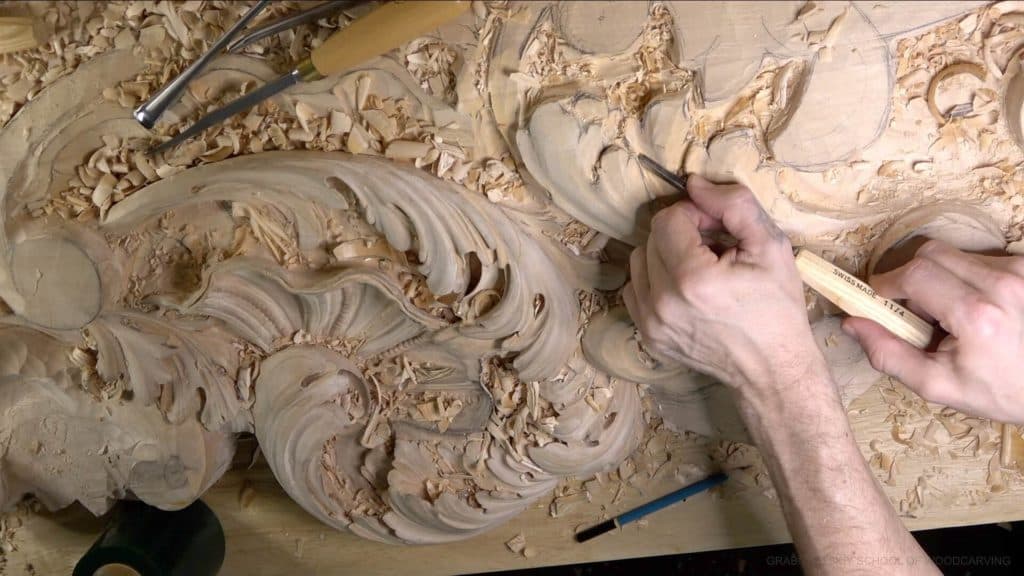
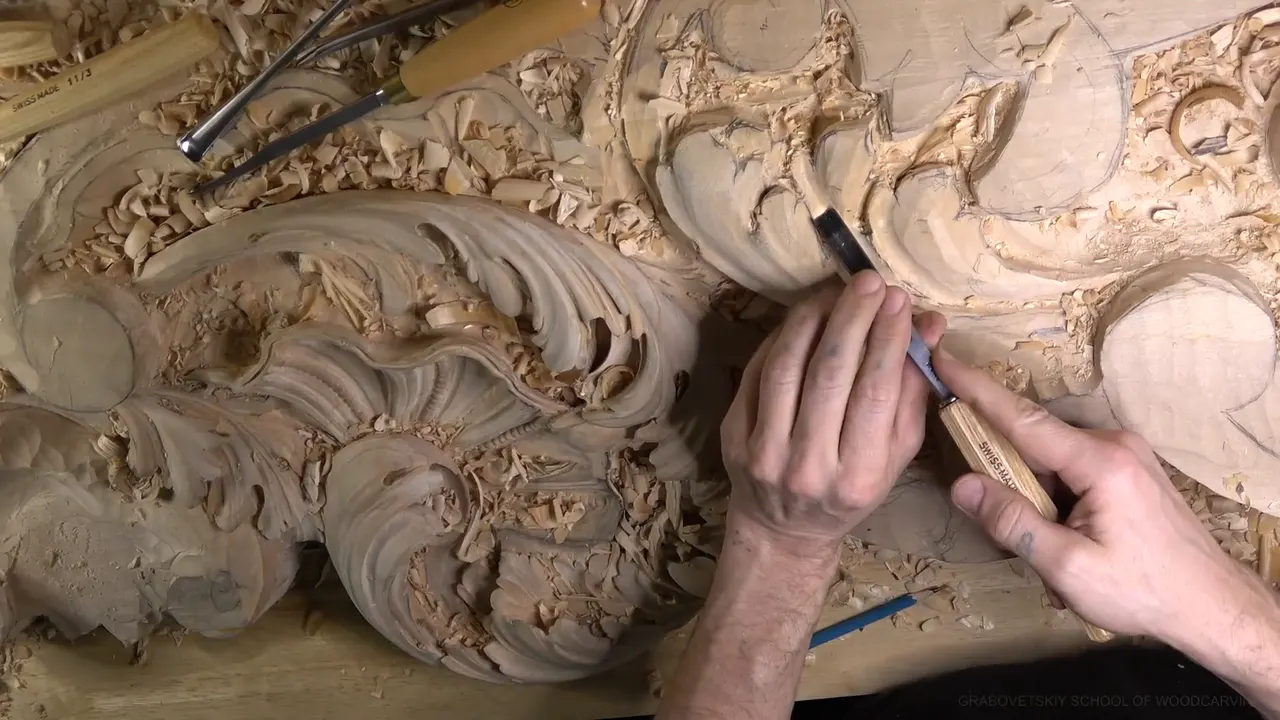
At 03:08 I named the point where I wanted rasp work to give an overall shape. Then came the passage I keep coming back to: "Because I have those rasps, why not to use them? I'm still trying to excuse myself, okay? Still feels it's fake. But it's not really fake."
I kept going, and the next line is where I landed. "Just because I didn't use them before, I have to probably use them and still call it a wood carving." And then the line this page is built on: "But I really like how quickly I can get my job done. That's what I like about it."

Next, 04:29: "See? It's just really nice overall shape. Beautiful overall shape." That was even before we put any details in it, and it already gave me the feel of how it was going to look. Then: "And I must admit, I like it. I actually like it."
Around 05:37 I hoped you could see how it was in three dimensions, with those movements blending together nicely. The last caption, at 06:19, is "That's probably enough for now."

What does quickly mean when I say it about a tool?
I am pointing at the speed. The camera is on the work when I say it, and I say it about very different tools. This part gave me a rasp, and my other videos give me a good many more.
Start with the Tray of Blessing course, lesson 1. Just before the line, I had told you that you can flip the piece as many times as you wish and attack it from another side. I pointed at my left hand, set down solidly, and at the rotation, or slicing, in the motion. Then: "See how quickly I can excavate the material." I named that stage roughing out.

A slicing cut carries the word in the Byzantine acanthus course, lesson 2. It meets a lot less resistance in the wood, by the logic of how it works. I went from the left corner toward the right, because I was going to escape to that side, and the material came out fast. I could establish my shape really quickly. You do not see it in slow motion, I added, but every cut has a rotation in it.

The knife gets its turn in Carving Greek Acanthus Leaf 3, part 4. My first stroke ran 90 degrees straight down, and the second came in with the bevel. Earlier came a warning not to go too far with the knife. A big chunk of wood came out, and I was happy with what I saw.

Excavating under a part is one more place for it. Carving Grape Onlay 13, part 2, shows me going to half a millimeter (0.02 in) from one side, then the other. Then I could get an excavation right underneath, and all that waste came out fast enough that I called it out.

Which tools do I praise for a fast start on a shape?
Blocking comes first. The skew in Grape Onlay 2, part 1, is about an inch (25 mm), and what I like about it is that you can quickly block the thing. Another option is a normal gouge, which could do the same operation, I added, with no skew needed. "But personally I really like it."
I also told you not to worry about losing the details of those individual grapes. The word came back at 04:06 for the next block.

Backgrounds come next. Clearing one with a router plane is what the Flower Rosette course, lesson 5 shows, in part 2. A few lines earlier I made a point that applies to any tool, gouges and knives too: it is supposed to be really, really sharp. Then you get really nice clean results. Then: "It's a really quick way."

In many cases I like that way much better, I told you, just to use my router plane. The background came off with ease, and I gave it a name: "it's a wood carving on steroids."

A bigger tool does a similar job in Carving Greek Acanthus Leaf 15, part 4. The tool is roughly an inch (25 mm), really handy for a background, and I could get really good results with it. The ridges came off quickly, and I told you to watch.
One tool in the Tray of Blessing course, lesson 3 is hard to find now, because almost nobody sells it. Before it, I planned a number two to roll a lobe a little more, just to show you a different tool. With the hard one, you can create any shape you want right there, I said, and I called attention to how fast that shape got established.
Venice Room 50, part 12, has a modified skew chisel that I love. Do you have to buy it? "Of course not." I reached for a normal skew, and the main shape developed really, really quickly. Sandpaper and rasps were not even needed. It was already giving me that movement.

My Maine class had another one, Grinling Gibbons class 3: a number seven at 14 millimeters (0.55 in) can create beautiful grape vines, I said, and then I asked you to watch how fast it got done.

The short list of what I praised sits here, in the words I used.
| Lesson | Tool | What I said |
|---|---|---|
| Flower Rosette 5 | A router plane clearing a background in part 2 | Really quick |
| Grape Onlay 2 | A skew, with a normal gouge as the other choice | Quickly block |
| Greek Acanthus 3 | A knife, first straight down, then with the bevel | Big chunk |
| Venice Room 50 | Just a normal skew, with no sandpaper or rasps | Really, really quickly |
What do I gain when changing a tool is quick?
Setup time counts too. For Carving Furniture Panel 38, part 1, I picked the big one, and my reason was the blade. "I like this one just because I can change the blades quickly." A couple of seconds, I told you, and the swap is done.
Right before that I spoke about hand tools. Hand tools leave no limit on what you can do, I said. Sometimes machines are really quick. With hand carving the limitation is just inside your head. Later in the same part I asked which blade to use, and settled on 3/16 of an inch (4.8 mm) in this case.
Acanthus over Moldings 2 shows a swap at 06:55 of part 2, when it was time to change the blade. I called attention to taking the old blade out. It takes me a second or so.
Reach is another gain. In Venice Room 52, part 6, the back bend helps me a lot to work on those areas. It is like a number one chisel, "and I can quickly do whatever shape I want to."

Is a faster tool a lesser way to carve?
Here I ask it out loud, in part 11. The rasp felt fake to me, and I said so before I gave my answer. My answer was to use the rasps, probably, and still call it a wood carving.
A second rasp line sits in Venice Room 82, part 12. A middle ridge was already showing the form, and one surface was not too smooth. "Let me take a rasp and just knock that down really quickly."

Both rasp scenes sit beside other work. In part 11 it comes up after my talk of 7, 5, 4 and 3 millimeters, and in workshop 82 it comes once the form showed. The skew of workshop 50 got me the main shape without a rasp.
A line on tool size ties in here, from Big tools vs small. The biggest mistake I see, I told you, is a small tool, dug in over and over, so that people spend so much time and get frustrated. I have a tool of about 80 millimeters, like three inches and one-eighth. On the big projects I take that big gouge and knock the whole thing out, really quickly, in one day.
When does quick cost me something?
Speed has a price in my lessons, and I name it just as plainly. Hashemi lesson 20, part 1, is where I said it is sometimes tempting to make all the cuts as quickly as possible. "But believe me, it's not the best idea." See Carving Hashemi Flowers 20.
Better to take your time, even if it takes an extra amount of time. A few extra minutes beat forcing it into a big mistake. Patience gets the same treatment in Carving Corinthian Acanthus Leaf 3, part 4. There is a temptation to get it done fast, I said, and it is not always helping. Mistakes happen, and you can mess up.
I count myself in. Carving Roman Acanthus 2, part 4, has me admitting I make that mistake many times when I am not too careful, trying to finish quickly and breaking stuff. I have done some gluing, though I prefer not to glue. If I broke something, let it be. That means it was meant to be like that, and you redesign around the broken part.

Less wood can be the faster road. "Don't dig too deep," I said in Carving Modern Acanthus 3, part 1. Not even a sixteenth of an inch (1.6 mm) at once. It looks fast, but somehow it works: take less material, and you get the job done faster.

My body keeps a count too. A lot of people bang like this, I said in Venice Room 55, part 3, and they get pain in the shoulder also. A mallet is supposed to hang free inside your palm. This is the right way, and the hand does not get tired. Use the whole body to bang on a mallet, and I would get tired really quickly.

Edges tire out the same way. Carving Roman Acanthus 10, part 4, has me constantly checking my edge for a wire. If there is one, I have to re-strop it, rebuff it or even resharpen it, and I do that multiple times daily. Some people say the best wood is a soft wood and your tools should not get dull. Not necessarily true, I said. Tools, for some reason, still get dull, and really quickly sometimes.
Cheap sandpaper adds to it. Over in Carving Modern Acanthus 7, part 2, I said it leaves a lot of abrasive inside the wood. Use a tool there again and it dulls really quickly, and you have to resharpen it. That is number one thing why people do not like to use sandpaper.
What should you take from all of this?
Across these videos, quickly points at a result you can watch. Wood comes out, a shape shows up, a blade swaps in a few seconds, and I point at each one. Those videos also pay for it in broken pieces, dull edges and tired hands.
Look at your own bench now. Is there a gouge in the drawer you skip because using it feels like a shortcut? Would you still call the piece wood carving if it came out faster? That question runs through part 11, and in the end I said I really liked the speed.
The lesson 26 page and the Venice Room course for workshops 26 to 37 hold the rest of this Venice carving, and workshop 27 carries it on. To see every lesson I teach in one place, start here. The figures in millimeters and inches on this page are mine.
How it's done
- Check the tool. In part 11 I said my tool needed to be sharpened.
- Pick the size. My plan was probably 7 millimeters (0.28 in), then maybe 5 or 4, and after that a switch to 3.
- Reach for the rasp. I named the point where I wanted rasp work to give an overall shape.
- Look at the shape. A beautiful overall shape, I said, even before we put any details in it.
- Stop for now. Probably enough for now, I said.
Frequently asked questions
Did the rasp feel like cheating in part 11?
For a moment it did. I said I was still trying to excuse myself, and then I settled it: I have to probably use the rasps and keep the name wood carving.
Which tool did I call a really quick way?
The router plane, on a background, in the Flower Rosette course. I put it as wood carving on steroids and liked that way much better in many cases.
How does a skew help block out grapes?
A skew about an inch wide (25 mm) lets you quickly block the thing. Plain gouges can do that operation too, I added, though I really like the skew.
What to carve next