

Alexander Grabovetskiy, woodcarver, School of Woodcarving · Published 2020
Do professional wood carvers break their own carvings?
Quick answer: Breaking a piece of my own carving happens to me, and I say so on camera. On camera in workshop 27 of the Venice Room, I told the camera I had broken my piece, something I could avoid and didn't. I blamed rushing, then dug underneath to see how much wood was left.
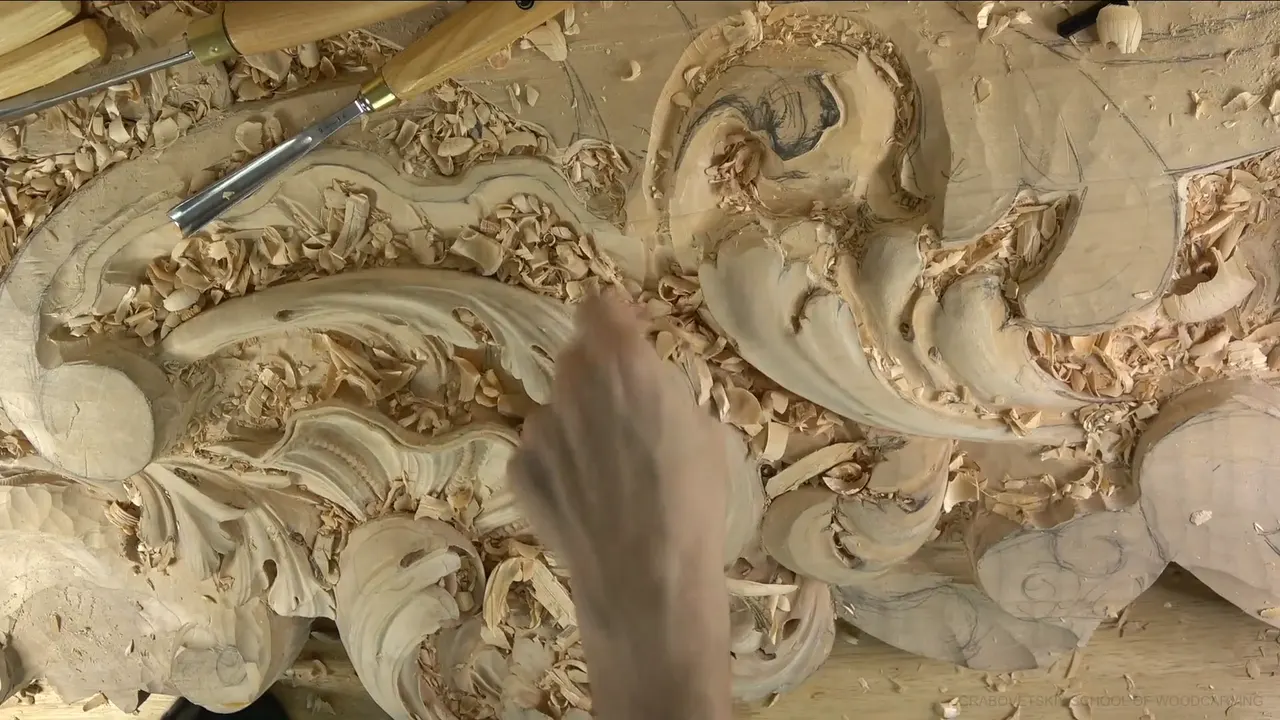
Yes, professional wood carvers break their own carvings, and I do it on camera. Workshop 27 of my Venice Room course has the proof. In part 4, a piece of a Venetian carving broke on me, and I said so before my next pass. "I'm not too happy that I broke my piece right here," I said, then, a few lines later, "that's something I could avoid and I didn't." I went back through my other lessons for the times something snapped, and the reasons I gave are below.

Have you ever felt a gouge give way at the edge of a shape you liked? Did you wonder if somebody who carves for a living ever has that moment? I do. Watch what I did next, and what I blamed.
What happened when I broke the piece in workshop 27, part 4?
A piece broke, and I put it on my own hurry. The video opens quietly, with me reaching for something like a number six to clean a little in one direction. Maybe, I said, it was a good idea to undercut right away, underneath of this movement.
Then came the confession. "So that is not too good," I told you. "It's still going to look good." One more line followed, the one I would hand to any student: "I guess I was rushing too much."

What did I do right after the piece broke?
Dig underneath, and look. "Let me excavate underneath where I can see much better what material I have," I said. The tool was a number 11 for undercutting, at seven millimeters, a little bigger than a quarter inch (about 0.28 in). I wondered out loud if a straight tool would work. I excavated a little deeper right there.

A section close to the upper level bothered me, so I knocked it down right away and went really low. "So it's going to look much better, I think," I said. After a while the chips piled up. I stopped to brush them out, because I couldn't see.
Here is the good news. "Now I have plenty of material, and I can develop this movement with no problem." That sentence came out twice in a row. That was going to be the main division, repeated on that side.

For better form I wanted a straighter tool, maybe even just a number three. A number three if it's English-made tools, I said, and a number two for the other kind I named. I wanted to give a better shape, and I cleaned it a little so I could see what I was doing.

The last stretch is about wood again. I took a number 11 once more, about seven millimeters, and began my divisions. One distance bothered me. To fix it I had to excavate kind of deep inside, since I needed that material, or it would look awkward.
The division beside it was wide, and the leaf that meets it was a lot smaller. That leaf had to go underneath, inside of the upper part. My words for the only way to do it were plain: "just excavate a really deep undercut." Part 5 of the same workshop picks up from there.

Is rushing the reason pieces break?
By my own account, often. In Roman acanthus lesson 13, I was working with a number three, an eighth of an inch (about 3 mm), when I put it plainly. When I rush, I tend to make a lot more mistakes, and I break, and then I have to glue back. "That's not nice." On production work I have to be much quicker, because I can't waste time. Still, I stay on the side of being careful.

The Lily Box course has my funniest version. Better to be on a safer side than to rush it and push it too hard, I said in lesson 11. "And ask me how do I know that," I said. "Yep, I made that many times, that mistake." Then came the joke. When I'm rushing something, it is not because I'm Russian. Yes, I was born in Russia, but I'm not talking about that type of Russian. I'm talking about rushing, trying to get stuff done quicker than it should be.
Hashemi lesson 5 has a shorter one. A number seven sat in my hand. "Oops, I should not do that," I said, and a moment later, "I made a rushing move. You should not rush. Or should I say, I should not rush."

Two lessons on, lesson 7 went worse. I refined my edges and took too much, which was okay. "Usually, I'm more careful, but I don't know why I'm rushing too much." "Well, I could leave it like this," I said. "I'll just use a number one." Seconds later: "Make a mistake after another mistake. Too many mistakes." A small knife helped me a lot right then, and gave me much more control.
My caution has a history. On the furniture panel, I admitted I'm maybe too careful sometimes. I made too many mistakes before, I said, when I was rushing and trying to do stuff too quickly. "That is not too good idea." So I raised my router plane first, because I did not want to go to the final depth yet.
Even a small slip can warn me. Workshop 24, part 9, gave me an extra notch, and I called it just extra detail. But it was a sign, I said, that I have to be really careful what I'm doing. That means I'm probably rushing, I said, when I'm grabbing my tools. I have to slow down a little bit.

Does pressing too hard break the edge?
It does. I admit it on camera more than once, and the furniture panel was one of those times. In lesson 27 I had a number 11 with two millimeters (about 0.08 in) in the wood, and I praised the spoon ones as excellent. A moment later: "Here you go. I just broke the edge, which means I'm pressing too much." Next I moved to the opposite side, where my flipping starts.

Workshop 13 of that Venice Room series gives the same moment another word, and a short one. I tried a tool of 9.3 millimeters, and the edge went. "No bueno," I said, and told you it was still okay, since that spot was just going to be lower. Further along I switched to a number 11 spoon gouge, two millimeters (0.08 in) and said I would try to be more careful this time.
My reason came a few minutes after. Crank too much and I'm going to break this side, I said, and "it's better to take time and just excavate little by little." Workshop 18 added a quieter rule. An edge broke there, and I said it didn't look right. I rounded it slightly, and said "Don't want to force it."

What breaks even when I am careful?
Plenty. A tool broke on me in Lily Box lesson 7. I put in a number 11 at half a millimeter (0.02 in) and heard a sound I didn't like. "I don't like when I break my tools, but it's okay," I said. Then I took it back: "Well, it's not okay." I do have another one, I said, and I'm going to resharpen the one I just broke. "You see, I was really careful. I didn't force too much, but just because that is a hard wood. It doesn't help."

A shape can fool me too. In the Greek acanthus course, one piece looked solid but was more fragile than it looked. "It looks like I just did it. I just broke it." We can use it to our own advantage, I said, and make that piece go all the way to the bottom. Two mistakes in one day, I said, is kind of not good. On furniture, where I had to make exactly the same pattern, I could not allow those errors.
Part 1 of that lesson used the same turn. Because I broke that piece, I could undercut a section I probably could not even reach, at five millimeters (0.2 in) again. And I could make it as deep as I wanted.

Sometimes the reason is the camera. In Grape Onlay lesson 10, my half millimeter number 11 (0.02 in) was almost there. "Oops. And I just broke that thing, right? That means change of design." The reason I gave was that I attacked from the wrong side and did not want to move my workbench because of the cameras. Without them I would obviously rotate the piece and attack that way.
Not every piece comes back with a fix like that. Over in lesson 7 of the same course I said, "I broke that section and I lost it." A new piece went in and I carved it again. Hide glue held it, the kind I like to use because it is easier to blend, and you can probably detect a couple of spots. "It happens sometimes," I said. "I wasn't too careful."

Another time, a knife was the thing that broke. Hashemi lesson 26 has me saying I broke my tip and had to resharpen it, on the same number 12 knife I used before. I actually like how it works, the shorter version.
When is a break not a mistake?
It depends on how much wood is left to work with. Back in workshop 4 of Venice Room Part 1, I broke the end of an element and said I did not touch the pencil mark. "I still have plenty of material, so I would not consider that as a mistake." Workshop 27 says the same, after my own break.

One more case is in lesson 13 of the Lily Box course. Maybe I was just rushing again, I said. Next I looked closely at how bad the damage was. It wasn't the end of the world, just a tiny spot, and I could fix it without anybody seeing what the problem was. A separation cut sat between two pieces, so now I could put a drop of glue in the middle and hold them together. "So maybe it's a good thing that that happened." I still need to be careful there, I added.
Where did each piece break, and what did I say about it?
This table lines up six places. Read the last two columns as the cause I gave and my next move.
| Lesson | What happened | Cause | What I did about it |
|---|---|---|---|
| Venice Room 27.4 | I told you I broke my piece | My rushing | Dug underneath to see my material |
| Furniture Panel 27.3 | The edge broke under a number 11 | My pressing | Moved on to the opposite side |
| Greek Acanthus 14.3 | The shape looked solid but was fragile | Fragile piece | Used the break to my advantage |
| Lily Box 7.6 | A half millimeter number 11 tool snapped | Hard wood | Resharpened the one I just broke |
| Grape Onlay 10.2 | The design changed after a piece broke | Wrong side | Lowered that part slightly, went deeper |
| Hashemi Flowers 7.5 | I took too much refining an edge | Rushing again | Took a small knife for control |
What did my broken pieces have in common?
Looking back across these lessons, the causes I named were few, and every one came out of my own mouth.
- Rushing, which I owned up to in workshop 27, Roman acanthus 13, the Lily Box and two Hashemi lessons.
- Pressing too much, in furniture panel 27 and Venice Room 13.
- Coming at the wrong side on the grape onlay, with my bench staying put for the cameras.
- A fragile shape in my Greek acanthus piece.
- Hard wood against a tiny tool, in the seventh Lily Box lesson.
- A lot of wood left, which in workshop 4 and workshop 27 kept a break from being a real mistake.
Would I admit a break to anybody?
Workshop 13 holds my joke about it. When something broke, I said, "it's meant to be that way," and that is a usual excuse for me. After that I got serious and said it is still better not to break. "Don't get me wrong." I've got to be careful how I work.
A few minutes on, another one went wrong, and I told you, "I'm not going to tell nobody that I broke it." I carved a bigger separation instead. Gluing it back was possible, I said, but "I just don't want to do it."
With a wink, I said the same on the Grape Onlay, "I'm not gonna tell no one. I mean, I told you, but you're the only one who's gonna know." I wanted the same idea, only with a change of the design, and I lowered that part slightly, a little deeper. "It's not the end of the world."

So the answer from my bench is yes. I break pieces, tools, and edges, and I say so each time. What I can do about it is look underneath for wood, brush the chips so I can see, and slow down when I catch myself rushing. The Venice Room Part 3 course holds twelve workshops of me carving that way, and workshop 27 follows one leaf from this break to its deep undercut. Which piece of yours would you slow down for?
How it's done
- Dig under the break. I excavated underneath the spot, to see what material I had left. Seeing the wood left tells you if the break matters.
- Knock down what sits too close. One section sat too close to the upper level, so I knocked it down right away and went really low. It looked much better to me.
- Brush the chips away. I stopped and brushed the shavings out, because I couldn't see through them. Seeing the form comes before the next pass.
- Develop the movement. With enough material, I could shape the movement with no problem. I called it the main division, repeated on the other side.
- Go deep where a leaf tucks under. Where a small leaf had to go under a wide division, I dug a really deep undercut. I needed that material, or it would look awkward.
Frequently asked questions
Should I glue a broken piece back on?
Workshop 26 had me say maybe I would glue it back, maybe not. A bigger separation came up in workshop 29. On my Lily Box I said I could put a drop of glue between two pieces. Both choices come after looking at the damage.
Does hard wood make breaks more likely?
On the Lily Box a number 11 of half a millimeter broke while I was careful. Forcing it was not the problem, I said. The wood was hard, and that does not help. There was another one, and I planned to resharpen the broken one.
How do I know I am rushing?
A small mistake can tell you. In workshop 24, part 9, an extra notch showed up, and I said that is the sign to be really careful. I was probably rushing while grabbing my tools, so I had to slow down a little bit.
What to carve next