
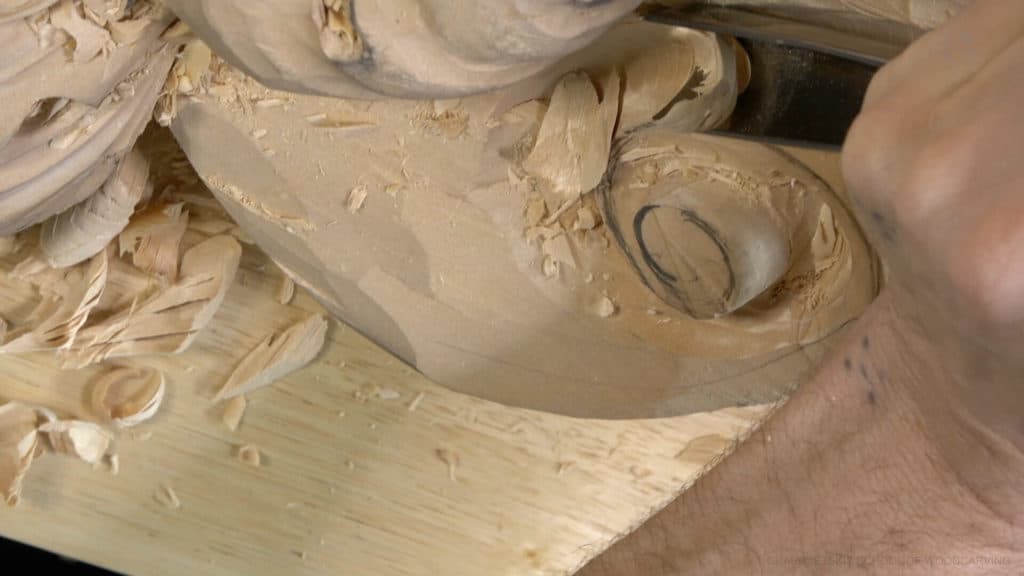
Alexander Grabovetskiy, woodcarver, School of Woodcarving · Published 2020
What does a wood carver mean by something nice instead of a flat wall?
Quick answer: Something nice is my plain word, said before the cut, for a shape I hope to carve instead of a flat wall. In one Venice Room part I want it, and in other clips it comes with wood to spare, a line I have, or a view from below.
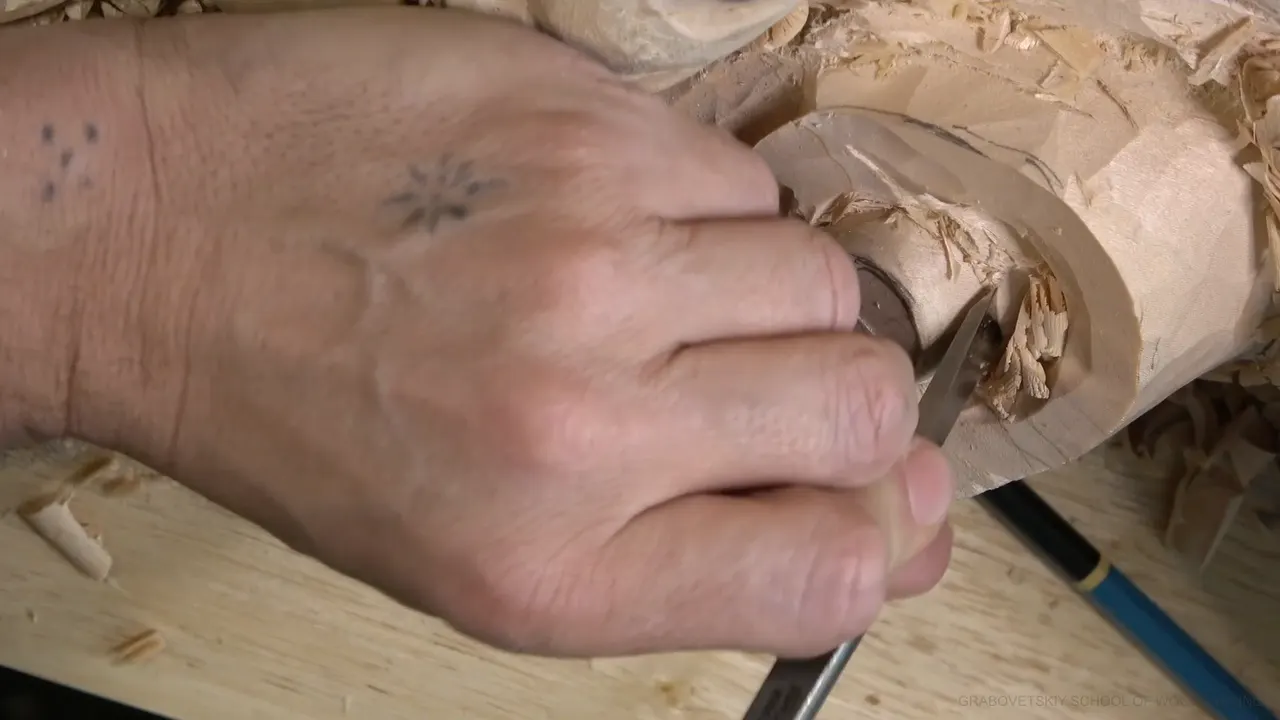

Something nice is my plain word, said before the cut, for the shape I hope to get in place of a plain one. Part 31.10 of workshop 31 is where the plain one is a flat wall. More than a dozen other clips of mine carry the same words or close ones, and I line them up here with what each one shows.
Ever stood in front of a spot you could leave flat and wondered what else it could hold? That is the moment I say it. Below, you get what I had in my hand and on the wood each time.
How does the flat wall come up in this part?
The part starts small, with "preliminary, just remove some of the stuff I don't need." A thought about a smaller tool crosses my mind, "not number seven, but maybe number three, and maybe this direction."
Both are maybes, so here they stay maybes.
A minute in, I warn you, "I know it doesn't make sense right now. It will." "You will see a beautiful movement." Meanwhile I'm "checking from all the positions" and "constantly checking from the sides."

What I don't like is a distance. One part sits "just a little too far" from the main volute, and I need to move it closer. "Just get that much closer." Then, "so that would make more sense." The tool is "my trusty skew," and I "carefully bring that much closer to this line."

Why do I skip the complete slope?
More than a slope is what I want there. A complete slope is out, I say, "because we're going to create some beautiful movement here." The line this page is named for follows. "We'll see what I can do, because I want to create not just a flat wall, but something nice." Right after it I repeat the two words, "something nice."
"That is just the beginning," I say. The shape "has to completely disappear underneath of here," and "that is how it's supposed to be rounded." After that I wonder if I "have to just excavate a little deeper right here."

How deep is up to me. "If I want to do a really high volute, sticking high above or not. And I think it's really gradual and nice. So I don't think I should do more than that." A little later I say it will be good "going all the way like that."
Then I check my direction. "I want to make sure I'm not doing a mistake," I say, "because I want to make sure I'm just doing the right direction." A mistake is easy with those, I admit. A number one comes up, "maybe," and a moment later "just the regular number one," to "chop a little bit this way."
I call that "preliminary chopping," and I say "I should say it."

Near the end I "see much better where I'm at." The skew could come back, "again just the skew," to "go in just like that." Part 31.9 comes right before this one, and it holds the same wish in plainer words: "All I need is just a really nice and gradual movement." There I'm "checking and double-checking from different points of view," and I'll attack that again "until I'm really happy with this line" if I need to. Going lower right away, I add, would not give me "really good movement."

What sat beside something nice in each clip?
The table lists seven clips, with what I said beside the words and the tool I named in the same clip.
| Where I said it | What sat beside it in that clip | Tool |
|---|---|---|
| Venice Room 31.10 | Not just a flat wall, but something nice | Skew, then number one |
| Workshop 76.6 | A quarter inch of wood to the ceiling | A larger tool |
| Hashemi Flowers 11.5 | Material to spare for another separation | Number 11 |
| Roman Acanthus 16.1 | Hopefully something nice, and not perfect | Number eight |
| Venice 53.11 | I really do not have to do it | Number 11 |
| Workshop 21.9 | A separation I did not like the look of | Number 11 |
| Workshop 72.6 | Not fully happy, but maybe something nice | Number 11 |
Does something nice need wood to spare?
Workshop 76 gives the plainest count. At part 6 I say "I do have plenty of the material, about maybe a quarter inch, about 6 millimeters at this point to the ceiling." Twice I tell you that I'll be able to. My pick is a "bigger tool, 7 millimeters" (0.28 in), and "I can go pretty much all the way if I want to." Next, "it looks like my 7 millimeters needs to be sharpened again."

Hashemi Flowers 11 comes at it softly. At part 5 I ask what we could do, "let me think," and then "something nice." I could place another pipe, with the eye and a pipe going down, and it will look "really nice." Next, "looks like I do have plenty of the material." My pick is "number 11, and that's one millimeter" (0.04 in), and I'll "just try to undercut." Another way gets offered too. "Oh, I also could use just a V tool. It would be exactly the same result what I am trying to achieve." My goal, I say, is to show you "a lot more ways to achieve exactly the same results."

Part 31.11 shows the other side of it. "I don't have too much material, but I need something right there," I say, and "I don't want to create too deep of a hole right there." A maybe answers it, an acanthus movement, so the undercut does not go too deep and too low. That part also opens on the bump from before. We keep it, I say, because I'll use it, and the plan is "something beautiful."
Can a line you already have give you something nice?
In Furniture Panel 14, part 5, a line already sits on the wood. "I know exactly what I want to see," I say, and I plan another acanthus movement, "just go in that direction, because I do have this line, so I can actually create something nice." It will go "from underneath," which gives "much better movement." I think it will look "much better" with "some kind of development in this area."

That part holds two wishes. One is to "hit this curvature with some type of movement." The other is a thought, "maybe create much bigger acanthus right here," and it stays a thought.
Part 9 of workshop 27 leaves it open. "I'm not sure what kind of movement I'm going to develop right here yet." One piece could go "right on top of that one," and it "just kind of creates interlocking almost." Twice I weigh it: "something nice could be done," and later, "something could be done."

Is a spot people see from below carved differently?
The plainest reason I have on tape, a short one, is in workshop 16. Part 9 has me saying "it's going to be visible from the bottom." Without that view, I'd "approach absolutely differently to this development." As it is, "it makes sense" to make something nice there, one that is "accessible and visible."
I also have a plan for the end of it. I can probably "just carve right here," and then "it just goes in and ends up on inside like that." I call it "really interesting movement." Later I plan to "excavate some of that material," and I'm "still not too happy about how it looks right here, but I'll deal with that."

What if I do not like what I see?
Workshop 72 puts the hope next to a dislike. Part 6 has me saying "I'm not 100% happy what I see," and the hope follows. "Maybe I'll be able to create something nice. Not 100%, but I should be okay." The spot "needs to be open," so I name "number 11 and 3 millimeters" (0.12 in) and go "carefully." Bigger still, "5 millimeters or so" (0.2 in), is possible too. The danger is a shell. "I have to be careful not to hit that shell part," because "that shell part, I cannot damage." My plan is "undercutting almost right away."

Part 9 of workshop 21 names a separation I don't like. "I don't like how this separation looks. I need to create something nicer, more distinguishable." I think "maybe just one millimeter" (0.04 in), a number 11, done carefully, "maybe even deeper." What I'm after is "really beautiful and gradual movement."
Two options sit side by side in part 12 of workshop 20. "I could do a point right here" is one option, and I'm "not sure if I should or not." The other is "something nicer." First I plan a rounder shape. Separations matter on that acanthus leaf, I say, because "otherwise, it's losing the purpose, and it's not going to look nice." Curliness is what I'm after in this project, "not on all projects." I "really like curliness in wood carving," I admit, and "it just looks super cool."

Over in workshop 13, part 10, I'd "maybe move this one a little bit inside" and give it something nice. The plan is an eye, "a double layer right there," and a part "going underneath of this." I admit "I know it doesn't make probably too much sense right there, but you'll see." A number three is next, to "kind of recreate that shape right here."
Is something nice a promise that it will turn out?
Part 1 of Roman Acanthus 16 says it is not. In the middle I plan a "fingernail design" "to make it more beautiful," and "hopefully it's going to turn out something nice." And "I'm not trying to be perfect with that." The Romans, I say, "did a really good job, but they never used to be perfect." A small gouge comes first for a concave on the side of those lines, a number eight of "about one-eighth of an inch" (3 mm), and I'll "create a relief cut at first."
Venice Room 50 opens, in part 1, on the same hope. I plan to "start developing that side." Hopefully, I say, we'll do "something really nice." For the chips I show you a hair dryer, one you can use "if you have an old hair dryer" and "if you don't like the noise of just the air compressor." Then comes a plan, "a marker" to draw "an idea," my "main center line of the movement."

A loose one turns up in part 6 of workshop 82. I tell myself "I can always" add something nice "right here, too." Then I admit I need "some separations," one "down below, which you don't see," and one "right here." That one "can be a little higher."
Is something nice for you, too?
In Furniture Panel 11, part 3, my goal is to show "that you are actually able to do something nice, something more complicated." It is not like carving "some simple flower or a simple leaf." I'm "always on the side of challenge," I add, "to do something what wasn't done before," and "you're going to feel good about it."
Lily Box 12, part 6, turns to your question. I want something nice on one spot there too, though "should I or not?" Some of you ask me, "Is it possible to make those just four petals look beautiful?" My answer is "Yeah. Of course. If there would be such a thing as a one-petal flower, you can still create something beautiful with that."

The Wood Carving Live video of Oct 21 holds one more, in the Livestream October 2020 lessons. I talk about tools. "You really don't have to have a lot of tools" to get something nice, "but you are limited." There was a time with "one knife and one gouge, which was number seven." I was "able to carve something nice. But it would take me so long." Fewer tools reflect on speed, I say, and on design, because "some of these unique tools, they're made for specific application."
And in Venice Room 53, part 11, one detail I "really don't have to do." It's "still going to look nice." The detail wraps inside, "beautiful, beautiful, beautiful," I say. Then, "make something nicer." I plan "some separation cuts" with "the same tool, 5 millimeters" (0.2 in), a number 11, to "create this eye." A saying comes with it: "it's not going to fly if something not good." I can make it "acceptable," I say, but I want it to "fly higher and farther."

Look at your own wood carving now. Is there a wall of wood you could leave flat? On my Venice Room panel I wanted something nice there, and for the whole run of my videos you can start here.
How it's done
- Name the spot you dislike. One part sat just a little too far from the main volute, and I said it needed to move closer.
- Say what you want instead. A complete slope was out, and a plain face on the wood was not the goal.
- Check the wood you have. Workshop 76 had wood left under the ceiling, and Hashemi 11 had material to spare.
- Pick a small tool. Workshop 72 named a number 11 at 3 mm (0.12 in), carefully, and part 31.10 named a trusty skew.
- Look from every side. I said I was checking from all the positions and constantly checking from the sides.
Frequently asked questions
What replaced the flat wall in this part?
Beautiful movement is the plan. I said no to a complete slope in that spot. I also said the shape has to completely disappear underneath, and that is how it's supposed to be rounded.
Which job does my trusty skew do here?
A skew is the tool I picked up to carefully bring a shape much closer to a line. It comes up twice in the part, and the second time I say I could use it again to go in just like that.
Does something nice need extra wood?
Workshop 76 had wood left under the ceiling, and I said it would work. Part 31.11 went the other way. There I had not too much material, and I said maybe an acanthus movement was a good idea.
What to carve next