
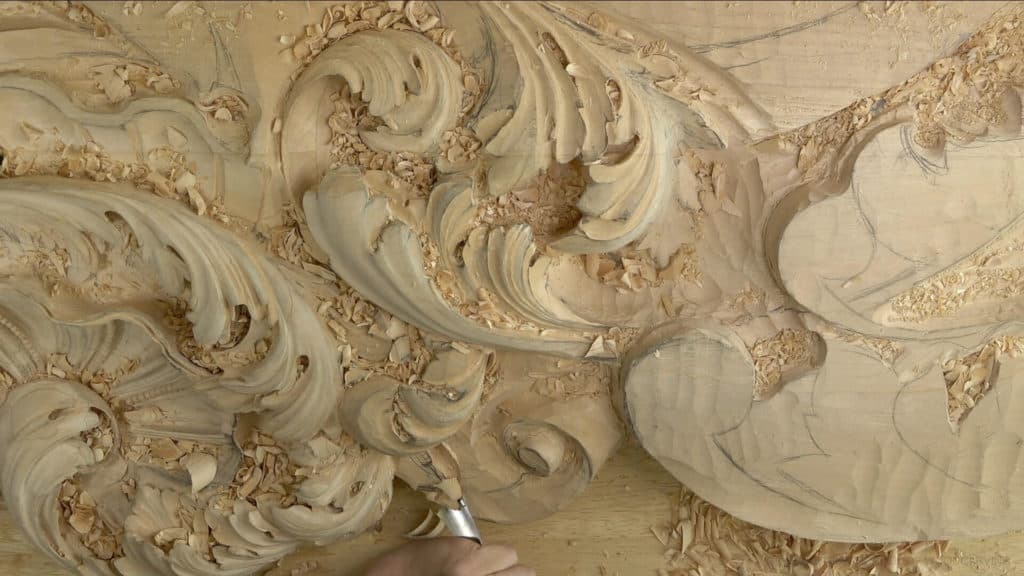
Alexander Grabovetskiy, woodcarver, School of Woodcarving · Published 2020
Why does a wood carver think out loud while he carves?
Quick answer: Saying a carving choice aloud is how I think it through before I make it. On my Venice Room panel I weighed one more acanthus movement, called it excessive, went back to the original plan, and then came back to it with a reason.
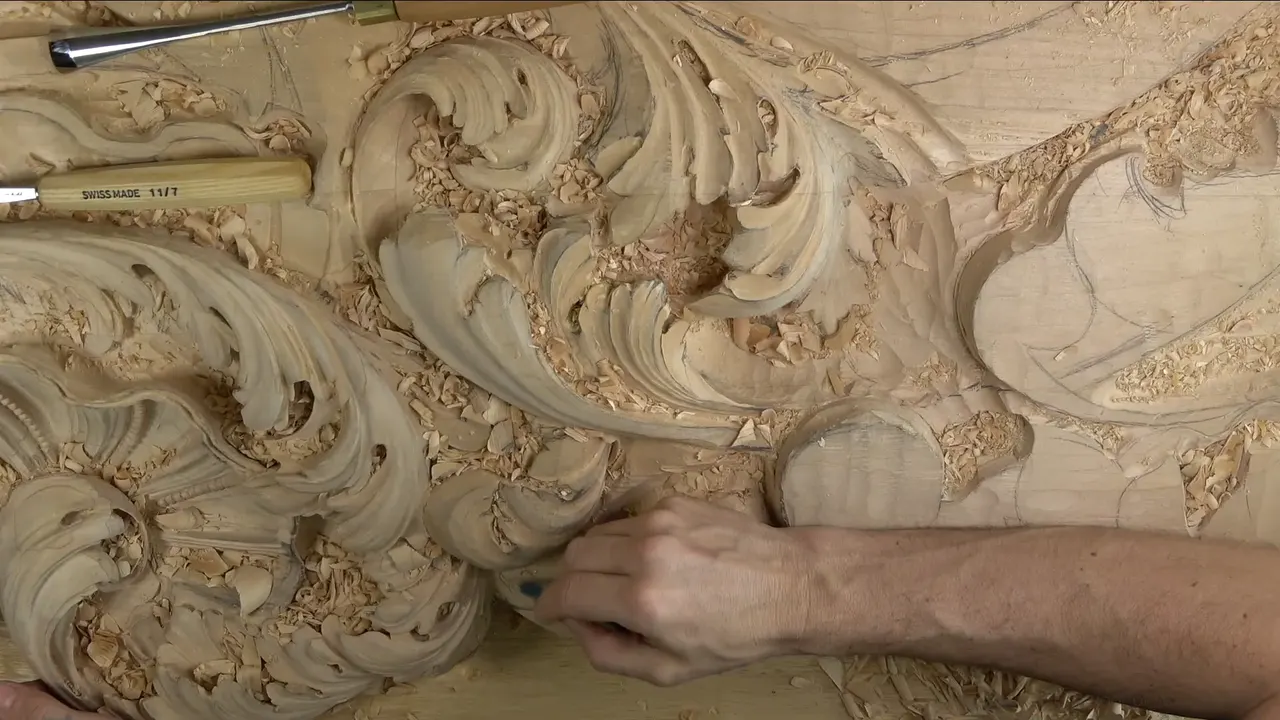
Talking a choice through is me saying a carving decision aloud before I make it, with a gouge still in my hand and the answer not settled. I did it near the end of workshop 31, part 11, on the ceiling panel I carved for the Venice Room. Moments before, I had argued with myself about one more acanthus movement, and I told the camera, "And yes, I am thinking out loud right now, at least."

Have you ever watched a wood carving video where the shape changes and nobody says why? I'm going to be honest with you. I talk my doubts through on camera, and in several videos I said sorry for it. This page follows that habit through my Venice Room course and my Lily Box course, so you can hear what the doubts sound like and what came after each one.
What did I say out loud on the ceiling panel?
The part runs a little over seven minutes by its captions, and it opens on a bump. I told you we should keep the bump, because like I said, I would use it. For now I was only creating the main movement. Next I began to excavate the area, and I said I would attack its side right away.
An idea and a doubt arrived together. An acanthus there had a division going downhill, one you can't see, and I thought I could get another movement of the same acanthus that would repeat the other part. That way I could nicely undercut underneath. "I'm not sure I should or not," I said. Soon after, I fixed my own word: not an acanthus, but the division of this one. A few seconds on came "Maybe it's going to be too much," and I let the idea go for the moment. "Let me just do original."
The original plan had almost no excavation at first, then a really deep one. I also had a question about filling the area, because I did not have too much material and still needed something right there. My answer was to excavate first and decide after.

The plan turned back toward the doubt. "Maybe it is a good idea to create some kind of acanthus movement," I said, and with it I could skip the low undercut. It would run just underneath of the acanthus. "I hope it makes sense. And that's exactly what I'm going to do." The reason came a minute later. Without that movement the end had to die almost from underneath, and there was no connecting point.
Then the depth. I could go pretty much down to the bottom, and I would stop short of it, I said. Another separation would sit on the inside where you can't see it, and I said it would bring a really nice transition. I picked a number seven, because the spot had to have a concave, and I began to approach my future acanthus with care.
Do I voice it when one more division tempts me?
An extra division was the need in workshop 27, part 3, and I said sorry for talking it through, "how it's going to look." I also had to decide where a point would sit, and one side obviously needed to be kind of higher than the other.

An eye needed to move in workshop 29, part 2. Different points of view were my check, and then a skew refined the movement a little, so I could see if I was going in the right direction.

The same turn shows from the other side in workshop 32, part 10. A movement needed to be maybe widened, and I could divide it a little more for a richer look. I liked one division, so I planned to outline underneath it. Next I wondered about a fifth division, a small, really small one, only for a more detailed look. If I did not like it, I said, I could chop it out.

The reverse sits in workshop 35, part 6. Maybe I had too many separations in one spot, I said, and I could only undo that by lowering the area even more and getting rid of one. Sorry again for talking it through, since it was a good problem to be solved. I loved those separations, but too many of them were "no bueno." One single part was the plan.

The twelfth part of workshop 36 starts with "Maybe I shouldn't," and then one form goes above another. Extra separations could come later. For now I made the first pass around it, and I told you I was thinking about what would look the best. The piece also looked too flat to me, and I wanted more dimension in it.

Another came in workshop 44, part 11. I needed a secondary division if I wanted to subdivide a piece that way, and I was unsure about it. At least those subdivisions had to be done, I said. One of them "must," and I could get by without the others.

Seven of these doubts sit in the table below, with what I did next, and the last column is my own wording from the video.
| Where it happened | What I doubted at the time | Outcome | Words I used |
|---|---|---|---|
| Venice Room 31.11 | Adding another movement to the same acanthus | Went back | Not sure I should or not |
| Lesson 35.6 video | Several separations crowded into a single spot | Planned one | I love them but too many |
| Workshop 41.1 clip | Whether to include one part at all | Maybe marker | Or let me work on paper |
| Part 44.11 video | Whether to add a secondary division here | Needed one | Others I could get by without |
| Lesson 58.7 clip | How far down to take the movement | Considered deeper | Hope it makes sense, not confusing |
| Workshop 60.1 video | Stop the movement short for a shadow | Went further | I probably should take this one |
| Lily Box 3.6 | Whether I had one too many there | Removed waste | I don't want to make mistakes |
Do I talk before I draw on the wood?
Sometimes the doubt is whether a part belongs at all. I asked it in part 1 of workshop 41, "Could I, or I could not include this part?" and then said maybe I could. I knew I was talking, but you would understand why. I believed I could do a really nice detail, and I might need a marker, a pencil, or a sheet of paper to work it out.

The marking itself shows in workshop 48, part 6. Slightly different, not differently, would be better, I said. To tie everything together, I planned to end that movement somewhere right there, and then it would continue. And then there is a middle line, I said.

How far down do I plan to go?
Depth gets the same talk. The challenge in part 7 of workshop 58 was digging far down right there. Yet I could, because it would repeat the other side with a really good movement, and deeper was possible. I hoped it made sense and that I was not confusing anybody.

Two reasons sat on the table in workshop 60, part 1. Taking a movement all the way up to a point would make it easier to excavate and create the details. Stopping it a bit short would give me a really good shadow, and maybe a little more on one side. "So let me think," I said. It was a piece that would be visible, and for me it was really important not to mess up at that stage.

I planned to take it to that point and said the piece would look really good with the divisions. I added, "At least you know my process of why I'm doing what I'm doing."
Later in that part I told you the choice looked easy but was a really hard one. How to make the transition to the ceiling was the decision, and it is seen from below, from above, from straight on and from another point of view. It still had to look good, and I called that a little challenging. A little bit, I said, not much.
Why do I say sorry when I talk it through?
It slows the lesson, and I know it. My apology sits in part 4 of workshop 41, for talking a little slower in development mode. Just thinking out loud, I told you. I explained that nobody is in my shop while I'm working, and the only people hearing me are you, on a camera. "Sometimes that's maybe annoying," I said, and I asked you to be patient. "You see the creation process."

The talk paid off there. Because I had taken this part down, I had a chance to create even more three-dimensional movement, and that solved my problem of too many empty spots. Keeping one part mattered to me, and I wanted to make sure I was not taking what I "don't have to take."
The Lily Box lessons say sorry too. The first layer, part 6, has me telling you I was just thinking, and I did not want to make mistakes. I removed some waste first. Next came a mallet, since that way I could control the work better. Earlier in the same video I said I was not sure, and that I might have one too many right there.

In part 5 of the second layer I said, "I do apologize when I'm mumbling." What came next is the line I most want you to hear. "That is the process," I said, "that is actually the goal of school." I was not going to give you just the lessons, since the school works like having you beside me in my shop, working together.
Why do I compare it to an apprentice in a shop?
I put you in a place where wood carvers worked, a guild or something, in the seventeenth, eighteenth or nineteenth century. There, apprentices would watch what the master does. Believe me, I said, watching someone work gives you a "much better idea how it's done."
That is apprenticeship, and what I said it gives you is a much better idea how a piece is built. A video does not put a stool next to mine, but it carries my doubts in the order they came.
A similar line sat in workshop 60, part 1. My goal, I said, was not to scare you but to show you that something is possible, even when it is scary sometimes. Researchers use the name think-aloud for talking through a task. I only called it my process.
Which tools do I name while I talk?
The gouge follows the choice. A number seven did the concave in workshop 31. Number one came first in part 12 of workshop 36, then a number two on the other side, and I wondered if I should skip the number 11 if I could. More movement was my aim, even in a small detail. Small depends on how you look at it, I said, and this one was small in the overall design.
A skew came out in workshop 29, so I could refine a movement. A number 11 at half a millimeter came out in the Lily Box second layer, part 5, then a number eight at an eighth of an inch (about 3 mm), because I wanted a better defined concave close to my volute. I even said I might need the magnifier lamp again, because I really wanted to see what I was doing.
How can you tell a planned move from a doubt?
Listen to what comes next. My doubt in workshop 31, about a repeat of the acanthus, ended in "let me just do original," and later the first idea came back with a new reason. Over in workshop 35 it ended in a lowered area and one separation fewer. The one in workshop 58 ended in "I could actually get deeper." Same words, three endings.
Watch for sentences that start with maybe or with let me think. Those mark a choice that is still open. A line where I say that is exactly what I will do, as in workshops 31 and 60, marks a choice I had closed.
Where can you watch these videos?
The spine of this page is workshop 31, with its part 11. The rest sit in the Venice Room lessons for 27, 29, 32, 35, 36, 41, 44, 48, 58 and 60, plus the two Lily Box videos I named. Pick one doubt you hear me voice and watch what follows it.
Next time you stand over your own relief carving, say your doubt to the empty room before you touch it with a tool. Then tell me what you decided.
How it's done
- State the idea. Another movement of the same acanthus could echo the first part and allow an undercut underneath.
- Name the worry. I was unsure and feared the idea was excess.
- Retreat to the plan. Back to the original plan, with excavation first to learn what I needed.
- Return with a reason. The movement came back because a low undercut could be skipped and the end got a connecting point.
- Pick the tool. Number seven for the concave, then a careful approach to the new acanthus.
Frequently asked questions
How did I describe what school is for in my Lily Box videos?
In part 5 of the second layer I tied my mumbling to the process. A student gets more than lessons, as if working beside me in my shop, and I said watching someone work shows how a piece is built.
How did my second acanthus idea end on the Venice Room panel?
First I judged it excessive and returned to the original plan. Later the idea won, because a low undercut could be skipped and the end got a connecting point.
Why did I apologize for my slower talking?
My apology sits in part 4 of workshop 41. Nobody is in my shop while I work, I said, and the only listeners are you, through a camera.
What to carve next