
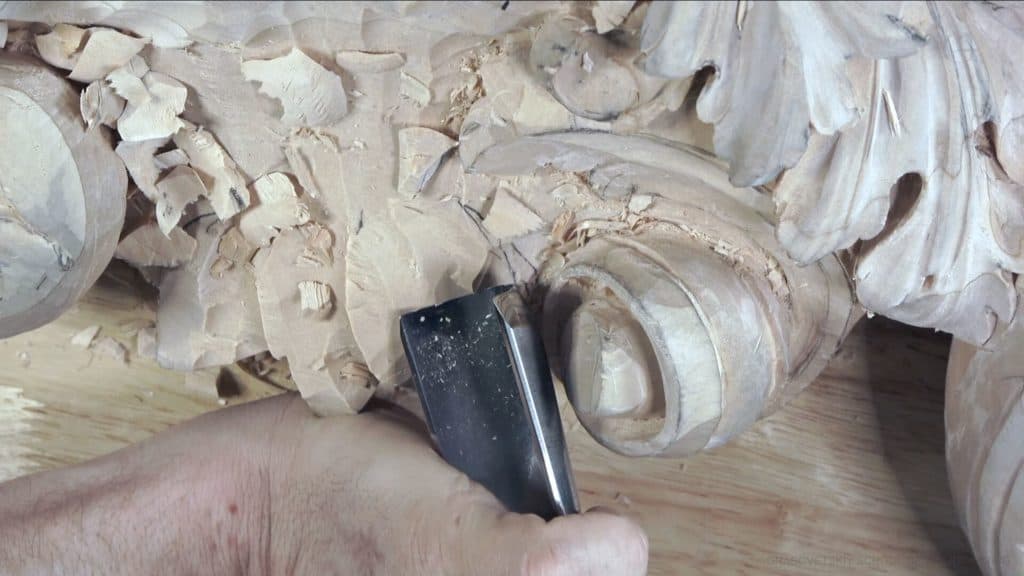
Alexander Grabovetskiy, woodcarver, School of Woodcarving · Published 2020
What does it mean when a wood carver says "at least" about a carving step?
Quick answer: At least is how I name the bit of a job I can do now, or the least I need, while the rest waits. Venice Room 47.5 has it after a clean-up still to do. Elsewhere it marks a floor of three millimeters, a first stroke, or what I think looks good.
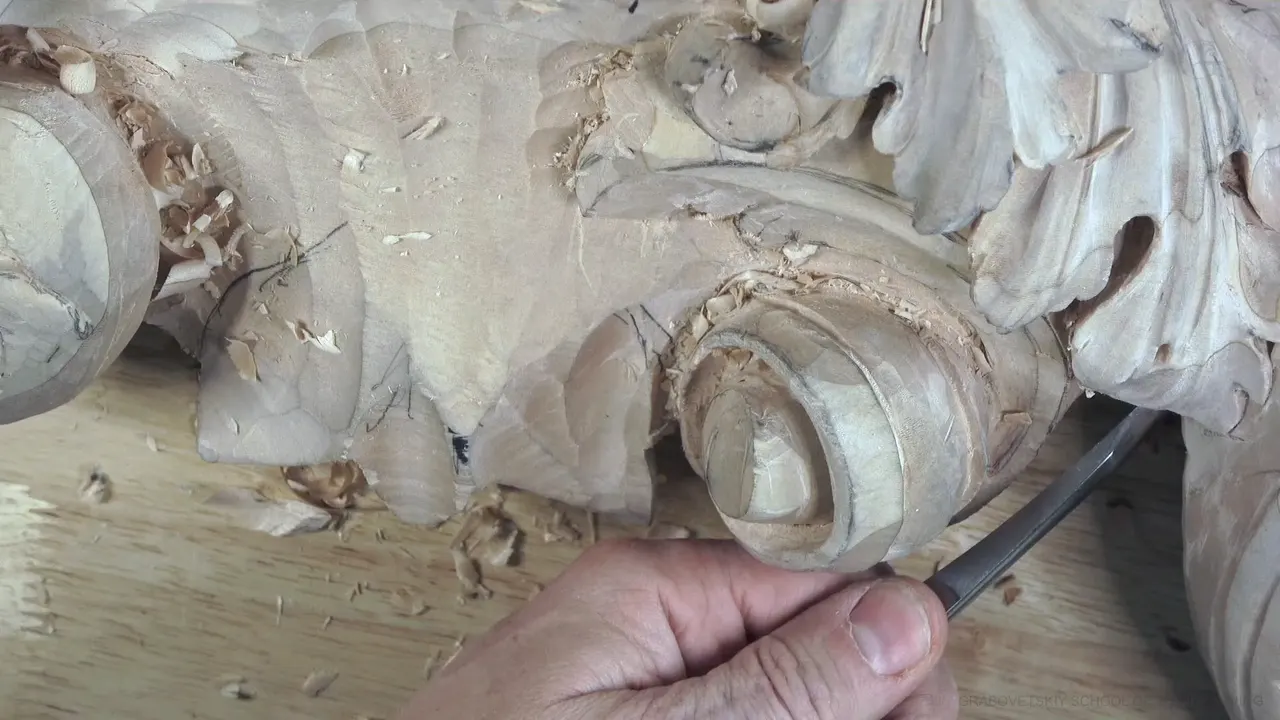
Saying "at least" is how I name the bit of a job I can do now, or the least I need, while the rest of the step waits. Part 5 of workshop 47 has it twice, and my other courses use the same two words in a few different ways.
Ever looked at a rough spot and still known what the next pass had to be? Did you stop, or did you start small? Two short words of mine cover that choice, and I'll follow them through my carving lessons to see what each one asked of my hands.

What does at least mean in this video?
The video runs close to seven minutes. It starts with me thinking out loud: "All I have to do pretty much right now is, let me think." Soon I name the next job, to excavate this section. "Again, I know you don't see it, but that movement is a really nice movement." My reason came in the same breath: "just to tie everything together."
"Let me cut this way, too," I said next. A thin pass followed: "I could shave this side of here." Around 1:22 I said, "So now everything is just tied together," and I called that a beautiful transition. Number three came next ("Get number three") and, at 2:16, "create even more shadow."

Then came a short burst of delight. Four times I said "I love it," and right after it: "Okay, I've got really nice movement."
The next breath was a confession, and I made it plain. "Yes, I still have to clean it and so on, but it's okay. Cleaning is a part of a job. But at least I've got something." The wood was not clean, and I still counted what I held.

Seconds later the words came back in a smaller job. "While I'm here, I can probably just give some development of these leaves." Then a limit: "I don't want to develop too much because I really don't need that. It's going to be hidden anyway. But at least I could get this one underneath of that one."
Same two words, different weight. The first time they marked something in hand. This time they marked how little I wanted to do on a leaf that would be hidden.
The line after that was "Let me get some idea." Then: "I like the movement upward of this one, so I can get this one underneath." At 3:54: "This could go like that, and that could go also underneath."
I knew how it sounded. "I know it's kind of repeating itself, but I think it's going to make sense." At 4:39 I said, "Yes, it doesn't look too good yet, but it will." A change of mind came a little over a minute later, only seconds after I named the tool, so here it is.

"Okay, going to take number seven now. Well, actually, I don't have to do number seven. I can just probably take number three and give some movements to the leaves. They don't have to look like flat pieces." So my plan was a number three instead.
Two small plans closed the part: "this one, I could just move a little bit that direction. And this one that direction." The last line is plain: "I'm going to leave it for now like this."
That is the whole use in this video. A clean surface was not there yet, and I counted what I held. Workshop 47 has twelve parts, and this is the fifth.

Can it mean a first small step?
It can open a job I cannot finish yet. In Lily Box lesson 5, part 1, a spot got the word rough, "as of now." My words were that I at least had an idea what to do right now. A lower level came next, an eighth of an inch (3 mm) of our main surface, and I said the process would be the same. Then: "Brush this out."
The 5.3 video does it with an undercut. I planned to start inside with probably a number 11 at one millimeter (about 0.04 in) and said, "I can always do that later," and then, "at least I can give the details in this section." It is a low relief, no more than an eighth of an inch (3 mm) by my own count, and actually less, about 3/32 of an inch (2.4 mm).

In 5.10 a line was waiting for its neighbor. I had not made it yet, "because we did not develop this area before." Step one, I said, could be a number 11 at 3 mm (0.12 in) at first, and the small gain was a start on that ridge. "Create that relief. And needs to be even more."
Video 5.12 starts a concave. My number seven of a quarter inch (6 mm) was "a little too small," and I wanted it more defined. So I told you, "at least let me start." A number seven concave at this end could probably do it, ending in a nicer one, like with a number eight or even a number nine. "Let me check if I can do that or not."

The Venice Room does the same. In workshop 143, part 3, I said I was somewhat happy: "It's not clean yet, but I am happy." The smaller spoon of two millimeters (5/64 in) would take care of the inside. "I don't need to go all the way yet to this part," and "at least just indicate my movement." A couple of relief cuts in a couple of spots came right away.

In workshop 137, part 2, a number 11 of 2 mm (about 0.08 in) could "somewhat undercut" right away. Deeper had to wait, because convexes and concaves were still to come. My two words went in front of the boundary it would give me. I wanted the shape to feel like it was laying right on top of the main body of the work.
Acanthus over Moldings, lesson 9, part 1, has a tool already in my hand, and I told you I could undercut some of the movements right away. "I don't know if it's a wise idea or not." Then: "at least you know, I can just start initial undercutting." Not too deep, I said: about a millimeter or so (1/25 in), "maybe millimeter and a half" (about 0.06 in).

Does it set a floor?
Here the words name a floor, and they sit between two numbers. Part 1 of Venice Room 143 has me say, "I have to leave approximately three millimeters in this space because I need to undercut." Otherwise it would not look as nice. I could go even lower than three millimeters, I said, "at least three millimeters. That is what I need."
That line has a number and a hedge together. Three millimeters is about 0.12 in. Later the same part had me say a pass had to go in, because under that line it had to be "a lot deeper shadow." Earlier in that part I had said my problem is not visualization: "I've got too many ideas."

A softer floor shows up with a time stamp on it. With a quarter-inch number six (6 mm) as my tool in Lily Box 5.8, I warned myself: "don't go too low with this one. Not yet at least." My job there was to separate an upper leaf from the lower movement. Going too low could be fixed, since I could always rework the area and take it lower. Keeping it, "as of now, that height," was the plan.
The same wording shows up in workshop 133, part 3, after a plan for the undercutting: about 2 mm (5/64 in), and in some spots 1 mm (about 0.04 in). I would leave it like it is, "for now at least," and a shell and the clean-up were still ahead.

Whose eyes made the call?
Several times the phrase tells you whose view it is. With the paper off one area in Lily Box 2.8, I said, "So far it looks good," and "at least it looks good to me." Then: "Actually, let me keep that, and I'll remove just the one section of the paper." Later I planned a number five at 10 mm (about 3/8 in) along the ridge.
A blend is where Lily Box 7.4 has it. I planned the flatter gouge to blend, then called it good: "I think that's good." Behind it came "at least," then the same view again. Next: "I could actually get a better concave right here. More defined." On my list was a number eight at 1/8 in (3 mm).

The phrase works for a hope too. A couple of millimeters were left in Lily Box 10.10, and I did not want to take more, because I still had to create the detail inside. It should still "look like a real flower," I said, and the words came again: "at least that's my intention, to make it look like a real flower."
After a first stage, workshop 113, part 3, has it. "We started the process. I think it looks good," I said, and I asked what you think. My next words were "at least it's already looking like something." Then came a 10 mm (about 3/8 in) number 11, to outline around the flower, which was "not a really complicated flower."

Is it for the viewer?
Some of these lines are for the camera. Venice Room 125 has me describe, in part 1, a curling from inside out, and I said, "You don't see that." I offered to rearrange the cameras. "At least you're going to get some idea what I'm doing. Maybe I can actually raise it a little bit just to show that to you. Or not."
After that came two separations, with the main end of the acanthus rolling from underneath, and a 30 mm number 11 (about 1 3/16 in) to outline the main ones first. Part 2 of the same workshop uses the phrase for a view of the whole piece: "I think it's a good area to start," and "at least I'm going to be able to see overall picture." I guessed I could use my clamp again, and then the piece was solid.

A viewer line can promise something that is still coming. Part 2 of workshop 142 had a marriage line to blend in. I would take care of the area a little later, I said, and "at least you know" a concave would be there.
A weak spot came next, and I owned it: "I need to create better cut against the grain, but it's okay." After that I planned to go about one millimeter deeper on the edge (1/25 in) a little later, and to undercut then too, "but that's later."

How do I talk when something breaks?
A small rescue shows up in Lily Box 12.5. "I pushed too hard and I guess inside there was some crack." Next came the stock-taking: "I'm safe because just that leg broke. That's it. But I'm okay," and "at least I've done the main shape."
I told you I could throw that leg away and work with my hands. "Maybe it's actually a good thing what happened. That way I can show you when you work with just the fingers." A warning came with it: "you got to be really careful when you do it that way." Soon after I called it sometimes "wiser" to do smaller details once a piece is glued in place, and a glued piece is "a lot more solid."

Over in workshop 144, part 3, a limit turns into a good thing. A hole did not need to go to the extreme, I said, since the piece would be painted. Some paint and dust would get in, so it would not be too visible. Using the two words, I said a really deep shadow was possible, and I attacked it from both sides. "It's a really dark spot. I like it."
My next plan there was maybe a detailing tool, a number 5 of 6 mm (about 1/4 in), to clean the edges and "make it look more appealing." The deep shadow came first.

What did the two words hold, video by video?
| Where | What the two words held | The small detail next to it |
|---|---|---|
| Venice 47.5 | A movement in hand, clean-up still ahead | Hidden leaves |
| Lily 5.1 | An idea what to do right now | Lowered surface |
| Workshop 143.1 | The least I needed was three millimeters | Undercut space |
| Lily lesson 7.4 | My own view of a good blend | Number eight |
| Room 125.1 | A view of what I was doing | Camera offer |
| Box lesson 12.5 | A main shape done after the break | My hands |
| Panel 144.3 | A really deep shadow in a hole | Painted later |
Each row is one video of mine. The third column is a small detail from the same moment.
A ridge, a relief layer, a deep shadow, a curl: the pattern is the same. I name what I hold, then keep working.
Where does the phrase fit in your own work?
Look at your piece right now. Is there a spot that is rough, but where you know the next stroke? Could you carve one small step and call that something real? If so, you are already doing what I did in 47.5.
The course this page belongs to is Venice Room, workshops 38 to 49, twelve workshops of acanthus carving, and workshop 46 comes right before it. Part 5 of workshop 47 is a short one, with the two uses at 2:43 and 3:00. Access opens every part, and I tell you the truth about what each one shows.

How it's done
- Say what you hold. My 47.5 video had a movement I loved, though the carving was not clean yet. The movement was my something.
- Start the step you can. A number seven was a little too small in 5.12. I said let me start, and I planned to check a bigger sweep next.
- Keep a floor. About three millimeters (0.118 in) was the undercut space I needed in 143.1, and I allowed going lower.
- Hold back where it hides. I wanted only a small amount of development on leaves that would be hidden anyway.
- Say it is your view. Looks good, I said in 2.8, and then I added that it looks good to me.
Frequently asked questions
Does at least mean the work is done?
No. In 47.5 I said I still had to clean it and so on, and then I said I had something. Cleaning is a part of a job, I told you. Those words named what I had while that work was still ahead.
How much is at least three millimeters?
The first part of workshop 143 had me leave approximately three millimeters (about 1/8 in) of space to undercut. Even lower than three millimeters was possible, I said, but three was what I needed. Otherwise, I said, it would not look as nice.
Is at least only my opinion?
Sometimes. Lily Box 7.4 had me say I think that's good, then repeat it with the two words in front. In 2.8 I said the area looks good, then pinned it to my own eyes. I went on to the next tool or spot both times.
What to carve next