
Alexander Grabovetskiy, woodcarver, School of Woodcarving · Published 2020
Why does a wood carver stop and correct his own words mid-lesson?
Quick answer: "I should say" is what I said at 03:40 of workshop 47, part 8, while I talked about the opposite direction, and I added "But I don't need." I say it in my Lily Box, Roman Acanthus, Furniture Panel and molding lessons too.
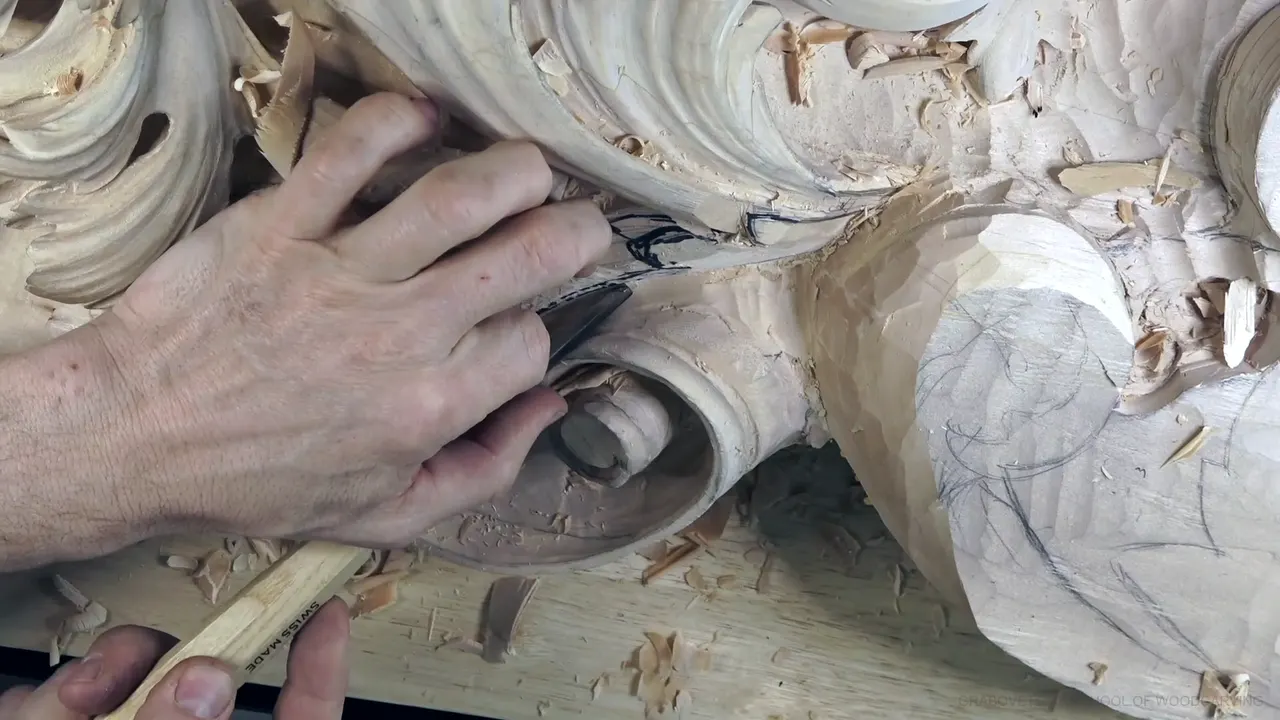

"I should say" is what I said in workshop 47, part 8, at 03:40, right after "attack pretty much with the opposite direction," when I swapped a word and kept going. Many of my videos carry those words. This page follows them through the workshop and several other courses of mine.
Ever said one word at your bench, heard it was the wrong one, and swapped it in the next breath? This part is short, so the page borrows from my other carving lessons and says where each passage comes from.
What happened in part 8 of workshop 47?
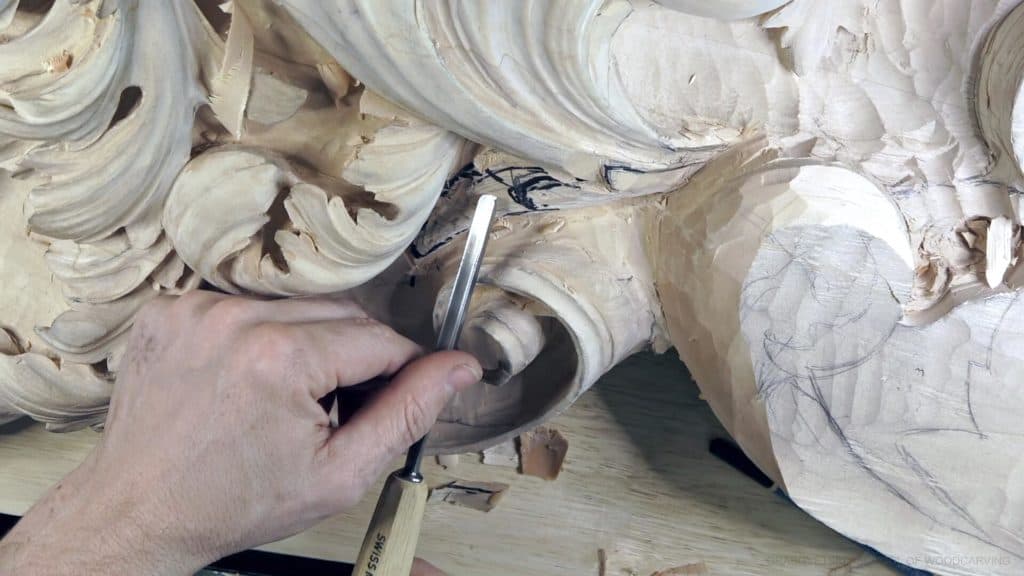
The first words come at 00:33, in the middle of a job: "And a bit smaller, because I need to start undercutting underneath right here." A smaller number 11 is what I need, and I'm using 4 millimeters (0.16 in).
Size comes next, and I correct it out loud. First: "Little bigger than 3/16 of an inch." Then: "I'm sorry, a little bigger than 1/8 of an inch" (3.2 mm). It's settled at 00:59: "It's not quite 3/16. Approximately 3/16 of an inch" (4.8 mm).

Where I stand shows at 01:13: "I have a challenging area because this part is also somewhat on my way." Attacking it is not easy, I say, and I really need to undercut. It will be the deepest undercut right here "because I need to rotate. Not rotate, but again, round that."
An apology follows at 01:38. "Apologize for my miscommunication, I do not want to confuse nobody." After that I change tools to a back bend, "and it's going to be 10 millimeters" (0.39 in), "Number five."
Back to the area at 02:23: "A little challenging area, like I said, because I do have that part on my way. It's not impossible area, but it's not the easiest also." By 02:42 "it looks like it is moving downhill."

How far to go? "I really don't need to do extreme," I say, and my plan is "maybe a little deeper inside."
The hands get busy at 03:16. The corner of my tool goes in. "Not the easiest way, but I can get really deep. See how deep I go in?" My word for the result is "Beautiful."
Right after it comes the line that names this page: "And now it would be much easier for me to attack pretty much with the opposite direction, from the opposite direction, I should say, and remove it. But I don't need." At 04:00 I say, "Hook this out, just like that."

Cleaning is next. "I could probably clean that with number 11, and I will," I say at 04:13. A small number 11 follows, and you can at least see the depth I just reached. My plan at 04:32 is a 2 mm (0.08 in) number 11, and I say maybe I should use a spoon.
The spoon wins: "And yes, spoon would help me a little more." A 2 mm one goes in first, and at 05:13 I call it "a little too big." My next plan is 1 mm (0.04 in), "and hook out all that mess."

Depth comes up again at 05:36. "And by now, there is no limit how deep I want to go. I don't really need to." Chips are next, and I fix my wording on the way: "Let me blow a little bit. Not blow it. With the fan. Get rid of some of the chips."

A movement is at stake at 06:10, and I say this movement has to go in this point. I want to follow the overall movement. One spot bothers me at 06:43: "Too pointy, but it's okay."
The last plan is an outline: "Let me outline this side preliminary." Too much of it isn't something I have to do, I say, because later on I'll have a lot more chance, once I remove it and create a concave on the inside.
Where else in workshop 47 did I say it?
Divisions come up in part 1, and at 00:41 I say "More divisions, I should say, like that." At 06:33 a shape I just made is "a really nice element." My fix comes at 06:39: "I mean, nice development. That's what I should say."
Undercutting waits in part 2: "I'm going to undercut deep later on, or deeper, I should say."
Over in part 7 I need that chunk on the side, and at 03:42 I add "Otherwise, it's not going to look as nice, I should say."

A result to aim at comes in part 9: "little by little, we'll achieve the result I'm after." Then the swap: "I should say, I will achieve the result I'm after." The "we" is gone.
Part 10 has me thinking I could go even lower and make one of the divisions higher than the ridge. "That's going to look actually really good," I say at 05:59, and at 06:08 comes "It should look good, I should say."
The number one double bevel shows up in part 12 at 02:33, when I'm slightly attacking one side. I name it for "some of the mess right there, I should say." Later I need to go underneath and use "a small, I should say smaller tool." Next: "Let me think which one I should use. Maybe number three."
Which word did I swap for "problematic"?
Challenging, in workshop 37, part 8. I'm using a number 11, 10 mm (0.39 in), at 04:41, and I plan to excavate underneath. Then, at 05:00, I realize that this "could potentially create a problematic area for myself, or I should say challenging area for myself."
We like solving challenges, I add, and one side needs me to attack from the opposite side too. That's the same word as in part 8 of workshop 47, and workshop 37 has the whole passage.
Which words changed in the Lily Box?
The Lily Box course has plenty. In Lily Box 2.1, at 03:53, glue is on my mind, and I put it this way: "I should say, I don't want to glue my paper." Spraying right on top of the wood is out too, and my plan is just masking tape.

Tape color needs a swap. "If you're in United States, there is a white one," and a swap follows: "I should say it's a yellowish color masking tape. But I really like that green one." The tape's purpose, I say at 05:54, is to keep my surface clean, "or my wood clean, I should say."
Style gets one at 26:20. "This type is actually a really good type of carving," I say, and then I fix it: "I should say it's not the type, but style of carving." You can embellish your furniture with it.
Thorns show up at 31:48, and I say "So those thorn bush." Then: "Or thorn bushes, I should say. They looked really nice." A second fix comes at 32:12: "Not the bushes, but thorns. I'm sorry. So we're going to make those thorns nice."

Tools get the same treatment at 39:36: "I'm going to use the same tool for outlining. Or same tools, I should say. Three millimeters and one millimeter, number 11 veiners" (0.12 in and 0.04 in). Right now, I say, I actually need the one millimeter. Another swap comes at 57:07, "Another spike, or thorn, I should say," and a smaller number 11 is a good idea there.
What came out different in the Roman Acanthus lesson?
A pencil mark comes up in Roman Acanthus 16.5 at 12:27. I left it "for the video sake, for the lesson sake," and usually I try not to use a pencil at the end, because it does create a lot of mess. To clean it I'd reach for a flatter gouge: "more flatter gouge, or I should say less sweep." In this case it's a number 4 at 10 mm (about 3/8 in).

A movement gets its swap at 37:36. I say it is going like that, and "I should say" leads into "it starts from this point and going inside and going inward and going even more inward."
My plan at 45:18 is a number 5, 1/4 inch (6.4 mm), upside down, to fix the pipes, and I need to buff it too. On pressure I say "I almost don't create any pressure, I should say," then "I create a really light pressure." The paper towel comes next, and "it looks beautiful."

Fingers matter at 52:28. "Please see how close to the blade my fingers are," I say, with my pinky referencing right on the board itself. "It just creates the point, or limiter, I should say." It limits my movements, so I don't take off too much.

One more comes at 01:04:13, after an extra ridge: "Not the ridge, but chamfer, and that should catch the light. Should be lighter point, I should say. Should look little different from my shadow, there's my shadow point, there's my light point."
What about the Lily Box, part 3.7?
In Lily Box 3.7 I say at 01:26 that I'll take probably number seven, a quarter inch (6.4 mm). Straight down, I say, "it's not really straight down, almost straight down, okay, I should say. I'm still giving some angle."
Refining an edge a little bit comes up at 04:20, and the words are: "Refine movement, I should say, okay? Because I don't like how it looks so far." Then, at 06:59, tiny chips from underneath are on my fingers: "Underneath of my design, I should say."
Did the Furniture Panel have one too?
In Furniture Panel 20.2 I plan something small right here at 03:35, then maybe just a slight blend, "or blending cut, I should say." Next, a knife comes for the sharp ridges.

Hand tools get talked about at 14:00. I use gouges a lot and knives a lot, I say, but sometimes you're tired of the same tool every day, and you want to challenge yourself with another tool and get to the same result. "Just more interesting that way, okay, I should say."
Up close at 19:34 I see what has to be gone, and I say I want to fix it. "And now it just creates a really nice flow. Nice movement, I should say."
Did the floral course do it as well?
Yes. In Floral and Molding for the Panel 2.3, at 00:30, I say a spoon number 11 would be two millimeters (about 5/64 in) again. Right away I fix that: "Not again, I actually didn't use that before." With the spoon I reach more tight spaces, where a straight tool sometimes can't go because "it's in the way," and I add "I mean, some stuff is in the way, I should say."
Grain gets one at 16:51. "I really have to attack that" is how I start, and I carry on with "opposite direction of the grain. Or with the grain, I should say."
Does the Moldings lesson have it as well?
In Acanthus over Moldings 7-3 I keep the overall movement at 03:27 and create movements inside. "And that gave me that. Life I should say it looks more alive."

Curls come up at 09:08: "I'm gonna have two curls, two curly ones, I should say, two curly movements." Force comes up too: "I'm not gonna force it. I mean I could."
A tool number gets fixed at 10:14. I'll use the same tool as before, number nine, and "I should say" opens the swap: "I don't know, number eight." I put it at eight and a half something like that, about five millimeters (0.2 in). Then: "But you can use number nine. It's gonna give you the same result, but this one is a fishtail."

Seven mm (0.28 in) is my guess for a number 11 at 19:53. On time I say, "I don't need to spend too much time," and next comes "I should say don't want to spend too much time."
Which words did I swap, side by side?
Here is what came first and what came second, in the words I used at that moment.
| Where | My first words in that moment | My next words |
|---|---|---|
| Venice Room 47.1 | I'm still going to have divisions | More divisions, I should say, like that |
| Roman Acanthus | I almost don't create any pressure | I create a really light pressure |
| Lily Box 3.7 | I actually have tiny, small chips on my fingers | Underneath of my design, I should say |
| Roman Acanthus | It just creates the point | Or limiter, I should say |
| Furniture Panel | And maybe just a slight blend | Or blending cut, I should say |
| Lily Box | So those thorn bush | Or thorn bushes, I should say, they looked really nice |
Where can you watch these passages?
This part belongs to Advanced Carving: Venice Room 47. The rest of the swaps are in the lessons I linked above. The Venice Room course for workshops 38 to 49 holds the full Venice room carving, and both it and my Roman course are acanthus work. The other passages come from my Lily Box course, my Roman Acanthus course, my Furniture Panel course and my Acanthus over Moldings course and my Floral and Molding course.
Every size on this page is the one I said in the video, with the other system next to it in parentheses. For all my lessons in one place, start here.
How it's done
- Start with the 4 mm tool. My first job was to start undercutting underneath, so I picked a 4 mm (about 5/32 in) number 11.
- Change to the back bend. For the deepest undercut I took a back bend, 10 mm (about 3/8 in), number five.
- Go in with the corner of the tool. I used just the corner of my tool, and I could get really deep.
- Clean with a spoon. A spoon came next, then a smaller one, to hook out all that mess.
- Use the fan on the chips. I used the fan to clear the chips.
Frequently asked questions
Which tool followed the number 11 in part 8?
A spoon. I said a spoon would help, and I named a smaller size as my next try for hooking out the mess.
Did I apologize for a word in the same part?
Yes. At 01:38 I apologized for my miscommunication and said I do not want to confuse nobody. A few lines earlier I had said I need to rotate, then fixed it to round that.
Which word replaced problematic in workshop 37, part 8?
Challenging. Right after it I said we like solving challenges, and that was while I planned to excavate underneath.
How did I fix the Lily Box thorns?
What to carve next