
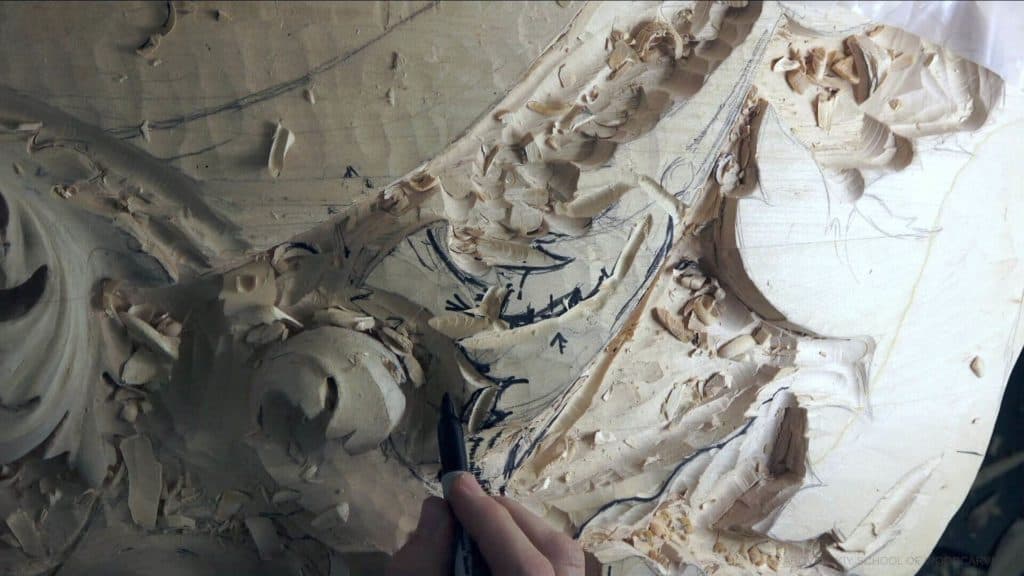
Alexander Grabovetskiy, woodcarver, School of Woodcarving · Published 2020
What does a wood carver mean by "simplified"?
Quick answer: In part 10 "A little simplified" came right after "Maybe I can actually just flip this part above that part." Before it I had talked about a deep channel that was not what I wanted. The same word is in my other lessons, from a 60/40 rule to a lily flower.
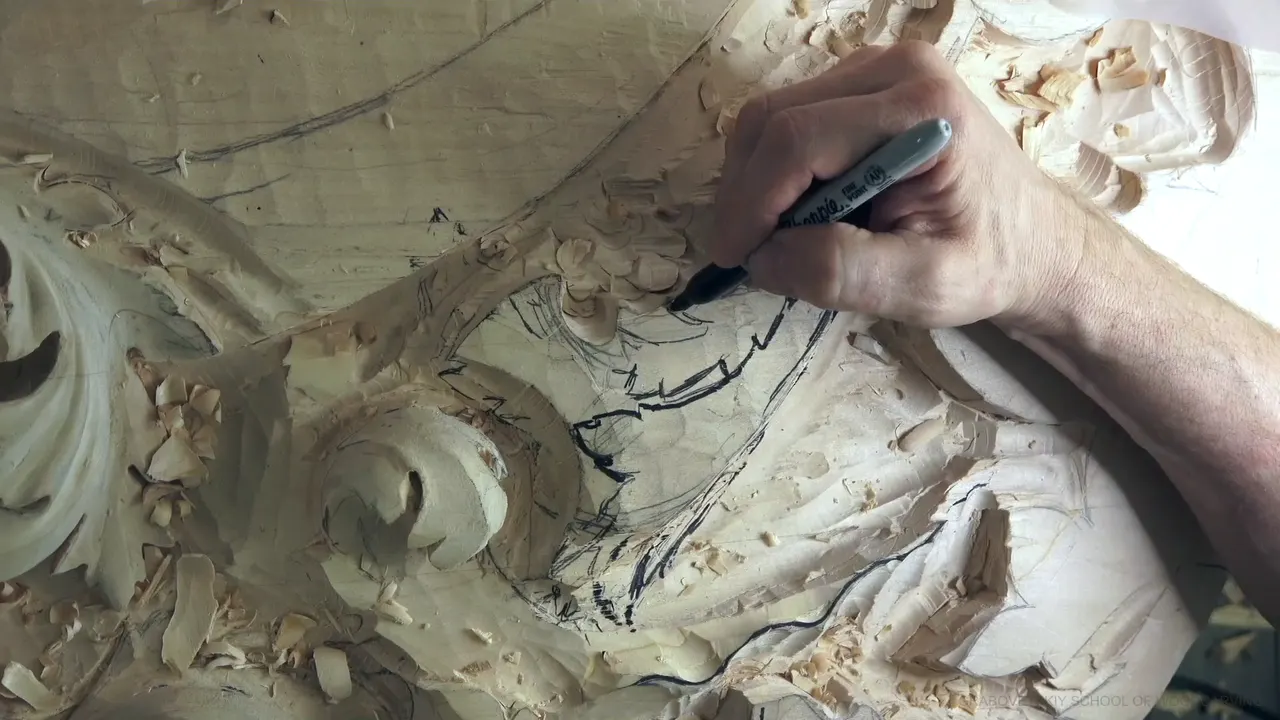

I said "A little simplified" in Venice Room 50, part 10, right after I said I did not want to excavate a deep channel and that maybe I could flip one part above another. My words were "Maybe I can actually just flip this part above that part and that is going to go underneath." The next line was "A little simplified. Okay?"
Is there a drawing in front of you with lines you cannot read yet? A spot where a deep channel looks like too much work? Both part 10 and my other lessons that use the same word are for you.
What was I planning when I said "a little simplified"?
Part 10 opens on a movement. An eye was coming. Then I said something would be rounded. Then: "it's impossible right now to do exactly the same, but still the idea is going to be pretty close." And: "we have to pay attention how it's going to develop because I still have to make sure it blends together in the overall design."
Next came what I called my "number one outline."

Then a plan about depth: "Let me also think about what is the best way to develop this movement because I really do not want to excavate a deep channel right here." The flip was a maybe, and an eye was coming. "I hope you can see that."
Light was a need: "By the way, I need to close my shades. Otherwise, it's not good." The color of the shot would "readjust in just a moment," I said.

How much space did I have?
"I don't have luxury of space. There is a ceiling already I'm hitting, so I can't use the tools the normal way." So I had to be careful how I used them. A plan followed: "I'll just go around first and maybe going to change a little bit the divisions, how they're dividing right here."
The mallet was next. "This mallet is a little too big. I'm talking about the head itself is just too big," and I was going to use a brass one.

A brass mallet "usually is used a little differently," I told you. "You usually place that right on your palm and knock like this." Then came "Sorry if you can't see that, but what I'm trying to explain is this way." And: "So that's how you use your brass mallet."

What did I say about lines that are hard to figure out?
Another outline followed. "It could get really confusing," I said, and I was talking about when you look at lines "and you don't know the final result, what you're after."
"It's not always possible for people if you did not design yourself, if you're trying to repeat somebody else's work. Sometimes it just gets so complicated, it's almost impossible to figure out what in the world he is trying to do right now."

My movement would turn underneath, with a big hole right there. The inside was to be excavated "really deeply." The path, in my words: "flipping like this, then go rotate, rotate, rotate, rotate, and open up like this." My question was "Make sense?"
"I know it doesn't make sense sometimes, but it's okay. You'll get it." A much deeper excavation was coming. Height was the other hand, and losing it was "almost impossible not to lose." My answer was "Somehow I still have to keep it, but we'll see."

"I really need to make a change right here." One spot would be "flipping" too, with an end "somewhere right here." On the inside, a continuation of movement was coming.
"I apologize for the confusion." Then "it's hard to explain" and, a breath later, "It is hard to explain sometimes, but you'll see. You will see." Near the end, a larger number 11 was my next need, and a detail would be lost and redrawn.

What came in part 11, right after?
The next video, part 11, begins with "maybe it's going to be more understandable if you're going to see in overall development how I'm developing it." A smaller marker was a maybe too. One part would go "inside, inward."
A ridge would get a little hit, and the movement beside it a little cleaning. "I'm using just the side of my number 11. Use that as a number three." Later, a need: "I have to lower down this section because that is going to flip above."

A rounded edge had its own words. "Not chamfer it, but fillet it," I said, and "it's still chamfer, but it's a rounded chamfer." There are "a lot of different ways" to do that. One tool got a name, and then I told you "You don't have to buy it, by the way. You could use just a normal skew just like that." In my words, that would give "exactly the same idea."

Marker talk followed. "Markers is not always the best idea because it's just messy. But on the other hand, it doesn't leave a dirt like pencil does." Next came "Your piece not becoming that dirty, so actually marker is much better, actually, than pencil."
I asked "Can you see the shape," and then "how it is shaping right now?" Of one direction I said "maybe, well, that is the wrong way. So it doesn't give me a really nice finish." After it came "So that gives me much better finish this way," and, later, "this part has to go underneath of this line."
Does "simplified" mean the same thing in every lesson?
It turns up in other lessons, and each time it points at something else, such as a number or a whole design.
Did I simplify the numbers too?
Furniture Panel 1, part 3, had a major and a minor Fibonacci number. Then: "to simplify that, if you divide the board in 10," you get "about six parts out of 10." And "to be exact, 0.62 of the 100."

The figures in Furniture Panel 5, part 1, were "approximately 62%" and "approximately 38%". For a short version: "you can always say 60/40 rule."
In Venice Room 41, part 12, the number went to an eye, and I called the golden ratio "1.62, or whatever you count". Then: "Or simplified ways, six parts out of 10."

Acanthus over Moldings 8, part 2, holds this line: "To simplify. That's a 62% versus 38%". The Tray of Blessing, lesson 8, has a focal point. "Where's gonna be the main focal point?" Then an example: "If it would be 10 units, let's say if it's 10 inches in the middle, it's gonna be five inches."
In metric, 10 in is 254 mm and 5 in is 127 mm. Then "Move it little bit, that's gonna become your six inches." Six inches is 152 mm, and I closed the thought with "Uh, just simplification." The lesson is Cabernet Sauvignon 8.

Venice Room 94, part 1, brought calipers: "if you do have calipers". The numbers were "62 percent out of one 100" and "38 percent out of one hundred", and then "or 60-40 rule to be more simplified version."
A pair of details is the case in Venice Room 72, part 5. "If this detail is a little smaller detail, so I have to make on opposite side a little bigger. Okay. To simplify the idea." Five inches was my example: "if it would be five inches across from this point to that point, of course it's not", and then "eight on this side."

In millimeters, 5 in is 127 mm and 8 in is 203 mm. Centimeters came next: one detail "two centimeters wide", the other "three centimeters wide", and that pair "would be a golden ratio". So 2 cm is 0.8 in and 3 cm is 1.2 in.
In Roman Acanthus 8, part 3, a gouge was marked 28, and I explained the marking: "an eight is a sweep, and a six is a six millimeters." Then came "Or a quarter inch, if you wish to simplify that." The figures are 6 mm and 6.35 mm.

Why did I undercut so deep, and how did I answer?
In Hashemi Flowers 7, part 1, I named "number seven. The big one, about one inch." About overdoing it I said "if I'm going to overdo it, that's okay too."
I put the question for you: "you would ask me why would I undercut extremely". From the top, "this is flat part, and right here it's no more than maybe 16th of an inch deep". In metric, 1/16 in is 1.6 mm. I added "I think I could actually go even more extreme right here."

"Well, easy answer. It's all about lights and the shadows, okay? That's the simplified version of my answer." Then "that is actually tiny detail, but really important, okay?"
Where did I simplify a whole design?
A customer was behind the piece in Hashemi Flowers 1, part 1: "he wanted to do something smaller." The size was "about 12 inches wide by 24 inches", or 12 by 24 in (305 by 610 mm). I called the new design a "little probably simplified version of this one." The board was "about 7/8 of an inch thick", which is 22 mm.

Egypt is in Roman Acanthus 1, part 3. "Probably more simplified forms of acanthus archaeologists found in Egypt also are semi-symmetrical, I would say."
Byzantine Acanthus 5, part 2, has me on low relief acanthus of the furniture kind, and its stripes. Then "Simplified version. What you see sometimes, you can see multiple stripes on the side."
"Byzantine didn't do that because, keep in mind, Byzantine acanthus leaf never left as a bare wood or finished wood or stained wood or whatever, shellacked wood. It was always gold leaf." Near the end of that part: "it was more simplified, except French."

The gold is in Venice Room 163, part 1. "It's really hard, if you understand, to get right on the side of the undercut if it's too deep. And they wanted to make it a simplified version to get the gold leaf underneath." Before the gold they used clay: "just normal earth red clay."
The phrase "right underneath" shows up in Venice Room 162, part 3. "My eye, the eye of acanthus, is right there." I wanted that part of my future separation, I said, "going upward, just uphill underneath." The result I wanted was "a lot less for me to undercut this area."

"That is just one of the techniques they used just because it looks beautiful and it actually simplifies the job of undercutting. And they did not worry about as much undercutting."
Maine class 1 of the Grinling Gibbons course has "some tulip going on". Then "we probably gonna simplify slightly later on. Just because of the limitation of the tools we have". In Maine class 3, part 2, I said "if you look at the picture", then "not necessarily to that degree. We'll see maybe gonna be simplified form."

Venice Room 98, part 2, shows "let me draw just one section". Waves came next, and then "that is a simplified form what I'm working on right now". My next words were "let me concentrate just on one of the sections".

How far can you simplify a carving?
I was on "this small, tiny thorn on the inside" in Lily Box 2, part 12. "If you feel like it's too much details for you, and you feel it's too hard for you to do, like I'm doing right now, the small thorn, it's almost impossible to see." Then "Feel free, just remove it."

"Although it would be nice if you can just follow along and do those details. But if you feel it's too much for you, that's okay to simplify it. Simplify the form. But don't simplify too much. Otherwise, it's not going to look as nice."
In Lily Box 10, part 2, I said "Of course, I could simplify this flower, but not with this project, okay? I really don't want to simplify it. I want to make it beautiful, okay? As beautiful as possible."

Which lesson holds which line?
Here is the whole run in one small table.
| What I called simplified | Lesson and part |
|---|---|
| A part I might flip above another part, with an eye still to come | Said in Venice Room 50, part 10, where this page began |
| A board divided in 10 | Furniture Panel 1.3 |
| Sixty-two percent against 38 percent, then a short version | Given in Furniture Panel 5.1 |
| An eye with a number given to it | Told in Venice Room 41.12 |
| An example of 10 in (254 mm) with the main point moved to 6 in (152 mm) | Heard in Cabernet Sauvignon 8 |
| A detail of 2 cm (0.8 in) answered by 3 cm (1.2 in) | Found in Venice Room 72.5 |
| A gouge of 6 mm, or a quarter inch (6.35 mm) | Spoken in Roman Acanthus 8.3 |
| My easy answer about lights and the shadows | Shown in Hashemi Flowers 7 |
| A smaller piece of 12 by 24 in (305 by 610 mm) | Said in Hashemi Flowers 1.1 |
| Forms of acanthus that archaeologists found in Egypt | Told in Roman Acanthus 1.3 |
| A Byzantine form made to get the gold leaf underneath | Heard in Venice Room 163 |
| A part going right underneath | Found in Venice Room 162.3, where I spoke of less to undercut |
| A thorn to remove if it is too much, and a form to simplify but not too much | Lily Box 2.12 |
| A lily flower that I would not simplify | Lily Box 10 |
Is a pencil or a marker in your hand right now? Each lesson has my words next to the picture, and the carving itself is on its page.
This video sits inside workshop 50, a lesson of my Venice Room Part 5 course.
How it's done
- Think about the depth. I said I wanted to think about the best way to develop the movement, and a deep channel was one thing I did not want.
- Turn one part over another. My maybe was a flip, with one part above the other and the lower one going underneath.
- Close the shades. My shades needed closing, I said. Without that, the shot was not good.
- Watch for the ceiling. A ceiling was already in my way, I said, and the usual use of my tools was out.
- Pick up a brass mallet. My mallet head was too big, so I was going to use a brass one, which you usually place right on your palm.
- Redraw the detail. A larger number 11 was my next need, and a detail would be lost and redrawn.
Frequently asked questions
Where in workshop 50 did I say it?
Part 10 has it. Just before, I said a deep channel was not what I wanted. A maybe followed, a turn of one part over another, so that it goes underneath. After that came talk of my shades and my ceiling.
How did my ceiling get in the way?
Luxury of space was missing, I told you in part 10. A ceiling was already in my way, so the usual use of my tools was out, and I had to be careful with each one.
Which numbers got simplified in other lessons?
Several. A short version, in a panel lesson, was 60/40. A Cabernet Sauvignon lesson gave me an example of 10 in (254 mm) with the main point moved to 6 in (152 mm), and I called that simplification.
What to carve next