
Alexander Grabovetskiy, woodcarver, School of Woodcarving · Published 2020
What does a wood carver mean by "you don't have to buy it"?
Quick answer: In Venice Room 50, part 11, I named a tool and a place to buy it, and my next words were about a normal skew. That skew, I said, would give me the same idea. My other lessons say the same about a vise, a stone and a marking gauge.
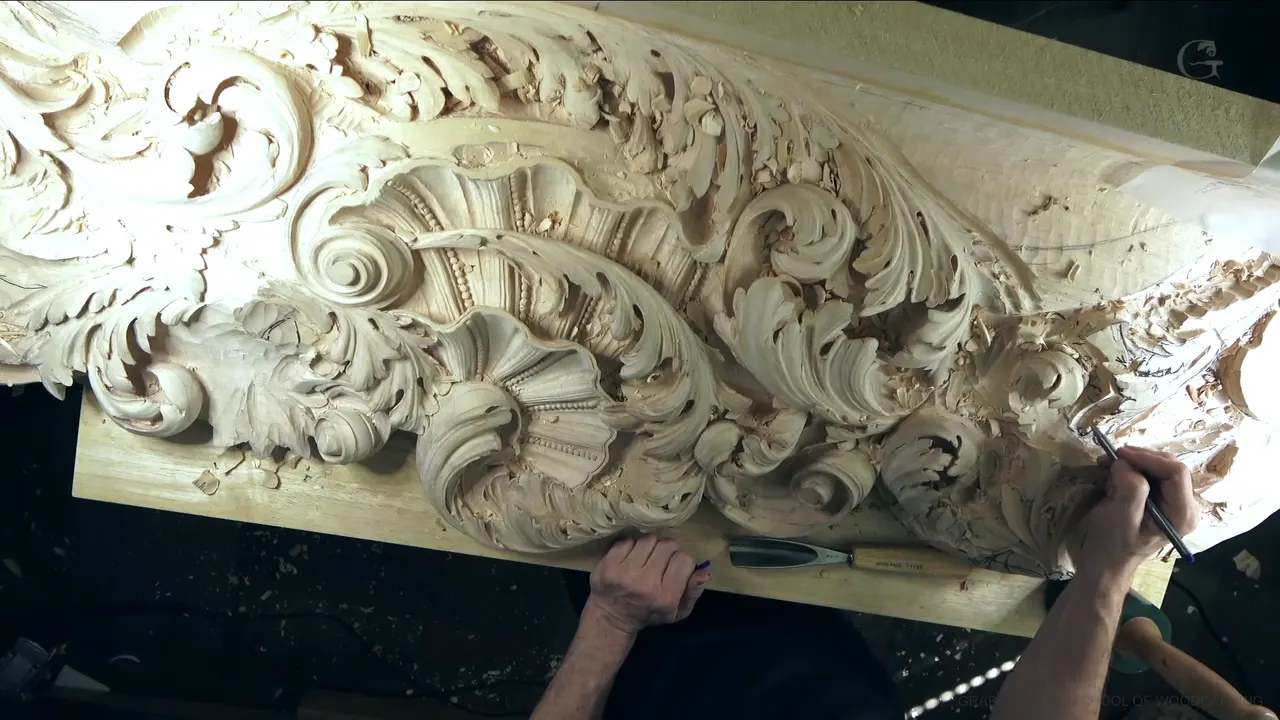

I said "You don't have to buy it, by the way" in Venice Room 50, part 11, right after I named a tool that another carver developed and told you where to buy it. The next words were about a normal skew.
Is there a tool in a shop window that you think you must own before you start? Maybe a vise, or a stone, or a skew. Those words, in part 11 and in my other lessons, are for you.
What was I carving when I said it?
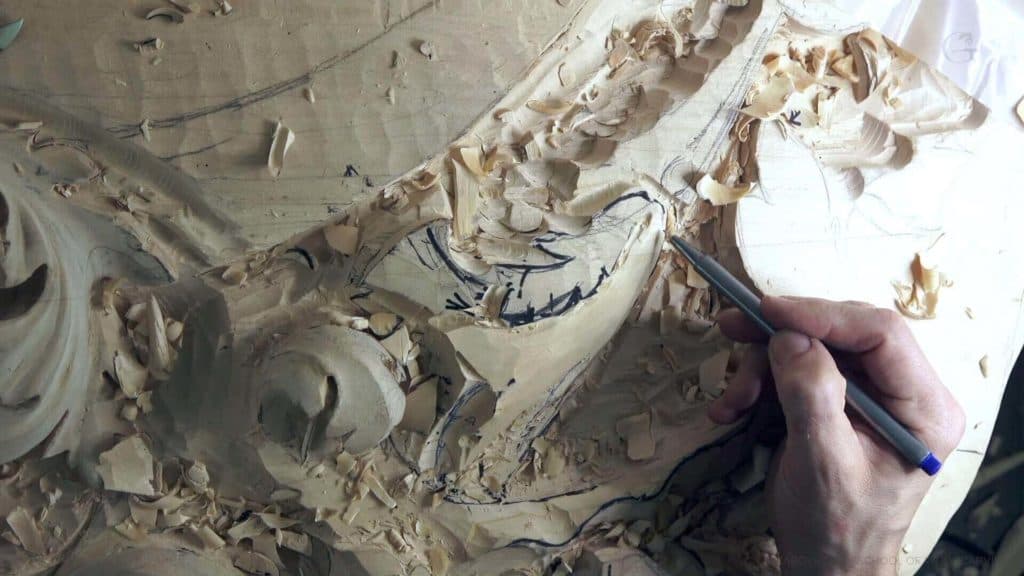
Part 11 opens with "maybe it's going to be more understandable if you're going to see in overall development how I'm developing it." The marker is next: "maybe I can use a little smaller marker," I said. Divisions were coming, I said, and one part would go "inside, inward."

A plan followed: "I'm going to hit little bit this ridge and clean little bit this movement." Then a swap in numbers: "I'm using just the side of my number 11. Use that as a number three."
Now a need. "I need to undercut, just remove that stuff. But I don't want to lose that part because this bottom wraps an inside going like that." "Again, I do understand that is a little confusing." Once it was done, I told you, "you'll see how beautiful it's going to be."

The ridge got its own line. "I have to pay attention not to lose this ridge right here because this movement is a part of that development." One wish for myself sat beside it: "I want to make sure I'm not doing the mistake."
"I'm going to start somewhere right here. And go in." I asked, "So what's going to happen?" The answer: "This part, I'm not sure if you see, also going to round up inside." Something else was going to round too: "this is going to also round, so I have to get rid of this and just to chamfer it. Not chamfer it, but fillet it."

Pretty much, I said, "it's still chamfer, but it's a rounded chamfer."
Which tool did I name before I said it?
"And the way to do that, there's a lot of different ways." One of them was a tool I could use on a push. Another carver developed it, and "I love it." I told you where to go if you want to buy it in the USA, and I named a web address for that.

Then came the skew. "You could use just a normal skew just like that." It would give me the same idea, I said. "See? I'm using just a skew."
Next, a need about a section. "I have to lower down this section because that is going to flip above. So I can take out some of that right away, pretty much." And more rounding: "I have to just round it and round it because I really want to develop beautiful shape."

Is a marker better than a pencil?
I use the marker "just for you people, wonderful people, to see." It has a flaw and a plus: "markers is not always the best idea because it's just messy" and "on the other hand, it doesn't leave a dirt like pencil does."

"Your piece not becoming that dirty, so actually marker is much better, actually, than pencil." Then: "Maybe I should use just the markers."
Which words went with the shape?
"Can you see the shape, how it is shaping right now?" I asked. A requirement came with it: "it has to be gradual movement, beautifully moving in three dimensions." Next: "maybe, well, that is the wrong way." It "doesn't give me a really nice finish", and "this way" gives me "much better finish".

A hope, too: "I hope you already can catch the idea that this right here, it is a part of a lower movement." And: "So this part has to go underneath of this line."
Part 12 asks it as a question, and my answer there was "Really don't." I added: "if you like different tools and different idea of tools, different approaches and so on, that is something to try out you could buy."

Where else did I tell you to skip a purchase?
A veiner number 11 of 3 mm (an eighth of an inch) is in Furniture Panel 15, part 3. "You can get really close with this one also," I said. Buying a tool I named by number is not a must if you own a veiner, "or even if you have just a small number nine gouge." Why I told you: "I just want to make sure you do understand that there's more ways than people think" to do the same job.

Big tools are the subject in Furniture Panel 23, part 1. The small ones win here: "With the small tools, it would give you exactly the same result." And: "Don't panic." Buying is optional, in my words: "If you will buy it, it's only a plus." Then: "It gave me really quick excavation."

A custom tool sits in Hashemi Flowers 28, part 3. "I do have a special tool, which I doubt most of you have." It was made "for just that exact purpose", and "it's custom made for me." Then I said, "I'm not going to use it just because most of you probably don't have it", and "you really don't need to get that specialty tool." The result is the same with "the tools you already probably have."

The same course as this page, Venice Room 55, part 1, goes back to the specialty tool. "I can just use my skew", I said. Buying the specialty one is fine, "unless if you really wanted to, which is fine." Then: "It's expensive."

A short one is in Furniture Panel 38, part 3, about a tool "like this": buying it is not needed. "You're still able to get it done with just the chisel."

The Dining Table Apron course, workshop 17, holds a someday plan of mine: "Someday I'm probably going to do and show what is possible to do with one knife or one chisel." A limit follows: "Of course, you are limited." I like a lot of tools. Owning all of mine is no need of yours, but "the more tools you have, you'd be surprised how much more you could do."

Do you need an expensive vise or bench?
In Venice Room 76, part 10, I got to the vise. Mine was "like a $20 vice", and it was "not expensive at all." No expensive one is needed, I said. A small change was all it took: "Just little modification, and it works just fine." And "that's solid now."

My own vise is in Furniture Panel 1, part 2, "an excellent vice", and I said buying that type is not required. Other choices exist: "There are different vices. There are different carver's devices you can just utilize." Then: "Just get the surface you want to work on, screw that to that surface." Then clamps: "just the clamps." A system I use is "a good advantage for me": "I can work from opposite directions."

People without a shop are the subject of First Cuts for Beginners, workshop 1, part 3. "If you don't have a dedicated space in your house, if you don't have a workshop, you can just use your kitchen table." And I have: "I've done lots of projects, actually, on the kitchen table." Expensive benches are not required, I told you, "but some surface." For a knife, "you don't use your mallet." Clamps are needed: "I'm just using a simple clamping system."

Is one knife enough to start?
One knife is the subject of part 2 in that same workshop. I spoke of "different cultures all over the Earth", and "They all had just the one knife available." My line to you: "with one knife, you can do a lot of stuff." Buying "multiple tools" is not a condition for "great results."

That was "exactly the same approach what my teacher taught me, what my master taught me." And "All he gave me, he just gave me first knife, and he taught me for a long time to use that knife in all of my carvings. Then he gave me a gouge."
One purchase I do name. Flower Rosette 5, part 1, is about a list of tools. A big Grinling Gibbons piece makes that list "tremendously long." Some of those tools, I said, can be skipped "because same results you could actually achieve just by using the tools you have." Then my one must, for anyone with no tools yet: "the number one tool which you have to really buy to carve is a knife." It was a chip carving knife.

Brand is secondary: "any other brand will do. I just like the quality of the steel of the knife." And a note on price: "chip carving knife, it doesn't mean the price is cheap."
And for sharpening and marking?
How to Sharpen Micro Tools, part 4, talks about money. "If I don't want to spend money on expensive stuff, what I can do, I can actually use just the sandpaper to sharpen any of my tools, pretty much." A flat surface works: "I can use it as a stone." The cost is low as well, and I said "sandpaper is not expensive at all. You just throw that away", and no stone is needed.

Someone in the sharpening class from the Maine Coast workshop, part 6, asked whether diamond stones last a long time. My answer: "it lasts long." Diamond is not a must. "Sandpaper lasts a long time, really long, and it's cheap also. Get the same result."

In Stropping, Honing, Buffing, part 4, plain wood does the job, and no money has to be spent. "With the block of wood, you really don't have any limitations." The shape is yours: "You just create your profile." Money is not needed here, and "on one block, you can get hundreds of different stropping profiles if you wish."

A trick sits in Venice Room 28, part 6: "just use a razor blade." Plain is enough: "Just a normal razor blade." Then: "just scrape it with that." Specialty tools are not needed for this, I said, and the blade gives "really nice results."

Marking is the subject in Acanthus over Moldings 1, part 1. I had "done some marking", and what I used was "Just a marking gauge." My advice: "I highly recommend." A really expensive one is not required. For a furniture maker, "you probably want to invest a little more money." For carving, "any marking gauge with just a sharp knife with the cutting part, and that's going to work."

In Acanthus over Moldings 2, part 1, a pen is the tool: "Just mechanical pen." "Those are cheap ones," I said. I own pricier ones too, yet "I really don't need expensive ones", and "it gives me good result."

Which lesson holds which line?
Here is the whole run in one small table.
| What I said you can do without | Lesson and part |
|---|---|
| The one I named, then a normal skew in its place | Said in this very part |
| A veiner, or even one small gouge, in place of a numbered tool | Told in Furniture Panel 15, part 3 |
| Small tools | Heard in Furniture Panel 23, part 1, about the big ones |
| A custom tool made just for me | Found in Hashemi Flowers 28, part 3 |
| A skew | Spoken in Venice Room 55, part 1, where the specialty tool is expensive |
| Just the chisel | Given in Furniture Panel 38, part 3 |
| More tools do more | Shown in the Dining Table Apron course, workshop 17, next to a long wish of mine |
| A vise that cost about $20 | Noted in Venice Room 76, part 10 |
| Different vises, different carver's devices, a surface and some clamps | Offered in Furniture Panel 1, part 2 |
| A kitchen table | Stated in First Cuts for Beginners, workshop 1, part 3, for people with no workshop |
| The first knife my teacher gave me, before any gouge | Said in the same workshop, part 2, about my teacher |
| A knife I do say to buy | Raised in Flower Rosette 5, part 1 |
| Sandpaper as a stone | Taught in How to Sharpen Micro Tools, part 4, where I spoke of money |
| No diamond stone | Answered in the Maine Coast sharpening class, part 6 |
| A shaped block for stropping, and the profile is yours | Described in Stropping, Honing, Buffing, part 4 |
| A normal razor blade | Mentioned in Venice Room 28, part 6, as a way to scrape |
| A marking gauge that is not expensive, or any gauge with a sharp knife | Recommended in the first Moldings lesson, part 1 |
| A cheap mechanical pen | Used in the second Moldings lesson, part 1 |
Right now, is a gouge, a bench or a pencil in your hand? Each lesson has my words next to the picture, and the carving itself is on its page.
This video sits inside workshop 50, a lesson of my Venice Room Part 5 course.
How it's done
- Swap the numbers. My number 11, on its side, stood in for a number three.
- Try a normal skew. A normal skew was my stand-in, with the same idea behind it.
- Bring one section down. Lowering a section was on my list, and I gave my reason in the video.
- Round it. More rounding was ahead, for a shape I wanted to be beautiful.
- Draw with a marker. A marker was there for you people to see. It is messy, and it leaves less dirt than pencil does.
- Send the part underneath. This part has to go underneath of this line.
Frequently asked questions
Where in workshop 50 did I say it?
Part 11 has it. First came a tool and a shop, then the line, then a normal skew. Part 12 repeats the question and answers it with "Really don't."
Which skew lines are in part 11?
A skew and nothing else was in use, I said. A section has to come down, I said, with something set to flip above. More rounding is on the list, since I want to develop a beautiful shape.
Marker or pencil, which one did I praise?
A marker is messy, I said, yet it leaves less dirt than a pencil does. I called it "much better" than pencil. A maybe followed, and it was about using markers alone.
What to carve next
- Venice Room Part 5
- Venice Room 50
- Venice Room 55
- Venice Room 76
- Venice Room 28
- Furniture Panel 1
- Furniture Panel 15
- Dining Table Apron
- Furniture Panel 23
- Furniture Panel 38
- Hashemi Flowers 28
- First Cuts for Beginners
- Flower Rosette 5
- How to Sharpen Micro Tools
- Maine Coast workshop
- Stropping, Honing, Buffing
- Acanthus over Moldings 1