
Alexander Grabovetskiy, woodcarver, School of Woodcarving · Published 2020
Did Venetian wood carvers use V tools?
Quick answer: In part 4 of workshop 50, I said I leave V tools out of this carving, because I want the Venetian style of wood carving. They just didn't have them, I said. Other lessons of mine say the same, and in some I picked up a V tool anyway.

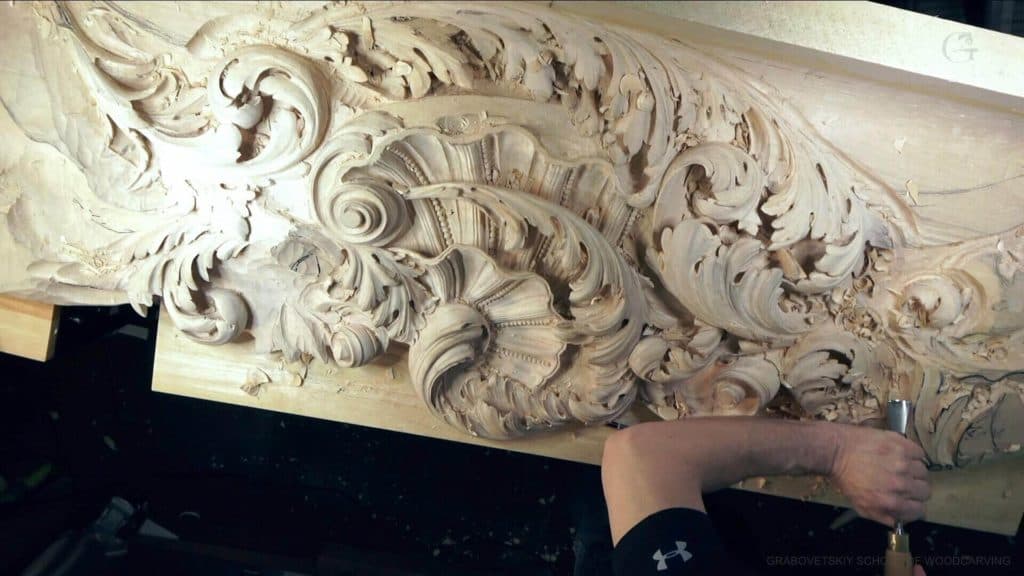
In workshop 50 of my Venice Room course, part 4, I said the Venetian carvers did not use V tools. In that same part, I named a number 11. Other lessons carry close to the same words, and this page goes through each place.
Ever wondered if a V tool would be quicker? Would you like your wood carving to look like Venetian work from the old masters? Then hear about the tool their carvers lacked, as I put it.
What did I say about V tools?
The line from part 4: "I don't use, in this carving, V tools, because I would like to be authentic to the Venetian design and Venetian style of wood carving, and they did not use any V tools." More from me: "They just didn't have them. They did not have them. It was invented a little later."
For tools, I named gouges, knives, skew chisels and normal chisels: "But they used gouges, and they used knives or skew chisels, if you wish, or just normal chisels."

I added: "And I want to be authentic to that culture. For an expert would look at it and would say, 'Hey, yeah, absolutely. Yeah, that looks like a really authentic piece.' So it's done by those masters."
Which tools did I name in that part of the video?
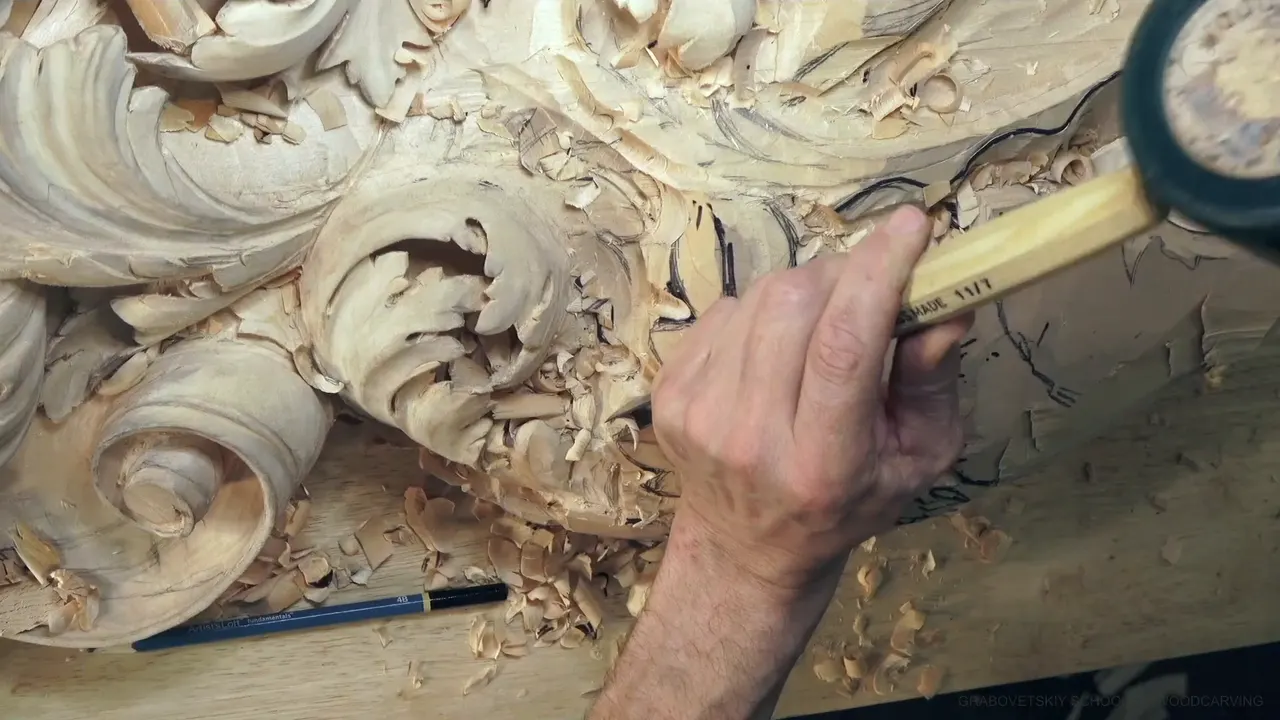
Seven millimeters (0.28 in), number 11, "same number 11 what I used before." My line: "I always start with the relief cut." I said, "Those are triangles."
For a 4 millimeter (0.16 in) number 11, my plan was to start digging a little bit inward, "and this side also, but not much."

The main shape was a plan too. I would take this away with "just that same shaft I had before, number three sweep," and create my final form. I could also start developing "my ridges and pipes and smaller divisions."
The tool was "not too sharp." Number five was my plan. "So I kind of raised a little bit that middle ridge," I said.
"And also, this one needs to be also cleaned out." There was to be a separation "exactly the same like on this side, but it's going to go underneath of that division."

For one concave: "I could use probably number eight, and about one inch" (25.4 mm). A word about bevels: "And again, look how big my bevels are." That gives me "ability to carve cleaner."
Part 3 has a line about my bevel too. I had reshaped a number three of 20 millimeters (0.79 in), "3/4 of an inch," I said: "I reshape the usual way I reshape it. I've got a really long bevel. That's the way I love to shape my tools."
What is the authentic movement?
The movement, in my words: "I want to create the authentic movement, and authentic movement means I have to create the concave, then it's supposed to be convex, and a concave again. And I want to raise this ridge much higher."

For the concave, I said I was not heading to this point: "That would not be the right movement. The concave going to go all the way like this. So that is going to be all concave."
Near the middle line, my plan was a careful start, without hitting it. That line "has to be really beautiful." In my words: "almost no concave right here, and much deeper concave closer to the edges."

One more line, same part: "I can actually get really nice and close movement to the lower leaves, but still keep at the same level, my upper leaf."
Part 5 has these lines. There is an invisible ridge underneath, I said, and "it has to be raised also." Then, I said, it matches the original. Another line: "Originally on those acanthus movements, you usually see concave, convex, concave." And for the blending: "I'll use just a number three and upside down." About the whole design: "I think it looks really good."
In part 5 I planned number 11 again, at four millimeters (0.16 in). To hit the ridge: "I could do it with the same tool, or I could just take a bigger number 11 and do something like that. Or just a flatter gouge, like maybe number three." The plan: "that's exactly what I'm going to do, just use a flatter gouge." I also said I would probably stop streaming: "I'm about 30 minutes in," and the rest of it would be "available just online in my school."

What does Roman Acanthus say?
Part 2 of workshop 16 in my Roman Acanthus course has my words: "They never used any V tools back then. So the V tool was invented later." Even today, I added, wood carvers in some countries do without it.
About the tool itself: "Although, V tool is one of my favorite tools, and I really like the V tool. But it's not necessarily you have to have it." My plan there: "So let me, again, use a number three, and kind of clean all that mess."

More sits in that workshop's part 4. In my words: "I'm still laying my tool on the side," "same like I would do with the V tool," "I am creating my initial undercut." Then: "And like I mentioned before, I really like V tool. It's one of my favorite tools."
The history follows: "But V tool is a more later invention in the wood carving world." In ancient times, I said, carvers had no V tool, "so they used more like a gouge and straight chisels."

And in the Lily Box course?
Workshop 10 of the Lily Box course, part 9, has this. There is nothing wrong with a V tool, I said, and I use it "all the time." On that project, "if it's possible, eliminate." Then: "I'll use just number 11s. Just in my opinion, sometimes it gives a much cleaner look when you look on inside in those cuts." The size: "two millimeters" (0.08 in), number 11.
The history again: "I believe I mentioned before, a V tool was invented much later in the history." I was not talking about ancient carvers, I said, but about AD wood carvers, "like Byzantine wood carvers." They "achieved really nice results with the design and so on, especially with acanthus leaf."

Their tools, I said: "They used only gouges and chisels. That's it, okay?"
Which other courses name Venice?
Acanthus over Moldings 2, part 1, I name Venice. I really like the tool for undercutting, but on this project: "I tried not to use it." The reason I gave: "it is somewhat replication of original workmanship." In Venice, I said, those V Tools were not in use "In the 15th beginning of 16th century." The area I was working on would not be noticeable.

The April 2020 livestream has it too. There are two types of undercut, I said. For the really sharp one, it would not match the original Italian Venetian style: "What they did, they used veiners and they used gouges."

Another is Venice Room 139, part 3. There are a few different ways you could hit that, I said. "You could use a V tool if you wish," but it would not match the period, and I would use "just a skew." The word came out as "Skew knife," then as "Skew chisel."

Where is a V tool fine with me?
In Furniture Panel 26, part 3, I had to take care of a separation: "I'm gonna grab probably number 16. That would be a V tool." My note: carvers in some of the countries back then went without it, "but that's okay. Okay, it's all right."

Part 2 of Furniture Panel 33 has this: I'm absolutely okay with someone using one. "I would prefer probably number 11." Also: "any V tool will work very much." Used the normal way, number 11 is "what they used previously in 18th century." And: "in reality, Number 11 would be about the same result. Even better. That's what I think."
Floral and Molding 10, part 1, has a line on a triangle: "so you really have to make a relief cut." On that project I really like to use number 11s. "You could do even V-tool." Then: "But I'm trying to be more authentic to the original carvers who worked on the project like that back then, and they didn't have that V-tool, but V-tool would be sufficient."

I added, "in this case, probably, nobody would even know if I used that or not." I asked, "Why don't I just show with the V-tool?" "So let me grab number 16 V-tool, and obviously it just goes right inside of that," I said.
In Rosette 2, part 2, I needed some concaves and convexes inside those petals. Another option was a V tool: "I'm not sure if I should or not because on this project, I'm trying to avoid that." I also said, "But I'll use a V tool for now." Some petals go underneath another one, I said, "so it's not going to be just the divisions."

Rosette 3, part 2: "in my case, I'm using number 11s," I said, and V tools were open to you too. "I just want to be authentic and also it looks somewhat nice when you have a clean undercut. But you go ahead and feel free to use whatever you feel the best." About my own choice: "I really don't have to use it. I'll use a number 11 and like a half a millimeter, and I'll achieve exactly the same result." That half a millimeter is 0.02 in. About taking the V tool: "pretty much the same idea, you just try to dig underneath," to "create a sharp separation right there on that side."
Rosette 4, part 2, brings a new tool: "a number 17 and 6 millimeters" (0.24 in). It looks almost like a V tool, though it is not one. The difference, at the bottom part of it: "it's just wider." It has about 1/16 of an inch (1.6 mm) of roundness on the bottom. A 1 millimeter (0.04 in) or 2 millimeter (0.08 in) veiner was possible, I said: "But with this tool, I'll be able to do that without switching the tools."
In Venice Room 90, part 7, I put the question the way you would ask it: "why don't I use a 90 degrees V-tool? Oh, absolutely you could." And: "Absolutely, no problem."
Venice Room 103, part 4, gives a pattern for the cap side of an acorn, with more than a couple of ways. One of them: "you could take just a V tool and create a bunch of V cuts." And: "you could just get a V tool, a really small, tiny V tool. You don't really have to use a big one."
Which lesson held which line?
Here are the lines in a row, each with the tools I named and the lesson where I said it.
| Line | Tools | Lesson |
|---|---|---|
| Not used in this carving | Number 11s, number three sweep, a five, an eight | Part 4 of Venice Room 50 |
| Invented later | Number three, to clean all that mess | Roman Acanthus 16, part 2 |
| A later invention in the wood carving world | Gouge, straight chisels | Roman Acanthus 16, part 4 |
| Early AD carvers worked well without it, I said | Just a number 11 | Lily Box 10, part 9 |
| Not using those tools in Venice, in the 15th beginning of 16th century | I tried not to use it | Acanthus over Moldings 2, part 1 |
| Sharp undercut, not true to the original Venetian style, I said | Veiners and gouges | Livestream, April 2020 |
| A V tool, though not for the period | A skew chisel | Venice Room 139, part 3 |
| No V-tool for the original carvers, but it would do | The number 11s, then a 16 | Floral and Molding 10, part 1 |
| My choice was number 11s, yours can be V tools | Just number 11s | Rosette 3, part 2 |
| Trying to avoid it on this project, then I said I'll use one | The V tool | Rosette 2, part 2 |
| Okay with a V tool, number 11 preferred probably | The normal way, number 11 | Furniture Panel 33, part 2 |
| Not used in some countries back then, but that's okay | Probably number 16 | Furniture Panel 26, part 3 |
| A really small, tiny one for a pattern on an acorn cap | A tiny V tool | Workshop 103 of Venice Room, part 4 |
Where can you watch them?
Each one sits inside a course of mine. The Venice Room Part 5 course holds workshops 50 to 61, and Venice Room 50 is the lesson for this page. The other courses in the table hold the rest. Pick one, and start here.
How it's done
- Begin with the relief cut. I always start with it, I said, using the same number 11 as before.
- Plan a dig inward. A smaller number 11. I was going to start digging a little bit inward.
- Plan the main shape. The same shaft as before, number three, to create my final form.
- Raise the middle ridge. Not too sharp, I said, and I would use number five. The middle ridge went up a little bit.
- Follow the movement. I wanted a concave, then a convex, then a concave again, with the ridge raised much higher.
- Hollow one big concave. Number eight was my idea for the big concave, with big bevels to carve cleaner.
Frequently asked questions
Why did I leave V tools out of this carving?
I don't use them in this carving, I said, because I want to match Venetian work. Gouges, knives, skew chisels and normal chisels were what the Venetian carvers used, I said. Its invention, I said, came a little later.
Which gouges did I name in that part?
The number 11s were for the relief cut and the digging inward, a number three for the main shape, a number five for the middle ridge and a number eight for one big concave. Several of these were plans.
Is the V tool among my own tools?
In the Roman Acanthus course I called it a favorite, and in Lily Box I said I use it all the time. On some projects I said I try to avoid it, and in another lesson I said any V tool will work very much.
What to carve next
- Venice Room Part 5
- Venice Room 50
- Roman Acanthus course
- Roman Acanthus 16
- Lily Box course
- Lily Box 10
- Acanthus over Moldings 2
- April 2020 livestream
- Venice Room 139
- Furniture Panel 26
- Furniture Panel 33
- Floral and Molding 10
- Venetian Flowers Rosette 2
- Venetian Flowers Rosette 3
- Venetian Flowers Rosette 4
- Venice Room 90
- Venice Room 103