
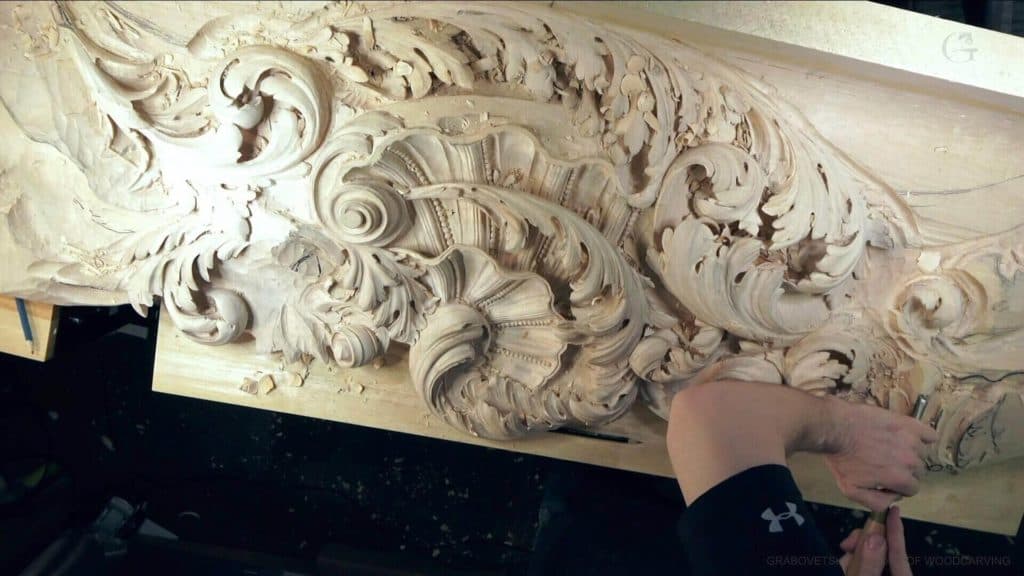
Alexander Grabovetskiy, woodcarver, School of Woodcarving · Published 2020
What does a wood carver mean by "a little deeper"?
Quick answer: In part 5 of workshop 50, I planned a channel cut and its twin, "a little deeper." For the ridge, I planned a flatter gouge. Other lessons of mine use the same words and attach a reason: a shadow, a pipe that should show, less resistance, or room in the wood.
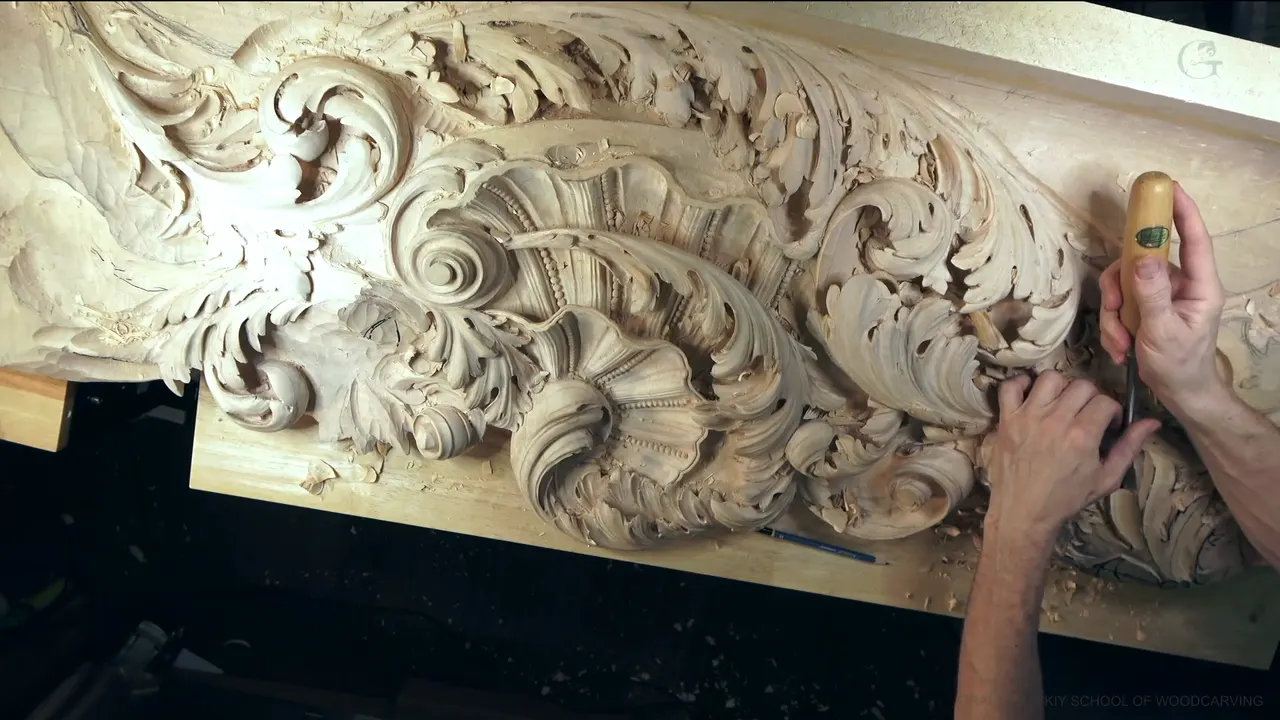

"Just a little deeper." That is how I closed a plan for one side of a channel cut in Venice Room workshop 50, part 5. The phrase comes back in many of my lessons, and this page follows it from one to the next.
Ever stood over a cut in wood carving and wondered how much deeper to go? Is a little deeper a lot, or only a hair? Here is what I said in this part, and where else the same words came out.
What happened around "a little deeper" in part 5?
Just before it, I said I really like that raised idea, and number 11 came back, with "four millimeters" (0.16 in).
I wanted to make sure of the distance before it hits the middle line, "somewhere on a golden ratio, so which means six parts out of 10." A pencil mark got a word too: "I wish I didn't put that mark with the pencil, but it's okay. I did it just for you."

Next, the plan itself, which opens with "Again, the same idea." A first channel cut would come, and then "exactly the same on this side, a little deeper." And: "what is it? Just a little deeper."
The ridge was next: "And now I have to just hit the ridge." Three options came up: the same tool, a bigger number 11, or "a flatter gouge, like maybe number three." I planned the last one, in my words: "just use a flatter gouge."

Turning the tool followed: "And just turn this upside down and blend it. See how nicely it blends? And it's not that deep cut, but still it feels like it's going underneath."
The part closes on a limit. I could probably clean a little better with the smaller tool: "Just hit that carefully, but I don't want to hit that too deep. I don't really need it." And the reason was that it would still be "visible from the bottom, and most of it I don't need to undercut too deep right here."

How do more and less fit together in part 5?
The part opens with "I'm not touching this edge." Then: "So really important to keep that ridge at the same level." The same was needed on "this side," also convex, "but not as much as that side."
An invisible ridge underneath "has to be raised also," I said. Then, in my words, "authentic to the original." Old acanthus movements, I said, usually show "concave, convex, concave." The concave is the inner cut, and the convex is "like going up and down again."

Everywhere else, the ridge was to be raised. The line that ties it to this page: "Somewhere it's going to be more deeper, somewhere less, but the idea is going to be the same."
Blending came next, to take out the sharp ridges. A number three would do it, or a number five, and I said I would use the three "upside down." Another note was about the stream: I was "about 30 minutes in," and the rest of it would be "available just online in my school." I said I was not going to lose my middle line, and "I think it looks really good."

What do the sister parts of lesson 50 add about depth?
The ridge goes up in part 4: "I want to raise this ridge much higher." The concave there was to run "all the way like this." Near the middle line, the plan was "almost no concave right here, and much deeper concave closer to the edges." That way, I said, I can get "really nice and close movement to the lower leaves" while the upper leaf stays at the same level.
One part had to come down in part 6, and my plan was "a slightly bigger number 11," 5/8 of an inch (about 16 mm), on its side. Later, "this part going to go underneath, deeper until it just hits the bottom," while my shell part will be "the highest spot." For me, "it's safe to remove a lot more." Then came the limit on it: "A lot more, but not too much, okay?" I also said I did not want to get too excited.
Where does a shadow come in?
Venice Room 62, part 7, starts at a pipe: "It's visible, but it's not deep enough for my taste." So: "I need to probably go a little deeper than that." And why: "it's really important for me to cast some shadows, and right now, it still doesn't." Maybe I would "establish my depth with the back bend." Then: "So now I've got the preliminary depth." The back bend was a number eight, and by my words three-eighths of an inch (9.5 mm), or 10 millimeters (0.39 in).

In the same course as this page, Venice Room 58, part 2, I did not want to get too deep or cut closer to the edge. Then: "But in the middle, it could be a little deeper, I would say. It would cast me a little nicer shadow."

Greek Acroterion 3, part 6, has this: "A little too deep." The cut had to be recreated "on this side," I said. After that: "I'm not afraid if I'm going a little deeper than I was planning to, because like I said, it creates the shadow line, and this shadow line is a really important element."

In Byzantine Acanthus 7, part 3, a deeper cut was possible with five millimeters (0.2 in), "just in case if you have it," using the same tool. My own plan: "little deeper, okay? I want to see that shadow."

The triangle cuts in Furniture Panel 25, part 3, come with advice. "Take your time," I said, and a really deep undercut was fine "if you wanted to." Then: "Look really nice if you just get a little deeper." Then, "Here you go. I've got really good shadow going on."

What about a pipe or a ridge?
Floral and Molding 11, part 2, begins with a tool choice. With a goose neck, a straight tool "would be in my way." Then: "Yes, I can get a little deeper because I want to see a really nice and beautiful exaggerated pipe." The other side would get the same.

Byzantine Acanthus 4, part 2, has two tools on the leaf, one for the concave and one for the convex. On this side, I said, the idea was the same. A deeper cut was there if needed, I said, and the exaggerated pipe was the reason.

The first part of that workshop names the ridge itself: "what I'm after, I'm after that ridge, and that ridge has to be also high, okay?" The digging, "even if we need to dig little deeper on the left side of the tool," came with the pipe in mind: I wanted it to show.
And less resistance?
Hashemi Flowers 43, part 3, starts with a spot I did not worry about. If I saw some of the original bandsaw cut, I did not mind, "because later on, when I'm going to work on my petals, that's going to disappear anyway." So: "let me make a little deeper cut right here." Next, maybe an even smaller number seven, for "a lot less resistance."

Hashemi Flowers 17, part 1, has this: "I could go actually a little deeper with those cuts." That would give me less resistance.

Where did the wood have room for it?
In Furniture Panel 25, part 2, I said I would like to make it "like half a sphere almost," and the background was deep enough there: "I have absolutely no problem of going little deeper right here."

Venetian Rosette 5, part 1, counts the wood: "I'm about half an inch deep" (12.7 mm), "but I need to go much deeper." Down to the background was "about one inch" (25.4 mm). Also: "I should be able to get at least at the highest spot." Then the line this page is named for: "So I can go a little deeper." It "will make the whole world of a difference."

Where did a little deeper bring movement or an outline?
In Venetian Rosette 3, part 1, I said: "But it's not the end yet. I would like to create extra movement in this section." The move: "So create a little deeper concave on this side." My reason was an extra dark spot, which would help it "look even better." About its size: "Make it a small cut like this." It did not have to reach the center.

Research comes into Greek Acroterion 5, part 6, when I looked into acroterions: "they also didn't make those roofs really deep," just "to determine to make it look outlined." So my cut needed to go deeper at that spot.

Which reasons do the Furniture Panel lessons give?
Furniture Panel 16, part 1, starts with a section of the middle: "I want to make this section a little deeper, more than eighth of an inch" (3.2 mm). The reason came in the same breath: one level that looks the same everywhere was what I wanted to avoid. Then the number: "five millimeters deep on this one" (about a fifth of an inch), half of a panel that was "10 millimeters" (0.39 in).
The background gets its own line in Furniture Panel 18, part 6. I was not afraid of a little more depth, because "it's much deeper carving right here," and I added that I meant the background.
In Furniture Panel 19, part 6, I said: "I could do actually a little deeper because it's already past the molding." About the effect: "even if it's invisible, your brain's still going to pick up there is something underneath."
In part 11 of that workshop: "Don't force it," I said, and "It's better just to recut a little deeper." After that: "I really don't want to do deep cuts because every cut leaves a mark. And let's say if I'm planning to undercut, those marks will remain visible."
A molding sits close to a flower in Furniture Panel 22, part 11: "I can't go really deep on this side." In the section between two lines I could go deeper "with no problem," a section that "could be a slightly deeper. Not much, but about eighth of an inch" (3.2 mm), "like three millimeters deep" (0.12 in).
Furniture Panel 23, part 1, adds: "I think that is enough." A little more was possible "even right there," with "material right here yet," and I wanted to exaggerate this one "because it's a central focal, the main point."
Which cuts did I put off for later?
In Greek Acroterion 2, part 2, the cut ran "about 3/16, I would say. So which is about 5 millimeters" (0.2 in). Maybe a little deeper later, I said, since it all depended on how I would see it. For now: "I think I'm not going to go deeper than 3/16. Okay. I think it should be good enough, 3/16."

A promise sits in Venice Room 43, part 3. Good, I said, with more depth possible on this side, "which I will later on." Then: "as of now, it gave me the right shape already."

Venetian Rosette 2, part 3, uses a number 11 "little smaller, maybe about two millimeters" (0.08 in). Deeper was the plan, though "it's not even the final cut even now." More cuts were still to come: "So that is just preliminary."

Byzantine Acanthus 3, part 3, sits at the eye, where the cut could still be deepened "now."

Flower Rosette 5, part 3, has a cleaning cut near the line. I was leaving about 1/32 of an inch (0.8 mm) before the line, for the cleaning cut I would make. Then: "I guess right here, I need to cut a little deeper. I didn't go too deep on my initial cut." And I said: "if you need to make a cleaning cut, just make the cleaning cut." That is for when more depth is needed "before the final pass."

When did I say that was enough?
A stop shows up in Venice Room 34, part 8. The convex would be blended in with the back bend, I said, and "I think that is deep enough." Then: "Maybe a little deeper, just to give more dimension. But I think it's enough." The next job: "Now I have to blend this part and create the convex."

Which side went a little deeper?
A check shows up in Greek Acroterion 1, part 4: "Let me double-check. Okay, now I can see this side is a little deeper." Next move: "So I'll just rotate and make my cut from this side now a little closer."
A bump came up in part 1 of Venice Room 58. "And if I need to create some spots a little deeper, like right here, I can feel I hit a little bump, so I'll do it." Later in that part: "I had to cut a little deeper right here because there was a bump, which you don't see, but I could feel it."

Four words from Hashemi Flowers 5, part 1: "Okay. Little deeper on this side."
And Hashemi Flowers 21, part 3, gives a V-tool line: "Again, don't force it. Don't go all the way. Take just a V-tool and clean it with the V-tool. If you need to make a groove a little deeper, just do it."
Which lessons gave which reason for going deeper?
| The reason I gave | A few of my words | The lesson |
|---|---|---|
| A shadow to cast, since the pipe was not deep enough for my taste | cast some shadows | Venice 62, part 7 |
| An exaggerated pipe I wanted, which made a deeper cut fine | beautiful exaggerated pipe | Floral 11, part 2 |
| Less resistance on the tool, so a deeper cut made sense | smaller number seven | Hashemi 43, third part |
| Room in the wood, since the background was deep enough | deep enough background | Furniture 25, part 2 |
| A cut that is not final, so more cuts still to come | just preliminary | Rosette 2, part 3 |
| A bump I could feel but you do not see, so one more cut | I could feel it | Venice 58, part 1 |
| A clear outline for the roofs, so a deeper cut at that spot | look outlined | Greek 5, part 6 |
Where can you watch all of these lessons?
Each one sits inside a course of mine. The Venice Room Part 5 course holds workshops 50 to 61, and Venice Room 50 is the lesson for this page. Courses in the list above hold the rest. Pick one, and start here.
How it's done
- Name the tool. Number 11 again, at four millimeters (0.16 in).
- Plan the second side. Second side of the channel: a little deeper.
- Pick a tool for the ridge. A flatter gouge was my choice over the same tool or a bigger eleven.
- Blend. Turn it upside down.
- Mind the limit. I held back at one spot, since it would still be visible from the bottom.
Frequently asked questions
What came just before that cut in part 5?
Number 11 would come back, and I needed to make sure the spot before the middle line was near six parts out of 10. Next I planned a channel cut, with its second side deeper by a little.
What did I say about the ridge after that cut?
I had to just hit the ridge. The same tool would do, so would a bigger 11, and so would a flatter gouge. My pick was the flatter one, turned upside down to blend.
Is deeper the answer in part 5?
I held back at one spot there. A lot more could come off one part in part 6, but not too much.
Why did I go deeper in other lessons?
What to carve next
- Venice Room Part 5
- Venice Room 50
- Venice Room 62
- Venice Room 58
- Greek Acroterion 3
- Byzantine Acanthus 7
- Furniture Panel 25
- Floral and Molding 11
- Byzantine Acanthus 4
- Hashemi Flowers 43
- Hashemi Flowers 17
- Venetian Flowers Rosette 5
- Greek Acroterion 2
- Venice Room 43
- Venetian Flowers Rosette 2
- Byzantine Acanthus 3
- Greek Acroterion 1
- Hashemi Flowers 5