
Alexander Grabovetskiy, woodcarver, School of Woodcarving · Published 2020
Is an axe a wood carving tool?
Quick answer: An axe is the tool I held up in Venice Room 50, part 6, and called a Viking axe. The Vikings used it for boat building and so on, I said, while carving itself was done with knives. Other lessons name a small hatchet for roughing out.

An axe is the tool I held up in part 6 of workshop 50, and called a Viking axe, the one the Vikings used for boat building, while the carving went to knives. A small hatchet appears in other lessons of mine too, so this page follows that one word from lesson to lesson.
Ever held a small hatchet and wondered if it belongs beside your gouges? Have you looked at an old boat and asked what carved it? Here is what I said in this part, and where else the same word came out.
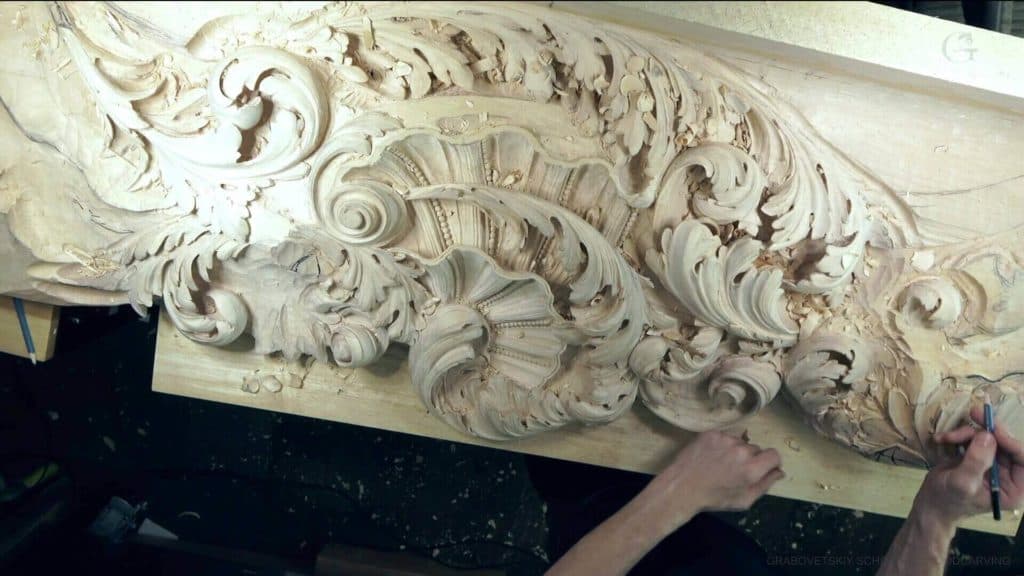
What was I carving in part 6 before the axe?
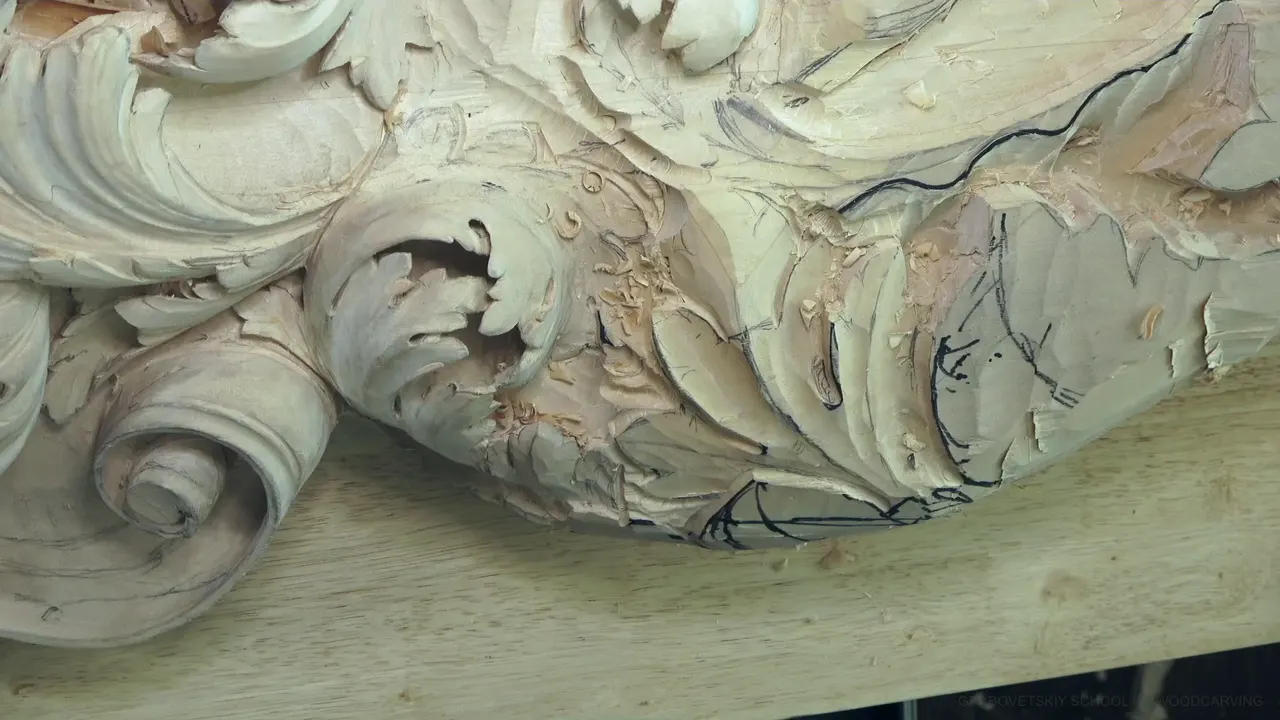
I began with "Let me outline it better." Another separation was coming, so I needed to make my relief cuts. One separation would sit "right here," another one "right here," and I planned to hit one of them from two sides, because I did not want to lose the ridge beside it.

"Let me think," I said. Maybe it was a good idea to create some movement going downhill from that part. That was also a possibility, though for it I would need to lower the part and go a little this way.
My plan was a slightly bigger number 11, using just the side of it, and carefully starting my movement. Later, this part would go underneath, deeper, until it hit the bottom. The shell part would be the highest spot, which meant it was safe for me to remove a lot more.

A lot more, but not too much, because I did not want to get too excited. Number 7 and one inch (about 25 mm) came next.
How many tools did old carvers have?
A really good question had come in, about people who carved about 1,000 years ago. The question was how they accomplished that without 1,000 chisels or gouges. I already tried to answer it in comments. For those who missed the answer, I put it plainly: nobody knows exactly how many tools they had.

And it depends on the country and the location. That part I called really important. In Northern Europe a thousand years back, I said, there was a lot of Viking carving development.
What is the Viking axe I held up?
"Viking style, I call it." Norwegian, Danish, even the upper Slavic countries were, to my mind, the same culture, pretty much Viking culture. Those people did not have too many tools. "All they had, pretty much, an axe."

Next I said I would show how it looks, the Viking axe, and it came into view. Its design is still pretty close to the original, what they had. We call it topor. I even have some runes written on mine, right there on the axe.
They used it for boats and so on. "But for carving, they used just knives."

I call that old style pre-geometric carving, and my beginner's course is built on one knife. The people of that time carved with only one tool. Their work is beautiful, yet it is not the same as what we are working on, and one knife cannot do that.
I have carved with a single knife and a single gouge, and the work came out really good. It just takes much longer. Much longer.
Where else did the word topor show?
In part 5 of workshop 55, a question about art and craft sent me to England. Wood carvers there, in the 17th, 18th and even 19th century, were divided into levels. The lowest were boat carvers, and their carving was huge and chunky. They used a lot of adzes and axes.
In Russia we would call it "topornaya rabota." I began to say what the main tool was, then said I would show it, and that it was right there. So that is what they would use, just the axe. Rough carvers, I called them.
One step up came the coach carvers, who carved coaches and buggies for the roads of England. Those got a little more detail, since people stood closer to those vehicles. Same main tool, maybe big gouges.


Did the Vikings carve with an axe or with a knife?
Both answers are mine. Workshop 50 gave the axe to boat building and the carving to knives. In a livestream of April 2020 I talked about 10th century Norway, where the people, Vikings, put some acanthus movements on their boats.
How did they even know that idea without traveling far? I asked. Because they had pretty much just a knife and axe. Still, they did a really great job, actually, with the knife and axe in wood carving. Copying is okay, I added, and it is the only way to learn and develop some more.
In a video about a tool set that held knives, I said I believe the most ancient wood carvers used only a knife. I meant ancient times, but also not too ancient, maybe the 10th, 9th or 8th century, like the Viking world. On a long boat you cannot take all the tools along, but you can grab one knife and carve something with it. I love the knife, I told the camera, though it was not what I love the most.
My beginner board, workshop 5, asked you to picture a 9th century Viking boat, a long journey, and a single knife in your hands. What beautiful things you can get done with one knife! The type of carving I chose there is pre-Viking era, so it existed before the Vikings became known as Vikings.
Is a hatchet a roughing tool?
I talked about one in part 9 of the first Venice Room course, where a big gouge was my first choice for removing big chunks of wood. A rubber mallet protects the ends of my gouge, I explained. A mallet made of wood is too noisy for me, and a brass one is not what I want on heavy-duty work, when a lot of wood has to go.

That way a tool stays in the same condition for many years. Not suggesting that you do it my way, I said, since I don't like to remove material along the grain. But a lot had to go, and it had to be gradual, and that is one of the approaches.
"The second approach you can do, use a hatchet, if you have a hatchet." I have a beautiful handmade one, just a small one. You can do some roughing out with it, but be really careful how you work with that.

Quick, too, for taking off a lot of wood. For me, though, it comes to about the same as using a gouge. I can take a lot of material at once, especially at a beginning stage like that.
I could use a different gouge too. A number 9 across the grain was possible if I wanted, but the one in my hand was probably the best and was going to work. After that, "I'm going to shut up, and I'm going to work."

Why would a hatchet meet a tool with no handle?
In some places the tool has no handle, and I described that in a livestream of April 2020. The European approach sets a long stem inside the handle. Chinese tools take the handle into a socket on the tool part. Go south, to the Indonesians and a lot of small countries sharing the same culture, and all you find is the steel part. Really primitive, I said, and it works. Absolutely.
Most of the time they do not reach for a mallet. They take a small hatchet and hit it just by the side. The metal part has a long stem and the carving part, and they do an amazing job also.
Here is what I noticed. Work from those countries, done with primitive tools and without too many bent gouges, is beautiful stuff. It did not reach the level of Baroque or Rococo. Never developed that, I said. More on a rougher side, I would say.
A second livestream, on sharpening an eleven, gave the same picture. The biggest difference between European design and the Far East is the handle, and a lot of Indonesian chisels have none. That is okay too, if you strike one with a mallet. They are using it with the axe a lot of times, a small hatchet.
In part 9 of lesson 15 of my furniture panel, I said it again while working with a small number one. Far East carvers have no handles, just the metal part, and really tiny tools. On thick wood, with small tools, they chop down and get to the corner all day long. Complicated tools are not what they have, I said. Really simple ones.

Were the tools of the south just as simple?
No. Go south in Europe, I said in workshop 50, to Italy and Greece, and even Asia, western Asia, like modern Turkey, then Syria and Persia, which is modern-day Iran. Sometimes people don't realize how much history those people have, I said, and I named their beautiful antique art. Thousands of tools, I said, a thousand years ago. "That's a proven fact."

Stone carving and wood carving, the whole idea of them, came from those people, and they had lots of tools.
I studied a little about the Egyptian, so we are talking about Northern Africa, and also the Ethiopian, a really developed artistic approach. ancient Egypt machinery was on my reading list too, I said, although it is not really machinery, since it is a little different. No electricity, and still what they were able to do with those machines is just amazing.
We are not talking about just 1,000 tools. Some of those tools are ones people wish to have today, but they lost the technology, how they did it. I went on to the Americas, Latin cultures like Peru. Go to Machu Picchu, I said, and see how they worked with the stone.

I asked how they carved. I named the granite. Back then there was some complicated machinery, "really complicated machinery." Don't get a simple idea that they had no tools. "They had really complicated tools."
I touched this again in workshop 3 of that same board, while I drew a line with a scaler. Living 2,000 years ago, I doubt you would have a ruler like we have right now. Yet they would probably have some type of really complicated tools.
What did I say about huge tools, and about sharpening them by hand or by machine?
A viewer wrote that he uses MDF for adzes. Oh, yes, I answered. That is great for any tools, for big tools, huge like adzes and axes and so on. But it is obvious that you do that by hand.

I got away from doing it by hand a long time ago. The problem for me with hand work is time.
In my sharpening class in Maine I told a story about a machine that cools the tool with water. I bought the whole thing when it showed up in the United States, with all the jigs and all the attachments. Some of them I never used. They still lay somewhere. One of them was for an axe.
"I don't have axe. I do have axe, but I never use it." And I bought that attachment also. Everything.
What did my teacher hand me before a gouge?
One knife, as I told it in part 7 of workshop 50. In Russia, my teacher gave me just one knife at first. I had to master it before I got my first gouge from him, and it took a long time. Everything I carved in those days came from the knife.

"If you can master knife, gouge is going to be a piece of cake," he would say. For those of you who are just starting, I suggest my beginner's course, and trying to master knife.
Which lesson holds which axe?
The whole run of this word fits in one small table.
| The tool | A few of my words | The lesson |
|---|---|---|
| The Viking axe I showed, with its runes | boats and so on | Part 6 of workshop 50 |
| Axes and adzes of the boat carvers in England | just the axe | Workshop 55 |
| A knife and an axe in 10th century Norway | great job, actually | Livestream, April 2020 |
| My beautiful handmade hatchet, a small one | roughing out | Venice Room 1, part 9 |
| A small hatchet that strikes the metal part of a tool | hit by the side | Livestream, April 2020 |
| MDF for huge tools like adzes, a viewer wrote | great for any tools | Stropping 4 |
| The axe attachment for my water cooled machine | bought it also | Sharpening class, Maine |
Do you own a small hatchet? Is there a gouge on your bench? Then you hold both ends of what I said in this part, the old tool and the kind I used on the board, in wood carving.
Part 6 sits inside Venice Room 50, a lesson of my Venice Room Part 5 course. The same word came out in Venice Room 55, Venice Room 1, my April 2020 livestreams, Furniture Panel 15, my stropping lessons, a sharpening class in Maine, a video about a tool set and workshop 5 of my beginner board. Pick one, and start here.
How it's done
- Outline the separation. Outline it better, I said, since another separation was coming and I needed my relief cuts.
- Protect the ridge. One separation I planned to hit from two sides, so I would not lose the ridge beside it.
- Take the side of an eleven. The plan was a slightly bigger number 11, used on its side, carefully, to start my movement.
- Take a lot more off. With the shell part the highest spot, I said it was safe to take off a lot more, but not too much.
- Reach for the seven. Number 7 and one inch (about 25 mm) was the next plan.
Frequently asked questions
Did the Vikings carve with an axe?
Their boat building tool, I called the axe in workshop 50. Carving was done with knives alone, I said there. On an April 2020 livestream I said all they had was pretty much a knife and an axe, and they did a really great job.
Can a small hatchet rough out a carving?
In workshop 1, part 9, I said you can use a hatchet if you have one, and I own a small handmade one. A quick way to rough out, I said, but be really careful with it.
How do carvers strike a tool with no handle?
On a livestream I said the Indonesian way is a small hatchet, hitting the metal part on its side. A second livestream, about an eleven, repeated that a lot of Indonesian chisels have no handle at all.
What to carve next