
Alexander Grabovetskiy, woodcarver, School of Woodcarving · Published 2020
Does a wood carver get paid to recommend tools?
Quick answer: Getting paid to recommend a tool is something I told you I was not doing, in Venice Room 50, part 7. I named carving tools for hobbyists and furniture makers, and I added it. Other lessons carry the same line, about a small plane, a flocking kit and a wood hardener.

Getting paid for a tool recommendation is something I said I was not doing, in part 7 of workshop 50: "honestly, I'm not making any money, by the way." It came out while I was naming carving tools for hobbyists and furniture makers. Other lessons of mine carry the same line, about other tools, and this page walks through them.
Ever read a tool review and wondered who paid for it? Would you like to hear my answer, in my own words? Here you have my own words, lesson by lesson, so you can check every one of them.
What did I say about money in part 7 of workshop 50?
The line came in the middle of the carving, just after I mentioned that I was still using the same number 3, 20 mm (3/4 in). I added that I wasn't making anything. What I was doing, I went on, was searching for the right tools for people who don't want to spend too much, "because tools are expensive."

Those people still want to get into the wood carving hobby world, if you wish. Or they build furniture. "Even furniture makers, they don't want to spend sometimes too much money on the carving tools." Five, seven tools pretty much is all they need, to use occasionally on some of the projects.
About those tools I mentioned my review on YouTube: the first set they had wasn't the best quality, and I was still able to carve with no problem. If you want to save money and still have tools, I would suggest a bigger set, 11 tools or 12, I believe. That would be plenty to do most of the work: "90% of work, what I have online, you'll be able to do with that set."
What was I carving while I talked about tools?
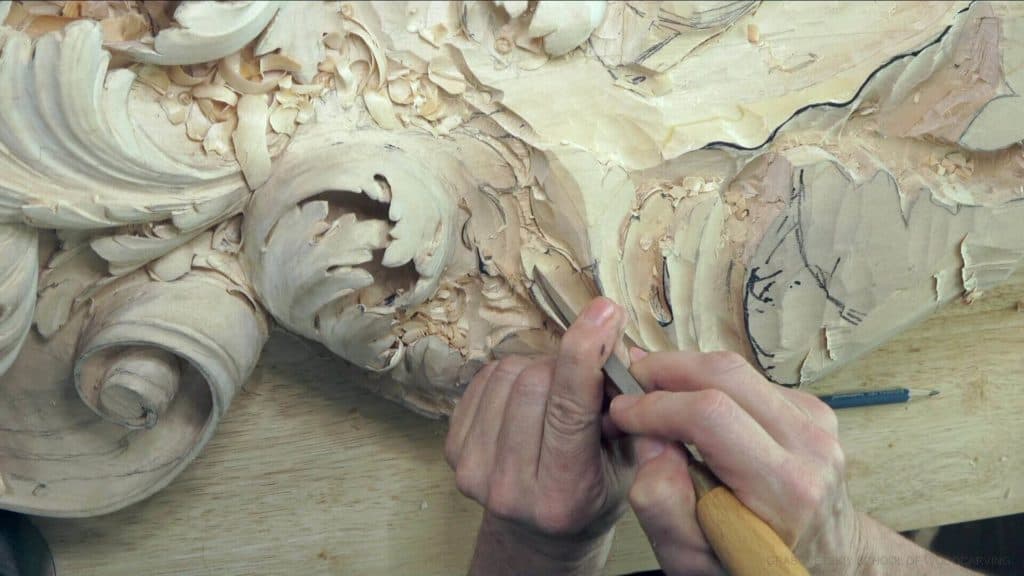
The talk sat between two stretches of carving. Before it, I said I need to excavate and get rid of this part, at "a point of another separation somewhere right there." "Chop a little in." And I could probably use the same tool.

Once the talk was over I was developing a pipe, with a number five. Excavating too deep was not what I wanted, I said, and that is why I'm using number five. As for the pipes, all of them are "always going to go to the center line."

"And let me move this direction also." Another separation, "right here," and I could actually go a little more this way. I'm going to do relief cuts, I said, and it is really important, actually, to do those relief cuts. And a plan for the tool: "Okay, let me use number five."

What about the mallet in my micro tools lesson?
In lesson 4 of the micro tools sharpening course, the tool I was talking about was "not expensive at all." A hobbyist, I said, can buy pretty much just one set and forget about spending. Then: "I'm not selling anything. Don't get me wrong, because I'm not making any money on that."
They do have a mallet, I said. I showed two mallets and called them pretty much equal. One was lasting me for a long time. Of one mallet: "I don't know how this one is going to last. That is the question." On the other hand, my good expensive mallet didn't last a long time either. "I found one crumpled. Completely gone." I also did a YouTube video with just those tools and carved the grapes with them. "They work the same. Essentially, all you need is just that metal part."

What went with me to Maine?
I didn't bring any sandpaper, because of the weight. I can't travel heavy. The only glass wheel I've got went along, the finest. So did my leather with the paste applied. A felt wheel went along too, and a bunch of cheap diamond ones.
I gave an Amazon address too: "I don't make any money, but I place right there whatever I can buy on Amazon." The diamond ones are Chinese, yes. "I have no problem with that because it's cheap, but I really don't have to replace it." That was at the sharpening class in Maine.

Why did I call a small plane a must have?
Small planes for tight spots came out in part 2 of lesson 32 of the furniture panel. One takes a really tiny blade. I have a 1/16 in (1.6 mm) one, and you can get a 1 mm (about 1/25 in) blade, "and you can get to the tiniest spots."
Next was "this little guy, even smaller guy," a microplane, I mean router plane, with a blade that is really small and tiny and still gives you a really good support. To clean up stuff in small spots like these, it's an excellent tool, and "one of the really must have for the wood carvers tool."

Again, I said, I wasn't trying to sell you anything with that plane, and no money came to me from it.
Did I say it about flocking and a wood hardener?
Before I put hinges on a lily box, I decided on black flocking for the inside, something like felt. It's just a powder, and it gives me a really nice texture on the inside. A kit, with a couple of tubes and a mini flocker. About a store's website: "please understand, I am not trying to sell anything." And: "I'm not getting any commission from those people."

"That's what I'm just using. That's why I'm explaining." There are other places to buy that stuff, I believe, but that store gives me an inexpensive solution with a really high-end finish. This was part 10 of lesson 13 of my lily box course.
The Q and A on back cutting has a question of its own: what do we do if we really have to do a staining? There's another solution. "In my case, I use a wood hardener, doesn't have to be that brand, I'm not selling anything, I'm not sponsored by anyone, I'm just telling you what I'm using."
It's made for rotten wood, for the outside pretty much, you'd be surprised. The stuff penetrates really deeply on the inside and dries really quickly, and I penetrate twice, sometimes three times.

Why do I care about the steel?
Lesson 29 of the furniture panel is where I praised the steel of some tools I have had for a long time: "just amazing, beautiful, beautiful, beautiful tools." Absolutely zero problems. "What I'm after, I'm after quality of the steel, not just the look." The look is really important too, but you can change it. You can do the handle yourself. "And no, I'm not affiliated with those guys."
My lesson on selecting tools put it this way, about one maker: "I'm not trying to advertise those tools." What I like is how thick it is, side by side. I like the fishtail shape too, because "you can get to the corners with the fishtail tools."

The butterflies plate course, lesson 11, has me holding up two knives, a right-hand and a left-hand. "Sometimes it's a really good idea to invest in good tools." I'm not even affiliated with that maker. They're nice tools, USA made, "and it just has some soul."
"Again, I'm not affiliated. I don't get paid for that. But it's a good idea sometimes to just invest in good tools, especially if you're going to do some carving like that."
In my lesson on scrapers I said I really like to buy really cheap carving tools sometimes, a spring steel one, and use it as a scraper. I held up a pack of steel cards I found on Amazon. I wasn't getting any money for that, I said, "but I kinda like what I found." A cabinet scraper is what the card is, I said, but I think it works better for wood carving, for what we do.
Which tools were sent to me to try?
A surprise came in lesson 15 of the furniture panel, part 5. I got some new tools, some new toys, "and the best part of it, I did not have to pay for it." One of the European companies based in Ukraine sent me just a few knives and a few gouges to try out.

One thing I already like is the size of them, and how they feel in the hand. Some of them I would probably use that day, to give a try how it feels. Later, a different project probably. I want to see the difference. The knives came as a set of four, with a really thick leather for stropping, like a double shoulder, and a green paste. I didn't even strop or sharpen the first knife, just took it out of the box pretty much.

The company sent a second set too: some gouges, a set of four, and actually two more gouges. One looked like a number 8, and when I checked how they marked it, "Yep, it's number eight and 10 millimeters" (about 0.4 in). The other was a number 7 and 22 millimeters (about 7/8 in). "So I'm going to try to use them."
In the video on that company's tool sets, the package I opened had the roll included, and I love that idea. "So that is actually excellent idea." My final opinion: if I wanted to buy a tool and wasn't looking to pay a lot for each gouge, "I would definitely buy tools from those guys."

"Now, I do not make any money from those guys, please." The only way I can explain why I'm a little biased, I said, is "just because I was born right there. I mean, in Soviet Union. Not Ukraine, but Soviet Union." It was a big country, Russian part of it.
And what about livestreams and ads?
My April 2020 livestream on sharpening a number 11 came back to budget tools I had mentioned a couple of times, "not expensive, really economical." You can judge as much as you want to how they finish, "but tool is a tool." I've got multiple sets of those tools, and this particular one is a full size. I tried them. "So he doesn't pay me." We do communicate right now, "but, no, I'm not getting any commission on that."
"I'm just thinking about a lot of people, they buy those tools." When you Google carving tools on Amazon, I saw that brand popping up as result number one, "because of the price, of course." And like all tools, a new one doesn't have a proper bevel.
In another livestream, after I read some comments, I asked you to share the link. "I really appreciate because I want to show that to the world." I wasn't making money by doing it. "Of course, I would love all of you would become a part of my School of Wood Carving online," I said.

I said I do not want to pay advertisement fees to Google. That was in lesson 16 of the furniture panel, part 6. "Not that I don't believe in those fees, I do, but first of all, I don't really need it." There is a joke about the best place to hide nowadays: the second page of Google. "I want to be on the first. Not for me, but for people who are still searching for lessons and woodcarving courses and so on."
After the tool talk, what did beginners hear from me?
"I told you already before about the tools," I said in part 7. When I was in Russia, my teacher gave me just one knife at first, and I had to master just one knife before I got my first gouge from him. It took a long time. Everything I carved, I carved by using a knife.

"If you can master knife, gouge is going to be a piece of cake," he would say. For those of you who are just starting, I would suggest my beginner's course, and trying to master that knife. "You would really appreciate you did."

Which lesson holds which line?
The whole run of these lines fits in one small table.
| The tool | A few of my words | The lesson |
|---|---|---|
| A bigger set of 11 or 12 tools for hobby carvers | not making anything | Workshop 50, part 7 |
| The tool I showed, and a mallet, in a sharpening lesson | don't get me wrong | Sharpening micro tools 4 |
| Cheap diamond ones I brought to Maine | I place right there | My sharpening class |
| A tiny plane for the smallest spots on a panel | sell you anything | The panel course, lesson 32 |
| A flocking kit for the inside of a lily box | any commission | Lily Box 13, part 10 |
| A wood hardener for rotten wood, outside pretty much | sponsored by anyone | Back cutting Q and A |
| Tools I have had a long time, loved for their steel | not affiliated | Panel lesson 29, part 2 |
| Right-hand and left-hand knives made in the USA | I don't get paid | Butterflies plate 11, part 1 |
| Knives and gouges that were sent to me to try | to try out | Panel lesson 15, part 5 |
| A budget set of gouges, tried on a livestream | he doesn't pay me | Livestream, April 2020 |
Are you holding a gouge right now, or a chisel? Is a set on your list? Then you have my words, lesson by lesson, and the rest of workshop 50 is waiting.
This video sits inside Venice Room 50, a lesson of my Venice Room Part 5 course. I gave a whole lesson to a budget set of tools for people starting out, a lesson on that set, and the livestream lessons are gathered on one page, April 2020.
How it's done
- Name the tool you use. I was still using the same number 3, 20 mm (3/4 in), and I could probably use the same tool to chop a little in.
- Say what you get out of it. Right at the start of the tool talk, I told you I wasn't making anything.
- Use a number 5 on the pipe. A number 5 developed the pipe, because I did not want to excavate too deep.
- Take the pipes to the center line. All the pipes were always going to go to the center line.
- Plan the relief cuts. A plan came next: relief cuts, which are really important, actually.
Frequently asked questions
Were any of the tools in your lessons sent to you?
One European company based in Ukraine sent me a few knives and a few gouges to try out, I said in my furniture panel videos, and I did not have to pay for it. My video on that company's sets has this: I'm a little biased, because I was born in the Soviet Union.
Do you earn anything when a student buys a tool you name?
In the 50.7 video I said I was not making anything. The lily box course has the same about a flocking kit, and in the furniture panel lessons, about steel I love, I said I am not affiliated. Those are the lessons I can point to.
Do you need a big set of carving tools?
Five, seven tools pretty much is all a furniture maker needs, I said in the 50.7 video, to use occasionally on some of the projects. A hobbyist can buy one set and forget about spending. A bigger set of 11 tools or 12, I believe, would be plenty to do most of the work.
What to carve next