
Alexander Grabovetskiy, woodcarver, School of Woodcarving · Published 2020
Does a professional wood carver still make mistakes?
Quick answer: In Venice Room 51, part 10, I said "I make mistakes" after a cut I did not relieve first, on the triangle side. Other lessons of mine talk about mistakes beside a molding, a flower, a thin spot and a drawn line. Each place is below, with its lesson.

Does a professional wood carver still make mistakes? In Venice Room 51, part 10, I said "I make mistakes" right after a cut I did not relieve first, on the triangle side. My other lessons talk about mistakes beside a molding, a flower, a thin spot and a line I had to redraw. Each place is below, with its lesson.
Did a tool ever land on the one spot you planned to take slowly? Do you have a favorite carving that still shows a pass you would like back? Then you know the moment I mean. I say it plainly in my lessons, and every line below comes from a lesson you can open without a login.
What did I say in part 10?
Early in the video I gave a size and a tool: "This is one and a half millimeters, about 16th of an inch," which is 1.5 mm (about 0.06 in), and "Number 11, of course." Next came "Sorry. Forgot to mention what tool it was." Then once more, "Number 11."

A little later I asked myself how I was going to do it. My answer was a maybe, "Maybe I'm going to create an eye and get this one underneath of this element." The eye would stay small, "Don't need big eye," and a 2 mm number 11 (5/64 in) would make it.
Before one spot I said a blend had to come first, or it would not look good. Any tool I had would do, I said. The tool in reach was "number five I have on bench. Not on the bench, but actually on a piece of carving." Next: "And here you go. We created that movement."
My pencil needed sharpening, and I said so. An apology followed: "My apology if you don't see what I'm doing, and also apology if my head was again in the way." Then "But that's okay," and "Keep forgetting."

Another line named a tool by its number. "Let me use number nine and remove some of that stuff right here," I said, and told you "It doesn't have to be number nine, by the way. It just happened. It was close to me."
Here is the moment I want you to hear. My plan was this side. "Oops. That's what happens if you don't relieve it." Right after that: "See? I make mistakes, even if I said that hundreds of times, just relieve that cut." I went on with "Relieve that cut. But I didn't." The spot was the one I named, "the triangle side." My next words were "but it's okay. I can hide it."

Seconds came up next. "I could save about few seconds, if I would just do the right thing, and every second counts." I tied that to production carving, which "still takes time, it still takes long time." And then: "every second, if you can save it, that would be wonderful."
Later I said I would also create a cut of 2 millimeters (0.08 in) and "I need to blend again." A small skew chisel was the idea. Near the end I said "Number two if it's a London pattern. And it's number one if it's a Swiss made." I called that skew "also, by the way, 22 degrees, which I really like it." Of the tool itself: "that is an excellent tool. See how I can develop the movement?" Then "Yes, of course, it still has to be excavated. This part still has to be gone, and it will be gone."

The parts next door carry the same care. Part 11 has me saying I did not want to undercut yet underneath, "So that would be mistake." The undercut would wait until "after I create that hole inside." In part 9, a number nine goes to a side. "Carefully. Without overdoing it."
Which spots get a warning from me?
The Venice Room 16 lesson, part 9, calls my own way of working "kind of dangerous." If I mess up there, I said, I can't glue it back, and "that's one of those areas that is better not to make mistakes." My pace follows: "That's why I'm taking my time and think every cut." I fixed my wording on the spot. "Think about every cut, I should say."

There is little wood at one spot in Lily Box 11. For a relief cut around it I named a number 11 at 2 millimeters, about 0.08 inch. "Just carefully again. I don't have too much material, so can't make mistakes. Not here at least." Number three came next: "I clean that with number three."

Floral and Molding for the Panel 3, part 2, has a number three. "A small one. This one is only six millimeters or so," I said, 6 mm or about 1/4 in. With it I was "barely removing wood because this area is kind of shaky, so it's easy to make mistake." Then, plainly: "No, no mistakes allowed." I had a tool for the spot, "I've got skewed gouge," and a plan to try it, "let me use it. Maybe number seven."

Rosette Workshop 1 has a final cleaning stage. I said "I'm taking actually less than 10 millimeter," under 10 mm (0.4 in). "Now I am watching my grain and how my wood behaves, because right now I can't make mistakes." The stroke I named was "sweeping."
My relief cut comes first in Venice Room 13, part 6: "I need to make a relief cut at first in this triangle." My pick was a number nine at "3 millimeters, one-eighth of an inch." My word for it was "Just relieve it," and my reason was mistakes: I wanted none. I also owned that even with that cut I still chop the edge a little bit, and I called it fine.

Where does rushing come in?
"It's important for me not to rush, because sometimes I feel like I have to rush it." That is Venice Room 24, part 7. I went on: "But it's not the best practice, okay? I can make mistakes, and it's going to be hard to fix." A hedge for the next step was "Maybe I should chop a little inward," with a number three to clean after, "maybe number three."

Part 1 of Venice Room 100 has "not to rush it," and the reason came right behind it: "Because when I'm rushing, I make mistakes."

Pressure comes up in part 5 of Hashemi Flowers lesson 12: "So don't create too much pressure." Next: "Like I said before, it's much better to do multiple cuts and to get the result slower than to rush it and make mistakes." The grain was in play there. "I got to be careful. So now I have to lower this down even more."
My hand held a number five in the second part of Hashemi Flowers 23. "I have to be really careful not to press too much." On passes: "It's better to make a couple passes than to make the mistake." My wish came next: "I wish I didn't make mistakes before, too." Later, "I have plenty of the material. So I feel comfortable doing it."

A scroll saw is the subject of Lily Box 1. "Don't rush it, please," I said. One reason was a blade: you "could break a blade, and you're not saving your time." The second: "if you rush, you can make mistakes and get off lines." How I know: "I've done it multiple times." Then: "If you rush it, that doesn't mean it's going to be quicker." The scroll saw belongs to the Lily Box course. The line about seconds belongs to a leaf in Venice Room workshop 51.
What do I tell myself at the bench?
Furniture Panel 15, part 6, has "I really don't want to make mistakes." After it comes my own voice: "That's every time on every project, I'm telling myself, 'Alex, don't you dare. Don't make any mistakes. You should not do that.'"

I caught myself in the second Lily Box lesson. First I said I was attacking a spot from the right, then corrected it: "I mean, from the wrong position." Next: "I almost made another mistake." A wish followed: "Someday, okay? Someday, I'm going to make a project without even one mistake." Last: "I know it looks messy, but it's all right."
A grain note sits in Venice Room 85, part 8, and the angle comes first. "I'm angling a little bit like 45 degrees because of the grain." The risk is stated: "I can split too deep," so "I have to just do it across the grain." Later: "There you go. I almost made a mistake."
A short one sits in Venice Room 71, part 11. "Don't want to make mistakes. Not in this case at least."
Does the distance from the eye change a mistake?
In the Dining Table Apron course, workshop 17, I went through the kinds of carvers there used to be: boat or ship, coach or vehicle, house or architectural, and furniture. "That is exactly what we're doing in this piece," I said about furniture, which is "really close to your eyes." A boat, I said, "it's not that close to you, to your face." There, "They could make a rougher wood carving." For vehicles I named mud, chipping and weather. House carvers were "really more careful, but still, a lot of stuff people don't see close to the eyes. It's somewhere above, like crown molding." I closed that thought with "So they could make some mistakes" and "They could leave some spots rough."
Which checks catch a slip early?
Measuring comes in Venice Room 160, part 2, which has me saying "Use a caliper and check that. Which side I'm off. And I hope I didn't mess up." Then: "I know it's not too late yet to fix it, but I still don't like to make mistakes." One side was good, "I am right on the line." The opposite side "is way off," and I said "So let me double-check."
A plan sits in the second part of Venice Room 154: "I need to go around this section and make sure I redraw the line." I called it a "One-inch line," which is about 25 mm, and said I did not want to overdo it. "It is easy to make mistake."

My finger did the guiding in lesson 2 of that molding course, part 2: "I'm just using my finger, butting against the edge, and that's my guide, and I can just approximately draw my future molding." An admission came next, that I can slip, and had, so I wanted to be sure of this line. The tool I planned to grab was a number nine, "three millimeters, one-eighth of an inch," 3 mm or 0.12 in.
Lesson 14 of the same course has a loose piece in part 2. I was going to lower a point with the same tool. "Oops, it's already loose. It was solid, but now it's moving, so I got to be careful."

Roman Acanthus 3 says in part 1 "I'm concentrating all the time on both sides. It's easier for me not to make mistakes." A grid helped: "That grid we created actually helps me to see."
Below is every place in one table, from Venice Room Part 5 and my other courses, with what I was working on and what I said.
| Lesson | What I was working on | My words |
|---|---|---|
| Venice 51.10 | The next side, after a relief cut I skipped | the triangle side |
| Venice 51.11 | An undercut kept for after the hole inside | after I create that hole |
| Venice Room 13.6 | A relief cut in a triangle, tool number nine | just relieve it |
| Venice Room 16.9 | An area that I could not glue back | think every cut |
| 24.7 in Venice | Chopping a little inward before cleaning, number three maybe | hard to fix |
| 71.11 in Venice | Developing movements little by little in a careful area | this case at least |
| Workshop 85.8, Venice | A risk of splitting, so the tool goes across the grain | I almost made a mistake |
| Workshop 100.1, Venice | An initial undercut that did not need the whole edge | later on I will |
| Class 154.2, Venice | A line to redraw, 25 mm (1 in) long | I need to go around |
| Class 160.2, Venice | Checking both sides of a piece with a caliper | I hope I didn't mess up |
| Furniture Panel 15.6 | Getting around a flower and inside a petal | Alex, don't you dare |
| Lily Box 2.1 | A spot attacked from the wrong position | even one mistake |
| Lily Box 11.5 | A relief cut around a flower, 2 mm (5/64 in) | Not here at least |
| Hashemi Flowers 12.5 | Multiple passes with the grain, then lowering more | slower than to rush |
| Hashemi 23.2 flowers | Number five, not pressing too much | a couple passes |
| Floral and Molding 3.2 | A shaky area, with a 6 mm (about 1/4 in) tool | no mistakes allowed |
| Rosette Workshop 1 | Final cleaning, taking less than 10 mm (0.4 in) | right now |
| Roman Acanthus 3.1 | Both sides of a leaf, with a grid to look at | helps me to see |
| Dining Table Apron 17 | Four kinds of carvers and where rough spots were left | leave some spots rough |
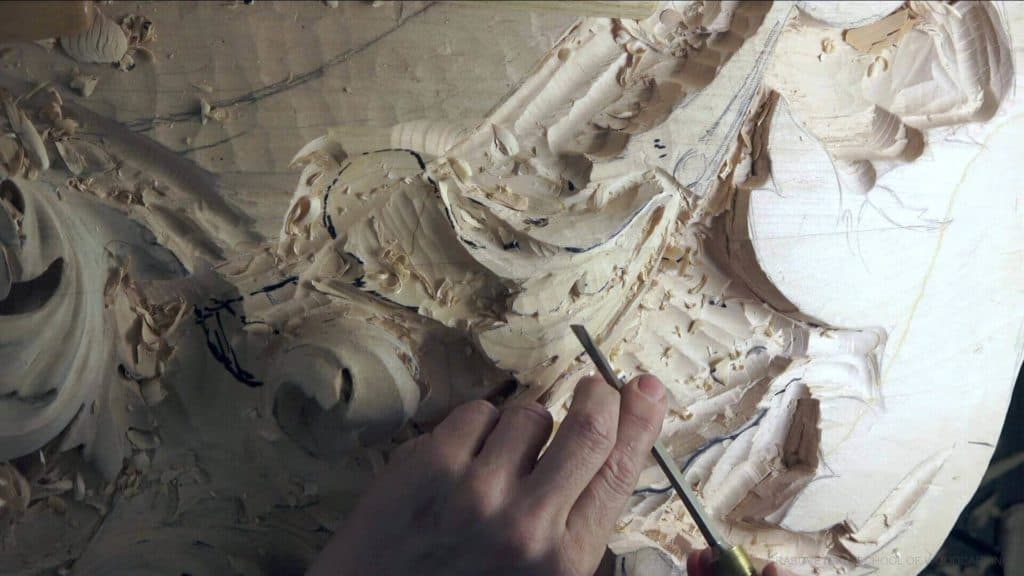
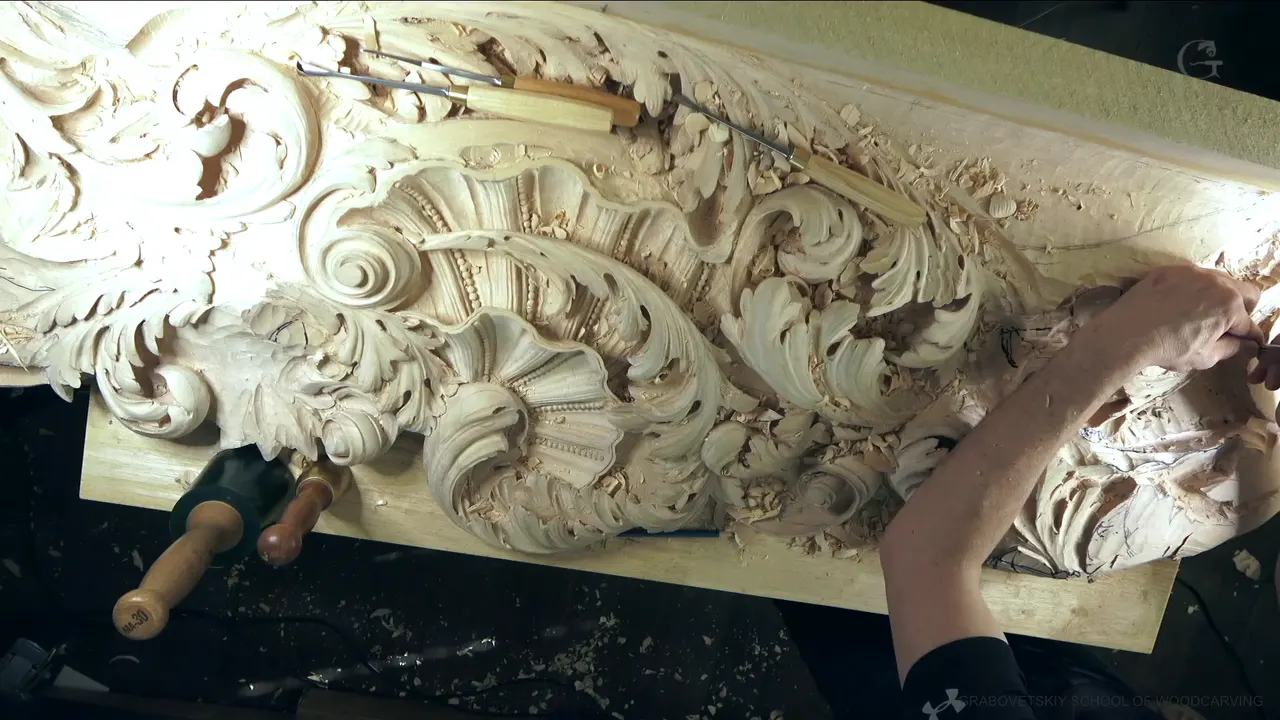
The wood carving in these courses covers Venice panels, a lily box and a flower panel, and each page shows its own gouge work. The Hashemi Flowers course, the Furniture Panel course, the Lily Box course and the Roman Acanthus course each have their own page.
How it's done
- Say it plainly. A skipped relief cut on the triangle side, owned right away in part 10.
- Relieve the cut. Workshop 13, part 6: I said I needed a relief cut first in a triangle, using a number nine.
- Slow down where you cannot undo it. Part 9 of workshop 16 has me calling it dangerous, and taking my time.
- Check a line. Workshop 154 had a line to redraw, 25 mm (1 in), with a note about overdoing it.
- Measure both sides. Workshop 160, second part, adds a measuring tool: I said to check which side I was off.
- Keep the grain in mind. Part 8 of workshop 85 has a 45 degree angle, a grain note and a warning that I can split too deep.
Frequently asked questions
What did I say in part 10 of workshop 51?
One relief cut was missing, and I owned it on the triangle side. I added that I could hide it. Next I talked about saving seconds, about how production carving still takes a long time, and about a small skew chisel later in the video.
Where do I say a piece can't be put back?
Workshop 16, part 9. I said my way of working there was kind of dangerous. If I mess up in that area, I said, I can't glue it back. A slower pace and thinking about every cut followed from that, in my words.
Does rushing show up in these lessons?
Workshop 100 of the Venice Room ties rushing to mistakes in one line. Hashemi Flowers 12 and Lily Box 1 carry rushing lines too, each at its own spot. The scroll saw lesson adds that rushing is not quicker.
What to carve next