
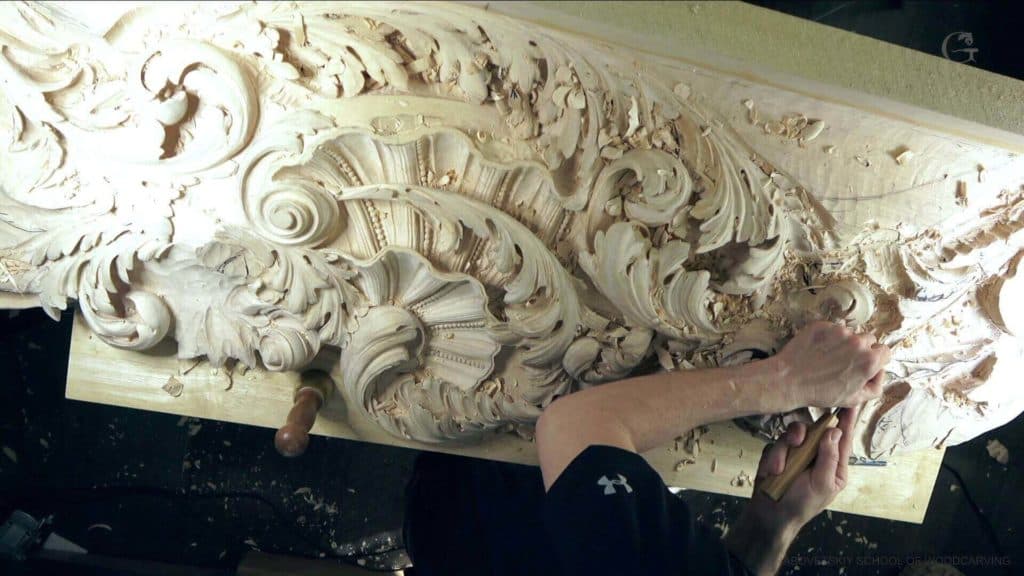
Alexander Grabovetskiy, woodcarver, School of Woodcarving · Published 2020
What does a wood carver mean by "less resistance"?
Quick answer: I explain why I use a smaller tool in Venice Room 51.4: less material, less resistance. My other courses carry the word too, beside a big gouge, a slice, a dull edge, the grain and a router plane.
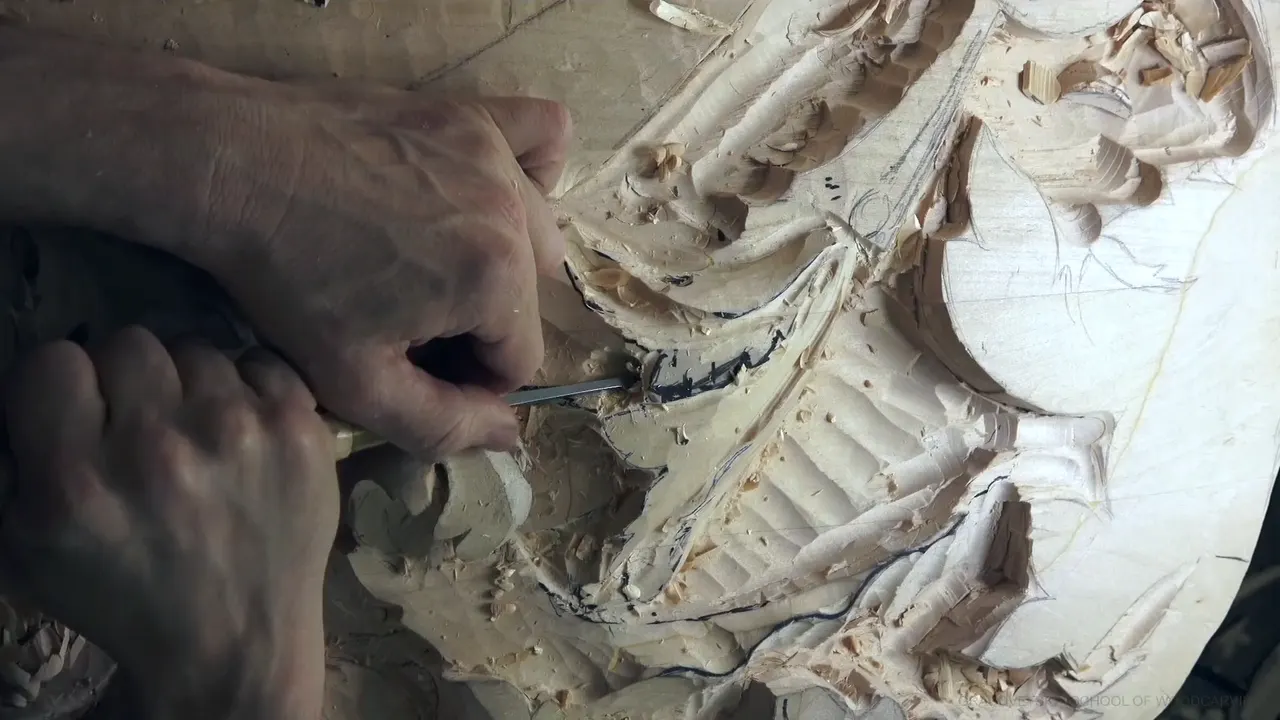

In Venice Room workshop 51, part 4, I said why I'm using a smaller tool: "it's a lot less material I'm grabbing at once, and it's a lot less resistance." My other lessons use the word too, beside a gouge, a bevel, a slice, a mallet and a sharp edge. Below are the places, each as I said it.
This is wood carving, and sizes come in millimeters and inches, my figure first. Open the lessons in a second window and see for yourself whether the page matches the video.
What did I say about a smaller tool in part 4?
My own question: "And why I'm using smaller tool?" About a bigger one: "I can use a bigger tool to clean up, but right now I really don't need to."

"See? Beautiful. Really deep and beautiful. Just like that."
A spot I could "easily lower," I said, but I'm "not going to undercut because that is a little too flat." I'm "going to still have to develop some movement of this detail."
For the tool, I'm "going to place my tool straight, not in, just straight, just cut a little bit away because I don't need that height right here," and "chop a little bit all the way." Also: "don't want to undercut it, but move this direction."

How did I show the movement in part 4?
"See what happens? It just looks like this is flipping like that and rotating and go that direction." A doubt, in my words: "Well, I'm not sure if it's clear or not." I plan to show you "a bigger perspective, bigger view."

About my thumb: "That is my thumb right here, and then it moves inward and goes up and goes like that." And: "So that's the idea." Of the shape: "looks like I am getting that shape really nicely."
What I "probably have to do right now before I excavate more in those areas": "I really need to develop this movement and that movement." Of one spot: "that is going to wrap on inside that part." And: "Now it's more understandable."
Which sizes did parts 4 and 5 name?
"Now I need to use a little bigger tool to clean that," I said. "It doesn't have to be number nine anymore. In this case, I could use just number seven." The spot is "kind of a tough spot because I am working against the grain." About a side: "at least this side, I am able to make a clean cut."

"Let me draw the middle line," I said. An eye is planned there, "Not big," at "maybe two millimeters, maybe three millimeters. Three millimeters, probably" (about 0.12 in), with "number 11, of course." The depth: "I could go a little deeper, create a little more shadow." And: "All I need is just a small eye."
To blend a ridge, "just a skew" is an option beside another tool. A tool that left marks got this from me: "it leaves marks, which means trails, trail marks, which means I need to sharpen it." I own two of one tool: "I have bigger one and smaller one." A third one got this verdict: "a little too small, I guess." And: "that's going to rotate downhill like that."

Sizes in part 5: "I can get even smaller. That was four millimeters" (about 5/32 in), "number 11, and I can use number 11, three millimeters" (near 0.12 in) "and get even deeper." One area gets this plan: "visible from the bottom, so I really need to use even smaller." "Two millimeters, number 11" (about 0.08 in), "probably to one millimeter" (near 0.04 in) "or maybe even a half a millimeter" (about 0.02 in). "We'll see."
"Two millimeters too big," I said. "But I also could use number seven and get more concave. That way, I can get much deeper cut." The number nine: "I'm still using quarter inch, by the way" (about 6 mm). "But see? I'm still able to cut the plugs out." And a thought on size: "I have to switch to smaller number nine, like three millimeters, one-eighth of an inch."
Does a bigger tool push back harder?

A 3/4 inch gouge (about 19 mm) is in my hands in Hashemi Flowers 43, part 2. "If you feel too much resistance with the 3/4 inch gouge which I have in my hands, just try to use a smaller one." And: "Sometimes smaller tools are less resistance, and actually, you can do a better job." The sizes: "about 5/8 of an inch" (about 16 mm). And "a number seven, I remind you."
That lesson's part 3 has this plan: "Maybe I should use an even smaller number seven." The seven, I said, would mean much less resistance. In part 6: "I could use, actually, one bigger gouge if I wish." "At bigger gouge, it's always a lot more resistance at the end grain."

Big tools get a line in Venice Room 140: "I like the idea of using big tools." On the push: "bigger tool you have, a lot more resistance you're going to experience, and you have to be strong to push it." A way out: "Or just use a mallet. Mallet is also always a good idea."
In Lily Box 9, a gouge of "number three and 14 millimeters" (a little over 0.5 in) still gives resistance. "A little too big." "I think I need something smaller even." Another size: "number three and six millimeters" (roughly 0.24 in). "Okay, a little better."
Part 12 of Venice Room 76 has this: "sometimes, if you feel like you're having too much resistance, so it's a good idea to switch to little smaller tool." A size: "Maybe seven millimeters" (close to 0.28 in).
"I'm using a smaller tool," I said in Floral and Molding 6, part 2, for "a preliminary undercut." My reason, in my words, was that with the smaller tool the resistance is much less.

What does a slice do to resistance?
Slow motion is in Byzantine Acanthus 2, part 1: "while I'm pushing, I create rotation movement." "when I'm pushing, I slice it." The wood pushes back less, I said, "just by the logic how it works." "it's called slicing cut."

On a straight down carve in Floral and Molding 1, part 3: "when I do a straight down cut, I'm not pushing it." "I'm not pressing on my tool." I still make "a rotation movement" and "the slicing cut, if you wish," with far less resistance.

Slicing gets its turn in Furniture Panel 37, part 2, with "six millimeters in my case" (about 0.24 in). "I am not pushing," I said, and "I am slicing." Slicing brings much less resistance.
Hashemi Flowers 24, part 4, has the long bevel: "it makes it a lot easier to slice through the fibers when you do have a really, really, really low bevel." Far less resistance, "I should say." "slicing, slicing, and slicing," I said, and "That's the secret." Also: "Make all your cuts slicing cuts."
Does a dull edge push back?
"a lot of success, I would say, depends on sharpness of your tools." Lesson 1 of the molding course has a tool "just rubbing" that "leaves a lot of marks," in part 2: "you have a lot of resistance, it's no good." And: "So spend few minutes more and just sharpen it."

Lily Box 11 asks for no pressure, in part 7 of that lesson: "Again, no pressure. Please, please, please, please don't create any pressure. Just a slice." Another line: "resharpen your tool. Maybe just a slight dullness gives you trouble."
In Stropping and Compound 2, part 2, I give an example with "a chisel": "When you honing on a soft leather or on a felt, so you actually getting rounding effect like this." And: "what happens if you round that, so you create resistance." Even a really sharp edge: "you're rounding it."
The in-person sharpening class has two lines. A skew is on show in part 5: "Take a look on my skew," and "See how big bevel it is?" And: "take a look how fast I can do my stuff because there's no resistance whatsoever. No fighting inside of the fibers." Part 1 has this: "I never saw perfect tool after sharpening by hand," I said, and even a super sharp edge brings much resistance. "You're able to carve it, no doubt. I'm okay with that."

A viewer asked, in the October 2020 livestream, how we know when our knives and gouges are sharp enough, and whether it shaves. "Not necessarily," I said. "You can actually see how clean the cut is, what kind of surface you're getting," and about a really sharp knife, first of all, there isn't a lot of resistance. Also: "I can do it against the grain, and absolutely no resistance." And: "I really don't have to use my muscles."
Can the grain push back too?
Venice Room 100, part 3: "Feels like I am getting some kind of resistance, but I know for sure my tool is sharp, really sharp." "But the resistance comes from the grain," I said, and "I'm really going pretty much digging, not supporting grain." "So that's why there is some resistance."

Over in Venice Room 78, part 9, I name "two millimeters" (about 0.08 in) and "gouge number five, quarter inch" (about 6 mm): "sometimes you get difficult pieces, even basswood, but this one is one of those pieces." "this one gives me a little bit resistance. Even with the super sharp tools, it still kind of gives me resistance."
Both grain directions are part of the carving in Hashemi Flowers 33, part 2: "a little resistance, because you're working with the direction of the grain and against that grain, you know." "in this carving, you can't always make all the cuts with the grain." And: "just don't force it. Make multiple cuts, it's better." Also: "constantly check if your tool is sharp."
Lily Box 10, part 4: "Maybe I can use a mallet." Of one spot: "Really lots of resistance." My thought: "probably should use number one and see if I'll be able just to dig underneath." "looks like I'm able to."
V cuts are the subject in Hashemi Flowers 17, part 1: "I don't worry about hitting this part because it's not the final, not the clean cut, how I call it." And: "I could go actually a little deeper with those cuts," I said, and "it's going to give me less resistance."
What about a router plane?

If it feels like too much, my advice in Furniture Panel 19, part 1, is "then do it a little higher" and "a couple, three passes if you need to." About the router plane: "router plane, leaves some marks." "It's jump marks." "that vibration when it just gives that resistance, creates those marks."
Here is Furniture Panel 15, part 9. A little resistance, I said, "and the reason why, because I'm actually a little too aggressive." "If you don't feel comfortable with that resistance when you're going to use a router plane, just like I said before, just raise it and take a little by little, and just go down."
"I guess I could actually take just a router plane and with the smaller blade," I said in Furniture Panel 18, part 8. Where it goes: "deeper, deeper, and deeper until the final depth." On why a small blade, my answer is that the resistance is much less. I plan to try "about 3/32 of an inch" (about 2.4 mm).
With a knife I called my favorite, in Furniture Panel 17, part 8: "I can hold it really low to the surface and that's not digging as deep. It doesn't give me as much resistance." "it's all about maneuverability. So I can maneuver a lot easier with this knife."
Which four lines sit side by side?
Here are four of those lines, with the course each one came from.
| Where I said it | The words I said, in full | Course |
|---|---|---|
| A big gouge | Sometimes smaller tools are less resistance, and actually, you can do a better job | Hashemi 43 |
| The long bevel I use when carving by hand | it makes it a lot easier to slice through the fibers when you do have a really, really, really low bevel | Hashemi 24 |
| Grain | I'm really going pretty much digging, not supporting grain | Venice 100 |
| A sharp knife | see, it has absolutely no resistance | Livestream October 2020 |
Where can you watch these lines?
The Venice Room Part 5 course holds workshop 51, and the lesson page is the one to open. To carve along with the room, the tuition opens each video.
How it's done
- Go down a size. In one part I said it's a good idea to switch to a little smaller tool when the resistance gets to be too much.
- Slice, do not push. Of a straight down carve I said I'm not pressing on my tool, and I still make a rotation movement, a slicing cut.
- Resharpen the tool. Resharpen your tool, I said. Maybe just a slight dullness gives you trouble.
- Look at the grain. Where the tool was sharp, I said the resistance comes from the grain.
- Raise it and go down. The router plane: I said to raise it, take a little by little, and just go down.
Frequently asked questions
Why did I choose a smaller one in Venice Room 51.4?
I said a smaller tool takes less material at once and gives less resistance. A bigger one for the clean-up is not needed right now.
Is a bigger gouge harder on end grain, in my Hashemi course, lesson 43?
Yes: I said a bigger gouge always means far more resistance there. Part 2 of that lesson says to try a smaller gouge when the big one gives you too much.
How did a difficult piece treat my tools in Venice Room 78?
Part 9 has me saying that some pieces are really easy to carve, but this one gives me a little bit resistance, even with super sharp tools.
What to carve next