
Alexander Grabovetskiy, woodcarver, School of Woodcarving · Published 2020
What does a wood carver mean by "not worried"?
Quick answer: In part 11 of workshop 55 I talk about my concaves, and right after I say I am not worried about how it looks yet. My next line is about a three-dimensional form, and I say part of it will change. Lessons in Venice Room, Furniture Panel, Lily Box, Roman and Greek acanthus and Hashemi flowers carry the same words.
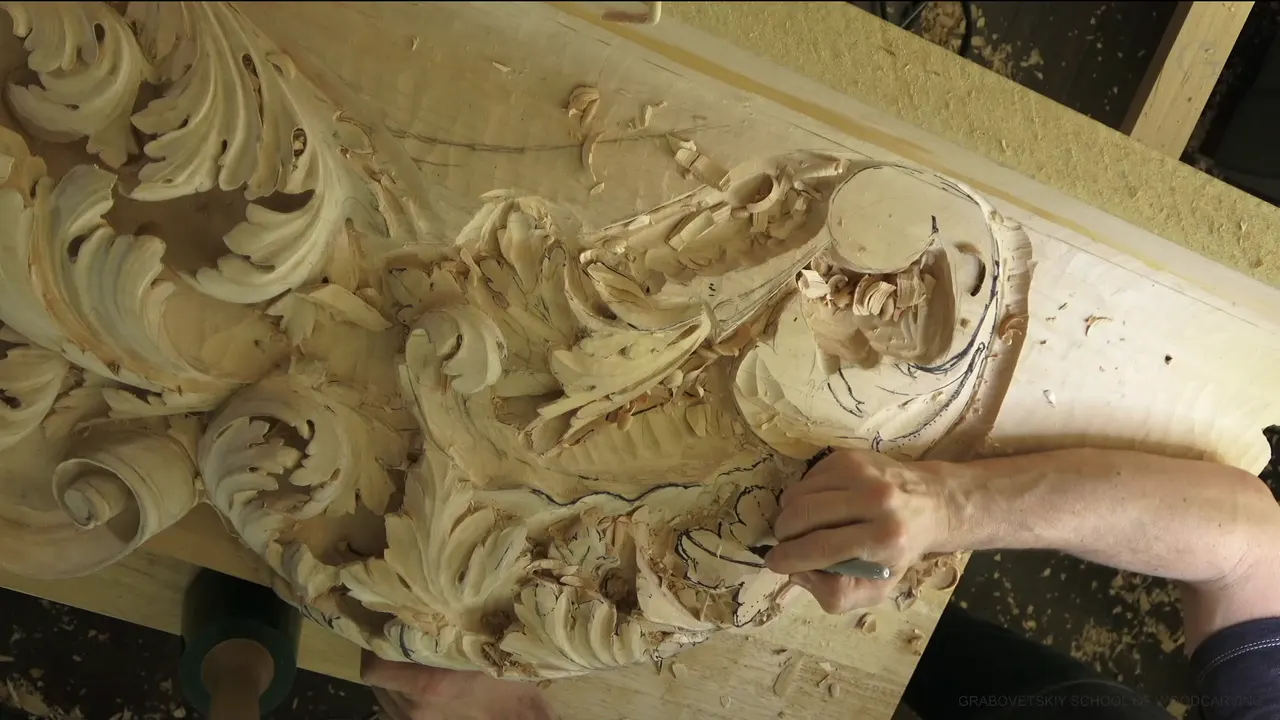

I said it in part 11 of Venice Room 55, right after I talked about my concaves. Other lessons of mine have the same words next to a mess in the middle and an edge I can draw again. Some sit beside a relief cut that is not accurate yet, and one sits beside a shell. Each place is below, with my lines.
Ever stopped in the middle of a carving and wondered how much a rough look matters at that moment? Would you like to hear what I said around those words, and in which lessons I said them? We begin with part 11.
What bothered me about the eyes in part 11?
The first line of part 11 is "You should be able to see already overall movement." Soon after it comes the thing I don't like, in these words: "how close I've got those eyes to the end."
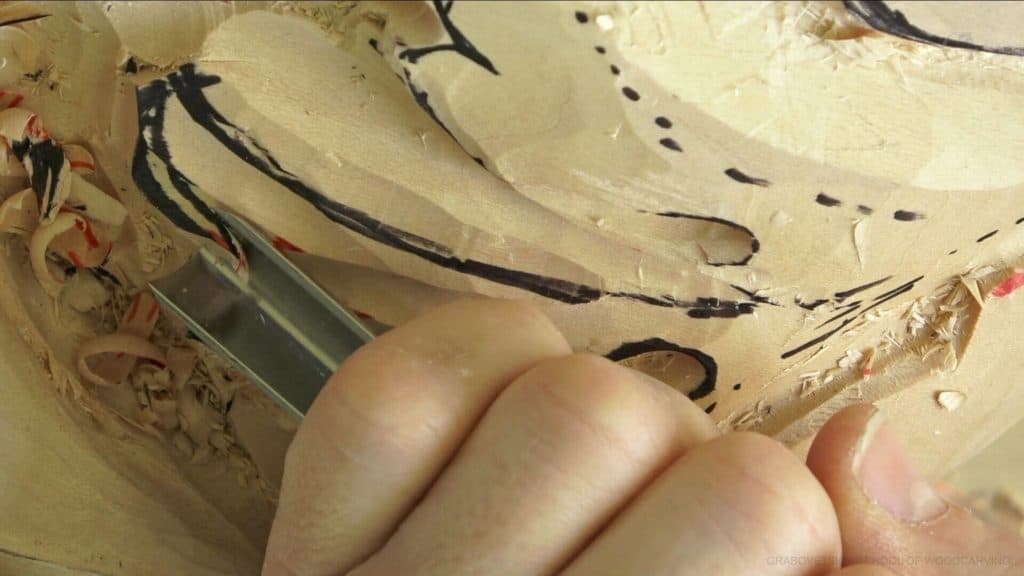
I want to see "a little farther like this" and "this side also a little bit farther like that." My view: "look better in my opinion."

Which tool and which size did I plan?
My tool plan is "the same tool, 7 millimeters in this case" (0.28 in). Next I say it could be "5 millimeters" (0.2 in), "4 millimeters" (0.16 in) or "3 millimeters" (0.12 in), "same thing." It "all depends how deep you want to create that cut."
Opposite direction is the next plan: "the right-hand side going to go above this side a little bit." Then: "Not much, but little bit." Afterward: "So that is better."

For a deeper cut I plan a "smaller tool, with the 2 millimeters" (0.08 in) "just to give some shadow." Later on I plan to "excavate it deeper," and I say "as of now, at least for I can see what is going on."
The next tool is a skew: "Skew, next tool. Blend in again. Just like that."
How big could those eyes get?
"Now I'm much happier, but I'm still not too happy how big those eyes are." A plan follows: "Maybe I have to shift it this way, and maybe I can shift that way."
"For some reason, I really want to do in this area a bigger eyes, much bigger eyes." On the size: "Even up to 10 millimeters maybe" (0.39 in).

After "That is good" comes "Chop little bit on this side." Next to it I say "careful how I attack it," because a part of a shell is coming.
What was I not worried about in part 11?
I am ready to create "a concaves and a convexes." I want "the convex in the middle right here," and I say "I have to create concave first."
The line in this page's title follows "exactly the same to the separation." Right after it: "I need to establish the main three-dimensional form because some of it going to change."

More plans: in "this area," I plan to "excavate deeper around." Then "I still need to create that" and "otherwise, it's not going to look as nice."
Next: "Deep concave." And "I'm leaning to the left to that side a little bit." I will show it "a little closer." I add "I just created that concave." In my marked area I plan to "also create another concave same way." Then: "I also going to lean a little bit toward the left," and then "maybe I should not." Maybe, I say, I "just have to create first just a straight down position cut."

The part ends on "Again, the idea behind is a concave, convex, concave."
What do parts 10 and 12 say?
The tenth part of Venice Room 55 has "Even if it doesn't look good yet, it will look good." Part 12 carries "you could clean pretty much right away, although it's not developed yet." After that: "Maybe it's too early for cleaning." Also in part 12: "I need to create nicer convexes and develop more details."
Which other Venice Room lessons carry those words?
For a first case, Venice Room 1, part 5 gives "for some reason, in the middle, I have some kind of mess." Next: "What is going on?" Those words end on "the upper part of the middle." After them: "just all solid, so I can redevelop that." Then comes "What I'm worried about, I need to make sure I do have a right dimension." A line later I talk about "the right dimension" and "the same point on another side."
In Venice Room 56, part 11 has a chop: "Just a chop. And that's going to give me a pretty clean cut." A line later: "Really good cut." The same words stop at "the edge right here, so I can always reestablish." Earlier there: "Three and one eighth. So 80 millimeters." That is my own pair, and 3 1/8 inch measures 79.4 mm.

Over in Venice Room 66, part 5 there is a spot "kind of deep, so it's a counterbalancing." A plan sits next to it: "Let me clean little bit with the skew." The next words are "I still will have to develop some concaves, convexes, so that's why I'm" and the line runs on to "how clean that cut is."

Workshops 87 to 143
Workshop 87 shows the other side of it, in part 6 of Venice Room 87: "All I'm worried about the center part," and then "lower anyway, so I am okay." Next: "I'm about three millimeters off this way" (0.118 in), "so I chopped that a little too early."
The case for a paint piece is in Venice Room 93, part 8: "those sharp lines, I really don't, especially in this case, because it's going to be a paint grade." Beside it: "this little tiny detail going to rest right on top of the next detail." Then "So which means I need to lower that down much better and much deeper."
Venice Room 98, part 5 includes "number 11 and 10 millimeters" (0.39 in), "get rid of those marks I just created." I plan "a mallet." The line begins "Again, going to remind that" and the same words end on "how it looks on outside yet." I say I will be able to "clean it nicer a little later." Last: "But preliminary, that's okay."

In Venice Room 99, part 7, I say the opposite: "it looks like I have plenty of material. I was worried a little bit."
Next on the list is Venice Room 114, part 1, which holds "first of all, I need to lower this down like this." It stops at "lose a picture, overall picture." Close by: "Just indicate that."

From Venice Room 143, part 3: "I'll just take it out." After it, "not bad." Beside the words: "So it's actually made it a little lighter." Another line has two offers: "I could go that part higher than this part, or I could make this part higher than that part."

The Furniture Panel and Lily Box lessons
Furniture Panel 18, part 5 has "three millimeters, number 11" (0.12 in) and "I'll just outline exactly the same way what I did before." Part of my line is "making it too deep." Further: "I want to probably stay away a little bit from the line." Then: "safer for me."

In Furniture Panel 19, part 15, I say "let me create opposite direction convex cut." About "losing the edge," I say "I really don't." Next: "I can always draw it again." Soon after, "right here in this spot, I can create a deeper cut."
The video Furniture Panel 28, part 3 offers "it's just preliminary just to get an idea." Later: "create multiple cuts."
Lily Box 2, part 6 has "again, the same tool, with number four, and blend that in." My words go on to "how clean my edges are. I'm talking about the edge of the design, because later on, we're going to use a smaller tool and get underneath and clean it even better."

I explain: "I don't want to create a mark on the wood if I'm going to go down," and I plan, later on, to go "underneath and undercut, and it's going to leave that mark on the wood."
In part 1 of Lily Box 13, my words are followed by "Because it's like a sacrificial piece. And that's about three-eighths of an inch thick, about 10 millimeters, no more than that." The pair is mine too, and 3/8 in measures 9.5 mm. Another line: "It doesn't have to be oak, like in my case."
Part 10 of the same lesson has "this is a throwaway brush, so" and my words reach "destroying it with adhesive." Next: "let me grab a knife, and I'll just trim a little bit the edge." Then "Any knife will do, but just a small one."
The Roman, Greek and Hashemi lessons
Roman Acanthus 16, part 1 has "I don't want to smash my fibers. Just relief cut." The words stop at "if it's not that accurate yet. Like I said, it's just a relief cut."

The second part of that lesson has the words, and next to them "I'll have a chance to remove it. And I would like to use my tool as long as possible before I switch to another tool."
Over in Greek Acanthus 3, part 2 gives "And at this stage," and the line runs on to "how clean I'm making my cuts." After it: "Right now, the most important thing for me to make it quick without losing too much time, not a really important stage of the carving."

I correct myself there: "Although every stage is probably important. I shouldn't say that's not that important. It is important, but I wouldn't worry about if it's not too clean right now." Then: "A little too messy. It's absolutely fine with me."
Hashemi Flowers 6, part 1 has "And I almost lost my original design, although I'm not that worried. I can always reestablish it." Next: "I'll take a V tool, and I will make my separation cut again."

What about movement and cracking?
In the April 2020 livestream a viewer asked about "the movements and cracking and stuff like this." My answer: "No, I don't." Next: "I'm wise when I'm gluing pieces together. I'm paying attention to grain." Then: "my wood is all seasoned. It's all air-dried."
Which lines from these lessons are in the table?
| What the lines were about in each place | Where I said it | A word of mine from that place |
|---|---|---|
| Concaves, and a form that will change | Workshop 55, part 11 | three-dimensional |
| A mess in the middle, and a part that will be all solid | Said in Venice Room 1, part 5 | redevelop |
| A chop for a pretty clean cut, and a size of 3 1/8 in (80 mm) | Taken from Venice Room 56, part 11 | edge |
| A deep spot on the opposite side, and concaves still to develop | Noted in Venice Room 66, part 5 | counterbalancing |
| A center part, and about 3 mm (0.118 in) off after a chop that came too early | Read in Venice Room 87, part 6 | center |
| Sharp lines on a piece that is paint grade, and a small detail that has to go lower | Found in Venice Room 93, part 8 | paint grade |
| A shell still to come, and a cleanup for a little later | Told in Venice Room 98, part 5 | preliminary |
| Lowering a part, an overall picture, and a line to indicate | Marked in Venice Room 114, part 1 | indicate |
| A part I take out, and a piece that looks lighter | Spoken in Venice Room 143, part 3 | lighter |
| A deeper side, and some distance from the line | Furniture Panel 18, part 5 | safer |
| An idea, and multiple cuts right on the line | Quoted from Furniture Panel 28, part 3 | idea |
| Edges of the design, a smaller tool to come, and a mark I don't want on the wood | Lily Box 2, part 6 | undercut |
| A sacrificial piece, 3/8 in (about 10 mm) thick and no more than that | Seen in Lily Box 13, part 1 | sacrificial |
| A relief cut that is not accurate yet | Roman Acanthus 16, part 1 | fibers |
| A quick stage, and cuts that are not too clean | Greek Acanthus 3, part 2 | messy |
| A design I almost lost, and a V tool for the separation cut | Hashemi Flowers 6, part 1 | reestablish |
| Cracking and movement, glued pieces and seasoned wood | The April 2020 livestream | air-dried |
Course pages: Venice Room Part 5, Furniture Panel, Lily Box, Roman Acanthus, Greek Acanthus and Hashemi Flowers. The Roman and Greek lessons are about the acanthus leaf, a number like 11 is a gouge number, and furniture panels are in the course above. Everything about wood carving and woodworking is one click away if you start here.
How it's done
- A little farther. "I think I want to see a little farther like this."
- The size options. "It could be 5 millimeters" (0.2 in), "same thing."
- The direction. The plan is "opposite direction."
- The smaller tool. The plan is "a smaller tool, with the 2 millimeters" (the size is 0.08 in).
- The concave. "Deep concave." I add that I am "leaning to the left."
- The form. "I need to establish the main three-dimensional form because some of it going to change."
Frequently asked questions
Was something bothering me about the eyes in part 11?
"But what I don't like, how close I've got those eyes to the end."
Which tool did I name in part 11?
"Okay, let me do that with the same tool, 7 millimeters in this case." The cue is a plan, and 7 mm is 0.28 in.
How big did I say the eyes could go in part 11?
"Even up to 10 millimeters maybe." Ten millimeters is 0.394 in, and the next line ends with "I don't think."
Did I plan to dig deeper later?
What to carve next