
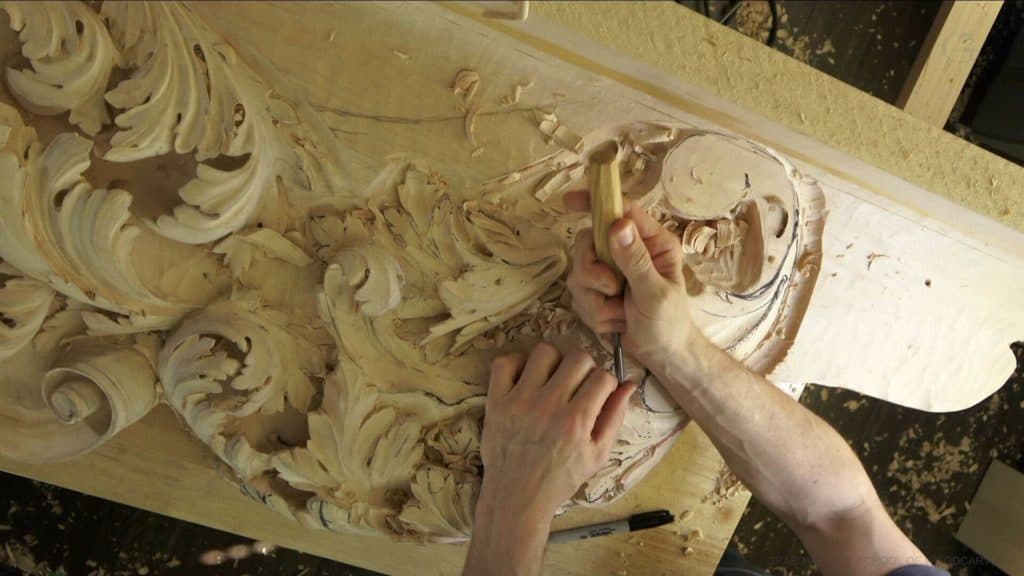
Alexander Grabovetskiy, woodcarver, School of Woodcarving · Published 2020
What does a wood carver mean by "even bigger"?
Quick answer: In workshop 55, part 12, the old tool was a half-inch one, and I named 15 millimeters, probably, as the one to use. In the same part I called that tool maybe a bit small, and I named 18 millimeters as a maybe. Venice Room, Furniture Panel, Roman, Byzantine and Hashemi lessons carry the same two words.
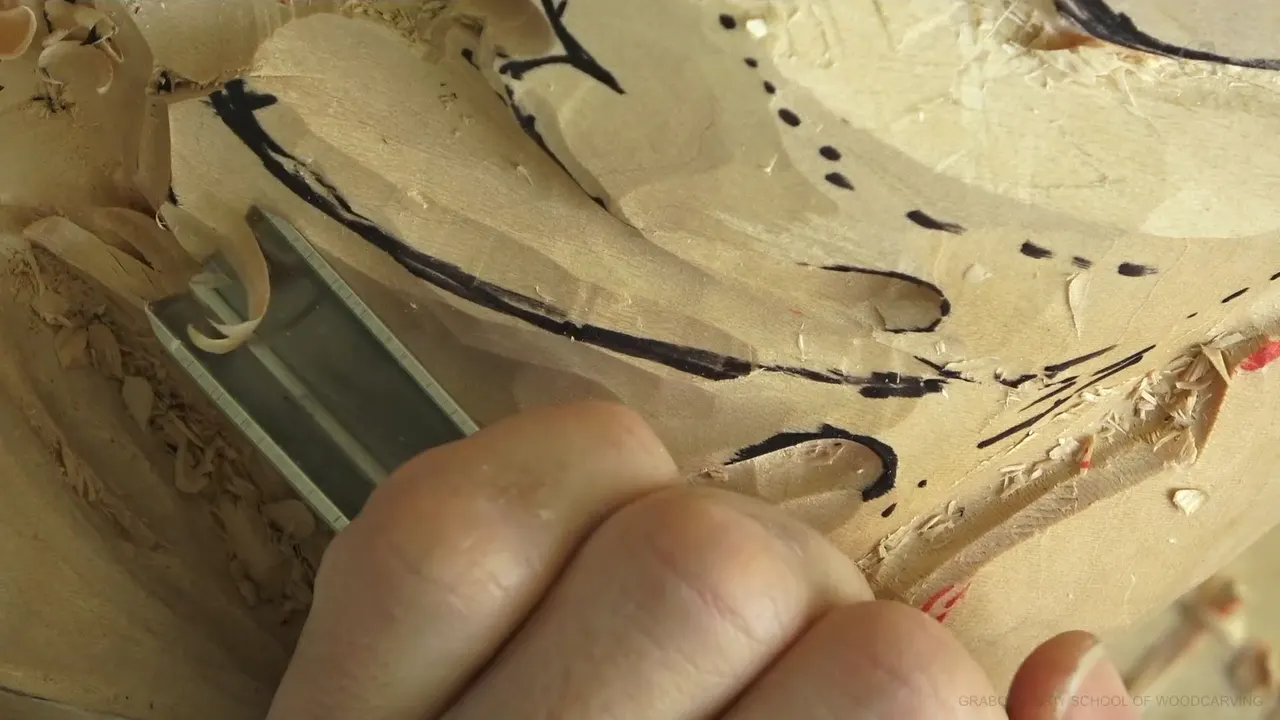

In part 12 of workshop 55 I said "a little bigger tool," and then "even bigger," with a size beside each. Other lessons of mine put the same words beside a tool, a shape and a size. Each place is below, with my lines.
Ever held a gouge and wished for the next size up? Would you like to hear how I name that size? We start with part 12.
Which size is in the first lines of part 12?
The first line of part 12 is "I could use probably a little bigger tool." Next: "That was half an inch, but I should use probably 15 millimeters, 5/8 of an inch." The old tool measures 12.7 mm. Fifteen mm is 0.59 in, a little under my 5/8 in.
The job is "And blend that little better." Then "And create kind of a deep excavation and give that form, shape." The part goes on with "Okay. So that is good."

How did I plan the second side?
"I'm going to do exactly the same on this side." About my marking, I say it marks the center of my concave. In future it will be convex, I say, but only "on a micro level convex." But "as of now," it will be a concave.

Again, "big tool. That's what I'm using. I'm using 15 millimeters, 5/8 of an inch." Of the other side I say "this side is not going to be as deep exaggerated concave, but I still want to raise this ridge."
When did the tool I had look too small?
"And this tool is also maybe a little too small for this operation. I could use a little bigger."

"But see what I did, I kept the same height, but I raised that up." About cleaning: "And yes, you could clean pretty much right away, although it's not developed yet. Maybe it's too early for cleaning."
One more problem: "And that concave is little wrong position. So I have to actually bring it all the way like that because it has to twist."
Where did a bigger size come in, and how big?
Right after the twist line I say "Maybe I can use an even bigger tool. 18 millimeters, three-quarter of an inch almost. And attack that this way." With 0.71 in as the other figure, my "almost" is fair. It is a maybe in my words.

In the same stretch: "I could have continued, actually, this cut around this big eye." Also a plan for the right-hand side: "I want to raise it a little bit up."

Where did the concave idea start, by my account?
After I name "Venetian style acanthus," I add: "Concave idea was first developed actually in Byzantine, and then it was widely adapted." Then comes "Okay, wonderful."
The pipe follows. Of it, I need to "create a pipe movement on this side." Then "So I can easily use the same tool."

An apology comes next: "Apologies if you can't see that, if I am covering that with my hands, but there is just no way I can do the other way."
What did I say about back bends in part 12?
It reaches "Now I need to create nicer convexes and develop more details. That's it." Another line: "Okay, so it's curly enough. I do have that detail. It's also a nice detail, but let me blend nicer a little bit."

The tool is named at once, in these words: "Back bends. That's what I'm going to use. Just the back bends. In this case, I believe it's a number three. Yep, and half an inch, 13 millimeters" (that is 0.51 in).
My plan, said right after the number three: "And I can blend that all the way." And "I could use just probably even straight tool." Then "That is okay."

How big could the eyes get in part 11?
In part 11 I say "same tool, 7 millimeters in this case." Five, four or three millimeters: "same thing." And "It all depends how deep you want to create that cut."
A limit follows: "Even up to 10 millimeters maybe. But 10 millimeters I'm not going to be able to fit I don't think." It works out to 0.39 in.
Which Furniture Panel lessons climb a size?
Furniture Panel 17, part 11 climbs, and then it comes back. The blade I have is a little small, I say, and "I could probably use one-eighth of an inch." I also say "I used 3/32nds, I'm sorry, before, but let me use a little bigger or even bigger."
"Yep, I think I'll be able to use even bigger." And "I'll use a quarter inch." Then "Well, quarter is a little too big. How about this? 3/16ths." I also say "Five millimeters." A quarter inch is 6.35 mm, and 3/16 in is 4.8 mm.
I call it "the blade of choice." Then "Let me try it." Soon after: "And yes, it fits perfectly inside."
At part 7 of Furniture Panel 15 comes "Hold on just a second." I go for a bigger gouge again, to see if it can "fit in any of those shapes." The size is "number seven and 80 millimeters" (3.15 in), and then I say "Maybe it's a little too big. But it gives me perfect line."

In Furniture Panel 18, part 3, I say "I probably have to attack that from opposite side." The tool for it: "I could actually use an even bigger tool. Here's a number nine and 10 millimeters" (0.4 in). The line in part 7 is "It looks like I don't have any more space for the router plane." I add "I can actually clean that with just the gouges."
Out of Furniture Panel 19, part 5 comes a line on bigger tools, "if I needed to for this movement." I want to see if I can use "some kind of extreme wrap," and I add "I'm not sure." Then "That would be probably too extreme." The gouge is number seven at 14 millimeters (0.55 in). Last, "So I should not risk it. A little too risky."
Which Venice Room lessons name a bigger tool?
Take Venice Room 40, part 3: "And I could use probably even bigger, maybe 10 millimeters" (0.39 in). Then "It's going to make a much cleaner cut."
Workshop 63, part 1, has "I really need to see a shadow of this concave." Next: "maybe even 7 millimeters, or maybe actually even bigger." Then "Maybe I should use 10 millimeters or even bigger. Let me try 10 millimeters first."

Over in Venice Room 113, part 2, I say "We take a huge gouge. Not a gouge, but veiner, number 11, 20 millimeters." Right after: "Actually, you know what? I can take even bigger, 30 millimeters." Those two sizes work out to 0.79 in and 1.18 in, in that order.
A similar climb sits in Venice Room 111, part 1, where I plan "a bigger number 11, maybe 20 millimeters." A size bigger still is on the table too, "if I wanted to."
Venice Room 117, part 1: "I take 20 millimeters again." The next line is "I could take actually even bigger, maybe about 30 millimeters. Thirty millimeters, number 11, of course." About it: "It's going to give me a really beautiful smooth cut." And "later on, I don't have to clean as much."
In Venice Room 118, part 2 a bigger one is within reach, "like 20 millimeters I would say." And in Venice Room 160, part 1 a bigger one is possible too, and my plan is "the 12 millimeters."
From Venice Room 163, part 2: "I can actually use even bigger than 15. Let me use 20 millimeters." The 20 is 0.79 in.
And in Venice Room 35, part 8, the line is "maybe seven is not even big enough."
What about the Byzantine, Roman, Hashemi and Lily Box lessons?
In Byzantine Acanthus 2, the first part starts with "take the biggest tool you have. The biggest of the biggest." In my case, "I took number nine, which is a half round," and you could go bigger. I brought number 11, "one of my favorite tools." I say I could get the job "much quicker" with it, but "that's a 30 millimeters" (1.18 in).

Roman Acanthus 2 has, in part 1, "I'm still using the same gouge, still number eight." I say I usually use bigger than number eight, and "I do understand not all of you have the big gouges." Then "Any big gouge, number eight, number nine."

In Hashemi Flowers 39, part 2 comes "And now I'll take again number four and make some cleaning." Next: "Well, I could use, actually, a spoon. Even bigger spoon." The spoon is about 5/8 in (15.9 mm), number seven, as I say it.

Over in Hashemi Flowers 2, the first part has "bigger tools, they give me a lot more flexibility and speed." The line goes on: "I'm using this one." Going bigger is possible, I say, and "I could use three inches" (76 mm). And "really often I am using that." Then "Although, maybe it's too big for this case. Maybe not."
In Hashemi Flowers 15, part 2: "Definitely, if you have a even bigger than this gouge, it would help." Next: "Let me take a three inch or three inches." Then "The idea is still the same. Bigger tools you have, quicker you do."
Hashemi Flowers 27, part 2 says "this one is about one inch and number eight. You could use number nine." Then "Any big gouge." Something bigger is possible too, and "Could use number seven and huge three inches."
In Lily Box 3, part 3 the line is "if you don't have a number 11, you can always use a small number three, well, even bigger one." Next: "Let me prove the point." The gouge is a number five, and "this one is about a quarter inch" (6.35 mm). And "you can just use upside down that number five." The result will not be the same, I say, and removing "all that junk" is hard.
In Grinling Gibbons Maine 8, part 1, after "Just excavate around," I say I could probably go bigger, and "it should be okay."
From Roman Acanthus 14, part 4: "Again, it's all about patience. Maybe I can get even bigger now." After it: "And just excavate, approaching from both sides. Don't press it too much."

Does the phrase ever point at a shape?
It does in Venice Room 48, part 7: "this is the smallest, this is a little bigger, that is even bigger." The biggest comes after it. My next line is "Okay, so it's logical for acanthus."

Hashemi Flowers 42, part 1: "those flowers, I've got different sizes. Smaller, little bigger, and even bigger. So all four of them, it's little different sizes."
Which lines from these lessons sit in the table, and where did I say each one?
| What the line was about in each place | Where I said it | A word of mine from that place |
|---|---|---|
| A 15 millimeter tool for a concave, after an older one | Taken from this part, 55.12 | concave |
| Eighteen millimeters, and only a maybe | This same part | attack |
| Back bends for the blend, and 13 millimeters | End of 55.12 | blend |
| Maybe ten millimeters, and a much cleaner cut | Heard in workshop 40, part 3 | cleaner |
| Four movements, from the smallest up to the biggest | Said in workshop 48, part 7 | logical |
| A veiner of 20 millimeters, then a bigger 30 | Noted in Venice Room 113, part 2 | huge |
| Twenty again, then thirty, with a smooth cut and less cleaning later | Workshop 117, part 1 | beautiful |
| Fifteen, a size bigger than that, and a plan for 20 millimeters | Spoken in workshop 163, part 2 | blending |
| A blade too small, then a quarter inch too big | Found in Furniture Panel 17, part 11 | perfectly |
| Seven, of 80 millimeters, maybe too big, with a perfect line | Marked in Furniture Panel 15, part 7 | perfect |
| Number nine and 10 millimeters, plus a router plane with no space left | Seen in Furniture Panel 18, parts 3 and 7 | gouges |
| Bigger tools if needed, and an extreme wrap I should not risk | Furniture Panel 19, part 5 | risky |
| Flowers in different sizes, the last one even bigger | Said in Hashemi Flowers 42, part 1 | waviness |
| Even bigger spoon, a number seven, as I say it | Quoted from Hashemi Flowers 39, part 2 | spoon |
| Three inches as an option, and a case where that is maybe too big | Heard in Hashemi Flowers 2, part 1 | flexibility |
| A gouge that would help, and a three inch to take | From Hashemi Flowers 15, part 2 | quicker |
| Nine to use, then a number seven of three inches | Given in Hashemi Flowers 27, part 2 | huge |
| Nine, a half round, and number 11 as a favorite | Byzantine Acanthus 2, part 1 | favorite |
| Small number three, then a number five of about a quarter inch | Lily Box 3, part 3 | junk |
| Patience, and a maybe for a bigger tool | Roman Acanthus 14, part 4 | excavate |
Course pages: Venice Room Part 5, Furniture Panel, Roman Acanthus, Hashemi Flowers and Byzantine Acanthus. A number like 11 is a gouge sweep number, and the acanthus is the leaf in those two courses. For wood carving, woodworking and furniture basics, start here.
How it's done
- Name the plan. "I should use probably 15 millimeters," I say about a smaller, older tool.
- Use it on the first side. "I'm using 15 millimeters."
- Say the same for the second side. "Exactly the same on this side."
- Watch the size. "Maybe a little too small for this operation."
- Keep the height. "I kept the same height, but I raised that up."
- Reach for back bends. "I believe it's a number three."
Frequently asked questions
Which size did I name after the old tool?
I named 15 millimeters, probably. Fifteen millimeters is 0.59 in, and the older tool was 12.7 mm. That part names 18 millimeters as a maybe, and calls the 15 millimeter tool a bit small for the operation.
Did I name a bigger size in part 12?
I said "18 millimeters, three-quarter of an inch almost," and it was a maybe, at 0.71 in. Just before it, I say the concave is in a little wrong position and has to twist.
What did I use for the blend near the end of part 12?
Back bends were my plan, and I believe it is a number three, and I give 13 millimeters, which is 0.51 in. A straight tool is another option: "I could use just probably even straight tool."
What to carve next