

Alexander Grabovetskiy, woodcarver, School of Woodcarving · Published 2020
What does a wood carver mean by "two tools in one"?
Quick answer: In part 2 of workshop 55, I gave my reason for the number 11. Straight down it is a gouge, and leaned toward one side it makes a more pronounced up cut. The veiner was 10 millimeters (0.39 in). Other lessons of mine use the words double tool, multi-tool and multi-use.
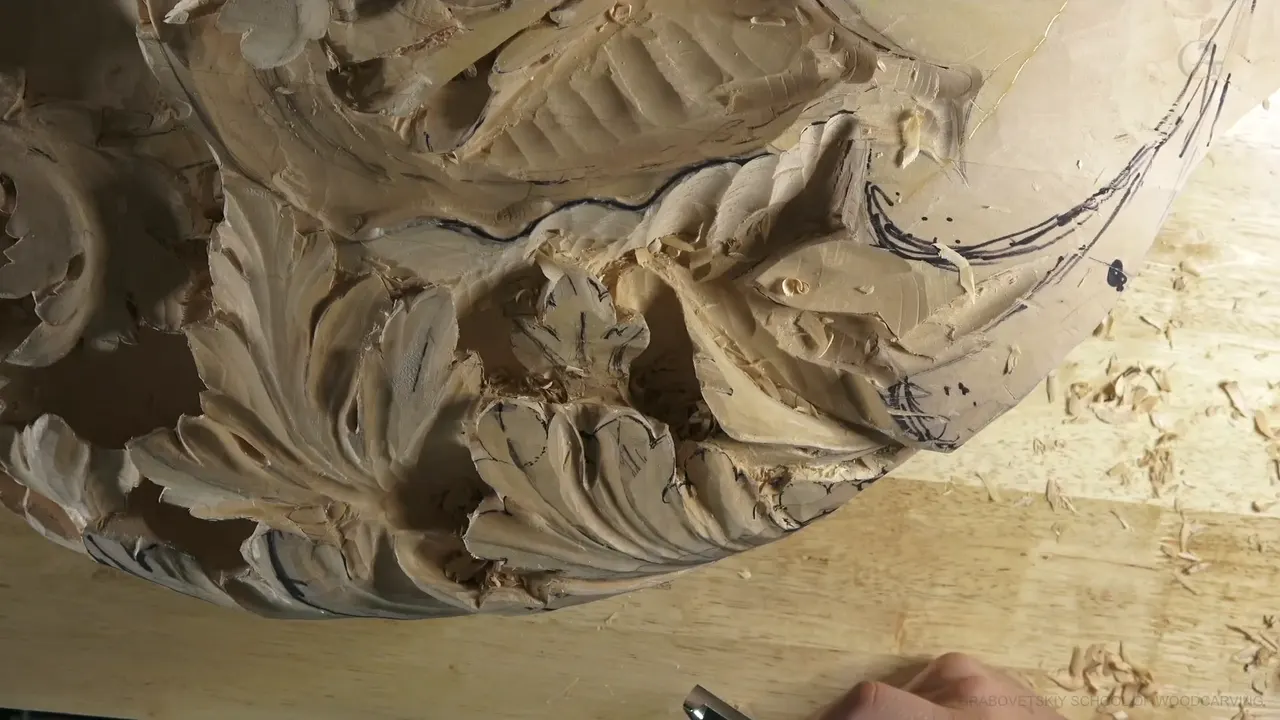

What does number 11 do for me? In workshop 55, part 2, I gave the answer while I carved a concave cut with it. It is a veiner of 10 millimeters (0.39 in), and for it and for other tools in other courses I use words like multi-tool, multi-use and double tool. This page goes through each place where I said it.
Ever wished one gouge could do the work of two? Would you like to see how I lean a number 11 to get a different cut out of it?
Which tool did I take for the concave cut?
"Let me get my concave cut right here." The cut had to go all the way like that, I said, and I planned it with the number 11 this time. That meant taking 10 millimeters, which is 0.39 inches, a veiner.

Why do I use number 11 so much?
"And why I like number 11, it actually like a two tools in one. Okay?" I can just place my tool straight down and use it as a gouge. Or I can actually create a different type of cut: lean it toward one side and make a lot more pronounced up cut like this. It's going to be concave, with this ridge raised up a lot more and a lot shallower cut on this side, which is going to be equal like a number three, I would say. And in this case, it's exactly what I planned to do.

What do I want from the ridge and the convex?
"I really want to exaggerate this ridge. I want to raise it and create extra shadow. See that? It's already casting the shadow." "Without taking too much of material on this side because I do not want to lose main convex, which is this part."

I can create "beautiful concave," I said, and "I can actually go even deeper if I want to. See how deep shadow it casts? Really nice." Again, I am leaning toward left side right now. "So I'm not using tool straight, but I'm leaning like this. Okay. Hope it makes sense."
"But see how deep shadow it creates? It just creates that effect, just rolling effect. All right? Extra dimension. And I still did not lose my convex." "So see? Beautiful, right?"
Where did I plan another concave?
"So now what I have to do, I also want to create a concave cut, maybe concave cut on this side." And: "Also, just to give some extra shadow." I planned to do that with the same tool. I want to raise this part, this region, this ridge, a little bit without losing overall convex.

I also will exaggerate this eye area. "This is the eye of acanthus." The tool is the same, 10 mm (about 0.4 in) by the way, a veiner number 11. "It's a U shape, like letter U shape." Not a straight cut, I said: I'm "leaning little bit toward the right side."

"And it's already created a raised part and extra shadow on this side. It's already casting it." As I said before, wood carving is pretty much all about shadows and lights.

Probably I can work on my eye right here a little better, or nicer. "And it's not the finished product, of course. There is a lot of work yet needs to be done. But you should be able to see it."

I offered to show you overall how it looks, and said it again: "That is Venetian style. Venice, Italy."

How did number 11 work in the other parts of workshop 55?
Part 3 holds the same tool. About an excavation on the side, the first cut I plan to create is, "as always, number 11." And: "In this case, I think it is absolutely the best tool to use." I planned 12 millimeters (0.47 in), about half an inch in my words.
Part 1 names it too: a veiner, number 11, at four millimeters (0.16 in) for an excavation right underneath. "Probably this one is a little too big." Two millimeters (0.08 in) was possible, or one and a half even, which would be better. "That's what I'm going to use": one and a half millimeters (0.06 in), a 1/16 of an inch.
Where else did I praise number 11?
Workshop 2 of the Vase with Grape Leaves course has it in part 6. For a concave cut I could use exactly the same number seven, but it's not going to give me really nice movement closer to that point. "So what I need to do, I need to change my tool." I like to use number 11 in 10 millimeters, three-eighths of an inch in this case: "like a U-shaped tool." The reason why: "I can exaggerate one side to another side." It matters, I said, because "we can play with the shadows."

My plan was to lean it a little bit to the left, just slightly, and kind of blend. "The beautiful thing about this tool, when I'm cutting with just the wing with that side, it pretty much becomes like number three, I would say. It's a multi-tool in one."
Workshop 15 of the Roman Acanthus course, part 1, has this: "You can see it creates a really deep, like a spoon effect, like an inside spoon, and it casts even more shadow. And that's what I like about the number 11." Even more pronounced, even deeper: that was possible too. Leaning on one of the sides, I said, my U cut will be on the inside, closer to this edge.
It works just approximately like a number nine gouge, "but it's different because it's a U shape. It's actually like a double tool." On the sides, for me, it creates a sweep, about maybe a number two sweep, I would say, or number three if you are in England. Attacking from the side, let's say number nine cuts inside, but my number three sweep just cuts opposite side, this side.
Part 8 of Venice Room 53: I have to create four concaves to create two pipes. "And again, number 11, that's the tool." Held straight, the tool does a gouge's work, but "if I'm going to move to the right or to the left, I'm creating absolutely different cut." There I planned to move to the right to make it blending, and to blend it with the previous cut.

Part 6 of Venice Room 34: the long bend doesn't work in this case. I have to use a short bend or medium bend. "That is a medium bend. Also number 11, by the way." "And why I'm using number 11s a lot, I like because it works like a gouge, but it also works as a U shape." Used on its side, it just becomes a gouge, a lesser sweep; used on the bottom only, it's also like a gouge, but like number nine. If I need to undercut, "it gives me a U shape. Okay. So it's like really nice universal tools."

Part 7 of Venice Room 57: "Not good. I pushed too much, so I have to be a little more careful." I could go with the 1 millimeter (0.04 in), "and I think I should. It's going to give me even more depth." Of course, that's a number 11. At least on this section of a room, I'm using a lot of number 11s. "And number 11, just a really universal tool, like I mentioned before. So you can do a lot of stuff with the number 11."

Over in workshop 12 of the Floral and Molding for the Panel course, part 1, I said: "I like number 11 because you can blend pretty much right away." The flute is facing up, like 12 o'clock. Rotating it in any direction and using either side of the tool is "a really, really good thing." My tool can go to about 10 o'clock and attack closer to this edge, which will also be raised up somewhat, or rotate to about 1 o'clock and blend the center part. I need to make sure it just feels like it is rolling, almost rolling underneath.
My April 2020 livestream on sharpening a number 11 U-veiner explains the shape. "It's actually a U cut." "It's like a letter U." Veiners are made for the veins of acanthus leaf: "They actually designed those tools around acanthus leaf. And the beautiful thing about veiner, it's actually a multi-tool, okay?" You do have a gouge part, which is the bottom part, the curvature, and you do have number threes on both sides.

You can make a straight cut, the way a gouge does. The cut I showed "cannot be done with the gouge because the gouge going to cut only straight down. Even if you're going to rotate, it's still not going to create that type of cut." With number 11, "which is normally marked number 11 everywhere in the UK and in Europe," you can rotate right when you cut, or work it as a number three, using just the side of it to blend.
Same stream, same tool: "you remember, number 11 is not the same as a gouge." The sides behave as number three gouges, and the bottom part works as a number nine gouge.
Which other tools do I call a multi-tool?
If you would ask me why this tool is different from a normal skew, I said in workshop 3 of the Chamomile and Bow Rosette course, part 2, I do have a heel, and I can get with that heel underneath. A normal skew has only one bevel, "doesn't matter, 22 and a half or 45 degrees, or 60 degrees," but this one has multiple bevels. Middle part, heel or point, any of them works for me, "and that's just like a multi-tool in one."

Part 9 of Venice Room 89 takes a question from one of you: "why I like this tool, why I'm not using number three or just a knife." A knife is no problem: "I love knives, as you know." Of that tool I said, "It's chisel, but it's a really handy chisel. So it has whatever the angle I want to use." I added that "with the same tool, I can get a lots of operations."

Part 1 of Venice Room 63: "It is chisel, actually," and "it has all of the skew chisels in it. It has a 45 degree, it has 22 degrees, and it's actually excellent tool to have. Multi-use."
Workshop 23 of the Hashemi Flowers course, part 4, is about a number 12 knife: "Just because of that sharp point of the knife, I don't have to use the same sweep gouge." I called it a multi-use tool: "So you can do a lot of work with just a cheap carving knife."

What about the V tool?
The V-Tool Problem lesson in the Carving Tool Sharpening course counts the parts of a tool: "I'm talking about three parts of this tool." The bottom part doesn't have a sharp point, "and I treat this part as a tool number one and I would call it gouge." The sides, this side and that side, are two chisels. When you're sharpening, I said, keep in mind it is three tools in a single tool. "Once you understand that it's not a problem."
In the in-person sharpening class, about the V tool: "Two chisels, number one, and gouge, whatever number it is." It's the same thing like other tools.
Which lesson held which line?
Here they are side by side, with the tool and the lesson for each one.
| The words I used in that lesson | Tool | Where I said it |
|---|---|---|
| Place my tool straight down, or lean it | Number 11 veiner | Part 2 of Venice Room 55 |
| A double tool, with a number three sweep on the sides | A U shape | Workshop 15 in Roman Acanthus, part 1 |
| Really nice universal tools | Number 11 | Part 6 of Venice Room 34 |
| Just a really universal tool, like I mentioned before | Number 11, 1 mm | Part 7 of Venice Room 57 |
| Rotate any direction and use just either side of the tool | Number 11 | Workshop 12 of Floral and Molding |
| A gouge part at the bottom, and number threes on both sides | A veiner | The April 2020 livestream |
| This one has multiple bevels, not a single one like a normal skew | Not a normal skew | Workshop 3 of Chamomile and Bow Rosette |
| So it has whatever the angle I want to use | A really handy chisel | Part 9 of Venice Room 89 |
| Multi-use: all of the skew chisels are in it | A chisel | Part 1 of Venice Room 63 |
| Just because of that sharp point of the knife | A number 12 knife | Workshop 23 of Hashemi Flowers |
| I would call it gouge, the bottom part with no sharp point | A V tool | V-Tool Problem, Carving Tool Sharpening course |
Where can you watch them?
Each one sits inside a course of mine. The Venice Room Part 5 course holds workshops 50 to 61, and Venice Room 55 is the lesson for this page. The other courses in the table hold the rest, and they are one click away if you start here.
How it's done
- Pick the number 11. The concave cut was planned for the number 11 this time, a 10 mm veiner (0.4 in).
- Hold it straight or lean it. Straight down it gives a gouge cut, and leaned over it makes a different cut.
- Raise the ridge. The ridge is the part I want to exaggerate, with extra shadow, without taking too much of material on this side.
- Keep the main convex. Main convex is this part, and I want to keep it.
- Plan the second concave. On this side I also want to create a concave cut, for some extra shadow.
- Look at the shadows. Wood carving is pretty much all about shadows and lights, I said.
Frequently asked questions
What size was the veiner in workshop 55?
At the eye area I gave the size, 10 millimeters, and said it's number 11, a veiner. That is 0.39 inches. It is the tool I planned for the concave cut.
What changes when the tool leans?
The concave stays, I said, but this ridge is raised up a lot more, and the cut gets a lot shallower on this side, equal to a number three.
Did I keep the convex while I deepened the concave?
I said I do not want to lose main convex. Right in that stretch of the part I said "I still did not lose my convex."
What did I say about the number 11 in the Roman Acanthus course?
What to carve next
- Venice Room Part 5
- Venice Room 55
- Venice Room 53
- Venice Room 34
- Venice Room 57
- Venice Room 89
- Venice Room 63
- Vase with Grape Leaves course
- Vase with Grape Leaves 2
- Roman Acanthus course
- Roman Acanthus 15
- Floral and Molding for the Panel course
- Floral and Molding 12
- April 2020 livestream
- Chamomile and Bow Rosette course
- Chamomile and Bow Rosette 3
- Hashemi Flowers course
- Hashemi Flowers 23