

Alexander Grabovetskiy, woodcarver, School of Woodcarving · Published 2020
What does a wood carver mean by "authentic"?
Quick answer: Part 3 of workshop 55 is where I talked about design and said "really authentic." In other lessons I said authentic beside Venice, the 15th century, a knife and a Dutch reed. Each place is below, with the lesson it comes from.
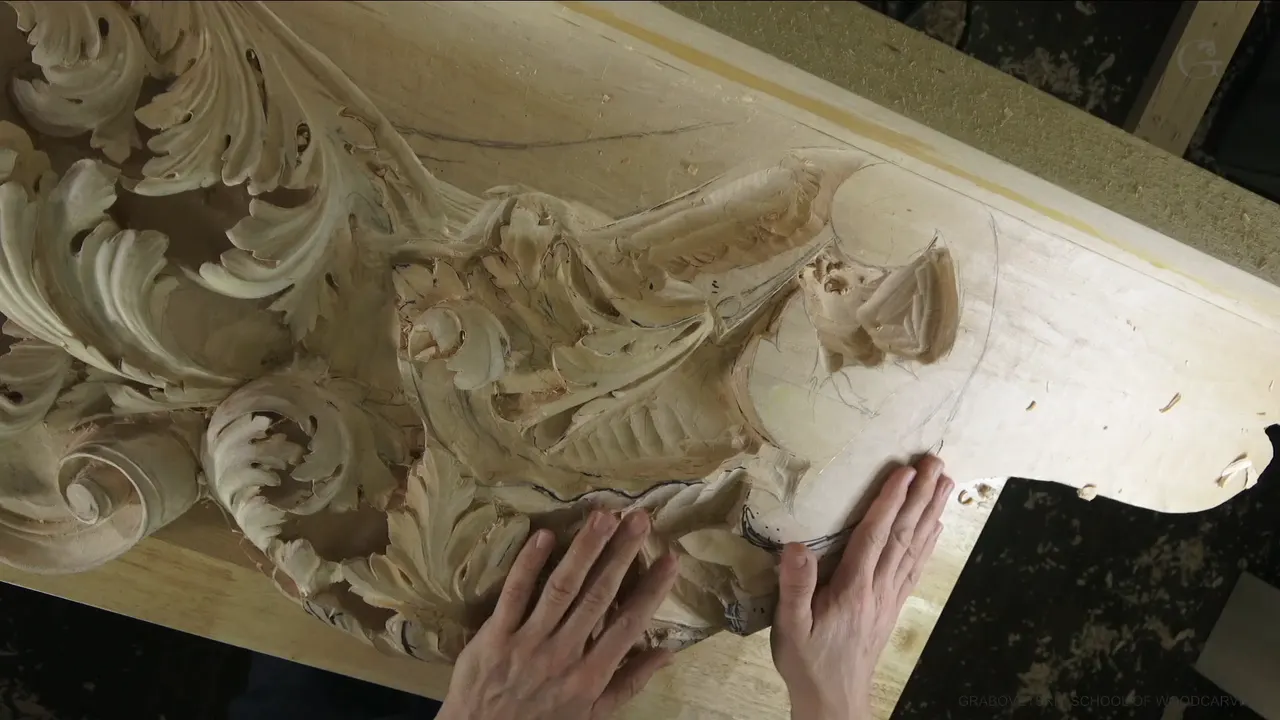

Where does authentic come in? In Venice Room 55, part 3, while I explained how I develop a chunk of wood into a movement. Other lessons carry the same word, beside centuries, tools, edges and leaves, and this page goes through each place.
Have you ever looked at an old carved leaf and wondered which tool made it? Would you like to hear which tools I said I could not use on one Venetian project?
What did I say in workshop 55, part 3?
My plan was to continue with the same development I worked on previously. The big picture, I said, I would probably not show, "because for me it's impossible." I'm moving toward the right, I said. I planned to work on just one of the sections.
I want to show my approach to design, and it's "not really the design techniques, I should say, but I'm going to show you how I develop." Let's say I have a chunk of wood right there, and I need to develop some movement out of it, one that connects to the overall movement. I also need to create beautiful acanthus.

One part, I said, "goes on the ceiling pretty much." It continues, so I have to extend it even higher and glue another board above. Another part will be a head of acanthus, and a little thing will be growing "from underneath of this movement."
And this: "But I need to make sure it's really authentic to the original."

"Okay, let me do that. Let me work on it." On the step number one I said: "I probably have to create the excavation on the side. So just outline it first."
A huge corbel will be connected in the future, I said, and I would connect it with the dominoes. "So I need to keep some of the thickness, which you don't see, but I have to keep it."
How did I plan the first cut?

The first cut I planned was, "as always, number 11." For this case I said: "I think it is absolutely the best tool to use." As for the size, "I'm going to use 12 millimeters, about half an inch." That is 0.47 inches. "And yes, I am using mallet."
A lot of people, I said, "bang like this. And they get the pain in the shoulder also." The mallet is supposed to be used "only like a free-hanging, just inside of your palm." That way "your hand is not becoming really tired." I use it that way, I said, "even if you don't see that."

I need to change the direction, I said, and outline my head of acanthus. I call the cut I had just made "Outlining Cut, or Setting In if you are in England."

"Really important for me to establish some shapes." Of the look I said: "Right now, it just doesn't look too appealing to me, so I need to raise this part."
Which place and century did I mean?

Over in my April 8 livestream I described movements that run in opposite directions and said I did that on a purpose, "because I really, really want to be authentic." In my words the style is "a Venetian style 15th and 16th century." Of regions I said: "different regions, they do different development of acanthus."
On April 14, in the livestream on plastic as a carving tool, I said "I developed the design. I did." But I must be "authentic to original Venetian design," I said. I went on: "The way they did acanthuses, the way they created concaves and convexes and so on." And the scrolls or volutes: "how they twist them because there's different twists."

For the architects "who are really picky about authenticity," to be authentic is "really important. What tools you're using, the movements you're using, even finish." For common people, I said, "it doesn't make a big difference."
A particular client, I said in Venice Room 1, "asked specifically for research and to match the design, match the details, what they did in Italy in Venice in 15th century." So I had to research, design, draw and model, "even 3D model on my computer until we agreed, yes, it looks authentic." "People checked and rechecked everything."
Venice Room 103, part 4, mentions "some kind of oak" that "doesn't really look like oak in my understanding." And: "But I had to be authentic to Venetian era, Venetian style, end of 15th, beginning of 16th century, and that is how they did it."
Furniture Panel 14, part 2, is a design lesson. Why those complicated movements? "I try to stay authentic." Every little detail "makes it look really, really nice," I said. In the same part: "we are trying to use some authentic movements," I said, and the panel itself will be "kind of unique."

The Plate with Butterflies course goes to a different place. Its workshop 4, part 1, has "stylized carving you have to be authentic," and I named "Scandinavian countries, Norway, Denmark," and the "northern part of Russia." I said you can find that type of movements all over buildings made from wood there, about the same. "Scandinavian Northern Russia, and that's what I would like to stick to."
My October 2020 livestream says that for a carving in Italian style, "that's 15th, 16th century Italian style," I had to study what they used back then. "And they used a lot of gouges and veiners."
A carving in my sandpaper video is made for a huge pipe organ and for gold leaf, and I said it has few details: "that's how it's supposed to look, right?" It's authentic to German Baroque, I said.
Why could I not use knives or V tools?

My April 13 livestream has this: "I didn't use any knives yet, but I'll show to you." My reason, I said, was the original carvers: "in Italy they didn't use knives too much, okay?"
The same livestream has the client side: "it depends on the client. If you're doing for yourself, you can use whatever tools you wish. Doesn't really matter." About my project I said: "I cannot use V tools or knife, okay? The reason why, because I really want to be authentic 15 and 16th century."
"It's not forgery. Don't get me wrong. So it's a known fact that it's done in 21st century by me. But the techniques, they have to keep authentic." For yourself, I said: "obviously knives and you can do V tools, you can use gouges. In combination, that is a good idea."
About a Venetian room, in Questions and Answers, I said I have to be "really, really authentic in wood they used, in tools they used, and I don't want to use any machines." I did use machines "in preparation of wood for the lamination, for gluing." As for the carving: "All I used is just the authentic tools."
Which other tools did I talk about?
The outline of my design, in Venice Room 1, part 1: "Yes, they would use a Bow saw to be authentic, but like I said, this is a production work." It's "all hand carved, of course, but if I can incorporate a jigsaw or a scroll saw, sometimes I will."
Part 5 of Venice Room 72 has a line about "this tool." Is that tool authentic for the time period I work in? "Of course, it's not," I said. But "they used knives, and this is a form of a knife anyway. So and a knife would be authentic, I would say."
On rasps, in Venice Room 24, part 6, I said that for a long time I did not buy them, since I thought they were not authentic in the wood carving world, "but it's not true." "I know for a fact that other master wood carvers, they're using those tools." "I think it just gives a really nice result."

In Lily Box 13, part 3, the idea behind those legs is "I also can hold it just by my fingers and work on that piece also more safely." Of those legs I said: "it's authentic technique, by the way, to the 17th and 18th century carvers. They did use those legs." The source of that, I said: "I really don't know. I just read that in the books."
How does authentic change the carving?
Concave cuts again on a Roman acanthus, I said, "a concave on the inside of those leaves." That was in workshop 6, part 6: "Well, it doesn't have to have, don't get me wrong, but I would like to stay authentic to the history in this case." And a hedge: "I can't say most, I didn't see all of them, but whatever I could find in the history books and the pictures online, ancient pictures and so on, they all have concave cut on inside of those leaves."

A Greek leaf runs differently. Greek Acanthus 5, part 4: "A lot of times on the Greek acanthus leaf, there is absolutely no ridge, just a pure V cut. But you could. It still would be authentic if you would leave a ridge on inside."

The edge in Roman Acanthus 16, part 3: "That is only one of the ways to make it look more classical." I really like a really sharp edge, I said, but in this case I'd like to be more authentic to history. "It just creates extra dimension, extra line, extra shadow, I should say." The knife "has to be absolutely sharp."
Sanding in Roman Acanthus 8, part 4: "I'm not going to use any sandpaper." "Nothing wrong with using sandpaper, but it's just if it's the purpose of wood carving, then you're just establishing the shape." What goes missing, I said, is "the chisel marks, the feel of the hand done." "It's better to leave those ridges," I said, and it's "going to be just more authentic." "Every ridge will create its own feel."

The eye in Roman Acanthus 10, part 2: "I have to take some more material inside like this. If I'll make my cut little deeper at the area of the eye, it's going to look more authentic, more organic."
Points matter too. Venice Room 18, part 5: "There is certain designs of acanthus where you see those sharp points. So it's not like that's the only way to do it." The only reason why I want to do it that way, I said, is "because trying to be authentic." "I know why they actually don't have those points. That wasn't on purpose."

Part 2 of Venice Room 62 is about a convex. "Just because I don't have a convex on the other hand, I can see really good shadow. But it-- Not authentic. I got to have some convex." And: "I really need convex at least on one side."
Facets in Venice Room 6, part 1: "Even small facet, even small cut creates the shadow." And about the look: "I want to look authentic, but not rustic."
Is hand work enough by itself?

Hashemi Flowers 36, part 1: I said I wanted to make it "more authentic and looking more realistic." I added: "It's still authentic. I shouldn't even say the word. It doesn't matter what you do, it's still going to be authentic because you've done it with your hands." "But more realistic looking." And: "I have to actually undercut underneath of this and create the shadow."

Hashemi Flowers 18, part 4, has a reed: "if you would be working in the 17th century, you would use a Dutch reed." "I actually placed it on a roll of paper, and it's dried, and they use that actually to work on the edges." Of a really sharp edge and no sandpaper, I said: "So it's a more natural, more authentic way. Just a Dutch reed."
Which lesson held each line?
Here are twelve of them, with the lesson they come from.
| The line I said | The subject | The place I said it |
|---|---|---|
| Make sure it's really authentic | Acanthus movement | The part on this page |
| Authentic in wood and in tools, no machines | Venetian room | Questions and Answers livestream |
| Not knife or V tools on this project | My project | My April 13 livestream |
| Italian style, that's 15th, 16th century Italian style | Old tools | October 2020 livestream |
| A concave on each leaf's inside | Roman leaf | Roman Acanthus, part 6 |
| More authentic, in this case, to history | Sharp edge | Roman Acanthus, workshop 16 |
| It's better to leave those ridges, I said | Chisel marks | Lesson 8 of Roman Acanthus |
| I want to look authentic, but not rustic | Small facets | Lesson 6 of Venice Room |
| The only reason why I want to do it that way | Pointy leaves | Workshop 18, part 5 |
| Not authentic, I got to have some convex | A lost convex | Workshop 62, part 2 |
| I called it a more natural, more authentic way | A Dutch reed | Hashemi, part 4 |
| It's authentic to German Baroque, I said of a carving | A pipe organ | My sandpaper video |
Where can you watch every one of them?
The Venice Room Part 5 course holds workshops 50 to 61, and Venice Room 55 is the lesson for this page. The lessons above are linked where I named them, and you can start here too.
How it's done
- Make sure it is authentic. I need to make sure it is really authentic, I said.
- Handle the side. The side needs an excavation, and I probably have to outline it first.
- Plan the first cut. A number 11, 12 mm (0.47 in), is what I planned, and I am using a mallet.
- Hold the mallet free-hanging. Just inside of your palm, so the hand does not get really tired.
- Name the outlining cut. The cut I had just made is an Outlining Cut, or Setting In if you are in England.
- Raise the part. It did not look too appealing to me, so I said I need to raise this part.
Frequently asked questions
Which line in part 3 mentions authentic?
In part 3 I said "really authentic" while I talked about design, with a plan for an excavation on the side.
Which tools did I say I cannot use on one Venetian project?
On April 13, in a livestream, I said I cannot use V tools or a knife on the project I'm working on. It depends on the client, I said. For yourself, I said, you can use whatever tools you wish.
Do my lessons call a knife authentic?
In Italy, I said, they didn't use knives too much. Part 5 of Venice Room 72 has me saying they used knives. Each line belongs to its own lesson.
What to carve next
- Venice Room Part 5
- Venice Room 55
- April 2020 livestream
- October 2020 livestream
- Venice Room 1
- Venice Room 6
- Venice Room 18
- Venice Room 24
- Venice Room 62
- Venice Room 72
- Venice Room 103
- Roman Acanthus 6
- Roman Acanthus 8
- Roman Acanthus 16
- Hashemi Flowers 18
- Hashemi Flowers 36
- Furniture Panel 14
- Plate with Butterflies 4