

Alexander Grabovetskiy, woodcarver, School of Woodcarving · Published 2020
Which old English wood carvers were tradesmen, and which were artists?
Quick answer: In old England, the carvers of boats and of road vehicles were tradesmen, I said in Venice Room 55. Carvers of architectural work sat above them, and a carver like Grinling Gibbons, who could design in three dimensions, was an artist.

Old English wood carvers sat on different levels, and in part 5 of workshop 55 I gave the lower ones the word tradesman and the top one the word artist. Men who carved for boats, coaches and buggies were the tradesmen. Architectural carvers sat above them. Someone like Grinling Gibbons was the artist.
Do you carve for love, for money, or a little of both? Would you like to see where the old English carvers drew the lines? Then pull up a stool.
What does the old ladder of carvers look like?
- Boat carving was the bottom rung, with huge, chunky work.
- Coach carvers, the buggy carvers, came next, and their work held a little more detail.
- Home carvers matched architectural carving: egg-and-darts, corbels, arches.
- A fourth level was artistic, and my example was Grinling Gibbons.
- Architectural carvers reached perfection with one detail, yet I said they were not able to design.
- Art against craft got a third word from me, and that word was trade.
Who were the boat carvers?
The boat carvers, I said, were the lowest level, and I placed them in the 17th, 18th and even 19th century in England. They carved for the big boats in the ocean and the seas. The carving was really huge and chunky, and the tools were a lot of axes and adzes.

In Russia we would call it the topornaya rabota. Then I said, "Let me show that to you. The main tool was right there." That's what they would use, just the axe. Those are rough carvers.
In my April 2020 livestream on making money in wood carving, I added that Grinling Gibbons used to carve for boats for a little while, until he found really good customers. Huge movements were their work there, and I said they could not do really detailed work.
What lifted coach carvers one step up?
Coach carvers came next. Those coaches on the roads of England were theirs, and then I put it another way: we're talking about buggy carvers. That is the second level. They got a little more detail, because people would come closer to those vehicles and look at the details.
But it was still on the road, where the work would be banged and destroyed, and it was still big. The main tool would be the same tool, maybe big gouges. The livestream says it again: vehicle carvers, or buggy carvers, sat a little higher than boat carvers, with a lot more details for people to look at a little closer.
Which work belonged to the home carvers?
Third and higher came the home carvers, equal to architectural carving. They did a lot of egg-and-darts, and a lot of moldings with some acanthus movements. Frames for the pictures, for the art, were theirs too, along with architectural stuff like corbels. Beautiful arches with some carved details came from them as well.
Who stayed outside? In that livestream I said people did not have projects like that inside common normal houses, only palaces. Nobody would let a boat carver or a vehicle carver go in and carve a mantel or an over mantel, and neither would carve egg and darts or the acanthus on a crown molding. Still, architectural carvers could carve on boats and vehicles.
Where did the artists sit?
The fourth level was artistic, "like a Grinling Gibbons." Those carvers developed beautiful designs over mantels and over picture frames. I fixed a word there: an art frame, I should say, because they did not have a picture, of course. They had a fine art. Someone carved that frame for the art, and people like Gibbons, the higher, artistic level, created something surrounding the existing frame.
In that livestream I called the top level artists. The three before were just craftsmen or tradesmen, I said, but he was an artist. He carved beautiful flowers and beautiful movements, with a lot of deep excavation, and that was the highest level, I would say. There I put the first three together. In workshop 55 I split them, with tradesmen on the boats and the roads and architectural carvers above them.
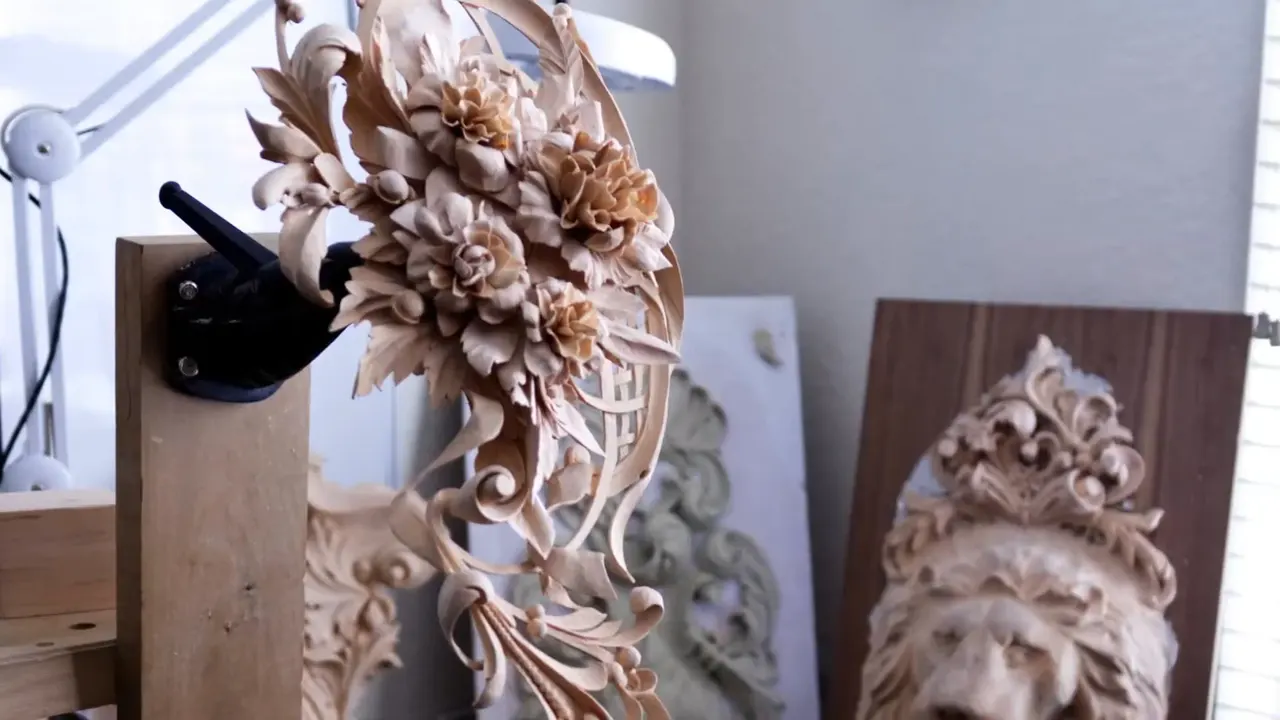
I showed you the piece with the flowers, one of the projects in my school online. It's really complicated. This piece is decorative or ornamental carving, and the name for the carver is ornamental wood carver or decorative wood carver. If that work pulls at you, my Grinling Gibbons class in Maine is its own course.
Why add trade to art and craft?
The question I opened with was art and craft: who is more artistic, and who is just doing a craft? It applies to wood carving and stone carving, I said. Are stone carvers and wood carvers artists? And there's a third option, tradesman, and "it's just a trade."
In part 4 a viewer had asked me about two approaches to traditional carving, one from a drawing in 2D and one from the form in 3D, in the words "craft against art." I had done both, I said, and I don't see anything wrong with both of those approaches.
Part 5 is where the third word arrives. People who carved for boats and carved on the road, those coaches and buggies and vehicles, "those are just the tradesmen." Different level. A craftsman would be an architectural wood carver.
Why is there so little art in architectural carving?
There's not much artistic going on there, because there's not too many details, honestly. Go into the old palaces and look at all the moldings applied: crown moldings, base moldings, chair rails and all the other moldings. They are about the same. Hundreds of designs, maybe, yes. But one detail got carved day after day after day, egg-and-dart, egg-and-dart, all the time.
Those people developed really good skills. They could carve with closed eyes with no problem, and not miss even one millimeter (0.04 in). It's perfection. But they were not able to create. They would not be able to design. That would be another level, like a Grinling Gibbons ability to design and think in a three-dimensional world. Those people were artists.
Are sculptors a different type of artist?
A different type, I said, and not a different level. Lots of artists draw and paint in a two-dimensional world, millions of people all over the world. Go into almost any village in any country, and at least someone is artistic. Almost every class, even a small one of 10 to 30 children, has one artistic child. I was one of those children at school. I always had to do something for the class.
Millions of artists, but not too many sculptors: maybe thousands of them. Sculptors work in the three-dimensional world, and carvers are sculptors too. Modern sculptors usually add on, with clay or other media, but a wood or stone carver chops out what is not supposed to be in that piece. That's the Michelangelo example I told before: a big marble stone, chopped to reveal what is inside. My workshop 55 page goes deeper into that split.
Does a carver need to be an artist?
I asked how all that applies to a carver who works from a pattern of their own design, against one who takes a chunk of wood and develops the idea on the wood. "I don't know," I said. You still have to be artistic and an artist, I said, and you still have to know how to do that, which is not that hard, by the way. I pointed to my Furniture Panel design course, where I spent a long time developing the idea of what it would be, because it was going to be authentic to 18th century design.
Any artist who is carving wood, I said, has to develop skills or craft, I would say: the skill of the craft of woodcarving.
How did my teacher sort carvers?
In another April 2020 livestream, the one where I confessed to using clay before wood, I told you about my teacher, the master who taught me wood carving. He divided carvers into two types. One type is artistic, artists, and they really love what they do. They usually rise up really high. And there are tradesmen. They're also really good carvers, but all they do is just for money, just get rolling, get some money.
History shows it too, I said, in the time of Grinling Gibbons in England. In his time he was the artist, and there used to be a lot of tradesmen. Look at his work and compare other rooms. His carving is all really deeply undercut, and that takes time. Undercutting and cleaning up takes a lot longer than just establishing form. Other carvers did not go really deep. Their chopping went about 15, 20 degrees down, I said. Maybe. I don't know what the degrees are.
The reason people say they developed a classical approach to wood carving, I don't buy that, I said. Easier, quicker, I said, and you get paid the same. As for my own approach, I told you I'd rather develop it really to the details.
Why do some palaces show so little undercut?

Lily Box 8, part 8, has more on this. If you go to some palaces and look at classical wood carving, you don't see that deep undercutting sometimes. There is a reason, I said, and the reason was not that it looks better. The work went much quicker, and they had done tons of it. People just didn't want to spend too much time. The carvers had to make some money, and they would get paid only after the work was done.

To get it quicker, they would eliminate some of the details. For common people it still looks nice, I said, and the overall movements still look really beautiful.

Only other tradesmen know exactly why they did it. It's all about money, all about how quickly you can get the payment for your work. But upper scale wood carvers, like Gibbons, did really deep undercutting, and he spent a lot more time working on those details.

Where else did I name the top level?

In Roman Acanthus 13, part 5, I said I know for a fact there are different types of wood carvers in history. Boat carvers carved for the big boats in the 18th, 17th, 19th century. Other carvers worked outside, carving for the vehicles. Inside carvers worked for the houses, divided also in two: architectural carvers, who concentrate more on architectural details, and ornamental ones, like Gibbons.

Ornamental wood carving is actually the most difficult, I said. You're working with the really tiny, smallest details if you work in an ornamental style. "And believe me, those small, tiny details make the biggest difference." The gouge I showed there was about 1/16 of an inch (1.6 mm).

Even if it's a simple form of acanthus leaf, I said, I still would like to see this one as a piece of art, not just a furniture detail, although you could use that on furniture. My goal was to make it look more unique, more ornamental. That's why I was spending time on those details, because I really wanted to see a beautiful end result.

What do perfectionists look for on a furniture panel?

In Furniture Panel 22, part 8, I told you we were trying to create "the real piece of art." The people who will look at it are furniture makers, and some furniture makers are perfectionists. I meant the real makers who can spend a lot of months on just one piece of furniture, not production furniture makers. They pay attention to every detail, and people are not stupid, I said, they will see all imperfections.

I was using a quarter-inch (6.35 mm) number seven. "Be careful," I said, "because you can't just push it." The grain goes like that, and if you push it, you can break that grain. I made my first pass like that, then another this way, and I said the next one would go in this direction. Not just pushing, but slicing a little bit. "It's almost invisible to the eye, but I'm still slicing. It is micro-slicing."

That technique applies if you're doing a bead molding with multiple parts, I said. "You can do really accurate, and people will look at it, they don't even know you did it by hand." It looks like it's done on a machine, but it's not.

In Venice Room 1 I was talking about people living in just one town. There are certain people, "wisemen" I call them, who developed their own techniques, even to the design. In Pennsylvania and in Boston they carved exactly the same shell design. The two shells look different. Local makers are just normal people, I said. They work every day and don't go too far.

Which lesson held which line?
Here are the places, each with the words I used.
| Lesson | Content | Words |
|---|---|---|
| Workshop 55 | Boat, coach, home and artistic carvers, level by level | they would be divided in different levels |
| Lesson 55 | Boat and coach carvers named as the tradesmen | those are just the tradesmen |
| Livestream April | Three groups below, and one artist above them | that would be the highest level |
| Livestream April | My teacher named two kinds of carver | And there's tradesmen. |
| Lily Box 8 | Quick work in palaces left the deep undercut out | other tradesmen, they know exactly why |
| Roman Acanthus 13 | Inside carvers split into architectural and ornamental | ornamental wood carving is actually the most difficult |
| Furniture Panel 22 | The real makers who spend months on one piece | people are not stupid, they will see |
| Room 1 | Local makers in every town found their own way | they're just normal people |
Where can you watch them?
Each one sits in a course of mine. The Venice Room Part 5 course holds workshops 50 to 61, and Venice Room 55 is the lesson for this page. The Furniture Panel course and the Roman Acanthus course hold more of my lines, and the rest are one click away if you start here.
How it's done
- Start at the lowest level. Boat carvers made huge, chunky work, with the axe as their main tool.
- Step up to the buggy carvers. Vehicles on the roads of England got more carved detail, because people came closer.
- Move inside with the home carvers. That level matched architectural carving: egg-and-darts, moldings with some acanthus movements, frames, corbels and arches.
- Reach the artistic level. My example was Grinling Gibbons, with designs over mantels and around frames, and the ability to design in three dimensions.
- Add the third word. Art against craft got a third option from me, and it's a trade.
- Sort the levels by word. Boat and coach carvers were the tradesmen, and the carvers who could design were the artists.
Frequently asked questions
Which tools did the old boat carvers use?
Axes and adzes, I said, with the axe as the main tool. Their carving was really huge and chunky, made for the big boats of the ocean and the seas. I called them rough carvers.
Why did coach carvers add more detail than boat carvers?
People would come closer to those vehicles and look at the details, I said. The work was still on the road, banged and destroyed, and it stayed big. Maybe big gouges, I said.
Which carvers sat in the middle level?
In workshop 55 those were the architectural carvers, who carved one detail like egg-and-dart all the time. They could carve with closed eyes and not miss one millimeter (0.04 in). Those carvers could not create or design, I said.
What to carve next