

Alexander Grabovetskiy, woodcarver, School of Woodcarving · Published 2020
Was a carpenter in Judea 2,000 years ago a woodworker or a stone worker?
Quick answer: Most carpenters in Judea, I said in Venice Room 55, worked with stone, as did most of those called carpenters across the Roman Empire. The word did not have to mean a woodworker or a framer, and the temple was being rebuilt in that time.
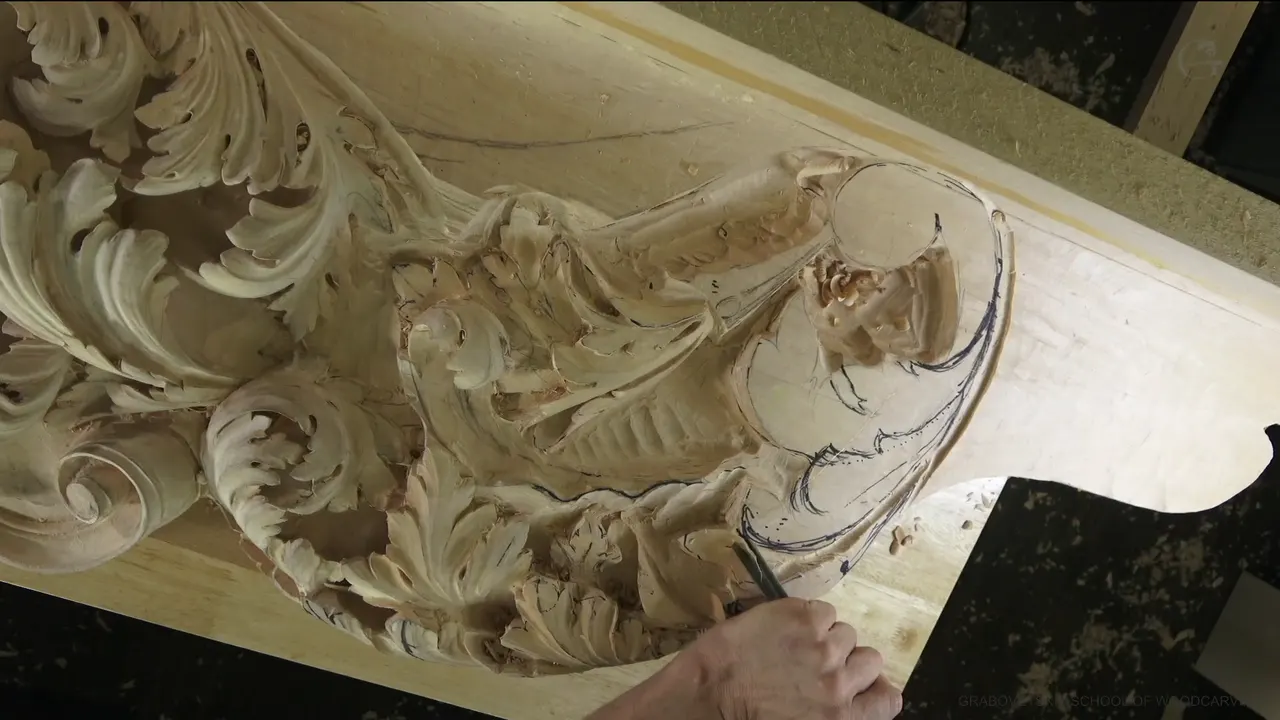

A carpenter living in Judea 2,000 years ago was not necessarily a woodworker, I said in part 6 of workshop 55, and most of the people called carpenters there and across the Roman Empire worked with stone. Someone had asked if Jesus and his father had inherited any of Noah's tools. "To say he inherited Noah's tools," I answered, "absolutely not."
Do you picture a man with a hammer and a stack of boards when you hear the word carpenter? Would you like to hear what I said about it? Here it is, and here is what I carved right after.
What I said about carpenters in Judea
- In English, Jesus's father is a carpenter.
- A framer or a bench builder is not what that word has to mean.
- Stone was the work of most carpenters there.
- The temple was rebuilt in those years, and a lot of stone workers worked inside it.
- Solomon's house was built from cedar.
- Noah's tools: absolutely not.
Was a woodworker the same as a carpenter?
The English translation, I said, has Jesus's father as a carpenter. Yet a carpenter living in modern-day Israel back then is not necessarily a woodworker. Nor is he necessarily a framer who would take lumber and frame a house, or build a bench, or do some kind of cabinetry work.
"It's not true," I said, if you know a little bit about the history. Most of the people who were called carpenters, there and in all the Roman Empire, were stone workers. They worked with the stone.
What was going up in those years?
A temple, I said. It was rebuilt one more time, and a lot of stone workers worked inside of it. They worked on other buildings and houses too. The Wikipedia page on the Second Temple covers that period of temple building.
Wood is a different story. As you know, there are not too many structures made of wood in Israel, I said, even if you know a little about the history, especially in Judea. Then I caught myself: "Yes, I shouldn't say not too many."
What could carpenter mean in Greek?
I took the same question up in my Tray of Blessing course, lesson 8, part 4. Of Jesus's father I said, "Yeah, he was a carpenter." Then came this: "word carpenter in Greek could mean anything." It could be just a stone carver, I said, or a stone prep guy who just does limestone and shaves the stone, and he is still going to be a carpenter.
The Wikipedia page on tekton shows how wide that Greek word runs. Another line from the same part: there was not a lot of forest in Israel in the ancient times.
Which wood went into Solomon's house?
Cedar, I said in workshop 55. There was a time, in Solomon's time, when his house was built from cedar, and then it was just gold-leafed and so on. They used a lot of cedar.
My April 2020 livestream says more. A viewer asked my opinion of yellow cedar, and I said cedar wood is great, but I just don't like the grain of it. It just distracts the eye. You can't do really tiny details because of the grain. But for huge details, I said, it's a wood that was used in history, even when Solomon built the temple: all inside, before they gold leaf it, it was all done in cedar. "But it's from Lebanon. It's different cedar." The cedar of Lebanon has its own Wikipedia page.
Did anyone inherit Noah's tools?
My words were "absolutely not." First of all, I said, we don't even know what kind of tools he had. For the story itself, the page on Noah's ark will do.

I wondered about tools the same way in my Lily Box course, lesson 2, part 5. Sometimes I just wonder what type of tools those people in ancient times used. I was talking about 3,500 years ago, or to be exact, 3,600 years ago, when they did the Ark. They did it in a wilderness, I said, and I wonder what tools this guy used, and the people who worked for him too.

Did they have gouges, or did they use just a knife? "Well, most likely, probably, they used just a knife, I would say." They did not do really complicated carvings, I said. Then: "But I don't know. Of course, I don't know." Even with a knife you can do really beautiful stuff. But there is some stuff a knife can't do that gouges and veiners can.
What wood is gopher wood?
On the first layer of the lily box this wood made me happy somehow, I said, because I was thinking about those ancient times and the people who used to work with it. I don't know why they chose this particular wood for building the Ark, and the same wood was used on Noah's ark. Then came a fix: "I should say, it's what people think."

Gopher wood is the name in the Bible, I said, and people think it is actually acacia. "For 100%, nobody can say it's 100% it's acacia." More theologians believe it, though, and I have no reason not to believe them.

On the olives, in lesson 13 of that course, I said the decision to use the gopher wood and the olive wood was made because the box is connected to the Bible and the Holy Land. It doesn't have to be that, I said. You can do cherry, you can do walnut, you can do even curly maple if you wish.
Who built the Ark of the Covenant?
A viewer wrote that the carving of the temple is what inspired them. I answered that for me there was a guy before the temple, who built the Ark. It says in Exodus 31 and 35, I believe, that God filled him with the spirit of knowledge, wisdom, and understanding, and ability to work with different materials and carve wood. "So he's one of the guys I really appreciate." Wikipedia has a page on the builder the book of Exodus describes.
My Hashemi course carries the same thought. Lesson 24 has me calling him a woodcarver and a stonecarver who also used to work with all types of material. In lesson 5 of Greek Acroterion I said the Bible calls him a wise man, and he could work with stone and wood and metals.

The Lily Box video gives the verse a second part: "And ability to teach." Which means he was teaching some other people to work alongside, I said, and they also carved and built together with him.
My video about carving wood behind bars in Russia has it as well. There is a verse in Exodus about a guy who was building the Ark and the tabernacle, the whole thing. It says God filled him with the wisdom, knowledge, and understanding, and with the ability to do all the crafts, and it specifically mentions wood carving. "So I had to be wise, what should I do to survive and be alive?" Wood carving, pretty much, was something I knew how to do really good. That story is in Let me introduce myself.
What would I add to wisdom, knowledge and understanding?
Patience, probably. In the Hashemi lesson I said you have to work for a long time in one area, and there is patience involved in that. You have to be kind of patient. It really builds your character. So that is not a trade for people who want to do something quickly. Sometimes, working with a customer, I said, some customers do understand, some customers completely don't, and I have to explain to them.
Have the tools changed since then?

Woodcarving is a really ancient trade, I said in that lesson. It takes the same tools as two thousand years ago, the same setup, the same thought process. The only difference is who is better, the ancient woodcarver or me, or you. A little later in the lesson I was using just a V-tool to make two berries.

Same knives, same chisels, same gouges, same hand planes for thousands of years, I said in the Greek Acroterion lesson. "So I can imagine he was still using the same tools carving his Ark of the Covenant." A woodcarver 300 years ago, 500 years ago, even a thousand years ago, would spend about the same number of hours on exactly the same piece. "The only difference would be who's better."
Where did gold come in?

In workshop 162 I said the Romans pretty much adapted the idea of the acanthus leaf from Greek culture. Byzantine is the eastern part of the Roman Empire, I said, pretty much a Christian country, and it adapted the idea from Rome. The Romans did not use gold leaf. The Byzantines used acanthus leaves in churches, and they wanted to use gold leafing. They started to make carving more beautiful by applying gold on it.
Then comes my line about the temple, in Venice Room 162: when Solomon built a temple, and even when Moses built the tabernacle and the Ark, it was covered with carving. And all of it was covered with gold.

The page on Solomon's temple has its history. In workshop 4 of my beginner cutting board course I said that long, long time ago, even in ancient Israel, King Solomon built the temple for God Most High, and he used what in some cultures is called Solomon's cucumber. Look at it really close, I said, and it looks like a cucumber. The whole element is a really ancient element, and its most recent name, probably, is volute.
What did I carve right after that answer?
After the answer my words were "Let me carve," and then, "It's that outlining." A little later: "That is the outlining."

Deeper in one area was the plan, because I really wanted to create a three-dimensional excavation there, a three-dimensional look. "I'm going to take 30 millimeters," I said, which is about 1.2 in. "Number 11. And I'll go all the way." After that came "maybe this way a little more," and a plan to probably lower this side right away.

It looks scary, "but it's not." I know what I'm doing, I said. Just like that. And "maybe even lower this part."

What was I trying to get? A deep cut, as low as possible, but still leaving some of the chunk for the connection point. And still, I said, I don't want to lose the overall feel, but I really, really need to create the movement.

For that I probably now have to switch to one of my favorite tools, just a skew chisel. In England that would be number two. In Germany or other European countries it would still be number one, "because in Germany, number two would be already a gouge. It's a different tool."

Two needs came next. I need to give some roundness to this area, and I'm also going to do a little bit of roundness of this side. And I need to reveal this part, because it is "going to be visible from the bottom." I really want to make sure it will be. "Okay, that is great."


In part 7 of the same workshop I said I need to develop this section before I move to another and work on details, and maybe I will have to make some changes to the original movement. In part 5 of that workshop I took on art against craft and called it a tricky question, really tricky. The rest of the workshop is on the Venice Room 55 page.
Which lesson held which line?
Here are the places, each with the words I used.
| Lesson | Content | Words |
|---|---|---|
| Workshop 55 | Judea's carpenters were mostly men of stone | they were stone workers |
| Workshop 55 | Noah's tools were not handed down | absolutely not |
| Tray of Blessing 8 | A stone carver was still a carpenter | word carpenter in Greek could mean anything |
| Livestream April | The temple inside was all cedar from Lebanon | it's different cedar |
| Lily Box 2 | Gopher is acacia, people think, though nobody is certain | nobody can say it's 100% |
| Hashemi 24 | Same tools and the same setup as long ago | same thought process |
| Greek Acroterion 5 | Knives, chisels, gouges and hand planes held steady | same hand planes for thousands of years |
| Venice 162 | Carving and gold covered the temple and the Ark | covered with gold |
Where can you watch them?
Each one sits in a course of mine. The Venice Room Part 5 course holds workshops 50 to 61, and Venice Room Part 14 holds workshop 162. The Lily Box course, the Hashemi Flowers course, the Greek Acroterion course and the beginner course hold the rest. The talk about gopher wood and olive wood is in Lily Box 13. Everything else is one click away if you start here.
How it's done
- Name the area. I carved an outline first, and said, "That is the outlining."
- Dig deeper. I wanted a three-dimensional look, and I said I was going to take a 30 millimeter (about 1.2 in) number 11 and go all the way.
- Keep a chunk. I wanted a deep cut, as low as possible, but still some of the chunk left for the connection point.
- Reach for a skew. I probably now have to switch to a skew chisel, my words went. In England that is number two, and in Germany number one.
- Add roundness. This area needs some roundness, my words went, and this side needs a little bit too.
- Reveal the part. This part has to be revealed, because it will be visible from the bottom.
Frequently asked questions
Was Jesus's father a woodworker?
In English translation, I said, his father is a carpenter. In Judea that title mostly belonged to stone workers, and a lot of them worked inside the temple when it was rebuilt.
Were Noah's tools handed down to Jesus?
When someone asked, I said, "To say he inherited Noah's tools, absolutely not." We don't even know what tools Noah had, I said.
Which wood do people think gopher wood is?
Acacia, I said on my lily box, and more theologians believe it. I have no reason to doubt them, though nobody can be sure of it.
Did Solomon build his house with cedar?
What to carve next