

Alexander Grabovetskiy, woodcarver, School of Woodcarving · Published 2020
What does a wood carver mean by "incorporate"?
Quick answer: I said in part 7 of Venice Room 55 that maybe I would incorporate one movement in the main one. My other lessons use the verb beside a volute, acanthus, wood turning, a jigsaw and olives, and each line is below with the words I used.
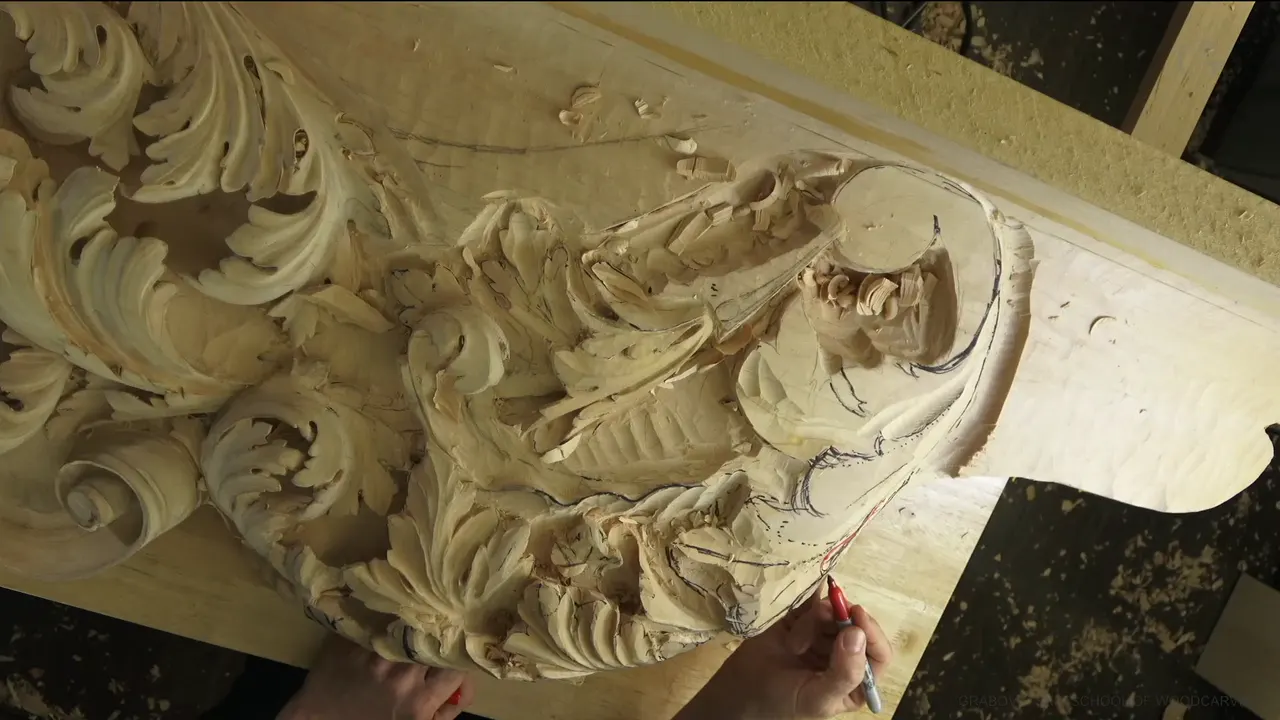

In part 7 of Venice Room 55 I said, "Maybe I will have to incorporate this movement in the main." The part holds a chunk I want to save and an original movement I may change. The same verb sits in my other courses, beside acanthus, volutes, wood turning, a jigsaw and olives, and each place is listed below.
Do you ever catch a drawing saying one thing while the wood says another? Would you like to hear my words? Here are the lines from part 7, then the lessons where the same verb sits.
What I said in part 7 about incorporate
- I don't really like this development.
- Maybe some changes to the original movement, but let me see first.
- My middle movement, middle point movement, I should say.
- I really, really need to get this movement much wider.
- Some kind of eye.
- Number 11 again.
Which section did I want to develop first?
One I was not done with. My words were that I need to develop this section before I move to another and work on details, and that some changes to the original movement may follow. After that, a short line: "But let me see first."
I would go this direction and make one long line. It looks okay, I said. The development itself I didn't really like. Originally, I said, the overall movement is supposed to go that way, and this piece is supposed to be below, but I kind of don't like the feel of it.

Right after that came the verb, for this movement and the main one. That would be my middle movement, my middle point movement, I should say. The movement, I said, really, really needs to get much wider, because there will be some separations, and part of this chunk has to become part of that middle line.
What did I want to do with the chunk?
Save it. "I know I'm not trying to confuse nobody," I said, and on the other hand I'll need to create some kind of eye. I still want to save this chunk, because I really like that it's a little bit sticking out.
Then: "And let me think what's the best way." I could actually roll and create exactly the same idea I had done in another area, I said. I planned to bring it all the way to this point and make an opening.
My next words: "I do understand it's a little bit confusing." I hope you understand what I'm doing, I said. And then a request: "please forgive me, I am developing at the same time with you."

How did art against craft fit in?
That day I did the live stream, and someone asked me a question about art versus craft. I added trade in wood carving. The artistic approach, as I understood the person who asked, is when you look at the piece of wood and try to reveal what is already hidden in that form. About the person's interpretation I added that I shouldn't say it, because I really don't know what it is.
Then my own words: "It's exactly what I'm doing right now." I was looking at the chunk of wood. On a piece of paper it looks one thing, I said, and in real life it looks little different.
Which marker and which tool came next?
A red marker, I said, would indicate my boundary for the lower part of this acanthus. My apologies, I said, if you really can't see. And: "I should use different marker." The division would go right underneath, and "I really want to see some eye." There would be another eye, with a division going toward this movement right there.

I think it will be good, and I believe it's really nice when I'm going to add some flowers. "Flowers and some movements. Then it's going to be super unique."
For the first tool on this movement I'd use the same number 11 again, to create my preliminary cuts.

The eye came next, in my words: "I can actually exaggerate this eye. I can make it bigger." Outlining that side would follow, and then "let me outline this way."
After "Okay, that's good," came a need: blend everything. "Otherwise, even I can get lost."

"Essentially, I'm doing exactly the same what I've done before." I'm just taking out this ridge and creating this eye, which you don't see, and it's supposed to feel like this movement goes right underneath of this part on the right-hand side.
In part 8 I said, "I'm using just the skew." Then the mess, which I said I'll take care of with the number 11. "It's a preliminary separation, but it's a good separation now," I said, and I need to blend this region because right now it also doesn't look too good. Further on, I said this part needs to be lower than that overlapping movement, so it can easily go a little deeper.
Where else do I say it about a movement or a volute?

In Furniture Panel 14 I said, "But overall, I like it." If I have a volute right here, I said, I should have a volute right there. I also have to follow this line and that line. My wish was to repeat the movement right here and also this one: "So I have to incorporate two worlds." After that came a doubt, in these words: "But maybe it's not good idea." Maybe it's better to just follow invisible lines.

Next I said I really don't like where this division is, and thought: "Maybe I should start with the same line." Then: "Yep, I think it looks much better."
The verb sits beside volutes in Furniture Panel 3. It was really important, I said, to make those volutes, for me and for the furniture makers in the 18th century. The ancient Greeks and the Romans, I said, did those volutes everywhere they could, on the columns, "So that's what we're going to incorporate, those volutes." A rule of rhythm in music came next. You can't just do straight repetition, and it should have some music in it.

A bigger volute can have a much smaller one beside it, I said, one that still repeats, a smaller volute but still a volute. "And let me do that." Then: "So I'm happy with this side."
I love acanthus design, I said in Furniture Panel 11, and it was "really common to incorporate a lot, some movements with acanthus." Just before it, I said maybe another acanthus. Next I said I want to hit this line, and that would be my baroque line.

Which details could you incorporate in your own designs?
In the first Venice Room workshop I said there will be a lot of different details you could incorporate in your own designs: the huge shells, the foliage flowers, some acanthus, some drapery. The one middle part I planned to work on that day is 10 foot (about 3 m) long.
In Venice Room 50, part 12, I said a piece 10 feet (about 3 m) long is not the biggest piece, and columns and a lot of beautiful details are coming. "You really don't have to carve this." Then: "Just try detail." And on: "Incorporate on a smaller level. This is only six inches overall," which is 152 mm. You can take just that part, I said, and "carve on the board."

In Roman Acanthus 16 I said I'll create my preliminary cuts just to establish the outside form of my future beads. "Hopefully, you can see that." And: "I really like doing those." Then: "I incorporate those beads in lots of different designs." Small details like that, I said, create beautiful movements.

Which tools could you incorporate?
Then, in the same first workshop: I'm going to apply the second layer, the third layer, and go on and go on, I said, and I want to be smart how I approach it. I glued only the first board, and I want to "cut outline of my design" with just the jigsaw. They would use a bow saw to be authentic, I said, but this is production work and "I have to be smart." Then: "Yes, it's going to be all hand carved, of course, but if I can incorporate a jigsaw or a scroll saw, sometimes I will."
Vase with Grape Leaves 1, part 10, I said sometimes it is a good idea to incorporate wood turning and wood carving, "so you can do really unique stuff, actually, unique pieces." Then I added: "If you do have access, if you do have a lathe equipment, if you wish."

Can you incorporate different acanthus styles in one design?
In the dining table apron workshop I talked about limitless acanthus leaf styles from different places. Then: "You can actually incorporate different styles of acanthus leaf in just one design." Nobody's going to know if it's Roman plus Greek, I said. Then a correction: "Well, I shouldn't say nobody's." Plenty of people understand the big difference, I said, and there is even some German Gothic acanthus leaf style.

In Corinthian Acanthus 4 I said you will understand, I would say, autonomy of the foliage, if it's a legit word. Because, I said, if you're planning a really complicated carving with me, there is all types of leafage, or foliage, I call it, and just practicing different types is a good idea. "You can incorporate lots of different acanthus leaves in just one design," I said, and it would look beautiful.
In Corinthian Acanthus 1 I said you can find acanthus leaf almost everywhere you look at carving, even in sculptures, especially ancient sculptures. "I incorporate Acanthus leaf almost in all of my carvings," and "I try to incorporate everywhere, even in the furniture like this panel." Over in Greek Acanthus 2 some furniture makers, I said, still incorporate acanthus leaf even today, and I think it's probably one of the oldest plants incorporated in different ornaments and different cultures.

What did I say about olives, a section and a second layer?
In Lily Box 11 I said I'm probably going to use the handle trick, I should say, with olives, and wondered if I should leave those olives all alone and not put them in the design. Then my wife came and said she loves olives, and that it's olive wood: "Why don't you use that idea, incorporate that in design, and use just the olives in design, not just the wood itself?" Then: "How I need to attack that? I need to think, because I'm catching grain." I was working with two millimeters (about 0.08 in), and I said it looks huge on a screen but it's not.

Later in that part I said I could leave a section out, and "Also, I could actually incorporate that section in the main piece, and just carve as a single piece." But my idea is to connect the flower with the dowel to the main body and hide the dowel with this part, because it will be glued in. Then: "Use a 1/16 of an inch number eight," which is 1.6 mm. "See if I'll be able to create my separation right here."

In Lily Box 13 I said, "And yes, I could actually use a second layer and incorporate that in a second layer as a single piece." But my goal was to find the better grain. The wood in that part is olive, I said, with a beautiful grain, and "I really wanted to play with the grains of the wood." And: "So that's why I separated those details." A single piece on a second layer would look really nice too, I added.

Which lessons held which line?
Here are the places, one line at a time, each with the words I used.
| Lesson | Where the verb sits in that lesson | A line from it |
|---|---|---|
| Furniture Panel 14 | Two lines to follow, then a doubt | better like this |
| Panel 3, furniture | Greek and Roman volutes on the columns | some music in it |
| Designing Furniture Panel 11 | Some movements with acanthus, and a baroque line | really common |
| Grape Vase 1 | Wood turning joined with wood carving | unique pieces |
| Venice 1 | The jigsaw for the outline of a design | be smart |
| Venice 50 | One detail, on a smaller level | six inches overall |
| Roman 16 | Small beads placed in lots of designs | beautiful movements |
| Apron 5 | Different acanthus styles together in one design | big difference |
| Lily 11 | The olives in the design, not the wood | catching grain |
| Lily 13 | A second layer in a single piece | better grain |
Where can you watch them?
Workshops 50 to 61 are in the Venice Room Part 5 course, and the rest of workshop 55 is on the workshop 55 page. The other lines sit in the Furniture Panel course, the Lily Box course, the Corinthian Acanthus course and the grape leaves vase course. Everything is one click away if you start here.
How it's done
- Develop one section. Before I move to another section to work on details, I said, I need to develop this one.
- Draw a long line. I would go this direction and create one long line like this.
- Mark the boundary. A red marker would indicate my boundary for the lower area of the acanthus.
- Reach for number 11. The first tool for this movement, I said, would be the same number 11, for the preliminary cuts.
- Make the eye bigger. I can actually exaggerate this eye, I said, and make it bigger.
- Blend it all. I will need to blend everything, I said, otherwise even I can get lost.
Frequently asked questions
Where in workshop 55 did I say incorporate?
Part 7. The overall movement is supposed to go one way and this piece is supposed to be below, and I kind of don't like the feel of it. The verb followed, about the main movement. I also said I really, really need to get this movement much wider.
Is it okay to put Roman and Greek acanthus in one design?
The apron workshop has me saying you can incorporate different styles of acanthus leaf in one design. Plenty of people understand the big difference between Roman acanthus and Greek acanthus, I said, and there is even some German Gothic style.
Would I put a lathe and a carving in one piece?
The grape leaves vase lesson has me saying sometimes it is a good idea to incorporate wood turning and wood carving, so you can do really unique pieces, and then said: access to lathe equipment, if you wish.
What to carve next
- Venice Room Part 5
- Venice Room 55
- Furniture Panel 14
- Furniture Panel 3
- Furniture Panel 11
- Furniture Panel course
- Venice Room 1
- Venice Room 50
- Vase with Grape Leaves 1
- grape leaves vase course
- Dining Table Apron
- Roman Acanthus 16
- Corinthian Acanthus 4
- Corinthian Acanthus 1
- Corinthian Acanthus course
- Greek Acanthus 2
- Lily Box 11
- Lily Box 13