

Alexander Grabovetskiy, woodcarver, School of Woodcarving · Published 2020
What does a wood carver mean by "the same flow"?
Quick answer: Part 8 of Venice Room 55 has my words about a line to repeat, a shell and the middle line. Other lessons of mine say flow beside a tangency line, a cutting board wing, Greek leaves and Hashemi flowers, and each place is below.
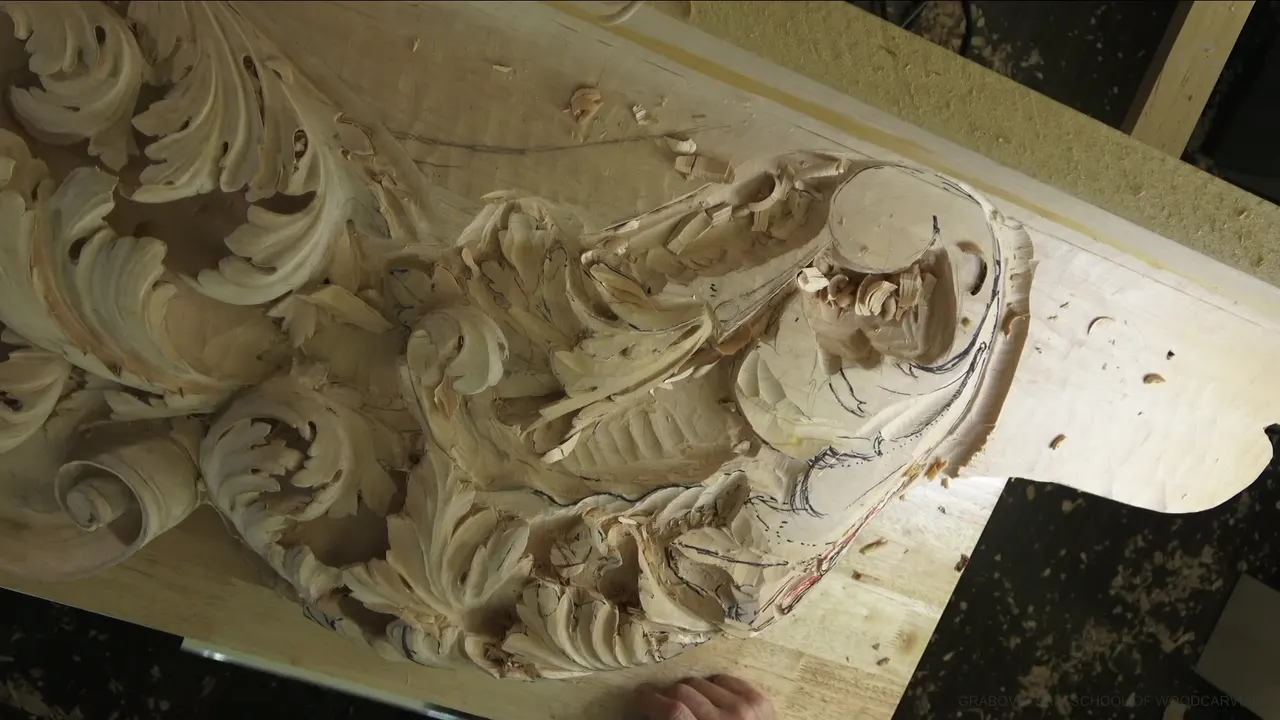

In part 8 of Venice Room 55 I said I had a line, and that I really had to kind of almost repeat it. I also said it has to tie with the shell together. Close words sit in other lessons of mine, beside a tangent line, a cutting board wing, Greek and Roman leaves and Hashemi flowers, and every place is listed below.
Ever drawn a second line on a piece and wondered if it belonged with the first? Would you like to hear what I said? The lines from part 8 come first, then the lessons that say it too.
What did I do first in part 8?
The part opens on the skew: "And I'm using just the skew." The mess came next: "Now that mess, I'll take care with the number 11." And again: "Take care of it with the number 11."
Next I said, "It's a preliminary separation, but it's a good separation now." A need followed: "So I need to blend this region." Another sat right behind it, "But before I do that, I need to continue my outline all the way right here, which you don't see."
A short forecast came next. "Okay. It's going to roll underneath." Right after, "Just going to go like that."

How concave did I plan to make the part underneath?
"So next tool. I probably could use the same tool, actually, and kind of shape a little bit this area." Then: "So there's going to be an excavation later on. It's going to be concave underneath, but I don't want to make it too concave." And: "We do not want to do that. At least as of now."
Then: "Just clean little bit just for where I could see overall movement." One part got its own note, "Anyway, this part needs to be lower than that overlapping movement, so it can easily go a little deeper." After that I said, "That is wonderful."

Which surface got my cleaning next?
Number 11 again, and I said I would clean a little bit. Then: "And that also. And it's good." Next, "Except now I'm going to clean little bit that surface because it doesn't look too appealing. Too many lines."
The skew again: "Again, I'm using just the skew, okay, to clean and get that roundness." I added, "It's not the final form, but it's a preliminary shape." And later: "And that's supposed to wrap like that on inside."

Which tool did I reach for next?
Next, a section: "Okay, now I need to take care of this section because right now just also kind of not good. Doesn't look too good." Of one tool I said, "this tool is not going to fly." Then: "We're going to need number seven right now." My size for it was "maybe about half an inch number seven," which is about 13 mm.
Not much cleaning, I said. "I still have to establish the shape. All I need is just a clean surface to work with, okay, to establish my main movements, main lines, and so on." Then: "That's good. I should say it is enough."

How did I mark the middle line?
"And let me put the main movement how I really want to see it." Next: "See, again, I've got this line and I really have to kind of almost repeat. So it has to go with the same flow. Maybe even a little bit because I do have a shell and it has to tie with the shell together. So that is the middle line."

Next, a division: "the main division right here." And a need: "I have to create about the same division going that direction."
A chunk came into it, "And that chunk is going to go that way," and about the size I said, "Maybe a little bigger like that," and then "the middle line."

Part 9 of the same workshop opens with "Okay, so now I will excavate around." Later: "a shell movement, but the shell is going to move that direction."
Where else do I say it?
Here are the other lessons where I say flow, one after another, each with my words.
Is it the flow of the whole design?

In lesson 14 of the Furniture Panel design course I said, "for me, like I mentioned before, really important to just follow the main movement." The next words: "The main movement of, if you wish, you can say that, of the energy. It's not really energy, but the flow."
My example: if I have a round section, the petal of a flower, I really want to replicate the overall movement. Then: "This line and that line, just want to show that somewhere." And: "Just want to repeat the law of repetition."
In lesson 6 of that course I was thinking about the inside of a leaf: "I'll do another couple lines, couple arches." There I said, "It's still going to repeat the movement or the flow," and later, "There is no such a thing as a T-stop." One line hitting another that way is "breaking the rule of the flow," I said.
Does the flow stay when I change a design?

In Venice Room 53, part 3, I said, "So I have to change a little bit the design." The chunk on the left side is going to become part of one main acanthus movement. And: "Not changing design, it's still same flow." What I am changing, a little, is how it feels overall.
Of "this line" I said it stays "feelable invisibly" and will "go inside below this movement."
In Venice Room 73, part 4, I said, "I want to keep that movement, it's really important for me, but it's only overall, okay, because it's really important to keep that flow." I called it "like an invisible line." About the section: "So the section itself is not too appealing in my opinion."
How do I make a new leaf follow an old line?

In Floral and Molding for the Panel 9 I said, "And now I can just establish the right direction, how that leaf's supposed to be." Right after, "for me, it is important, I would just keep that same flow, okay, same flow with this line."
Of a micro pipe I said, "that way, I could just make it feel like it just grow in this direction." And about an S curve: "I'm going to have S curvature in that point." About all of it: "So that, I think, would be a good plan."
Then: "let me get the number nine again. Maybe not that big."
Next, Hashemi Flowers 7: "I like the movement right now, but I still don't like overall shape of this leaf. It just doesn't flow together." For the gouge: "I'll take number eight." And: "Take a number eight and kind of recreate the same idea, the same flow. Same movement, I should say." I barely create any pressure, I said.
A check followed: "I have to check if I have enough thickness. It looks like I do." Sizes came after that, "Number nine at one inch" (25 mm) and "number seven and about 10 millimeters" (about 0.4 in).

Over in Furniture Panel 34, I said, "Let me redraw whatever the separation I supposed to have." Then: "I'm gonna repeat that same flow." And: "This one gonna go also the same way, the same flow." Maybe a pair of them, I said, are in "opposition movement."
Is there another name for it?

Yes, and I give it in Lily Box 3. "Let me reestablish the middle line." Right behind that: "Again, my goal is to create the same flow, or there's another term for it, a tangency line. So it has to be tangent to this section of the stem."
Then: "Again, I'll take number seven." A caution came with it. I'll try to make my cut as long as possible, I said, but "also keep an eye. Don't go too low right here because I'm already close to my background." Otherwise the transition would not be really nice, I said.

In Curly Kitchen Cutting Board 4 I said, "that line needs to be refined and go to the same flow. Well, let me explain that better if I can." The explanation: "See, that is the line of my wing, and this is my plant line, and everything should go to the same flow."
A warning from that part: "I have to be really careful." The plan was a cut away from myself, with a finger helping to make the cut more accurate.

In Greek Acanthus 1, part 3, I said, "Everything goes to the same flow line." I went on, "And let's make this one bigger." One more plan: "I could probably still continue my movement toward this direction."

In Greek Acanthus 5, about one acanthus leaf: "I'll change the design." Next: "And again, I need to establish my flow. I call it flow lines."

In Roman Acanthus 7 I said, "I could actually use even smaller and kind of fix that movement until it looks somewhat like on the same flowing line." Next: "And let me do exactly the same on this side."
Do I ever fix a flow line?

In Hashemi Flowers 12 I said there will be a flow line. Next: "let me make a V cut." And: "So that is just preliminary V cut." Then: "Well, I could actually use a spoon V tool and work with the grain." And: "That's a number 12, and that's eight millimeters" (about 0.3 in).
In Hashemi Flowers 15 I said of a shape, "It's actually not a true triangle. It's still going to have an inner flow line." Next came "Let me see if I can fit number seven," and a size, "this one is about half an inch" (about 13 mm).
A tip about an edge sits in Hashemi Flowers 20: "It doesn't look like my edge is actually flowing. Okay? So I need to fix that flow line." The easiest way, I said, "would be to find matching gouge to the edge." On a gouge: "Let me check number 8." And: "No, number 8 is actually perfect." Place it straight down, I said, and the leaf will be "perfectly flowing." My name for it: "perfect flow line."
And in Hashemi Flowers 22, "Definitely, I need to fix my flowing line right here." A tool, then: "I could use just probably about number five and six millimeters" (about 1/4 in), and to connect one cut with another I said, "Make sure I'm not going to destroy my flow line." Then: "without forcing."
Which lessons said which words?
Here are the places, one line at a time.
| Lesson | Work I was doing at that point in the lesson | Words from it |
|---|---|---|
| Workshop 55, part 8 | A line and a shell to tie it to | the middle line |
| Design course, lesson 14 | A round section, the petal of a flower, and the main movement | not really energy, but the flow |
| Design course, lesson 6 | A couple of arches for the inside of a leaf, and a T-stop | the rule of the flow |
| Workshop 53, part 3 | My middle line, moved to a new place, with a chunk joining a main movement | I am changing my design |
| Venice 73, part 4 | One section I don't like, and a movement I want to keep | keep that flow |
| Floral 9 | The right direction for a leaf, and a micro pipe | same flow with this line |
| Hashemi 7 | A leaf that doesn't flow together, and a number eight | recreate the same idea |
| Furniture Panel 34 | A separation to redraw, with two maybe in opposition | also the same way |
| Lily Box 3 | The middle line to reestablish, and a stem to stay tangent to | a tangency line |
| Cutting Board 4 | A wing line beside a plant line, with a cut away from myself | my plant line |
| Greek 1 | Curls on a leaf, in part 3 | Everything goes to the same flow line |
| Greek 5 | A leaf whose design I'll change | I need to establish my flow |
| Roman 7 | A tiny gouge for fixing a movement, and the same on this side | the same flowing line |
| Hashemi 12 and 15 | A V cut, and a triangle that is not a true one | a flow line |
| Hashemi course, lesson 20 | An edge that doesn't look like it is flowing, and a matching gouge | perfect flow line |
| Hashemi course, lesson 22 | A cut to connect with another one, without forcing | my flow line |
Where can you watch them?
Workshops 50 to 61 are in the Venice Room Part 5 course, and the rest of workshop 55 is on the workshop 55 page. The other lines sit in the Furniture Panel design course, the Furniture Panel course, the Floral and Molding course, the Hashemi flowers course, the Lily Box course, the beginner course with the cutting board, the Greek acanthus course and the Roman acanthus course. Everything about wood carving is one click away if you start here.
How it's done
- Clean, but not much. "All I need is just a clean surface to work with," I said.
- Set the main movement. "And let me put the main movement," I said.
- Check the line I already have. "See, again, I've got this line."
- The shell. "Maybe even a little bit because I do have a shell."
- Mark the division. "I have to create about the same division going that direction."
- Think of a size for the chunk. "Maybe a little bigger like that."
Frequently asked questions
Where in workshop 55 did I say it?
Part 8. I spoke of a line I really have to almost repeat, of a shell, and of the middle line. The main division comes in there too.
Does it have a second name?
In the third Lily Box lesson I said my goal is to create the same flow, or there's another term for it, a tangency line. It has to be tangent to the stem.
Did I say a design keeps its flow when I change it?
Venice Room 53 has me speaking of one design, "Not changing design, it's still same flow." How it feels overall is what I am changing a little, I said.
Which lessons say flow line?
What to carve next
- Venice Room Part 5
- Venice Room 55
- Furniture Panel 14
- Furniture Panel 6
- Furniture Panel design course
- Venice Room 53
- Venice Room 73
- Floral and Molding 9
- Floral and Molding course
- Hashemi Flowers 7
- Hashemi Flowers 12
- Hashemi Flowers 15
- Hashemi Flowers 20
- Hashemi Flowers 22
- Hashemi flowers course
- Furniture Panel 34
- Furniture Panel course
- Lily Box 3