

Alexander Grabovetskiy, woodcarver, School of Woodcarving · Published 2020
What does a wood carver mean by "I kind of like that"?
Quick answer: Workshop 55 has it in part 9, and the words that follow are about logic and a shell movement. Other lessons of mine have the same words beside leaves, details, tool marks and a step that is something extra, and every place is below.
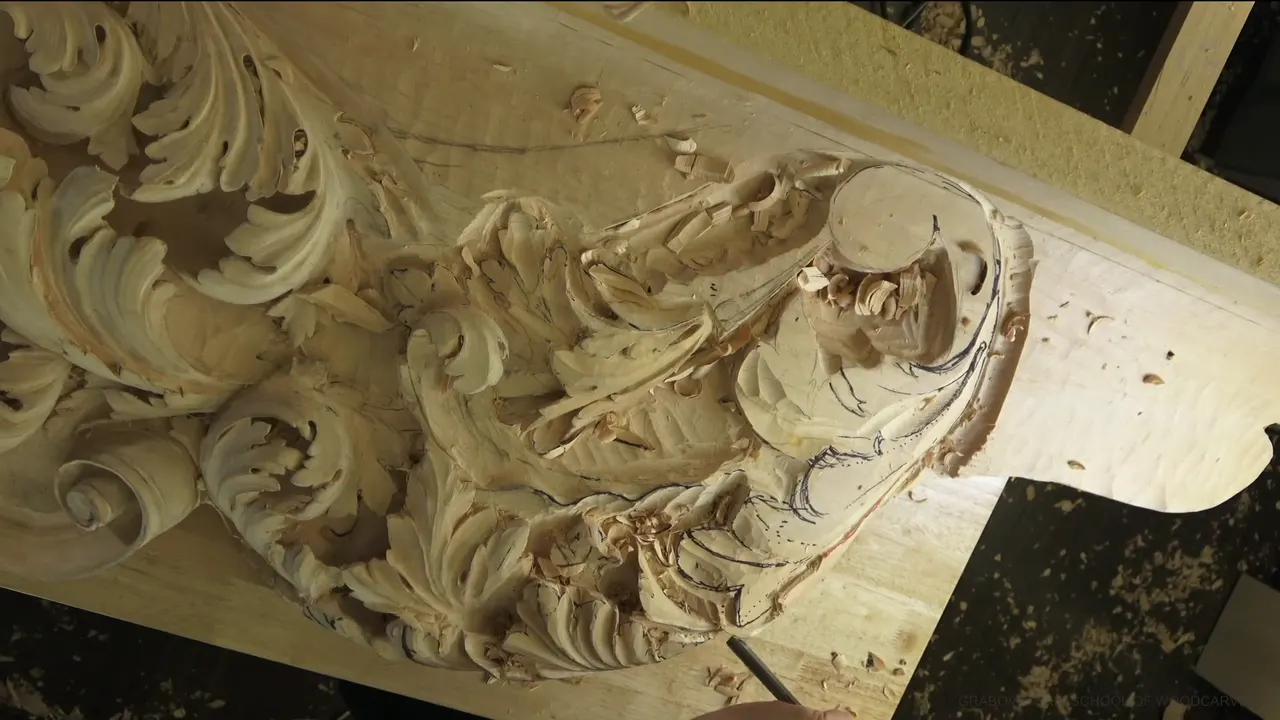

I said it in part 9 of Venice Room 55, and the words right after it were about logic and a shell movement. Close words sit in other lessons of mine, beside leaves, details, tool marks and a step that is something extra. Each place is listed below, with my lines.
Ever liked something on a piece and still not been sure about it? Would you like to hear what I said right after the line, and in which other lessons I said it? Part 9 comes first.
What did I say about the shell in part 9?
Part 9 has "Okay, so now I will excavate around." Also: "Go around."
Next, the line itself, in full: "I kind of like that, but it still has to have some logic behind." Right after it, about the shell: "It's going to be a shell movement, but the shell is going to move that direction." And then: "But let me see."

An offer came next, and it stays an offer: "So what I could do, I could actually excavate little deeper right here underneath."
Which part did I not like in part 9?
I said, "And I don't really like how it sticks out too much." After that: "I don't think I like it. Maybe I do, maybe don't." Then, about the marker: "But let me get the marker again, and I'll try to find the form."
Also: "I think I could actually go and move that inward like this and get a feel that that piece going all the way like that, but little shorter."

Next came "It's going to be wrapping underneath of main movement." Of the same piece, later: "That is good."
What does the inside need in part 9?
I named a spot of the acanthus, "the end of this acanthus." A plan: "I'm going to do a little deeper in this area." A need: "I really need that depth inside. But I need to clean now this way, this shell." Another plan: "And to do that, let me see if number seven will help me."

Why did I say you shouldn't carve toward yourself?
Directly after the number seven: "And go like this. And you shouldn't carve toward yourself." The next words: "I just don't have that ability to rotate my piece. It's too big, so it's got to stay in place."
Also: "I don't want to walk around." A little later, about the position: "If I would attack that from this position, it would be a little too far for me. Okay? So it's also not good."
How did I plan the rest of the shell?
First: "Maybe I could bring that down slightly." Later: "I will excavate later on, but at least that just creates a better movement." About the depth I said, a little further down in the same part, "deep excavation right here because I really need the shadow spot."
The technique comes next: "And to create that shadow spot, same technique, plug cutting technique." For the size: "That's a big area, and I can probably use a half an inch number nine," and half an inch is 12.7 mm.

Which line closes part 9?
The last lines are a correction: "Straight down cut. Well, actually, I can't do straight down cut. I apologize. Big mistake." Then: "Part of a shell, I should say. So got to be careful."
Part 10 of the same workshop picks it up: "So I really can't do plug cut in this case. As of now." Next to it: "Sorry for the confusion." Later in part 10: "And now I will create my first eye and the first big division."
Where else do I say it?
Each lesson below has those same words in it, and I put what I said beside them.
Which lessons name what it still needs?

In lesson 11 of the Furniture Panel design course I said, "But I'm not completely sold on it yet." Next to my words: "that movement right here, but it's not perfect." Then my plan: "What I would do, I would take, again, this tool and find my closest circle and place my more perfect line."
Lesson 14 of that course has "some kind of acanthus flip." After it: "Okay, let me think how I can do that."
Venice Room 14, part 8 has "Again, I don't want to make this part too weak, which is always a possibility." Close by: "it curls backward a little bit." And: "Cleaning needs to be done to that part."

From Venice Room 72, part 11: "So that would be 7 millimeters, a little bigger than a quarter inch," which is 7 mm (0.28 in). Alongside it: "that it has a movement upward here." Around it: "I'm not sure if you could catch that, but I don't like it has a little too big of a overall concave." And: "I'm after convex on this side."
Over in Lily Box 12, part 4: "this part is just raising up little bit. Did I plan for it? No, but it's naturally happened." Following that: "What I don't like, really sharp shadow on this side, and I need to take care of it."
Which lessons put a question beside it?
In Venice Room 53, part 2 I said some part of this movement goes "right below this chunk." Beyond it: "But how below? I can determine that little later." Further on: "See, that was a good idea not to dig too deep in this area."
Next, Venice Room 59, part 11: "Or maybe I should get rid of altogether this chunk." Close by: "that returning effect."

In Venice Room 35, part 5: "It doesn't have to be." A moment on: "But why would I do that if I have some material?" Straight after, "Just little more details."
Part 3 of Venice Room 12 has "that small detail we created, or I should say I created. But something off right here yet." Then: "So kind of not too happy about how it looks right here. So I think I should give a better defined piping."
Which step did I not have to do?

Back in Lily Box 12, part 3: "So that is the big movement. You can detect it from a side view, okay?" Right next to it: "didn't have to, but I really liked it."

Hashemi Flowers 49, part 1 gives the aim: "to create some kind of wall, okay, or some depth right here, for I can create my wave as deep as possible." Soon after: "I don't have to." Close beside those words: "that waviness, unevenness, and so on. I think it just looks better, okay, in my opinion."
More from the same part: "And naturally, when you look at the flowers, they all wavy. Well, not all. I shouldn't say all. Some of them are not as wavy."

Floral and Molding for the Panel 1, part 3 has "This step is not really necessary, I should say." Just after: "that step because it creates a clean surface to draw on and so on, just like a canvas almost. It is something extra." Later: "Like I said, you don't really have to do it, but personally, I do like to do that."
Over in Venice Room 73, part 3: "I'll use number five and about 12 millimeters or so," which is about 12 mm (0.47 in). Near it: "that method. I could use just a knife or anything else for this method, but I really love the idea. It gives me perfect curvature." And: "Not that I need that perfect curvature."

Roman Acanthus 7, part 1: "You don't have to have that. You'll still be able to use just a normal straight gouge."
Which marks and ridges come with those words?

The tool marks sit in Venice Room 61, part 4: "And yes, I could get rid of some of the inside." Beside it: "it leaves some tool marks. It just gives some life even on inside." Soon after, in the same part: "It just gives even more life."
Lily Box 2, part 8 has "I do have a visible ridge that I can see." Beyond that: "I can exaggerate it a little bit." Alongside that: "that leaf. And I don't worry about that I lost the outside main details. I really don't care about it right now."
A detail from Lily Box 6, part 12: "that detail. It gives a really nice movement. Although what I could do, I could take care of this ridge and make it a little more around it, so I can give a little fillet."
From Venice Room 82, part 6: "why not leave some texture right here on the surface?" Following that: "With those rifflers, or whatever you call it, I can take out the high spots and create beautiful form. Although, I just damaged the edge, which I shouldn't."
In Grape Onlay 13, part 3: "And I see it's beautiful shadow." Close to it: "that shadow." Beyond that: "And there's gonna be a point when, um, I'm gonna have a trouble to get deeper excavation and I'm gonna switch to a spoon. But in this case, probably number 11, spoon will do probably the best."
Which lesson has me say more than kind of?
Part 11 of Lily Box 7 gives "So it's actually creating the gradual movement, okay?" Then: "I really like it, actually. Not kind of. I really like it." The plan after that: "Let me use number nine again," and "I'll try to follow the line, the main line."

Part 9 of Lily Box 10 has "Although one of my favorite tools is actually number 16, a V tool, and I'm using it a lot, and you see that in other projects." After it comes a plan: "I'm going to switch to smaller, number 11, and I'll switch probably to one millimeter." One millimeter is 0.04 in.
And Venice Room 65, part 4 has "Cut that separation." Straight beside it: "idea to give more movement, more curliness, even right here, too." Later: "But you should see the difference already."
Part 3 of Venice Room 105 has "what I can accomplish with this big tool. So it's a big tool, two inches or so," and two inches is about 51 mm.
Hashemi Flowers 22, part 4 has "number 16" and "35 degrees. Really sharp angle." Not far from it: "The common ones are 90 degrees, 60 degrees, and 45." Just after that: "Take 14 millimeters, number seven," which is 14 mm (0.55 in).
In Furniture Panel 21, part 8: "Really don't need to force it, because I can always undercut it with the number 11 again." Just beside it: "that look."
Venice Room 54, part 7 has "And see how deep that shadow is. Beautiful shadow." Close at hand: "that future development."
Hazelnuts 1, part 1 has "I'm not going to do a bandsaw around and glue on some background." Then: "I hope it makes sense." Near that: "that approach because it's actually going to train your hands to feel, and we're going to take a lot of wood out."
Which lines from these lessons are in the table below?
| Where I said it | What the lines were about | My words |
|---|---|---|
| Workshop 55, part 9 | A shell, and the direction it is going to move | some logic behind |
| Lily 2, part 8 | A visible ridge I can exaggerate a little bit | I don't worry about that |
| Lily 6, part 12 | A detail with a really nice movement, and this ridge | give a little fillet |
| Lily 7, part 11 | The gradual movement, with the main line I will try to follow | Not kind of. |
| Lily 10, part 9 | Favorite V tool, and a plan to switch to a smaller number 11 | number 16 |
| Workshop 14, part 8 | A part that curls backward a little bit, and a part I don't want too weak | always a possibility |
| Workshop 53, part 2 | Some part of this movement that goes right below this chunk | But how below? |
| Workshop 59, part 11 | A division that may be part of the movement, and a chunk I may drop altogether | returning effect |
| Workshop 61, part 4 | Some of the inside, and tool marks that give it some life | even on inside |
| Workshop 72, part 11 | A movement upward, and an overall concave that is a little too big | convex on this side |
| Workshop 73, part 3 | Number five at about 12 mm (0.47 in), to match the curvature | perfect curvature |
| Lesson 11, Furniture Panel | A movement that is not perfect, and a circle for a more perfect line | find my closest circle |
| Floral 1, part 3 | A step that gives a clean surface, not really necessary | just like a canvas |

Course pages: Lily Box, Hashemi flowers, Floral course, Roman acanthus, Hazelnuts and Venice Room Part 5. Everything about wood carving is one click away if you start here.
How it's done
- The shell. "Part of a shell, I should say."
- The part that I said sticks out too much. "Maybe I do, maybe don't."
- The piece and its size. "It's too big, so it's got to stay in place."
- The shadow spot. "And to create that shadow spot, same technique, plug cutting technique."
- The area to be dug. "That's a big area."
- The correction at the end of the part. "Big mistake."
Frequently asked questions
What came right after the line in part 9?
Logic. It still has to have some, I said, and then I named a shell movement and said where the shell is going.
Which lesson has me thinking about a chunk?
In part 11 of Venice Room 59, where I said I may drop the chunk.
Where do I say I liked something and did not have to?
In the lesson on small filler flowers I said I really liked it.
What size is the piece in part 9?
What to carve next