
Alexander Grabovetskiy, woodcarver, School of Woodcarving · Published 2020
What does a wood carver say after "oops" in the middle of a cut?
Quick answer: In part 10 of workshop 56, the line after it was about talking too much. Then came a story about a student and millimeters. In other lessons the words after it were things like "relieve that cut," "I could break this part" and "I already excavated too deep."

In workshop 56, part 10, I said, "Oops, I cut on the wrong spot." The words right after it were "Talk too much." This page follows my oops through other lessons and lists the words I said right behind it.
Ever slipped with a tool? What does a carver do next? Would it help to hear what I said while I was filming, and what I did about it in other wood carving lessons? Start with part 10 of workshop 56. The other lessons follow, with the lines I said in each.
What was I working out before the oops in part 10?

I said, "What I'm doing right now in this piece, I'm trying to develop a better idea." About my middle line, "which it is," I was thinking I could bring a movement "pretty much this direction." From the bottom it would be invisible, I said. Stand in another part of the room, "like a far point of the room," and "you're still going to be able to catch it."
A decision about the shell had to be made. "So I cannot have T-stops," I said, "like a letter T." Of two directions, I said: "I can't do that toward this direction, and I cannot do it toward that direction." One direction did get a yes: "Although this direction would be okay." And: "I think I'll just end up going right in the middle between those two movements."

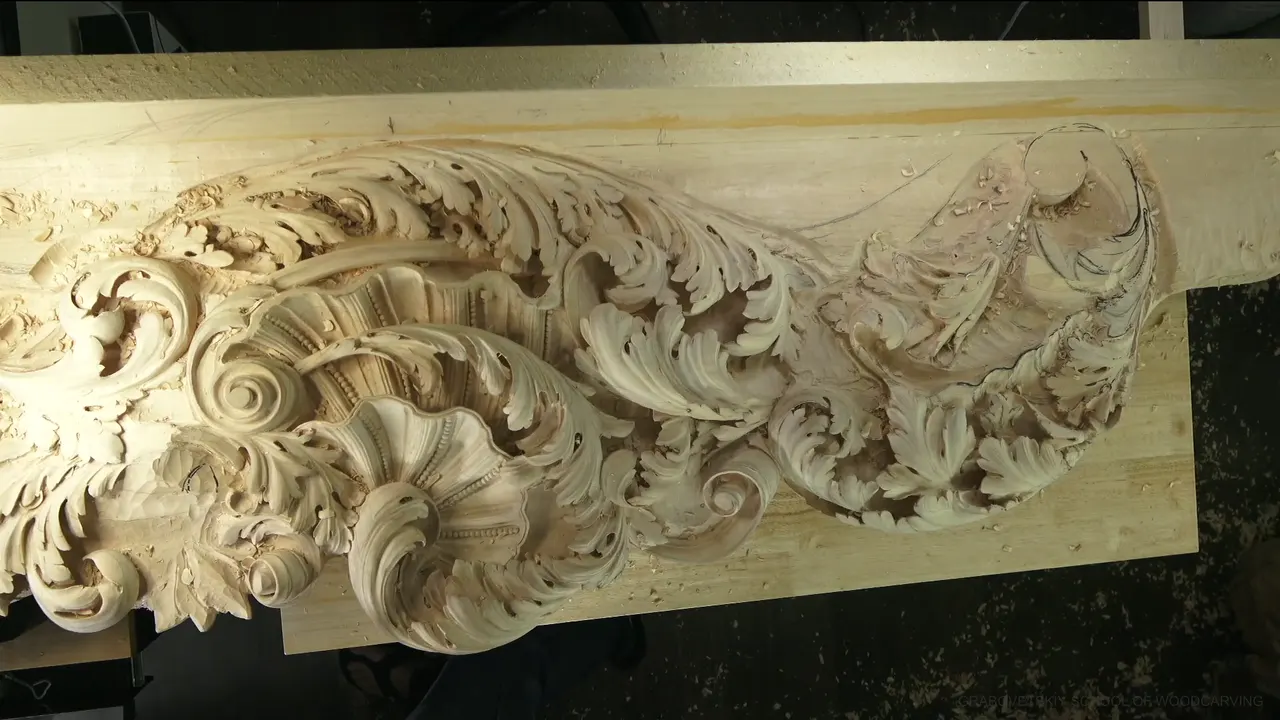
I named the shape "a front of a fisher boat." And: "So it's always like that, my starting point for the development of foliage. It doesn't matter if it's acanthus leaf or not, even if it's grapes."
Was there enough material on that side?

One separation goes in one direction, and another goes in another. "I need to repeat that separation on that side, but I don't have too much material," I said. The solution would be to take one down and end up somewhere on the bottom, and then it repeats the left side movement over there. Another option I gave: "I could actually overlap with this movement right here."
"So it is a little bit challenging," I said, and added "honestly." Then: "But I have still doubts. What should I do?" Maybe, I said, "I'm not going to overlap that over this one, but maybe I'm going to actually cut underneath this part, the right-hand side, in my case." There's a problem, I said, because "that's sloping upward like that." I was trying to keep the same feel, "raising up, raising up, raising up, and going all the way to the ceiling."

"This section right here is little higher than that one," I said. I called that "a challenge," and added, "I do not want to make mistake." Then a question: "how I going to develop it?"
Which job was step number one in part 10?

To solve that area, I said, "I need to probably widen it little bit." Same idea, "like a boat of a fisher." The plan was to go with this movement "all the way to the eye," and the rest of that movement will go underneath this leaf, stick out, and "continue to move like this."
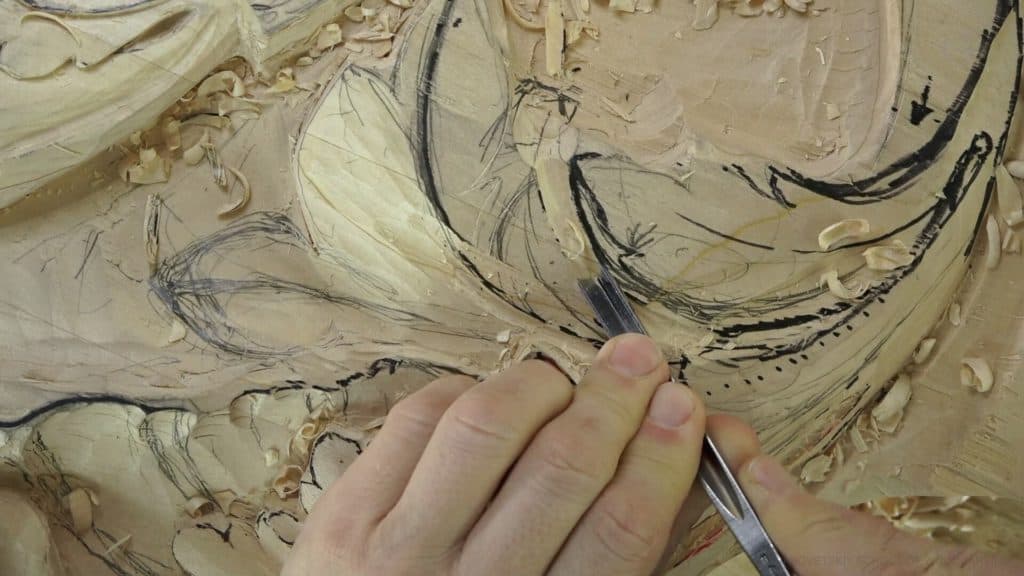
"The step number one for this, I have to create the cut around," I said. For tools: "same tools like always. Going to be veiners." The word veiner gives me trouble: "I'm struggling little bit," I said, and "it's hard to pronounce it correctly." My pick for this case: the number 11 veiner in the 7 millimeters (about 0.28 in), "pretty much bigger than a quarter inch if you are in United States." A quarter inch is 6.35 mm.

Which story followed the oops?

After "Talk too much" came a story: "I had a guy, actually, one of the students, and of course, he's from United States." About that "of course": "other people from all over the world, they did not say that." The student asked, "Why would you say that all that millimeters and metric stuff, nobody knows about it?"
My answer: "You're kind of not right. You're really not right. You're wrong." Nearly everywhere, I said, people don't know inches or imperial measurements. "Most of the people in the world, they're actually still using metric," meaning millimeters, centimeters and meters.
"And that's why when I mention my tool, sometimes I forget," I said. Sometimes I forget to say if it's 1 millimeter or "let's say 1.5 millimeter, but it equals to 1/16 of an inch." In metric terms, 1.5 mm is about 0.06 in, and a sixteenth of an inch is 1.59 mm.
What did part 11 say about tool sizes and mistakes?
In part 11: "I really want to make sure people from all over the world do understand exactly what size tool I'm using at this point." The sound in the background, I said, was me stropping my number 11: "That is what I'm doing, just stropping."
About a mistake, I said, "If I did a mistake, I'll fix it. I still have some material." A few lines on comes "Oh, I apologize. You don't see it." Then: "So what I did, I just did a cut right here." Later in that part: "I think I saved approximately five minutes or so just with two cuts." About depth: "I do not want to do really deep excavation at this point. I'm not sure." About the grain: "yes, I'm carving against the grain and I am breaking the rules."
Which words followed the oops in other Venice Room lessons?

Workshop 51, part 10, has number nine, which was close to me: "It just happened." Then "Oops. That's what happens if you don't relieve it." I added, "I make mistakes, even if I said that hundreds of times, just relieve that cut." And last: "But I didn't."
About the triangle side: "but it's okay. I can hide it." And: "I could save about few seconds, if I would just do the right thing, and every second counts." I was talking, I said, about "if you're doing production carving."
Workshop 61, part 2, has a slip: "Oops, I made a mistake. I slipped." I created "a cut that I didn't want to create right in the middle part." My words after it: "That's no bueno. Not good."
The fifth part of workshop 74 reads: "Oops, that is not bueno." If I would just continue to do that, I said, "I could break this part, and that would not be a good idea." It would be, I added, "really bad idea." A few lines later: "And now I can easily create the line again, recreate the movement."
Did an oops change my plan for a marker or a size?

Part 12 of workshop 60 has my words: "I have to be mindful how I do at that side. And maybe I should actually do movement from inside here, another division from this eye, which is going to repeat that side." The next line: "Oops, shouldn't put that marker right there." Then: "And go that way, and develop this way."
Down in workshop 44, part 6, I said "Let me see which way I should do it. Actually, let me start and I'll see." The size I gave was "20 millimeters," about 0.8 in. After the oops came "that's not good," and right behind it, "Oh, that's actually okay, but I should control better."
Part 12 of workshop 66 has "I'll use two millimeters... Oops." Just after: "I'm dropping my tools." Also: "I just dropped my mallet." Then the size and the tool again: "Two millimeters, number 11." In inches, that is about 0.08.
Over in workshop 40, part 8, there is a deep spot: "somewhat deep excavation. Oops. That is not what I want to see." Then "That is okay, although it's not too okay," and then "So I need to outline it."
How did I deal with a break or a spot that went too deep?

Carving Byzantine Acanthus, lesson 6, had me on carving downhill. "If you don't have a knife, you have a flatter tool, so exactly the same idea." Then: "Oops, I broke something. You didn't see that, right?" And: "If I broke something, what do I do? You just glue it. No, I'm going to redesign it." Then came "It meant to be," and "It's a French acanthus. I guess that's how they developed that, right? By breaking stuff."
In Carving Grape Onlay, lesson 4, the words were "Oops, I just messed up big way actually." Right behind them: "Okay, so change of design. I mean I could glue it but, uh, probably not gonna do it. I'll just lower down the whole section." I gave the reason too: "Oh, I see why, because I already excavated too deep."
Later in that lesson: "Nope, actually I'm fine. I am fine. So I have plenty of the material." And: "That is one of the oops moments. It's all right."
Carving Furniture Panel, lesson 32, has "Oops, that was little too much." The piece "became loose." One way: "I could just remove it and cut little deeper. I don't wanna do that. I'll just use a glue and glue that back, okay." And: "And I'll glue it back and it's gonna look good."
What happened when I checked the depth?

Carving Vase with grape leaves, lesson 3: "I could actually go extreme and create really deep undercut." The depth I had in mind was "like maybe three millimeters deep" (about 0.12 in). Then "Let me see how deep I got. Oops, I'm sorry. So I've got more than three millimeters. I've got about five millimeters deep undercut on inside." Five millimeters is about 0.2 in. Next: "But make sure I don't want to pierce it. But I really want to undercut."
In Lily Box workshop 5, part 6, I said "about 5 millimeters" (just under a fifth of an inch). Right after: "Oops, I don't want to go too deep." Next: "Let me get a flatter gouge, like maybe a number three, and chop out this." Then: "And that is no bueno. What just happened?" And what I found: "Inside of the wood, there is a void, and that's a good thing that I have enough meat right here, so actually, I didn't lose anything."
In Venetian Flowers Rosette 4 I said "Let me clean a little bit around. That's not final cleanup." Next: "Oops. I shouldn't drop my tools." And: "Looks like I did some cuts super deep."
And when it was not supposed to happen?

Carving Dining Table Apron, workshop 15, had number nine in use, "a little bigger." Then, in the middle of a sentence, "And I'll use the same... Oops, that's not supposed to happen." Right away: "But we'll make it look like it's supposed to be that way." This one has to go below the flower, and "I'm not going to tear my hair over that." And: "Just make this section a little deeper."
In Carving Floral and Molding for the Panel, lesson 12, I said, "I going to grab a small number nine, and just clean right underneath right here." Next came "Oops." Behind it: "That is no bueno," and then "but it's okay." After that, a need to fix that part.
Carving Hashemi Flowers, lesson 4, has "Oops," and then "Okay, I'll take, again, a V tool." Lesson 1 of Venetian Flowers Rosette has "Oops. I didn't want to break it," and "I don't know why I'm dropping stuff, but anyway, take a look from above."
Carving Furniture Panel, lesson 20, has "oops, should not slip." Near it: "Sometimes it helps just controlling little better, which I didn't do." A plan too: "what I could do, I could use a mallet. That's going to give me even better control."
Grinling Gibbons class in Maine, lesson 8, reads "Oops. What am I doing?" Straight after: "Okay, I'm gonna do blending slightly."

Which tool sat beside which oops?
Here are the tools I named near each oops, side by side. The course name comes from the lesson itself.
| Lesson | The tool I named near the oops | What went with it |
|---|---|---|
| Venice Room workshop 56, part 10 | Veiner, number 11 | 7 millimeters, or 0.28 in, a bit more than a quarter inch |
| Venice Room workshop 51, part 10 | Number nine | It was close to me, and it just happened |
| Lily Box 5, part 6 | A flatter gouge | About 5 millimeters deep (0.2 in), and a void inside the wood |
| Carving Floral and Molding for the Panel, lesson 12 | A small number nine | Clean right underneath |
| Carving Dining Table Apron, workshop 15 | Number nine | A little bigger, and it fits really good |
| Carving Hashemi Flowers, lesson 4 | A V tool | Okay, I'll take, again, a V tool |
| Furniture Panel 20, part 4 | A mallet | A mallet could be used |
Where can you watch these lessons?
This page's lesson, Venice Room 56, sits inside Venice Room Part 5. The other courses are one click away if you start here.
How it's done
- Work out the idea. "I'm trying to develop a better idea," I said in part 10.
- The cut around. "I have to create the cut around."
- A flatter gouge. "Let me get a flatter gouge, like maybe a number three, and chop out this."
- Lower the section. My plan in the onlay lesson: "I'll just lower down the whole section."
- Fix it with glue. My plan in Furniture Panel 32: "I'll just use a glue and glue that back, okay."
- Take a mallet. "what I could do, I could use a mallet."
Frequently asked questions
Which tool did I choose for that cut?
I said I'd take the number 11 veiner in the 7 millimeters, a little over a quarter inch, and that the word veiner is hard for me to pronounce.
Did a student object to millimeters?
A student from the United States asked why I use millimeters and metric stuff. "You're wrong," I told that student, and I said most of the people in the world still use metric.
Could I hide the slip in workshop 51?
Hide it, yes: I said I can. And a few seconds could be saved by doing the right thing.
How deep did the grape vase undercut get?
What to carve next