
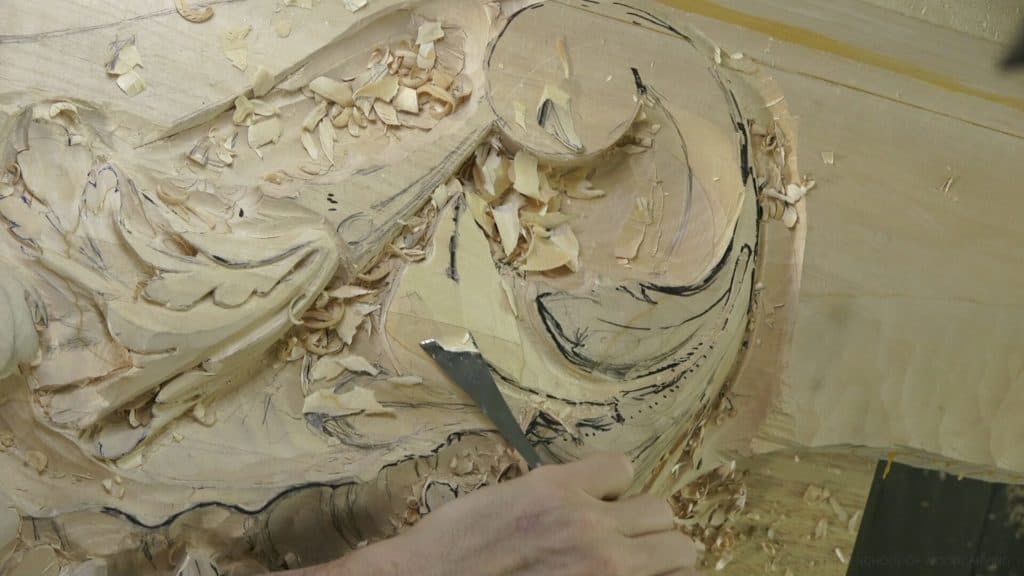
Alexander Grabovetskiy, woodcarver, School of Woodcarving · Published 2020
What does a wood carver mean by "I apologize"?
Quick answer: During part 11 of workshop 56 I began to say why I was making a cut, broke off, and apologized to the viewers for something they could not see. A line about the cut I made came next. Other lessons put the same word beside hands covering the work, a wrong tool number, a black screen and a noise.
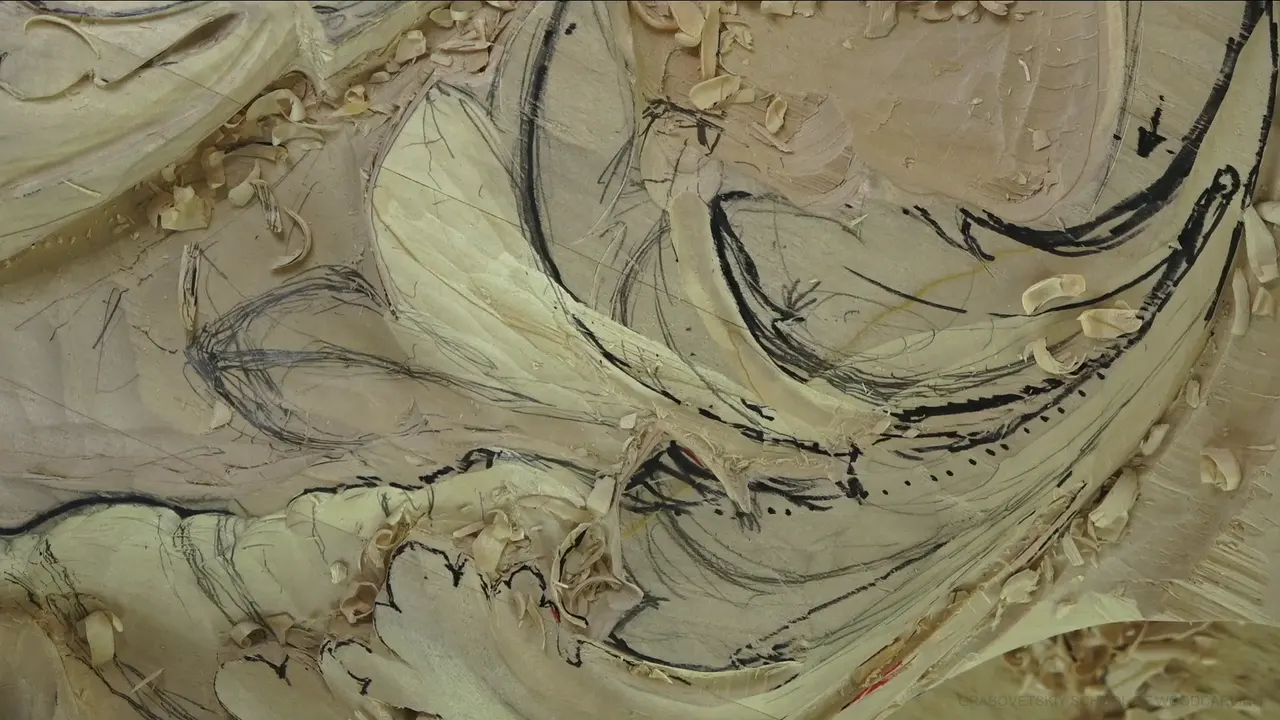

In part 11 of workshop 56, I said "Oh, I apologize. You don't see it." Just before that I had started a question, "Why I'm doing it? I really need to lower down," and then I broke off. This page sets that apology beside the same word in other lessons, and each lesson has its link.
Ever watched wood carving with a hand over the cut and wondered what happens under it? Would it help to hear what I told the people watching? Then start with workshop 56, part 11.
What did I say just before I apologized in part 11?

Before the apology I said, "If I did a mistake, I'll fix it. I still have some material."
Then came the question I started and left, the apology, and the line "You don't see it." Only after those did I say what I had done: "So what I did, I just did a cut right here."

Next: "So I want to make sure it looks like this part is going underneath." Then a plan: "And also preliminary, I'm going to chop out some of that, that I don't need."
"Again, that is just preliminary, but the idea is behind," I said, then "I really want to cast a shadow in this area." Under this movement, "I think it's going to make sense."
What else is in part 11 about that spot?

The part opens with a line about size: "I really want to make sure people from all over the world do understand exactly what size tool I'm using at this point." The sound in the background was "I'm just buffing it or stropping it actually pretty much my number 11." Then "That is what I'm doing, just stropping."
About the machine I use for it: "The reason why, because it's not as loud as other machines while I'm filming." Then "So I think it's a good idea. Okay, let me go around."

I named one point, "this point right here," and said "So that has to wrap. It has to wrap." On depth: "I do not want to do really deep excavation at this point." I also said I was not sure, and did not have the idea yet of how deep to go right there. Then: "So we'll see."
What I know, I said, is "I can actually work, like define that separation and start my eye." Next came "Not my eye, of course, eye of acanthus." And "Just preliminary get the idea there's going to be an eye."
Which tool did I name for lowering that spot?

"I can actually lower this down pretty much right away," I said, and for it "I could use actually big number seven." That tool "would give me just really clean starting point." Right after naming it I gave a size, "Three inches and one eighth," then "So 80 millimeters." A quick check puts 3 1/8 in at about 79 mm, so my 80 is a round figure.
Then: "And I can just do like this. Okay. Just a chop. And that's going to give me a pretty clean cut." After it, "Really good cut." On the edge: "I'm not really worried about the edge right here, so I can always reestablish."

"But for now, I think I saved approximately five minutes or so just with two cuts." A plan: "So let me approximately redraw where it's going to be." I said it "is going to go right underneath and continue all the way right there."
"So which means this side needs to be going a little down," I said, and "I could probably use just a huge big, I should say gouge." Then about the wood: "And yes, I'm carving against the grain and I am breaking the rules."
My words about emails and spam in part 11

Next I talked to my school: "I really appreciate if you can check out those live streams." I asked people to connect if they could and "tune in," a "good opportunity to ask me any of the questions," I said, "so much better than even emails." Then "It is better if you can just ask me in the comments." And the reason I gave: "I'm getting hundreds of emails daily and sometimes it just slips through my hands."
"I'm not trying to ignore nobody, by no means," I said, then "I really appreciate everyone in the school." If I'm not answering, "it could be a couple reasons." One is "a really heavy anti-spam filter." About marketers: "And I never mark anybody as a spam. Never, because I know how hard it is sometimes to get the message across." My own live notes, I said, can go "straight to spam. Did I spam? No." And "Sometimes your emails also ending up in my spam box and I'm not checking spam box every day."
When a hand covered the work, which words did I use?

Hands in the way are in part 1 of workshop 38: "And yes, I'm covering with my hands." Then the apology, and "but I really have to." The reason follows: "I need to lower down this one even more because I have to match this side."
The grain is the worry in workshop 58, part 2: "it's easy to break it. So have to be really patient." Next an apology for my hands, "but I'm trying to drive my point home." The rest of it, I said, would be done "probably off-camera, but you should get an idea."
My sizes are in workshop 57, part 7: "I'll just go everywhere with the 2 millimeters, and then I'll just hit with the one and a half, and maybe with 1 millimeter later on also." Those come to 0.08 in, 0.06 in and 0.04 in. For the cut under my hands I apologized too, "but see, I'm just doing the same cut pretty much. Nothing new." With the one and a half: "It crumples because I've got too deep of a cut, so that's not good."

Over in workshop 84, part 7, I said "I'm sorry if I'm covering up," and "Let me show from the right position, but you can't really see." My apology there said that if I do it where you see it, I would cover it with my body. "But I really need to carve it."
A need comes ahead of the apology in workshop 63, part 10: "Now I need to give a little bit roundness." I told the viewers I knew they did not see it. "Maybe I should do it off-camera, this section." I asked for forgiveness, and added "I need to figure out maybe how to show that to you."
The camera angle is in workshop 53, part 1: "I apologize I can't place the camera on the angle." Next, about one part: "closer to the corbel, okay? And that section is about two inches, which is approximately about 50 millimeters, I'd say." Two inches is 50.8 mm.
In Furniture Panel 15, part 7, I said "That is my final. How deep it's supposed to be." Then an apology "if you really don't see that on the camera, the result, but it's actually beautiful."
Nearly the same line is in workshop 68, part 4, with "Oops" in front of it. Next: "You didn't see it, so my bad." And "Have to switch my cameras more often, and it looks like I didn't."
In workshop 71, part 1, I said I needed to take care of a little bit of "this triangle right here," and apologized. "Let me try a different view," I said. Then "And you don't see that, too."
Another apology is in workshop 65, part 10: "Oh, I apologize if you didn't see it." Then "I just worked on this section," and "My apologies."
Inside workshop 56 itself, part 12 says "Which you probably don't see. Let me get little better view." And part 10 says "See if you're able to see that better."
Which words came with a wrong tool number or size?

In Hashemi Flowers 10, part 2, I said "And I'm sorry, I actually said it's a #7 what I used, but it was actually #5." Then the apology and "It was #5, one inch. And now in my hands, it's a #7, also one inch, 25 millimeters." One inch is 25.4 mm.
A fraction was wrong in Hashemi Flowers 44, part 4: "not 1/32nd." An apology sits between the two numbers. Then "I said it's 1/32nd, but it's actually half a mil, half a millimeter," which is about 0.02 in. Then came "Please don't break your tool," and "It's better to make multiple passes."

Furniture Panel 19 has two corrections. Part 7 has "This one is three millimeters, not five," and an apology if I said five. In inches, that is about 0.12 against 0.2. Part 9 has "The previous gouge was number five. Six millimeters. This one is number three." Six millimeters is about 0.24 in.
Reaching for a size, I grabbed the wrong tool in workshop 69, part 5: "Let me use 20 millimeters again, three-quarters of an inch." Then "this is actually not number 11," and "This is number 17." And "It look like number 11, but it's not." My plan was "Okay, let me use number 11."
In workshop 55, part 9, I named a size: "Number nine, half an inch. Straight down cut." After that, "I can't do straight down cut," I apologized, and called it a "Big mistake" because it is part of a shell. Half an inch is 12.7 mm.
In part 9 of Furniture Panel 18, I first said "final destination." Then "Well, not really final destination." Then an apology, with "It would not be accurate if I would say that."
How did I answer a black screen, a flicker or a noise?

A noise in the background is in Hashemi Flowers 19, part 4, and I apologized: "somebody's trying to do a backyard grass mowing and nothing I can do." Then "They always decide to do stuff like this when I'm filming," and "I think it's a law of whatever, Murphy, how you call it?"
The screen went black in workshop 72, part 3, and I apologized. "I don't know what is going on. Sometimes my camera or whatever, the recorder, gives me trouble, although I spent thousands of dollars on it." I added "even that really expensive equipment fails."

Flickering showed in part 9 of Furniture Panel 19, and I apologized for it. "I don't know what is going on with the cameras today." I also said "I don't want to stop filming just because of that."
Footage was lost in Furniture Panel 21, part 9: "I lost approximately five, 10 minutes of my work. It's just a video glitch." Next the apology, then what I had done: "I pretty much just removed the background all the way to one-eighth of an inch seam, what is on both sides. Three millimeters deep." And "I know it's kind of frustrating for me also when I'm losing some footage, but at least I didn't lose too much."
A loose screw is in Hashemi Flowers 12, part 4, with the apology: "I don't want to overtight my screws on the bottom, and that's already kind of loose." And "Maybe I could little make it tighter."
What was my line when I was quiet?

Being quiet is in Hashemi Flowers 47, part 3: "I do apologize again for being quiet sometimes." Then "It's just pure work. That's it," and "And work and feel and logic, that's it."
Lesson 21 of the Furniture Panel course has the same apology in part 14: "I am trying to concentrate on that movement, that I'm pretty much doing the same operation over and over and over." For a tool, "I can probably use just a small gouge, like number eight," and "maybe one-eighth of an inch, three millimeters." An eighth of an inch is 3.2 mm.
In Hashemi Flowers 46, part 1, the apology is for not naming my tools. I gave one: "number eight, an eighth of an inch," which is 3.2 mm.
Thinking time is in workshop 81, part 11: "I apologize, I have to think before I cut." Then "if I'll make a cut and it's a wrong cut, that would not be nice." And a plan: "I'll create a shallow cut first, not that deep."
Marks I made are in workshop 60, part 11: "I apologize that I messed up a little bit with all those marks."

Which apology came with which problem?
Here is each one next to what went wrong. The lesson names are the lessons themselves.
| What I apologized for | Lesson |
|---|---|
| A cut that you don't see | Venice Room 56 |
| Covering the work with my hands | Workshop 38 |
| A tool number I said wrong | Hashemi Flowers 10 |
| A black screen and recorder trouble | Venice Room 72 |
| A noise in the background, nothing I can do | Hashemi Flowers 19 |
| Being quiet sometimes while I do pure work | Furniture Panel 21 |
Where can you watch these lessons?
Workshop 56 is Venice Room 56, inside Venice Room Part 5, and the other courses are one click away if you start here.
How it's done
- Strop the tool. I said it in part 11: "That is what I'm doing, just stropping."
- Define the separation. "I can actually work, like define that separation and start my eye."
- Hold back on depth. "So we'll see," I said about how deep to go right there.
- Start the eye. "Not my eye, of course, eye of acanthus."
- Take a chop. "Just a chop. And that's going to give me a pretty clean cut."
- Name a tool for the chop. My chance for lowering it: "I could use actually big number seven. It would give me just really clean starting point."
Frequently asked questions
After the apology in part 11, which words came next?
"So what I did, I just did a cut right here," came first. Then "Again, that is just preliminary, but the idea is behind," and a line about wanting a shadow "in this area."
Was the sound in part 11 a machine?
The sound was "I'm just buffing it or stropping it actually pretty much my number 11." On the machine I use for it: "The reason why, because it's not as loud as other machines while I'm filming."
Which tool number did I get wrong in the Hashemi lesson?
#7 was my word and #5 was the tool, one inch, which is 25.4 mm. A #7, also one inch, was in my hands then, in lesson 10, part 2, where I said sorry.
What to carve next