
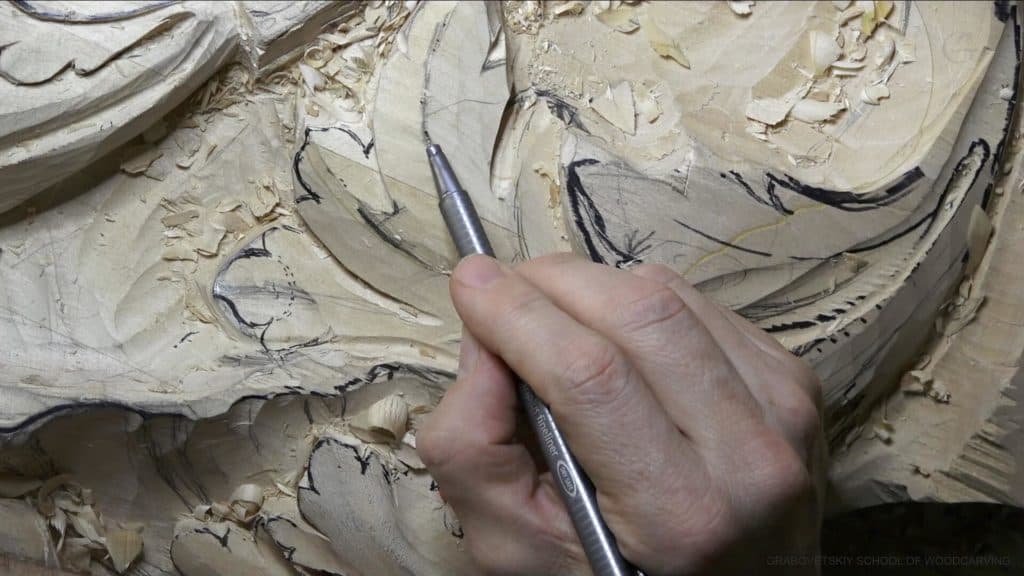
Alexander Grabovetskiy, woodcarver, School of Woodcarving · Published 2020
What does a wood carver mean by "get closer"?
Quick answer: Workshop 56, part 12, has my plan to excavate toward a final line, and later a request to go a bit nearer, "even to you." Other lessons of mine put the word beside design lines, edges, final depths, stems and the word "you."
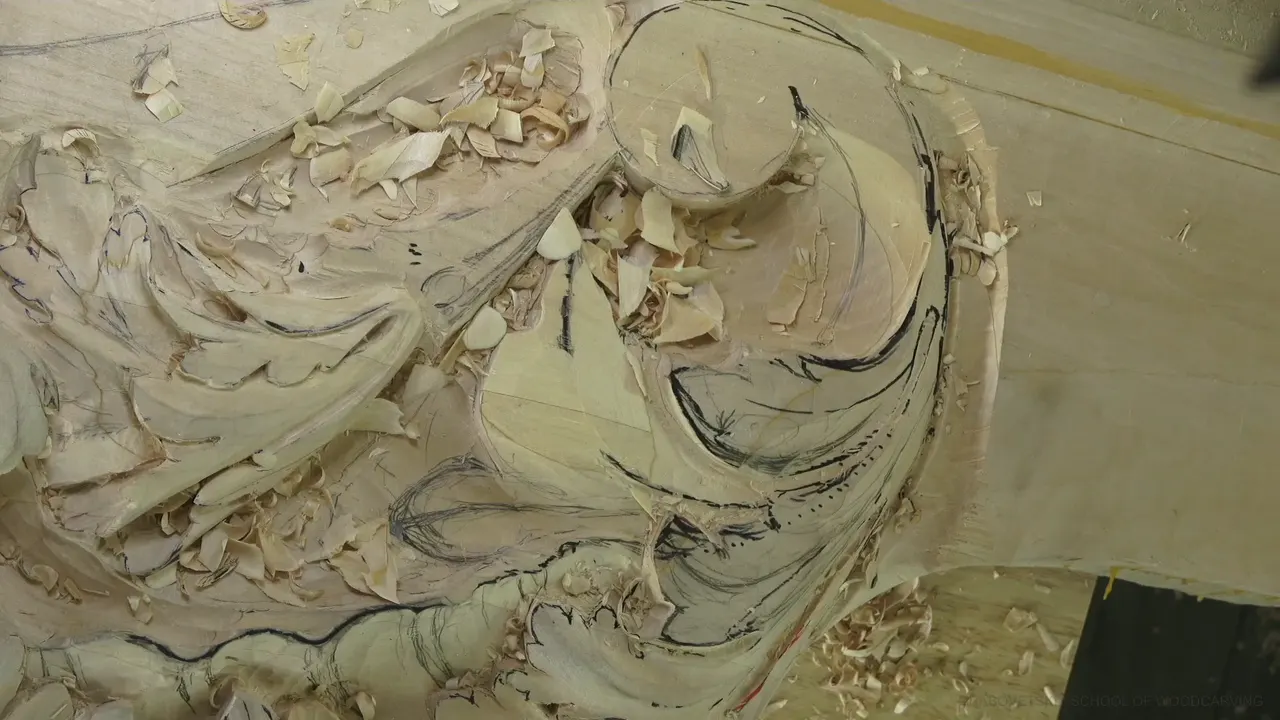

In part 12 of workshop 56, I said "I'm going to excavate a little closer to the final line I just created." This page sets that plan beside the same word in other lessons, where the word sits beside lines, edges, depths and even you. Every lesson has its link.
Ever wondered how near a gouge goes to a drawn line, and who decides? Would it help to hear the tools and sizes I named? Then start with workshop 56, part 12.
What came before the carving?

At the start: "So if you do have a question, it is much better if you would go directly to the comments section." The live chat: "I can probably address right away."
On Instagram: "it's not the best for me to answer the questions because there's a lot of people actually plugging in and plugging out constantly." Instagram again: "Instagram shows everyone who connects it and just instant, and I can miss some of the questions."
"So it's better to connect with me either on YouTube or on Facebook." A reason came with it: "YouTube is better because of the quality of the stream." I called it "a full HD versus limitation of Facebook." Last: "And yes, I will go live in about 30 seconds."
How did I find where the movement ends?

Next: "I think I'm ready to develop a little more this idea right here." After it: "Okay. So right now, I've got the main movements." The endpoint: "I'm still not too happy that that's going to be approximately my endpoint somewhere right here."
Then "be logical how far this is going to extend." I have to make sure the end is not off with the overall design. My way of finding the spot: "I just get from this point, I'll find some middle spot and just try to draw invisible arc."

The arc, I said, "falls right here. So just like a full round, just going right here and go all the way." Of the end: "this development going to end up somewhere right here." Then "more organic, I'd say," and a second try: "a lot more organic."
Which tool did I name first?

"Again, I'm going to use number 11 and four millimeters," I said, "which is really close to 3/16 of an inch." Four millimeters is 0.16 in, and 3/16 in is 4.8 mm. For the line: "Go all around just like that."
"I don't worry about what's going to happen on the side," and also "I really don't need to do anything in this area. Only clean up."
Where did I mention being aggressive?

"Okay, let me take care of a little bit of this mess because it doesn't look too appealing as of now." My plan for it: "number seven and half an inch, about 14 millimeters." That half inch is 12.7 mm, and 14 mm is about 0.55 in.
"And clean it." Then "Get a little closer. Although, I don't have to be that aggressive."

"I know why I'm saying it because when I feel that I'm rushing something and I'm becoming a little more aggressive towards my cuts, I can break tool." And "Not that I'm breaking them all the time, but I broke before."
Which words followed my line about you?

I asked to go a bit nearer, "even to you." After it came my plan, "start my divisions" and "do semi-final form," and with it "I can see much better" and "finalize those divisions."
"So right here, I can envision letter S movement." My rule for it: "when you're doing a letter S, it's supposed to face always out if there's a middle line of the main piece." Also "Usually, it goes outward, that direction, out of middle line."

On the other side of the line: "I could actually do letter S movement opposite direction. Okay. Which you probably don't see." A request followed for a "little better view."
Near the end of the part: "right now, it's a little too big. It's not true round, but pretty close."
Where else did I go nearer to a line, a design or an edge?

Workshop 58, part 12: "I need to use a spoon number five," then "go that direction." Next, "just to hit the high spots," and to get nearer the line. And "It is becoming a molding."
Next there: "Let's try number six if it's going to fit inside." Then "maybe number six is not going to work everywhere, but some spots it will." And "it creates really beautiful and smooth surface." Then "now I need the smaller one again and blend inside right here."
Venice Room workshop 10 has a bigger tool too: "And maybe even with the bigger one," for the edge. For the inside: "That's going to give really good shadow and really smooth on inside."

The sanding line: "It's better to create a really smooth cut from the beginning." Just before it, I asked how you would sand it inside. A bit after that: "I just want to make sure, just in case if somebody's going to stick their nose inside." Then "It's really smooth anyway, but just in case."
Furniture Panel 16, part 10: "And get bigger number 11," then "clean it little bit." Next, to move in on the design, "without chopping too much, and get the number nine." About a wall: "I'm not really happy with this wall. Okay? Because it's not straight down."
My plan for that wall was number one, "a little smaller number one, like a quarter inch number one." Also "I can establish my 90 degrees straight down." A quarter inch is 6.35 mm.
Which sizes came with a final depth or a final detail?

Part 12 of Furniture Panel 18 says "Pretty close, but I probably should clean as of now." The other choice was to work on toward the final depth. "I'm using number two at 12 millimeters, almost half an inch." Twelve millimeters comes to 0.47 in.
I said "let me use the same number seven in this section and four millimeters," about 0.157 in. Next: "probably a good idea" and "a flatter gouge." Then "Maybe I should even use a crowning tool." Last: "I want to make it look as clean as possible pretty much right away."

Over in Furniture Panel 21, part 10: "Now I can get closer and closer and closer," and after it, "the final line, to the final detail."
Size next: I could probably use a 1/16 in number one (1.6 mm). Along with it: "It's one and a half millimeters, okay?" Last: "Maybe I have to use a one millimeter," about 0.04 in.
Over in workshop 26, part 10, I named number 11 at 10 millimeters, marked three-eighths: "At least that's what it's marked, but it feels much bigger." In inches, 10 mm is 0.39, and three-eighths is 9.5 mm.
Then, going nearer the edge: "that's three-eighths right there, but it's wider a little bit on the outside."
Which lessons put it beside a bead, a stem or a final shape?

Venice Room workshop 7, part 6, has a line about going nearer the beads, and "I'll use just the side of my tool." Then "I'm after a really consistent long cut," and "I'm just pretty much just sliding my tool and let it catch if there's some high spots."
Lesson 7, part 5: "I think it looks really good, actually." Later in that part, I said: "I could attack" nearer this end "and get to my beads." And a shadow: "Oh yeah, that gives me a really good shadow. And that's what I'm after."
In workshop 61, part 5: "I need to use an even smaller number nine." And "I could use number 11, I guess," for the area beside the stem. "What is really important for me right now, just establish the true line in the middle of the stem."
Later in that part: "the problem is this is in my way, and I can't really reference my hand."

Hazelnuts 2, a hazelnut lesson, has a maybe: I could probably go somewhat nearer that final shape, though not all the way, and "pretty close." Next: "I also don't want to lose the idea of a husk."
Further on: "I don't want to do too much at this stage, but I still want to create some kind of rough idea of those guys."
Workshop 35, part 12: "I've got beautiful movement, like concave, convex, concave." Then came a maybe for this edge, to come in on it.
Which other lessons said it to you?

Part 8 of workshop 22: "Let me try to show you from different angle." Next, my plan to excavate, "and that is left side of this movement." Soon, "I know you don't see that," and I asked to "try to get closer to you."
Then: "just for you would not be confused at this point, let me just explain to you. See my pencil?" And "I'm just changing the camera and now you can see from this perspective." On the change of view: "I know sometimes it's just confusing for the brains when I'm changing the points of view. But my goal is just to show you the idea how it's supposed to be developed."

Later: "I can use probably number five and start rounding even more." And "Number five and eight millimeters and get little bit movement on inside like that." In inches, 0.31.
Lily Box lesson 2, part 3, has the same ask. A little later: "you should see that better now, what I'm doing in those tiny spots." And "I am using just one of the sides of my tool."
Hashemi Flowers 16, part 1, has a "you" who gets closer: "We could actually do really fun and really complicated thing. We can actually bring this one down underneath, and it's going to just be underneath really deep."
Then, of what stays hidden: "which is not going to be visible too much when you staying really far from it. But once you're going to get closer to this, you're going to see the beauty." Then, for getting underneath: "I'll take just a quarter inch number five gouge." That is 6.35 mm.
How did I plan to get nearer in the Lily Box?

The Lily Box course, lesson 4, part 9: "but not right on the line." I planned to leave "approximately maybe, I would say, one millimeter away." Which is 0.04 in. Then "But the goal is little by little."
Before getting closer there, I had about 1/8 in (3.2 mm) of depth, and "I have to step farther" to take off more material.
For a smaller area, a smaller nine was the plan, or even micro tools: "Like maybe a 3/32 of an inch." In metric, 2.4 mm. A warning came with them, about a mallet: "They're not designed for that."
Hashemi Flowers 45, part 6, has a plan to attack again from this side and bring it "even closer to the edge." Then "But tools, they absolutely must be sharp." For another tool: "Number four. Quarter inch. And work inside." That quarter inch is about 6.4 mm.
Further in: "you can see how deep excavation is it right here."
Furniture Panel 19, part 10, has a "closer look" for you. First: "I know you don't see the shadow, but let me show that to you." Next: "See, it just gives me that extra shadow." And a request to "get a closer look to you, okay?" And "Every little bit of undercutting, just like a black line, actually, is what it is, creates that shadow."
The tool I planned for it: number 11 with "half a millimeter" (about 0.02 in). And "half a millimeter is not the smallest tool you can get."
Which tool came with which closer?
Here is each tool beside the lesson it came from. The names are the lessons themselves.
| Aimed at | The tool I named, and where |
|---|---|
| the line I created | number 11, four millimeters (0.16 in), in this video |
| the line | spoon number five, then a try with number six, in workshop 58, part 12 |
| the edge | a bigger tool, put as "maybe even with the bigger one," in workshop 10 |
| the design | a bigger number 11, then number nine, both as plans, in Furniture Panel 16 |
| final depth | number two at 12 millimeters (0.47 in), in Furniture Panel 18 |
| the stem | an even smaller number nine, or maybe number 11, in workshop 61 |
| you | a maybe: number five at eight millimeters (0.31 in), in workshop 22, a little later |
Where can you watch these lessons?
The lesson from workshop 56 is Venice Room 56, inside Venice Room Part 5, and the other courses are one click away if you start here.
How it's done
- Find the end with an invisible arc. "I'll find some middle spot and just try to draw invisible arc."
- Work around the line. "Go all around just like that," I said, after naming the tool.
- Name a second tool. "Let me take care of" the mess, and then "number seven."
- Mind the rushing. "I can break tool," I said about rushing.
- Start the divisions. "start my divisions," and "do semi-final form."
- Face the letter S outward. "Usually, it goes outward, that direction, out of middle line."
Frequently asked questions
What was the first tool in part 12?
I named a number 11 at four millimeters, or 0.157 in, and said it was really close to a size in inches.
Which words about rushing are in part 12?
"Not that I'm breaking them all the time, but I broke before."
Where do I want questions during a live stream?
In the comments section, I said, and in the live chat. YouTube was my pick for "the quality of the stream," and Instagram is where "I can miss some of the questions."
What did I say about the side?
What to carve next