
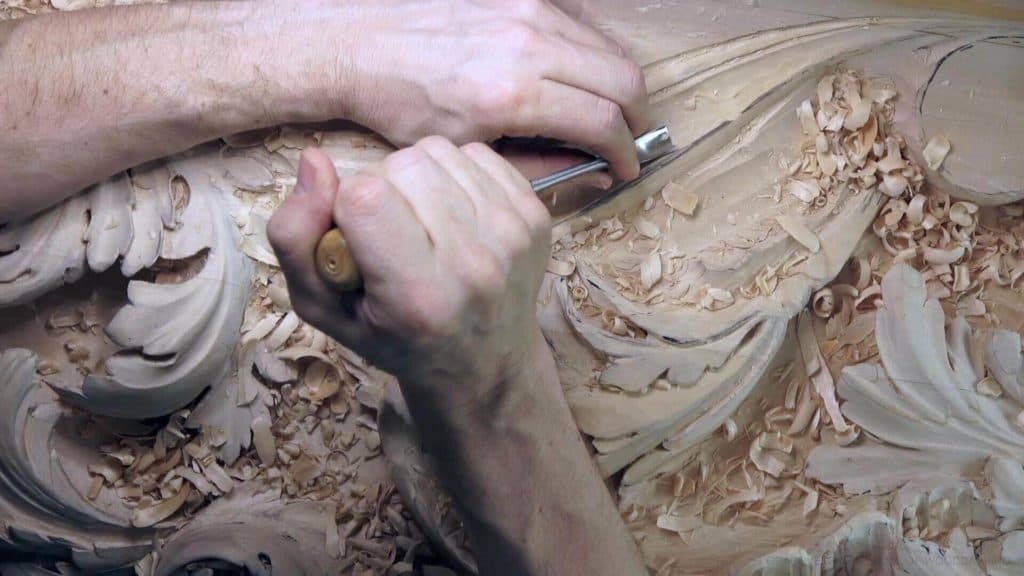
Alexander Grabovetskiy, woodcarver, School of Woodcarving · Published 2020
What does a wood carver mean by "super sharp"?
Quick answer: In part 10 I said I was carving along the grain and called that dangerous. Right after, "Super sharp." The same two words are in my other lessons, next to big tools, a knife, a wavy edge and a strop.
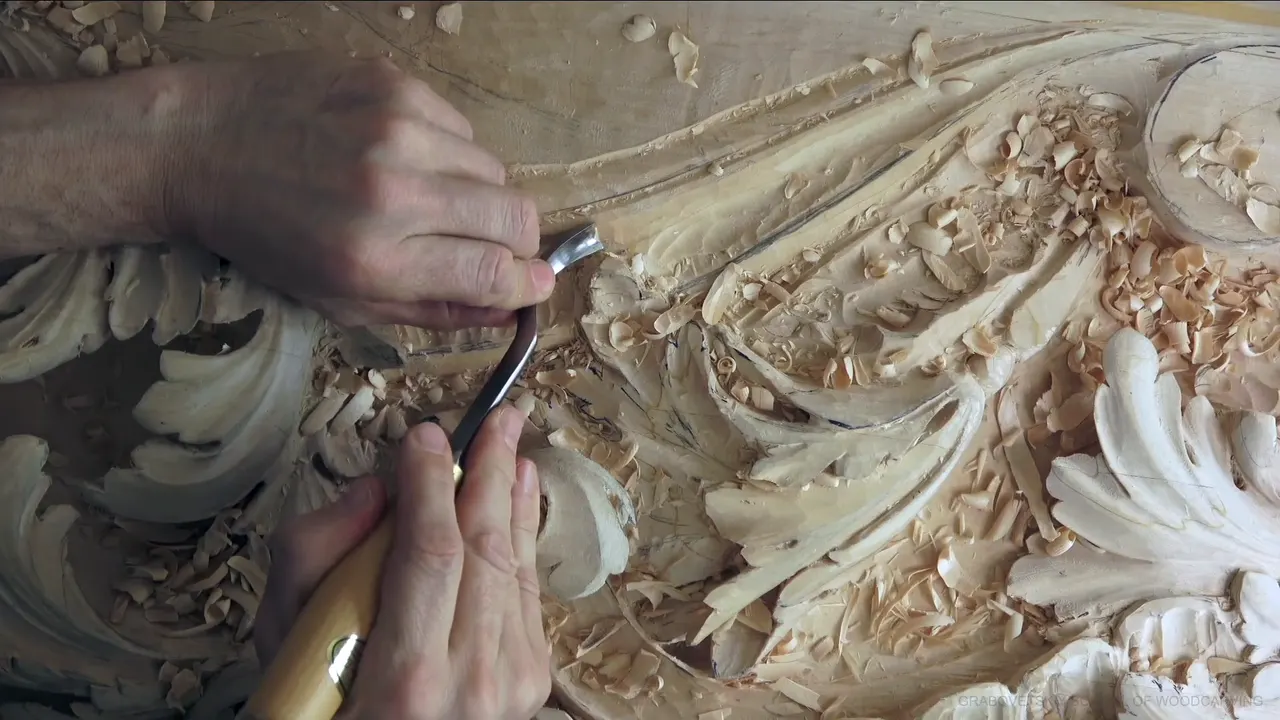

I said "Super sharp." in Venice Room 58, part 10, while I was calling my carving dangerous. My other lessons use the same words.
Does a gouge tear the wood where you push it? The lessons below hold my words on that, and so does part 10.
What was I carving when I said it?
Part 10 opens with "What I need, I need really smooth movement." "Just inside the concave, of course, I'm talking about," I said in that part.
On the line, I said "really soon I'll be able to go all the way to the line or close to the line." And: "I'm still going to stay away approximately maybe one millimeter later on, but it's time for me to move closer to the line, to the left side line." One millimeter is about 0.04 in.

Did the light matter?
"But I need better lighting because I can't really see. I need much better lighting." I told you "It's going to adjust. It's going to take a couple seconds to adjust on the camera. My apologies."
Then came "carefully I'm going to approach." And: "it's really important, actually, for me to work with the proper lighting. Maybe someday I have to explain about the lighting."
How close did I want to go to the line?
"See? I'm still creating my form, but I'm a lot more closer to the final look." About the concave: "It's far from final look yet, but I'm really close." Then, of the final line: "Now, I don't want to be too close to this final line, but maybe about one millimeter."
My words were "And now my cut is becoming longer and more continuous, just like that. And that way it's all clean on inside."
The gap had a reason: "The reason why I'm leaving about one millimeter yet, because I don't know how consistent this line is."
The numbers: "Again, one millimeter, that's what I'm leaving. Just one millimeter. Like 3/32 of an inch. I'm sorry, 1/16 is what I'm leaving, about one and a half millimeters. Maybe a little less." In metric, 3/32 in is 2.4 mm and 1/16 in is 1.6 mm, and 1.5 mm is 0.06 in. After that: "Sorry, didn't want to confuse anybody."
What about the grain?
"here I have to be a lot more careful. Although on inside right here, I'll clean little later."
Then the grain itself: "But again, I'm going to get close to this line, but I'm carving against the grain. Actually, along the grain, not against the grain. And that's dangerous. So the tool must be really, really sharp. Super sharp. Switch and go opposite direction."

The video before, part 9, has this about force: "It feels like when you're watching on TV that wood is resisting, but it's not. My tool is really sharp, and I'm barely creating any pressure." And: "But I'm trying to control my tool, that's why it looks like I'm applying some force. I'm not." Then: "I'll get really close to my design."
What else is in part 10?
"Okay, double check. All I need is just a really consistent line all the way." Also: "Really gradual, continuous movement."
Of the ridge: "I don't worry about that I created a ridge on inside. It's not a big deal at all. I can use a bigger tool later on and just get rid of all of those ridges."
"But now it is probably time. Turn to that line and cut from opposite direction." Next, a word to you: "My apologies if I'm covering that with my hands. I'll try not to, but if I am, please forgive me." Then: "That's the only way, because I really do have a ceiling. See? Can you hear that? That's the only way I can do that and still create a clean cut."
This is what I said: "I don't worry about the middle yet. I don't really worry about the middle yet. What I worry about, clean and clean. Two sides clean." And: "Just sounds a little weird. Almost like attorney office or something."
The next video, part 11, has "Now I've got the two sides pretty clean. Now I have to take care for this middle, although this side is not too clean yet."

Where else are those two words?
They are in other lessons of mine, beside other jobs.
Do big tools need it more?
Carving Grape Onlay 9, part 2, has me saying "Here you go. That is, uh, really good movement." Next: "I could just, uh, create a couple cuts this way. Just make it motion." On tools: "the only thing with the big tools, they must be super sharp. All the tools, they must be sharp, but with the big ones, even more important". A plan: "Let me switch to smaller one 10 millimeters" (0.39 in).

Can a super sharp tool go deeper than I mean?
Knife talk is in Venice Room 92, part 10: "See how quickly I can outline everything." And: "I do have to be careful how deep I carve, because my knife is super sharp, and it can penetrate really deeply." Then: "so that way, I can damage my background. Although, not in this case."

A surgeon comparison is in Venice Room 45, part 2: "When I'm doing a cut like this inside, I got to be really careful not to dig too deep. And my tools are super sharp, and see how long bevel I have? That is just like doctor's tools, like surgeon tools, so really easy to dig inside of the fibers. You can actually shave yourself with it." Then: "But see? Beautiful movement. But now I can give that pipe the right direction."

Mallet talk is in Venice Room 69, part 7: "I've got to be careful not to touch it because it's super sharp right now." My next words: "And why I didn't do bigger bevel on this particular tool, because I'm planning to use a mallet on that too. And I don't want to do too low bevel for the mallet tools." Before that I said "I can just slice through it, no problem. See? It's beautiful."

How do I get an edge that sharp?
The stropping lesson of my Carving Tool Sharpening course has this in part 5: "The second wheel, the red one, I'm charging with the blue, and that's a really fine diamond paste. And that just gives me super sharp edge." And: "See? It becomes black."
Part 6 of that lesson has these lines. "I'm not afraid of rounding effect. If you are afraid of rounding effect, you shouldn't do that, but I'm not. But see how sharp that piece is. Not piece, but this tool is. Let me pull a board, and I can show it to you." Then: "I can just hold by two fingers like this without a second hand. See? No hand, and I can already start carving." And: "Right there is my hand, just to prove you a point."

Next in that part: "It just shaves so easily because it's already super sharp. Just after honing it". And: "Beautiful and clean cut."
A strop and a hone are in Venice Room 64, part 9. First: "I'm kind of breaking rule because I'm not going to be able to attack from that side." Then: "Everything's on my way, but the tool must be super sharp. Okay. If you know what I mean." I grabbed "number two and a six millimeters" (0.24 in), and I said "Maybe I just have to touch it up little bit, sharpen it." On the edge, my words were: "I stropped a little bit. Actually, I did not strop it. I did hone it on a 6,000-grit sandpaper. That's what I did." And: "In this case, I didn't want to round this, so I really needed a really super sharp edge." After it: "And looks like it works really good. Okay, wonderful."

Another line of that lesson, in part 1: "And yes, I am damaging this side, but that is absolutely okay because I can clean that. I have no problem with this side because I can clean it, and actually I can clean it with the number nine." Then: "Just super sharp number nine."
What if the wood still pushes back?
Sponging is in Venice Room 63, part 12: "And it's sponging slightly, even with the super sharp tools. Maybe some of them I have to actually do even more sharper. Yes. I guess that's exactly what I have to do. Otherwise, it's just sponging." A plan came next: "Let me check if I have sharp enough tools to take care of that sponging effect."
"Okay, let me make it sharp. Okay, I got that tool little sharper now. Let me try." Then: "right now I got super, super sharp." Also: "I'm slicing through. Okay? I am slicing through. That was number nine, by the way." Then: "Okay. Wonderful. So now it's much better."

A difficult piece is in Venice Room 78, part 9: "sometimes you get difficult pieces, even basswood, but this one is one of those pieces. It's not as nice, okay?" And: "some pieces is really piece of cake, really easy to carve, but this one gives me a little bit resistance. Even with the super sharp tools, it still kind of gives me resistance." That part has a plan too: "Let me use maybe a two millimeters, number 11." Two millimeters is 0.08 in, and the next words were a plan to "excavate a little deeper in this area."

What if the other side is not convenient?
Opposite sides are in Venice Room 94, part 8: "It's just not convenient for me to attack from opposite side," and "just because of that camera position." Then: "as long as I have my tool super sharp, I shouldn't have any problem."

Does the edge have to look perfect?
The Maine Coast class, Sharpening V-tool, has "important for me to get to the edge as close as possible and be consistent at the edge." I added "But even if I'm not consistent at the edge, sometimes some tools, you can see some waviness."
Next: "So, I'm not in business to make sure it's a really straight line. I'm in business of carving wood. And if my edge little wavy sometimes, I'm okay as long as it's super sharp. I can do a medical operation, surgery with my tools." Next: "And some of the guys who have really straight tools, they can't even dig in wood because it's rubbing. But the tool looking good." Then: "So now, we're going to switch to carving."

How small a job asks for it?
Lily Box 11, part 10, is the lily flower lesson. As I had mentioned many times, I said that really sharp tools are the key. Then: "even if I'm holding it by finger, it's almost impossible to create a solid support. So the only way you can really take some material out and make a cut if your tool is super sharp." Then: "And if you do have any ideas how you could support it better than that, you are welcome to comment on it." Next: "I'm carving for a long time, that type of carving, really tiny small stuff."

Which lesson holds which line?
The whole run sits in one small table.
| What was in front of me | Lesson and part |
|---|---|
| Something I called dangerous, then a switch of direction | Venice Room 58, part 10 (this page) |
| Big tools | Carving Grape Onlay 9, part 2, with a plan for a smaller tool of 10 mm (0.39 in) |
| A knife that can penetrate really deeply | Seen in Venice Room 92, part 10 |
| Care not to dig too deep, and a mention of surgeon tools | Venice Room 45, part 2 |
| One tool to be careful with, and a bevel not made bigger because of a mallet | Heard in Venice Room 69, part 7 |
| A number 2 of 6 mm (0.24 in) and a hone on 6,000-grit | Lesson 64, part 9 (Venice Room) |
| A wheel charged with a really fine diamond paste | Stropping lesson of Carving Tool Sharpening, part 5 |
| Two fingers | That same lesson, part 6 |
| Sponging | Found in Venice Room 63, part 12, where a number 9 slices through |
| A difficult piece, even basswood | Lesson 78, part 9 |
| An opposite side that is not convenient for my camera position | Spoken in Venice Room 94, part 8 |
| An edge a little wavy, and some waviness in tools | Maine Coast sharpening class, V-tool |
| Really tiny small stuff held by a finger | Lily Box 11, part 10, lily flower lesson |
Is a chisel in your hand right now, with the edge not quite where you want it? My words are next to each picture. The carving is on its own page.
This video sits inside workshop 58, a lesson of my Venice Room Part 5 course.
How it's done
- Say what you need. I opened part 10 with "What I need, I need really smooth movement."
- Leave a little before the line. The distance: "I'm still going to stay away approximately maybe one millimeter later on" (0.04 in), and "I don't know how consistent this line is."
- Get the light right. The light: "I need better lighting because I can't really see."
- Watch the cut change. The cut: "my cut is becoming longer and more continuous".
- Say it before the grain. "Super sharp." After it came "Switch and go opposite direction."
- Go to the line. The turn: "it is probably time. Turn to that line and cut from opposite direction."
Frequently asked questions
At what point in part 10?
Right while I was calling my carving dangerous, and just after I said "really, really sharp."
Did the light come into part 10?
Yes. "I need much better lighting," I said, and I told you the camera would take a couple of seconds to adjust. "My apologies."
How far from the line was I leaving the wood?
One millimeter, about 1/25 in. Then: "about one and a half millimeters. Maybe a little less." In metric, 1.5 mm, or 0.06 in.
Is there a lesson with a knife?
What to carve next