
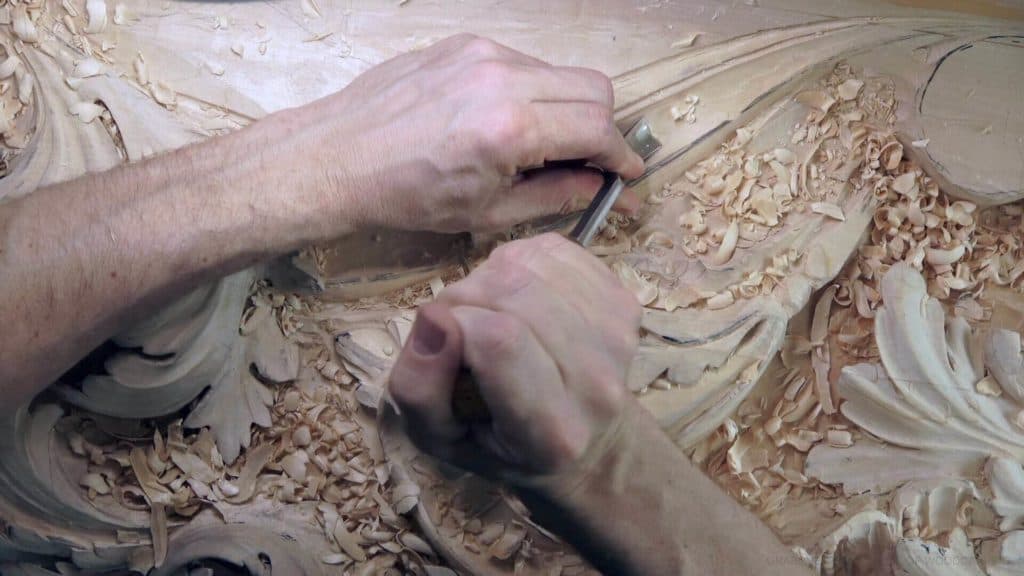
Alexander Grabovetskiy, woodcarver, School of Woodcarving · Published 2020
What does a wood carver mean by "I'll survive"?
Quick answer: Part 12 has "I'm in the camera shot" and "I'll survive." The same words are in Venice Room 33 and 67 and in the Furniture Panel course, and "It'll survive" is in the livestream of October 2020 about a mushy spot in the wood.
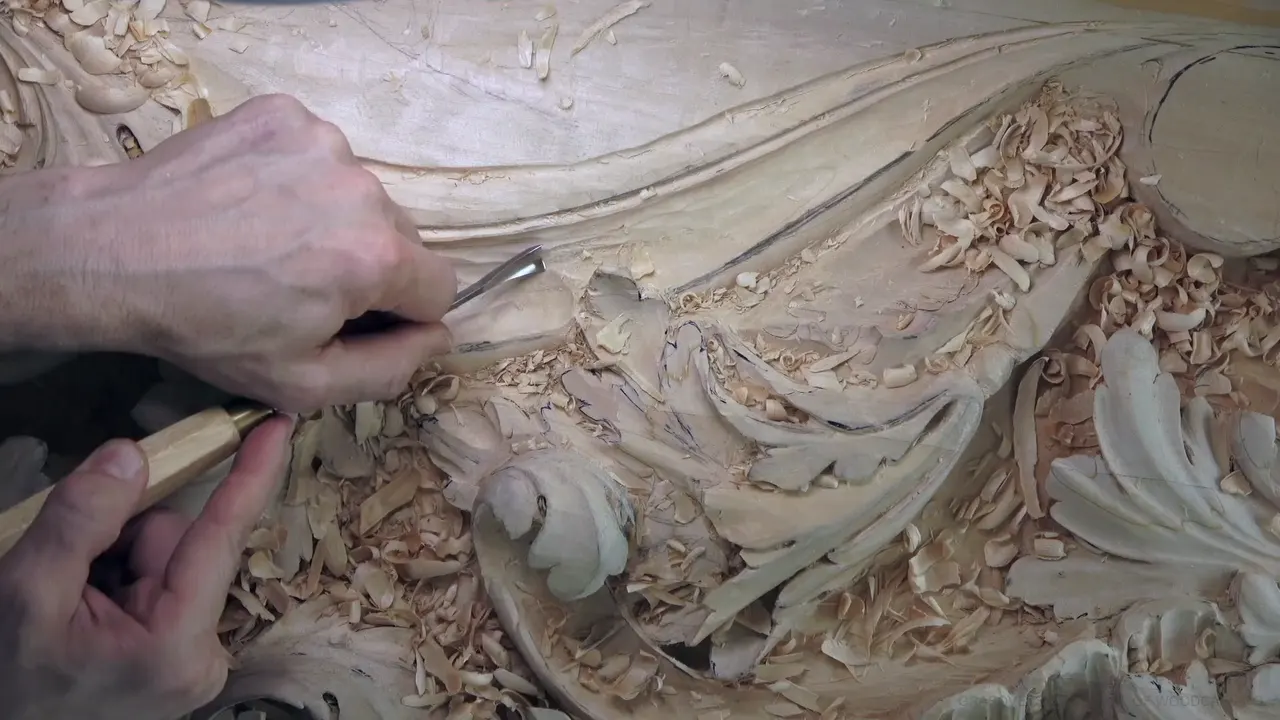

I said "I'll survive" in Venice Room 58, part 12, and in other lessons too.
The lessons below hold my words on what gets in the way of the work, and so does part 12.
What was I carving when I said it?
"The grain of the wood." Next: "I don't think I'll be able to use a straight tool from this side. Maybe some of it. To a certain degree I'm able to."
About the rest, here is what I said: "And later on, I'll clean on inside, but at least I can remove some of that with the number seven." I added "And create consistent movement, and gradual movement all the way up. Again, it's kind of little by little, chip by chip."

"And this was number seven." After it came a plan: "But let me probably use, I think number five maybe now." And: "let me use a bigger number five and see if it's going to grab some of the stuff."
On the bigger gouge, my words were "And why I'm doing a bigger, that way I'm going to eliminate the lots of carving marks, tool marks, facets. See? Just gives me really long, consistent cut, really long and beautiful cut."
What about the camera shot?
"It's not that comfortable for me to work without getting inside of the shot. I'm in the camera shot, but it's okay, I'll survive."

How did part 12 go on after that?
"So pretty much the idea is you start from small cuts with the smaller tools, and then you use a bigger tool to blend everything." With the bigger tool "you're able to actually eliminate absolutely almost all of those tool marks. That you even don't need to use any sandpaper or anything."
Then: "Okay? So it's almost there, but I need to do it this way and clean little bit that direction against the grain. Although, I'm not going to touch yet." My plan was "probably off camera, just undercut because nothing special about it."
A spoon was in the plan: "I need to use a spoon number five. Spoon number five. And go that direction. And again, just to hit the high spots. Just to hit the high spots and get closer to the line."
"It's becoming a molding. It is becoming a molding." A bigger tool was needed now, I said, and "Let's try number six," to see if it would fit inside.

Maybe number six would not work everywhere: "but some spots it will. See? It just hits the high spots. And it creates really beautiful and smooth surface. Really beautiful and smooth."
About one side: "Don't pay attention to this side yet. I know it just not done yet, okay? It's just not done yet. Okay. And also it's not done underneath right here. But now I need the smaller one again and blend inside right here."

On the whole piece I said "And here you go, and I think it looks really good. Let me move that light out, and see how it casts a shadow? And depends how I am going to hit with the light, just creates a different look."

About the work ahead: "There's going to be shells and there's going to be a canvas again." Movements uphill were the plan.
About one spot: "Now, this part, I'm probably going to take care off camera. We'll see, but I still have to develop this one, and I still have doubts what I want to do. Either a volute." Maybe I would do a volute "like that."
"Because I do have a volute like this on this side, and I need to repeat about the same right here, I would say." After that: "Just a volute right there. And it's going to give me ability to create gradual movement uphill."

Is it only part 12, or do the other parts of workshop 58 have lines like it?
Part 10 has "My apologies if I'm covering that with my hands. I'll try not to, but if I am, please forgive me, that's the only way, because I really do have a ceiling. See? Can you hear that? That's the only way I can do that and still create a clean cut."

Lighting is in part 10 as well: "But I need better lighting because I can't really see. I need much better lighting."
The line in part 11 is "Well, let me attack little bit underneath of this piece because right now there's too much and it's on my way." For that I would use "the two millimeters, number 11" (2 mm, about 0.08 in) and "carefully remove some of it." And: "I could use number nine and a quarter inch." (A quarter inch is about 6 mm.)
Was I upside down in another lesson?
Yes, in Venice Room 33, part 4, a lesson of my Venice Room Part 3 course: "Right. And that is looking good, even if it doesn't look good. It does look good in my opinion, because I know how it's supposed to look at the end."

Before the line: "Let me use number six maybe. Maybe even straight will work. But again, don't want to dig too deep." Next: "And yes, I'm working upside down because that is the ceiling part already. It's not really convenient, but it's okay, I'll survive."
After that: "Okay, that is good enough, probably I don't have to go farther than that." On chips I said "one of the ways to clean all those chips without air compressor taking all the space," and "Those chips would fly all over the room."
"I still don't like how it looks right here, but I'm really happy with this area. So I can probably go ahead and develop, to the almost final look, this section of acanthus." Number 11 was in the plan, a smaller one, "maybe about quarter inch." Quarter inch is about 6 millimeters.
Also: "this part going to go a little bit underneath. Which is not always good idea, but let me see how I can make it look much better, okay? But I'll make it look really good. Okay. That's enough for now."

A piece in my way, in workshop 67
In Venice Room 67, part 6, of the Part 6 course, I said "So that is good, that is actually exactly what I want to see. So now I can establish my concave," and "So that would give me really nice motion or movement."
A "little bigger tool" was the plan, and "In this case, I'll use a 12 millimeters, a half an inch." That 12 mm works out to about 0.47 in, while half an inch is 12.7 mm.

Before starting: "And it's not that easy, I should tell you, because everything is in my way. That's not too convenient, like I said, everything, this piece is in my way. I can't attack from this side because the grain runs that direction." It was okay, I said.
"Every project like that, okay, every project, there is some areas which is inconvenient, really inconvenient. So I'll survive, I'll do my work, I'm okay with that. I actually like those challenges and just to find a solution, the right angle, it kind of makes that work really interesting."
"Here you go, and I was able actually to create that concave, although I need to blend that ridge a little bit and give a more correct motion, movement." The big tool, I said, "gives me a lot nicer, cleaner, wider cut."
And a plan: "Let me try to use 5/8 of an inch, 15 millimeters. And I'm going to just do even wider." In metric, 5/8 in is about 15.9 mm, and 15 mm is about 0.59 in.
Carving toward myself, in the same part
On carving toward myself: "I would encourage you not to because it's not the safest way. So what can happen, you can slip and cut yourself, and that would be big mistake."

Next: "But it is okay. I've got a pronounced pipe which is going right here, I've got a really nice concave, and it just rolls to the convex and goes underneath, and that is actually exactly what I'm after." And: "That's going to give me even better movement, I should say."
"I just created a really sharp middle line, which I don't need." I would hit it with the back bend, and I said I thought it a good idea.
The rule when you have to carve toward yourself: "you really lock your elbows, your hands right on the piece." And: "But if you don't have to cut toward yourself, don't do it, okay?" Also: "But to be honest with you, every carver does it."
What if you do not agree?
Carving Furniture Panel 11, part 2, is from the Design, Part 1 course. Words of mine: "And maybe this one I can make a little bigger. Just like that." Next: "I think it's good, I think it's good, that's in my opinion. Some of you are maybe not going to agree with me." After it: "I'll survive. And let me think what else I can do."

More from that part: "I kind of like what I see right here." About my first line: "The first line I placed, it was just a sketch line, but I do have to be really careful and be as close as possible."
"Maybe I can fill this space first. Preliminary." And: "maybe coming from the center and through this intersection." And: "Like a S shape."
I thought it was good, but "I'm not completely sold on it yet." And: "What I would do, I would take, again, this tool and find my closest circle and place my more perfect line. Okay. Get rid of the rest of it."
What about the wood itself?
In the October 2020 livestream: "let me also now create the cut with the two millimeters number 11" (0.08 in) and "I want to create that cut right underneath of it." On a spot in the wood: "But see, that area is mushy because it's a green color, which means it's already starting to rot. I mean, the wood itself, it's a watermark. But that's okay. It'll survive."

Does the word fit anything besides me?
No. In Carving Flower Rosette 4, part 1, I said "Let's work on another side." About tools: "They are excellent tools actually to have. Although I survived without them for a long time. It's a good thing to have, but not necessarily you really have to have it."

In Carving Grape Onlay 13, part 1, I said "Uh, I broke one." and "you know, it did not survive the trip."

Did I mention the camera in other lessons?
Venice Room 72, part 9, has "Let me show what I've done off camera. Okay. So yeah, don't pay attention to all that junk inside. But anyway, I worked a little bit on this section, and you can see, it was really hard for me to work with the camera on, I should say, because my head would stick always in the shot, and not really pleasing to the eyes."
Venice Room 60, part 1, has "I don't want to get inside of the camera shot, but obviously I got to put a midline which is supposed to go all the way to the center line right here."
I was not sure I would film a side in Venice Room 43, part 7, "because it's too far from my point of view." And: "that area is not too convenient for me."
In Venice Room 22, part 9, I said "That is for me not convenient to carve," with my head in the way of the camera, "but at least once in a while, I can show what is going on."
Which line sits in which lesson?
The whole run sits in one small table.
| Lesson and part | What was in front of me |
|---|---|
| This page, part 12 | Staying out of the shot while I work |
| Same lesson, part 10 | A ceiling, and the chance of covering it with my hands |
| Same lesson, part 11 | There was too much, and it was on my way |
| 33.4 in Venice Room | Working upside down, because it was the ceiling part already |
| 67.6 in Venice Room | Everything in my way, and a grain that runs one direction |
| Furniture Panel 11.2 | Some of you maybe not agreeing with me, in my opinion |
| October 2020 livestream | A mushy area, with the wood itself a watermark |
| Flower Rosette 4.1 | Going without those tools for a long time |
| Grape Onlay 13.1 | Breaking one, and a trip, in two lines |
| 72.9 in Venice Room | My head sticking in the shot while I worked with the camera on |
| 60.1 in Venice Room | Not wanting to be in the camera shot |
| 43.7 in Venice Room | A side too far from my point of view, and not sure I would film it |
| 22.9 in Venice Room | A head in the way of a camera I had just repositioned |
Is a ceiling or a piece in your way right now? My words are next to each picture. The carving is on its own page.
This video sits inside workshop 58, a lesson of the Venice Room Part 5 course. Other courses I quote are Carving Furniture Panel, Carving Flower Rosette for a rosette and Carving Grape Onlay.
How it's done
- This side. "I don't think I'll be able to use a straight tool."
- Number seven. "this was number seven," and then the plan for a five.
- Bigger number five. Here the plan was "I think number five maybe now."
- In the camera shot. "I'll survive," said about being "in the camera shot."
- Spoon plan. My plan: "get closer to the line."
- Number six. Here the try was "Let's try number six."
- Smaller tool. Then I said "now I need the smaller one again and blend inside right here."
Frequently asked questions
Was something not comfortable in part 12?
Working while staying out of the shot, which I said was not that comfortable.
Which tools are in part 12?
I used number seven. My plans were number five (a bigger one), then a spoon, number six, and a smaller tool.
Is sandpaper needed after the bigger tool?
With the bigger tool you can "eliminate absolutely almost all of those tool marks," and you do not even need sandpaper, in my words.
Which tool sizes are in workshop 67?
What to carve next
- Venice Room Part 5
- Venice Room 58
- Venice Room Part 3
- Venice Room 33
- Part 6 course
- Venice Room 67
- Carving Furniture Panel
- Carving Furniture Panel 11
- October 2020 livestream
- Carving Flower Rosette
- Carving Flower Rosette 4
- Carving Grape Onlay
- Carving Grape Onlay 13
- Venice Room 72
- Venice Room 60
- Venice Room 43
- Venice Room 22