
Alexander Grabovetskiy, woodcarver, School of Woodcarving · Published 2020
What does a wood carver mean by "eight-quarter"?
Quick answer: In Venice Room 61, part 10, I called my board eight-quarter and gave its thickness as maybe 1 15/16 in (49 mm), and I said I have two inches of board. In other lessons I gave the word a thickness too, around the two inch mark.
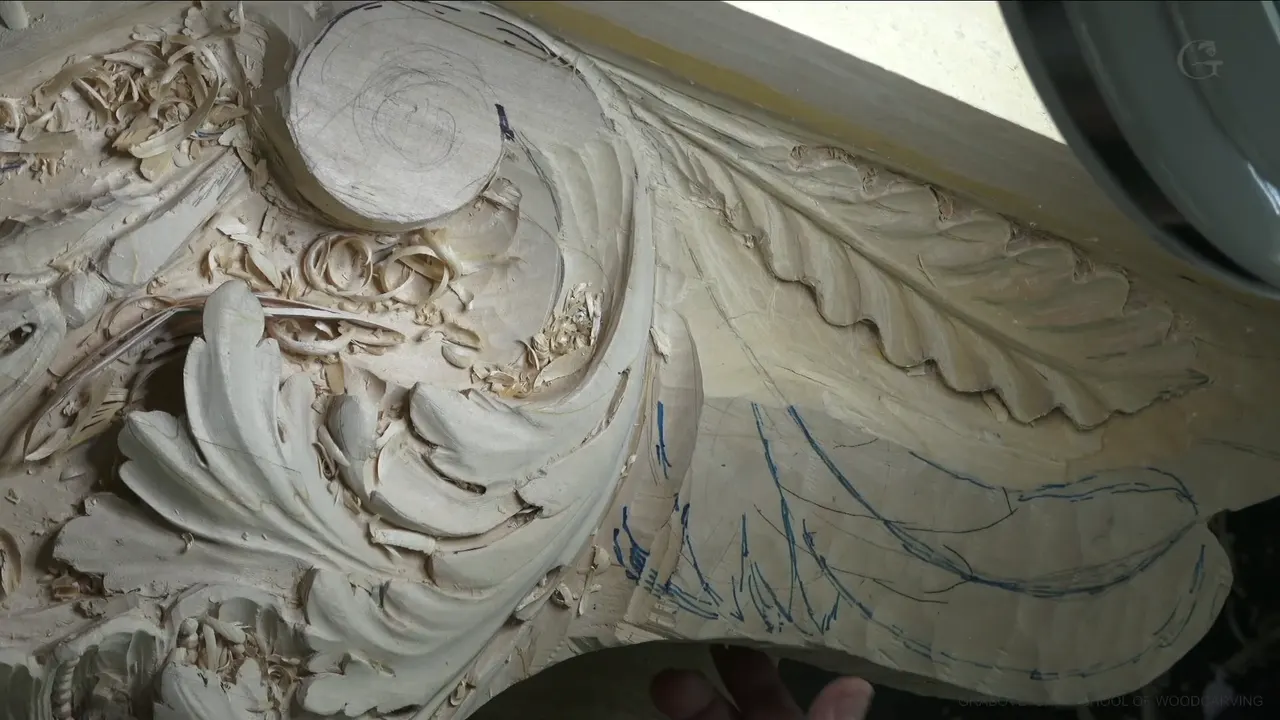

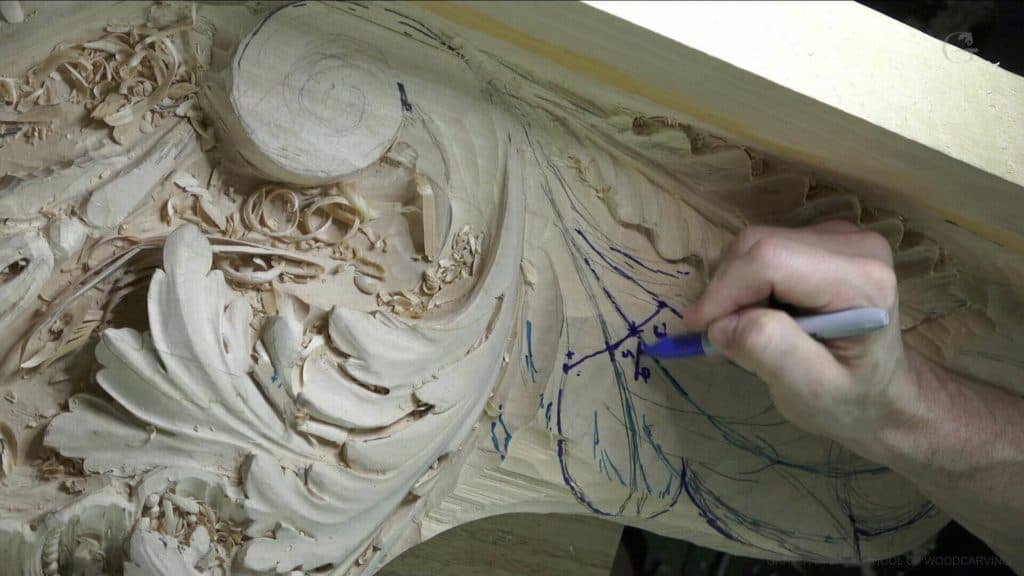
In Venice Room 61, part 10, I called my board "about two inches eight-quarter material" and planned what to lower and what to keep on it. Other lessons of mine give the same word with a thickness each time, and the figures stay around the two inch mark.
Have you ever stood at a lumber rack and heard a number like eight quarter, with no idea what it meant for your hands? Did you pick up a board, measure it and find it thinner than the number said? Below are the lines where I said the word, the places I said four quarters or 16 quarters, and a table with every figure side by side. Check them against a board of your own.
What did I say about the board in part 10?
The next lines gave figures. "Maybe it's about an inch and 15/16, something like that" (49 millimeters). Then: "And above, I've got to this point, approximately a half an inch. But it's not what I want to do." A half inch is 12.7 mm.
What did I plan to do with those two inches?
A corbel would be connected, I said, and then came a need: "And what I need to do, I need to lower down a little bit this section on both sides." My doubt was in the next line: "But I also don't want to lose overall feel to it, and that is why I still have doubts." And then: "Should I do that or not? But looks like yes, I really think so." "Still going to keep the mass two inches," I said, because of what I would use "to connect to the corbel."
Which tool did I plan for chopping, and how was the grain?

"Okay, now, so let me chop out some of the material." My plan was a number six, a size near an inch: "And I think I'm going to use number six and about one inch for this." An inch is 25.4 mm. A warning followed: "But I've got to be careful because the grain runs that direction." About the angle: "In this case, it would be better to attack from that side, but it's not really convenient for me."
"Okay, that's probably enough. I'm not going to chop anymore." For the other side: "And I'm going to keep exactly the same thickness on the opposite side of my board."
How did I find the middle line?

With the chopping done I said: "But now I need to get my middle line, and I have to make the decision how my division is going to work out." The line looked "little bit too straight" to me: "Maybe I need to twist slightly this direction." The reason I gave was "more unified with the flower." Later: "Maybe I can go all the way and fill pretty much everything with this acanthus."

"I know sometimes it is confusing what I'm doing, especially if you've never done any design for wood carving." And: "keep watching the logic behind."
What rule did I try to stick to?

Of the main middle line of overall movement: "If you take this point and that point and divide that by 10, my middle line shifts little bit to the left." After that: "So which means this is four parts out of 10, and this is six parts out of 10, approximately. Just eyeballing." The part ends on this: "And I'm trying to stick to this rule or law everywhere I can."
Where else did I say eight quarter?
Every passage below carries a figure, its course, lesson and part, and the link opens the lesson.
Is eight quarter exactly two inches?
By my own figures, not exactly: I said two inches or so, then gave a smaller figure. Venice Room 59, part 2, has this: "I'm glad that I do have an eight quarter material ceiling right now." Then: "So it's two inches almost, a little less than two inches, but like one and 15/16, something like that." And: "About 50 millimeters, a little less than 50 millimeters probably, something around that." The 15/16 comes to 49 mm. After it: "So I have to be mindful how deep am I going to go." And: "And also how it's going to blend all together."

Part 1 of Hashemi Flowers 42 says: "I took about eight quarters board and 16 quarters board. To be exact, the eight quarters piece, what I have, it's about 1 15/16 of an inch or about two inches." Over in lesson 27, part 1, I said I like that project to stay "a little rougher," and "it is a time to work on the second layer." I took "an 8-quarter piece of material, which is approximately two inches. To be exact, one inch and 15/16 after I planed everything." The size of that piece was "approximately 13 inches tall and about 7.25 inches wide," and "in the metric system, would be about 184 millimeters wide and about 330 millimeters tall."

Venetian Flowers Rosette 1, part 3, gives the thickness: "the thickness of this piece, it's about one inch and seven-eighths, so that would be eight-quarter stock if you're in United States." I called it "kind of big," a "little over 40 millimeters," and "a little bigger than that." And: "It's less than one and seven-eighths, but pretty close." The seven-eighths figure is 47.6 mm. I picked a veiner next: "I'll use number 11 veiner, and that would be 12 millimeters" (0.47 in). And of the groove: "it's pretty close to half an inch deep in this case."

Venetian Flowers Rosette 5, part 3: I started with "a two inches block of wood," I said, and the actual thickness was "an inch and seven-eighths" (48 mm). It was "an eight-quarter stock." I could "just scroll that and carve it and apply it on a background," but "I thought that's a good idea to do solid." It was "a single solid piece."

Carving Grape Onlay 1, part 1, reads like a shopping list. The first item is the board: eight quarter, near two inches, and mine about one and seven eights. "That's what you're gonna need, 4.76 to be exact, but it doesn't have to be exact." Five or six centimeters of material (2 to 2.4 in) would be even better, I said, then: "24 by six by two inches, that's what you're gonna need." That works out to about 61 by 15 by 5 cm. basswood was the wood, as always.

The Schaaf tools lesson, in All about tools for wood carving, gives the same word a figure. Its size was "approximately six inches wide and approximately eight inches long." On the thickness: "It's less than two inches. It's inch and 7/8," I said, and called it eight-quarter, "just planed down."
What does four quarter mean?
The thickness in Carving Floral and Molding for the Panel 1, part 1, was "about maybe 19, 20 millimeters, about three-quarters of an inch." Use "just the three-quarter-inch material or four quarters if you're in the United States," I said, and "about 20 millimeters." Then: "You can use one inch." Same wood: "I still use the same basswood, limewood, linden wood." Even thicker works "if you wish to pop those flowers a little higher." I planned "just three-quarters of an inch material," and the piece was "carved from a single piece."
Livestream April 2020 has the wood movement talk. "You don't really have to buy thick stuff," I said. "So you can get just the four quarters material, which is three quarter of an inch material." Then: "And again, just laminate together. And here you go, you got a thicker board." In metric, 19 mm. I added: "If you don't plan to spend thousands of dollars for just the best wood."

Carving Hazelnuts 2, part 1, opens with "All three blocks are glued, and they are dry." The count was: "So we've got eight quarters and four quarters, so 25 millimeters, and we've got a full two inches right here." Then: "So about 50 millimeters." I put the total near 75 millimeters. The 25 is about 1 in, the 50 about 2 in and the 75 about 3 in. "Now, why is that important for this project?" I asked, and: "I am planning to do a full 3D." The chunks came "based on the size," and "it's really important to create full 3D shapes."
Venice Room 77, part 7, has a shorter note: "a block of cherry" is what I had, "about four quarters."

What is 16 quarter stock?
In Carving Hazelnuts 1, part 3, I said: "Yeah, you could get the solid 16 quarter material if you wanted to," and it would be "double work to remove all those extra fibers." My reasons for not gluing the blocks first: "it is a lot easier to get the tracing done on just a single piece because we use the carbon paper." And: "it's nothing in your way."
Hashemi Flowers 42 puts a size on it: "I could take a really thick piece of wood, like a four-inches, 16 quarters, and just carve from the solid all the flowers and details." Four inches is 102 mm. "I already have a two-inches thickness," I said, and I would "have to add another three and a half inches above to carve this flower." That would mean "a six-and-a-half-inch thick block, and there's no reason."

The block I took instead: "And another block I cut from the solid block, it's about 3 5/8, three inches and 5/8 of an inch. Okay, so it's not exactly four inches." That makes 92 mm. Of the peony flower: "And really, above the flower, we're going to have just that much, two and a half inches." That is 63.5 mm.
Does the grain matter on two inch stock?
Part 9 of Venice Room 76: "And again, that is two inches thick," I said, and called the piece "eight quarter." Next: "And in this case, I really don't care as far as the grain run." Then: "If it would be stain grade, I would definitely have to use different piece. But that is not stain grade." The piece would get paint, I said, and: "So I have no problem of changing the direction of the grain."

I would need the whole body, two inches, I said, "Although I don't have too much space." Then: "Maybe I do. Maybe I do." The piece would go to my scroll saw first. My words on the background: "This is of course, basswood, but you can apply it on oak background, and I'll show you."

Is eight quarter the same as quarter sawn?
Each lesson above gave the word a thickness figure. The wood movement livestream lists quarter sawn as one of the "four main slicing of the boards": "Just because that is sawn, which is called just a plain sawn. Okay? The next one, it's a quarter sawn." "Also there's a rift cut," I said, and "there's also live sawn."

"But the best of the best is a quarter sawn," I said, and I gave a reason: "Because, again, the closer to the center you get, the tighter ring's going to be, and it's going to be a lot less movement." On buying wood: "So choices when I'm buying wood, I'm getting those two. Either quarter sawn or rift cut."
Which lessons gave a figure for eight quarter?
Here they are in one table, with the thickness I said and what stood beside it.
| Lesson | What I said about the thickness | Beside it |
|---|---|---|
| This lesson, part 10 | A bit short of two inches (49 mm) | A corbel to connect later |
| Venice 59.2 | Almost two inches, close to 50 millimeters | Mindful how deep I go |
| Workshop 76.9 | Two inches, the whole body | Basswood, and paint was to come |
| Venice 77.7 | About four quarters, and I said nothing special | A block of cherry |
| Hashemi 27.1 | Short of two inches (49 mm), after planing | 13 by 7.25 in (330 by 184 mm) |
| Hashemi 42.1 | Close to two inches (51 mm), and four inches (102 mm) for the thick one | Beside a block from 16 quarters |
| Rosette 1.3 | 1 7/8 in (47.6 mm), over 40 mm | A veiner, 12 millimeters (0.47 in) |
| Rosette 5.3 | Not quite two inches, about 48 mm | Called a single solid piece, I said |
| Grape Onlay 1.1 | Near two inches, and mine ran a bit under, 4.76 to be exact | A 24 by 6 inch board (61 by 15 cm) |
| Hazelnuts 2.1 | 25 millimeters (about 1 in), a full two inches, 50 millimeters | Three blocks, glued and dry |
| Floral and Molding 1.1 | Three-quarter-inch material (19 mm), or 20 mm | Basswood, carved from a single piece |
| The Schaaf lesson | Inch and 7/8, about 48 mm | A six by eight inch block (152 by 203 mm) |
| Wood movement stream | Four quarters at 3/4 in (19 mm), laminated up | Boards laminated together for a thicker one |
Where can you watch the full video of each lesson?
Every lesson named above sits inside one of my courses. This lesson holds all of workshop 61, and workshops 50 to 61 are in Venice Room Part 5. The other lessons are linked where I named them. To watch the full videos, start here.
How it's done
- Name the stock. The board was eight-quarter, close to two inches (51 mm).
- Decide what to lower. A section needs to come down a little on both sides, and I planned to leave the mass at two inches.
- Choose a tool and watch the grain. Number six was the plan, near an inch (25.4 mm), and the grain runs that direction, so I had to be careful.
- Match the opposite side. The opposite side of my board was to keep exactly the same thickness.
- Find the middle line. I needed the middle line first, and the decision on how my division would work out.
Frequently asked questions
Did I have doubts in part 10 about lowering the section?
I didn't want to lose overall feel to the piece, and that is why I still had doubts. Then I asked whether to do it or not, and said it looked like yes, I really think so.
Does eight quarter mean exactly two inches?
Close. Workshop 59 had me at two inches almost, like one and 15/16 (49 mm). The Venetian rosette came to 1 7/8 in (48 mm), and in the grape onlay lesson the exact figure was 4.76.
How thick is four quarter material?
The floral panel lesson gave three-quarter-inch material, or four quarters in the United States, about 20 millimeters (0.8 in). The livestream on wood movement said four quarters material is three quarter of an inch (19 mm), and I said to laminate boards for a thicker one.
What to carve next
- Venice Room 61 lesson
- Venice Room Part 5 course
- Venice Room 59
- Venice Room 76
- Venice Room 77
- Carving Hashemi Flowers 27
- Carving Hashemi Flowers 42
- Venetian Flowers Rosette 1
- Venetian Flowers Rosette 5
- Carving Grape Onlay 1
- Carving Hazelnuts 2
- Carving Hazelnuts 1
- Carving Floral and Molding for the Panel 1
- Schaaf wood carving tools
- Livestream April 2020