
Alexander Grabovetskiy, woodcarver, School of Woodcarving · Published 2020
What does a wood carver mean by "supposedly"?
Quick answer: Part 11 of Venice Room 61 has a number 11 at 10 millimeters (0.39 in), and I added supposedly after 3/8 inch (9.5 mm). In other lessons I say it about a point on the golden ratio and about two tools marked six millimeters (0.24 in).

In Venice Room 61, part 11, I named a number 11 at 10 millimeters (0.39 in), and I put the word supposedly after the size. In other lessons I say that word about a point on the golden ratio, about two tools that both say six millimeters, and about a spot you supposedly already cut.
Have you ever read a size off a tool and wondered if the number holds? My words from part 11 come first, then each lesson where I use the same word, so you can see every spot for yourself.
Where does the golden ratio fit in part 11?
"It's golden ratio, if you wish." I gave it as "62 parts out of 100." In the same stretch: "But you don't have to think like that, okay? Easiest way, for me, it's 4 out of 10. Or I should say 6 out of 10. Okay?"

What about eight parts?
"But there is another way. If you divide that in eight parts, it's actually sometimes even easier," I said. For the count: "So if you divide that by eight, one, two, three, four, five, six, seven, eight, so it's easier to divide, then it will become 5:3 ratio, which is approximately right here. Okay? So that would become three and that would become five. It's exactly the same thing."
Is there a way with halves?
"It's actually, for some of you, a lot easier to do that. So if you take point to point, let's say, and find really the middle of it, which is going to be equal, equal. And find another middle between the center line and the end."
And: "And again, just divide it in half. That's going to become four parts and four parts. And move five and it's going to become also pretty close to golden ratio. Okay? So that is another way to do that."

Which tool for the outline?
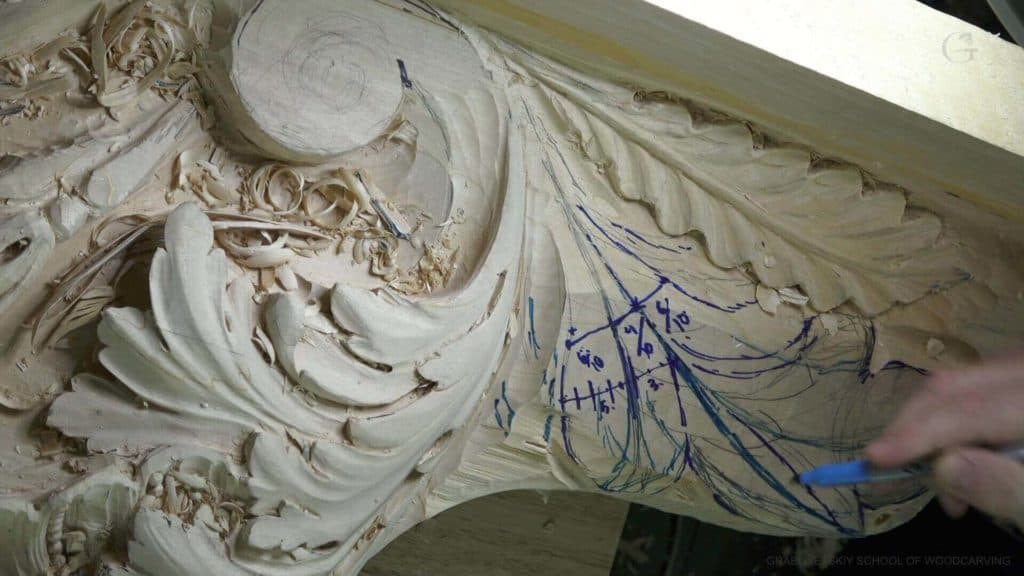
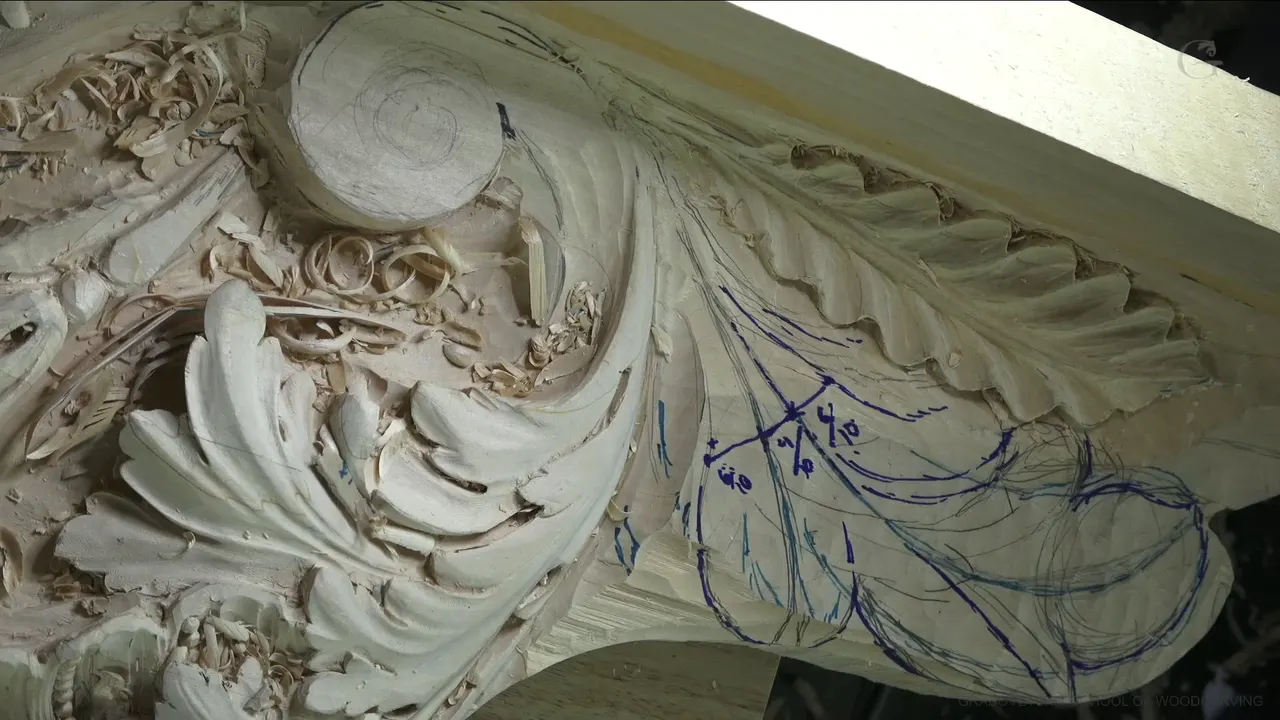
"Okay, let me work on it." On the size: "I'm going to use, in this case, 10 millimeters number 11, which is 3/8 of an inch, supposedly." Ten millimeters is 0.39 inches, and the 3/8 is 9.5 mm.
About the board, a two-inch one (about 51 mm): "But I got to be careful on the bottom how I do that because I don't want to damage a two-inch board, which I need to keep for joining. For connecting my future corbel. And future corbel comes really soon." Also: "This part is only one part which you see."

How did I plan to develop that area?
"Now, I also want to develop somehow this area, but that can be done a little later. Couple ways I could develop. I could stick leaf sticking from a flower, or I could get acanthus movement going from this direction. So we'll see."
What bigger tool was in my plan?
"I need a little bigger number 11, and I will take 15 millimeters, about 5/8 of an inch, and remove some more." Fifteen millimeters is 0.59 in. Part 11 also has: "I can break my piece."

The part has this too: "left approximately three millimeters" (0.12 in) "till the first layer," and I "outlined the head or front of acanthus."
Did I plan extra details at the point of connection?
At the point of connection, maybe some extra details. Whether I would need them, I don't know, and then: "I doubt" it.

Next to "the stage number one of this" comes: "Again, just outline a little bit this side also slightly just to give some depth. Later on, I will do excavation much deeper because I need that shadow. But for now, it's okay. I'm not trying to rush."
Could my middle line move a little, and did I like the movement?
"Maybe I can actually stick a little farther this part, move slightly this leaf away, and shift my middle line even more like that and make a little wider." And: "I don't really like this movement."

Where else do I say supposedly?
Each passage below comes from another lesson, with its course and part named. Where a lesson has a public page, the link opens it.
Is the golden ratio ever part of it?
Carving Vase with Grape Leaves 1, part 6, has the golden ratio too: "Again, let me start separations." Same part: "I'm pretty sure I'm on a golden ratio again. Just put it right there. See? It's right on the golden ratio point. Okay. So which is supposedly be really good to the eye, to the human eye."

How does the word sit on a size marked on a tool?
I held up two gouges in Questions and Answers about Woodcarving, in the answer on straight gouges and fishtails: "And both of them are approximately quarter inch. This is little wider. This one says six millimeters, and this also says six millimeters. Supposedly, they're both supposed to be six millimeters. But anyway, so see those two tools, six millimeters, even if it's marked both." Plus: "So it's a six millimeter, six millimeters, quarter inch. But the difference, this has a long groove on inside."

On a handle, in Tools Selection for Wood Carving: "So the design of it, it's beautiful, and it also has a octagonal handle, which is also supposedly not to roll out." Then: "which like I said before, I never had any problem before with the rolling out."
An old tool is in the U-veiner video of Livestream April 2020: "and that's a gouge number nine, supposedly. I mean, number nine. It should be number nine. All right? They did not mark it the proper way, and the woodcarver who carved before, he marked it number 12, and it's not."
What about a cut I plan, or a shape I name?
Part 6 of Venice Room 2: "And create the cut just like that. But I got to be careful because later on I can actually fix it, but that's not a big deal. But I'm not going to go all the way down because I need to make it more like rounding right here, okay? But for now, it should do it. And just because that is supposedly overlapping, I can actually get it deeper if I wish. I think it's a good idea to make it deeper."

A pipe is in Venice Room 10, part 11: "which supposedly is to be a raised part." For this one I named an old trick, with the pipe "reverse-- Just opposite direction, like a concave." Plan: "let me dig a little deeper and inside."

Venice Room 51, part 11, has a cut and an eye: "But I do have a cut right there, which is supposedly supposed to be another separation," and I said I would create it "little later." In the same passage: "I think I can't use big one. I have to use three millimeters" (0.12 in).

Over in Venice Room 19, part 6: "I have a small subdivision right there," and about creating one later, "supposedly good." I said: "I also could actually excavate underneath a little better just to create really nice curvature on this side." And: "But later on, I'll make the decision".
A ceiling is in Venice Room 60, part 1: "So it looks like it's easy decision, but it was a really hard decision how I make that transition to the ceiling." Then: "And that still supposedly look good. That was a little challenging."
Furniture Panel 17, part 3, has a turning cut: "And yes, if you noticed, I am changing position of my cut. I'm cutting away from myself as of now." And: "And when you start, your heel is always on a higher spot, and when you turn this way and continue to cut, you'll notice you're still cutting in a place where you supposedly already cut, but not really. It just doesn't work that way, so you have to change the position of the tool, how you cut it."

How about the way a carving will look?
Hashemi Flowers 26, part 2, has "raised above the background" and a "shadow underneath of it": "supposedly, it's going to look beautiful."

On a leaf in Grape Onlay 5, part 1: "If you see a lobe in this case, I've got supposedly five lobes. Not sure if you can detect that or not." Plus: "And I've got 1, 2, 3, 4, 5." Further on: "So that section, if you see an eye, you're supposed to have a raised up area. Supposedly, it's all depends, okay?"

Lily Box 7, part 6, has a knot: "It's really tough area. I can barely cut anything because of the knot." Later: "And I think it is enough, not going to dig deeper than that. I could probably return and rethink, but I don't want to make it too weak because like I said before, this is supposedly going to be used daily. I don't know, but that's the idea."

The curly kitchen cutting board is in Beginner Workshop 6, part 2: "And you can see I do have some type of flower coming out from here. Okay, so maybe I'll divide those cuts in two. What I mean I'll divide the cuts in two, you can see the distance between this line and that line, and most logical this flower have to grow from the middle between those two lines. And I'll place my knife on this side and make my bevel cut, and I'll place my knife on that side, and I'll make my bevel cut. And supposedly I'm going to have a nice beautiful central line."

Is it only a word for the bench?
No. In Venice Room 36, part 1, I talked about my website: "Especially in the beginning of 2020, I had a big issue with the server, couldn't handle the traffic a lot. When I had thousands of people at the same time trying to be on the site, and the server I used before did not handle it. So almost crashed everything. So I had to move to a different server twice, actually. I moved to one server, and even it supposedly much better, but it didn't handle all, so I had to move to another server."
The April 5 video of Livestream April 2020 has "my internet connection decided to drop on me," and later in that video: "I'm paying good money. I have a gigabit internet connection, supposedly."
Another video of that lesson, on making money from carving wood, has this about the picture: "And I'm trying to stream in the 60 frames," and then "supposedly going to give me a better quality picture."
Which passages sit side by side in one table?
The table below has the thing I called supposedly in each lesson, and words from the same passage.
| Lesson | What I said with the word | Words in the same passage |
|---|---|---|
| This lesson | The size I gave for my number 11 gouge, 10 millimeters | Number 11, which is |
| Grape Vase 1.6 | A point I was pretty sure sat on a golden ratio | Really good to the eye |
| Fishtail answer | Two gouges that both say six millimeters (a quarter inch) | Even if it's marked both |
| Tools Selection | An octagonal handle, not to roll out | I never had any problem |
| Room 2.6 | A part that is overlapping, so I can get it deeper | If I wish |
| Workshop 10.11 | A pipe that is to be a raised part | Like a concave |
| Lesson 51.11 | A cut for another separation, to be created a little later | 3 mm (about 1/8 in) |
| Venice 19.6 | A small subdivision I can create later on | I'll make the decision. |
| Workshop 60.1 | The transition to the ceiling, which looks good | Challenging |
| Furniture Panel 17.3 | A place where you are cutting, and already cut | But not really |
| Hashemi 26.2 | How it looks with a shadow underneath it | Raised above the background |
| Onlay 5.1 | How many lobes a grape leaf has, which I counted as five | Not sure if you can detect that or not |
| Lily Box 7.6 | A piece for daily use, in a tough area with a knot | That's the idea. |
| Cutting Board 6.2 | A nice beautiful central line, with a bevel cut planned on each side | The distance between this line and that line |
| Venice 36.1 | A server I moved to, which was much better | It didn't handle all. |
| April 5 video | A gigabit internet connection that I pay good money for | I'm paying good money. |
| U-veiner video | A gouge number nine, found with old tools | It should be number nine. |
Where can you watch the full video of each lesson?
These lessons are all in my courses. This lesson holds all of workshop 61, and workshops 50 to 61 are in Venice Room Part 5. To watch the full videos, start here.
How it's done
- Start from a hundred. It's 62 parts out of 100.
- Try eight parts. It will become 5:3 ratio, which is approximately right here.
- Pick the tool for the outline. My plan: a number 11 of ten millimeters (0.4 in), to outline it the same way.
- Take a bigger tool for more wood. I need a little bigger number 11, and I will take 15 millimeters (about 0.6 in).
- Go deeper later. I will do excavation much deeper.
Frequently asked questions
Which tool was in my plan for the outline in part 11?
A number 11 of ten millimeters (0.4 in). For more wood, I planned a bigger tool at 15 millimeters (0.59 in), and I said I need it.
How do I divide a line in eight parts?
Eight parts are sometimes even easier, I said. Counting one to eight gives a ratio of five to three, which I called exactly the same thing.
How were the two six-millimeter tools marked?
Both said six millimeters (0.24 in). Supposedly both should be six millimeters, I said, and for both I also said approximately quarter inch (6.4 mm). One of them has a long groove on the inside.
What to carve next
- Venice Room 61 lesson
- Venice Room Part 5 course
- Carving Vase with Grape Leaves 1
- Questions and Answers about Woodcarving
- Tools Selection for Wood Carving
- Venice Room 2
- Venice Room 10
- Venice Room 51
- Venice Room 19
- Venice Room 60
- Carving Furniture Panel 17
- Carving Hashemi Flowers 26
- Carving Grape Onlay 5
- Carving Lily Box 7
- Beginner Workshop 6, curly kitchen cutting board
- Venice Room 36
- Livestream April 2020