
Alexander Grabovetskiy, woodcarver, School of Woodcarving · Published 2020
What do wood carvers use screws for?
Quick answer: A screw, in my lessons, fastens a vise plate onto the back of a piece, and I name it, beside a dowel and glue, as a way to link one carved part to another. A flower in workshop 61, part 12, could take a screw, I said, though I had not decided.
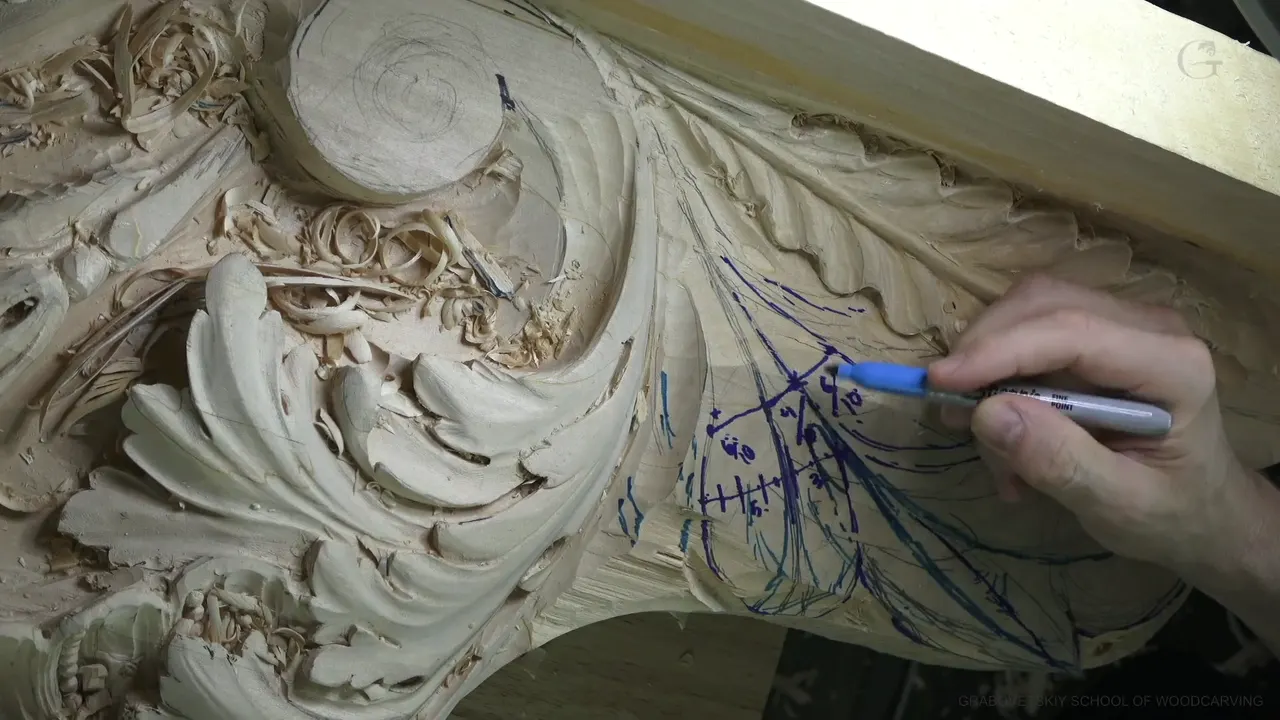

Screws in my lessons fasten a vise plate to a piece, and I name a screw next to a dowel and glue as a way to join carved parts. In Venice Room 61, part 12, I said I could screw inside a flower, though I was not sure.
Have you ever held a carved flower over a slot and wondered how it stays there? Did you think wood glue was the only answer? Below are my words on the flower, the divisions I talked through in the same part, and the lessons where a screw does a job.
Where my screws go
- My vise goes on the backside of a piece, on about one-inch (25 mm) long screws.
- Inside a socket, my plan was a dowel or even a screw.
- In one Venice Room lesson I planned two screws or so, and called removing them no problem.
- Drywall screws are the ones I asked viewers to skip.
- Checking a depth is one more job I named, a screw left standing, though I said I don't.
What did I say about a screw in part 12?
I called this section an "excellent section for you to try," and said I am not going to do "a lots of complicated forms in this area." Then came a need: "And I need to create a slot also to connect my flower."
My words went on: "I don't know if I should shave it little more or just a leaf, actually, the flat spot glue in. But I actually don't need to. I could always screw inside that flower with no problem. So I'm able to do that."

One more line: "But I am afraid if it's going to stick too high, the flower itself. So I'm not sure. I have to think." And: "But let me concentrate first on this section, and I'll make the decision. And looks like I need to change something."
Why keep the two-inch board?
In part 11 I said I did not want to damage a two-inch board (51 mm), "which I need to keep for joining." The joining was "for connecting my future corbel." And: "future corbel comes really soon."
A different joint for the corbel is in part 10. I would keep the mass two inches (51 mm), I said, because I would use probably a domino to connect to it. "Extra large ones, huge ones like that."

How did the rest of part 12 go?
About the divisions: "the decision which one is going to flip, which one is going to overlap." About one edge: "it's supposed to go somewhere underneath. So there's supposed to be an eye."
I also have to do exactly the same eye on the opposite side, I said. "That going to give me ability to widen a little bit this section, which I don't really need" and the flower would cover most of it.

For the divisions my tool was a number 11, 7 millimeters (0.28 inch). "Seven millimeters, that's what I'm using. Little bigger than a quarter inch" (6.4 millimeters). First cut, in my plan: "establish my first cut to the eye."
About the ridge: "this ridge is going to be my high spot," and "I have to follow this movement with my cut."

On shadows: "nothing stops me from exaggerating the shadows of those movements. So I can actually get deeper." In the same part: "number 11 and 5/8 of an inch, 15 millimeters."

On the blend I said "Now I need to blend," and the easiest would be "just to use a skew." That skew "gives me ability to move downhill almost to the line," and I kept maybe about three millimeters (about 1/8 inch). The other side was planned the same: "exactly the same on this side. Just to use a skew."

"Skew gives me just a clean canvas, okay? So clean surface to work with." My aim: "just to get my surfaces clean, and that way I can develop a lot more." There would be some concaves and convexes, I said, and in the same part: "I'm getting picture what it's supposed to look like."

Can a screw hold a carved part to the layer under it?
Sockets in a flower are in part 1 of Hashemi Flowers 27. The plan there was to "take a gouge and carve this out," then drill through those sockets "right in the middle." "You can use screw, or you can use a dowel," made of wood, like they would use in the 19th century and the 18th century.
I planned to carve the middle of the flower from a separate piece and insert it in those sockets, "which is going to look like just a really solid piece, but that way, we can hide the connection points." They did use screws, I said, naming Grinling Gibbons, "the greatest of the greatest carvers": "he used screws, and he had no problem with that." Grinling Gibbons has his own page on Wikipedia.

For a socket, part 2 of Hashemi Flowers 28 has a plan. I called the inside of it "a connection point." My plan: "I'm going to use a dowel or even screw, you'll see, and screw it to the first layer." Then glue, in a few years, "is going to fail." A dowel glued on the inside would hold, I said: "even if the glue is going to fail in 100 years, a dowel is going to hold that piece together. So that's the reason."
A second piece is in Byzantine Acanthus 1. In part 3 I said it can be glued, or "you could actually screw that from the backside." Pegs and screws were both on my list, "or you could just glue." My own plan: "in my case, I'm just going to glue it, okay?"

Part 1 of that lesson has this: "they used tacks." Another line: "Some of them later on, not in Byzantine, of course, they didn't have screws, but later on, Orthodox Churches, they used screws from the backside."
Does a screw take the place of glue?
My plan in Venice Room 79, part 2, names a couple of screws: "I probably should just use a couple screws and screw right here. Maybe it's a good idea." Then: "Let me get a couple screws, and I'll screw that. Maybe bottom, it's not going to be visible, and I can always remove those screws with no problem."

Another glue-up is in Venice Room 39, part 6: "I still want to keep some area for our glue-up." Then: "I really don't have to. I can actually screw. All I need is just a small section to glue."

How do screws hold a piece in the vise?
The plan in Hashemi Flowers 1, part 2, is this: "I'll just screw that on the backside of this piece. Approximately in the middle somewhere." My reason: "That is actually the reason why I left a solid spot on the backside of it, for I can just fasten my vice to it." The screws: "about one-inch long screws" (25 mm). One more figure: "it's about seven-eighths in the middle" (22 mm).

I added: "You could just clamp that piece to that workbench, but I really like this vice, and I use it almost on all of my projects." Then I said "Let me fasten it," and "I can rotate, I can work from different angles, and it's really solid." You're still going to see some shakiness, I said, "but that's solid enough for me."
In Vase with Grape Leaves 1, part 1, I named "a two inches carver's plate" (51 mm), and screws of "about inch and a quarter" (32 mm). My warning about drywall screws: "Just make sure don't use, please, any drywall screws." They are "too brittle," I said, and "You could break it inside."

Longer screws were an option there: "if I wanted to, I could actually use even longer screws."

For an odd shape, Hashemi Flowers 43, part 1, has this: "So what I found, probably one of the easiest ways, I cut myself block. So it's an oak block, about an inch and three-quarter square" (about 44 millimeters), "a couple screws in the middle." My reason for a couple: "you really need to make sure it's not wiggling on inside."

The length: "I'm using right now two and a half inches" (64 millimeters). Then: "I'll use three-inch screws" (76 mm), "or even four inches if I have to" (102 mm), and "Right in the middle, I'm going to use a thicker screw." I would mount my plate for the vice, I said: "The smaller plate, it's actually only two inches plate" (51 mm). With the piece in the vise: "It's my preferred way to work around."
A three-inch plate is in Venice Room 85, part 3. I use a carver's vise, "and a plate three inch, which I mentioned multiple times" (76 mm). The screws: "like about two and a half inch screws on inside since I do have a really big chunk of wood" (64 mm). And: "I don't have limitations if you wish. If I would place it just on the bench, I would be able to carve only two sides."

Bench work is in Furniture Panel 1: I screwed my plate from the carver's vise onto the back of an MDF board. On that bench: "I still can rotate. I can raise it." And: "Just get the surface you want to work on, screw that to that surface. In my case, what I did, I drilled 20-millimeter holes or three-quarter of an inch, if you are in USA, and I'll use just the clamps."

An extra plate helps, I said in Hashemi Flowers 21, part 1: "just to leave those plates in place at the front and the back." And: "That way, you don't have to take it apart all the time. Because when you use your screw multiple times, you actually make the hole from the screw much bigger, and you have to retight."

What other jobs does a screw do?
A refastening plan is in Hashemi Flowers 4, part 2: "probably the good idea would be to take this piece and just refasten from the front." Then: "Unscrew it." Later: "absolutely hidden."

An idea about holes is in Hashemi Flowers 7, part 4. I could glue a piece of paper on a block of wood, glue that on my carving, and "then screw that to the block of wood. And then later on, I could just remove that block," and no screw holes would show.
The Antique Style Rosette course, workshop 3, gives a depth check: "just take, let's say, a nail or a screw." Then: "screw that all the way through and leave it 1/8 of an inch right there" (about 3 millimeters). "That way, you can always check the background." Then: "But I don't."

Which lessons put a screw in the work?
Here they are in one table, with what each screw would hold or did hold, and my words on it.
| Lesson | What a screw would hold or did hold | Words I used |
|---|---|---|
| This lesson, part 12 | A flower, with a screw as one option | A decision I left open |
| Lesson 27, Hashemi flowers | The connection points inside the flower sockets | Dowels or screws can be hidden, I said |
| Lesson 28, Hashemi flowers | A socket's connection point, with a dowel and a screw as options | Glue in a few years will fail |
| Byzantine Acanthus 1 | Second piece, glued or screwed on from behind | My own plan was glue |
| Venice Room 79 | A couple screws I planned to use at the bottom, maybe | Removing them is no problem |
| Workshop 39 of Venice Room | A glue-up area, with a screw as the other option | A small section to glue is all I need |
| Hashemi Flowers 1 | My vise, screwed on the backside of the piece | One-inch (25 mm) long screws |
| Vase with Grape Leaves 1 | A carver's plate of two inches (51 mm) | Inch and a quarter (32 mm) screws, and no drywall screws |
| Hashemi Flowers 43 | An oak block, with a couple screws in the middle | Longer if needed, even four inches (102 mm) |
| Workshop 85 of Venice Room | Plate of three inches (76 mm), with screws on inside | Long screws |
| Antique Style Rosette | A screw left standing for a depth check | I named it as one of the ways, and I don't |
Where can you watch the full videos?
Every lesson above sits inside one of my courses. This lesson holds all of workshop 61, and workshops 50 to 61 are in Venice Room Part 5. The Hashemi, Byzantine and other lessons are linked where I named them. To watch the full videos, start here.
How it's done
- Keep one place solid. That is actually the reason why I left a solid spot on the backside of it, for I can just fasten my vice to it.
- Screw the plate to that spot. I'll just screw that on the backside of this piece. Approximately in the middle somewhere.
- Skip drywall screws. Just make sure don't use, please, any drywall screws.
- Hide the connection points. We can hide those dowels or screws if you wish to use the screws.
- Wait on the flower. I have to think. But let me concentrate first on this section, and I'll make the decision.
Frequently asked questions
Which connection did I weigh for the flower in part 12?
A slot to connect my flower was the need I named. I said I could always screw inside that flower, and I said I was afraid it might stick too high. Concentrating on the section came first, I said, and then I would decide.
Which screws did I ask viewers to skip?
The vase lesson names drywall screws, and I said please don't use any. It's not too good, I said, and too brittle, and you could break one inside. Longer screws were an option there, I said.
What did I do to the backside of the piece for the plate?
A solid spot stayed there, for fastening my vice. My screws were about one-inch long (25 mm), and I said I use that vice almost on all of my projects, though not on every project.
What to carve next
- Venice Room 61 lesson
- Venice Room Part 5 course
- Hashemi Flowers 27
- Hashemi Flowers 28
- Byzantine Acanthus 1
- Venice Room 79
- Venice Room 39
- Hashemi Flowers 1
- Vase with Grape Leaves 1
- Hashemi Flowers 43
- Venice Room 85
- Furniture Panel 1
- Hashemi Flowers 21
- Hashemi Flowers 4
- Hashemi Flowers 7
- Antique Style Rosette workshop 3