

Alexander Grabovetskiy, woodcarver, School of Woodcarving · Published 2020
What does a wood carver mean by "for some reason"?
Quick answer: In part 5 of workshop 61, I said I really like one detail for some reason, calling it something different. In other lessons of mine the same words sit beside a gouge I favor, a hand that holds it, a size gone missing and a bench that moves.
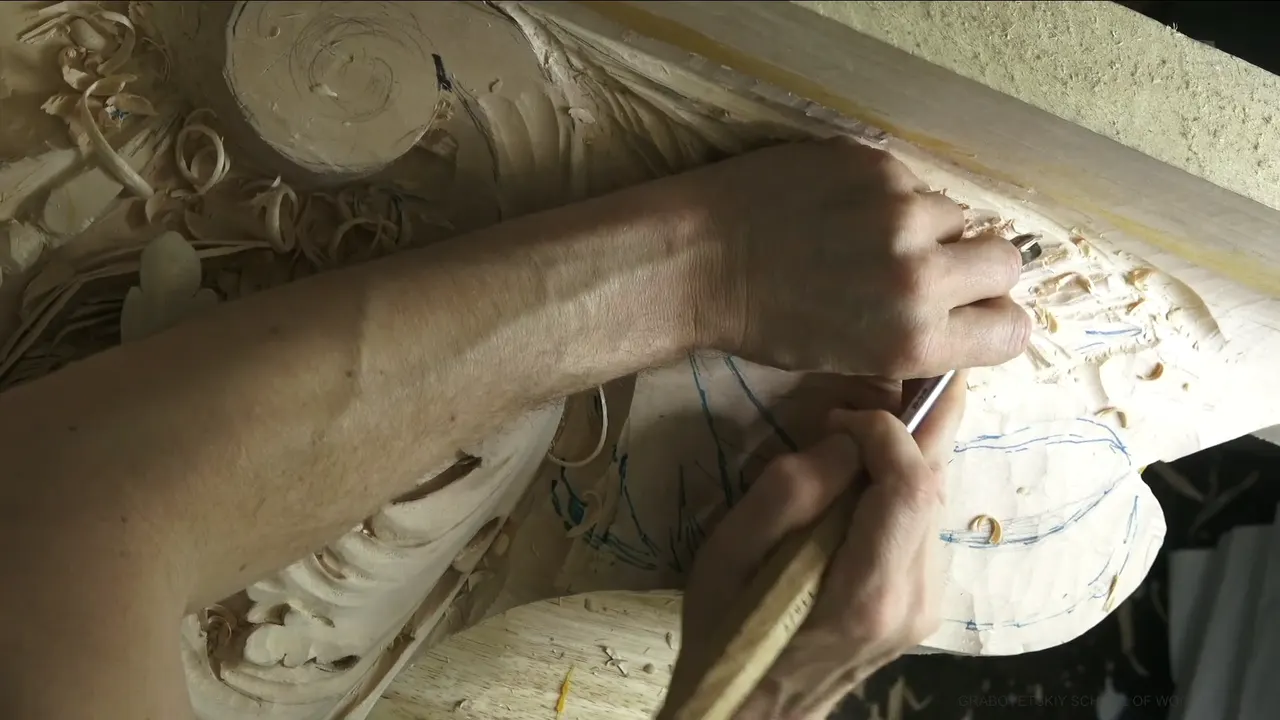

In Venice Room 61, part 5, I said of one detail that I really like it for some reason. I called it something different, not the same old, same old. Other lessons of mine carry those words about a tool, a shape and a spot that went wrong.
Is there a tool on your bench that you pick up first, and you could not say why? Below I list lessons where I said the words and what sat in front of me, so you can find the one that matches your board.
What happens in this part?
"And here it's how it looks in overall," I said. "See, it looks beautiful." It gives some extra movement, and it repeats the busyness of this area and of those shells. It is spread at approximately the same distance, I said, and if you take a hand like this and move it along, it goes about the same everywhere. "So it's strategically designed."
"But anyway, let me continue." I asked what was going on with my light, and said I need to see. Then: "Got to be careful how I approach this area. That's really important."

In that area it is a little harder for me to give consistent lines, I said, and I added that it's almost impossible to carve there. "I am just building and building." A smaller one might work a little better, I said, and next, "Maybe it's going a little better."
What did I like in this part?
"Okay, one more time. You can see how it develops in overall picture. And I really like that idea. I really like that detail for some reason. It's something different. Okay? Not like same old, same old."

Right after it I named my tool: "All right, I'm using number nine, by the way."
What sizes are named in this part?
The number nine "would be 13 millimeters" (0.51 in), I said. I guess it's a little too far for you, and you can't really see what I'm doing. With it I'd bring a little more depth all the way up.

"Got the glue line. So there is already going another layer." There is a glue, I said, and to go up like that. Then: "13 millimeters supposed to be half an inch, but it's bigger than half an inch." A half inch is 12.7 mm. "I don't know, it's just the tool makers, the way they mark."
"But I like the results so far." Maybe I can hit the inside of here too, I said, to get an even deeper concave on this side and see if it's going to look nice. "I can always put those marks back with no problem."
A smaller one is next: "Right here, I almost lost the detail, but let me use a smaller number nine, maybe 10 millimeters" (0.39 in), "like three-eighths of an inch." Then I added, "Oh, I have to show you the right way, I guess."

"And I like it. But now I need to use an even smaller number nine. Or actually, I could use number 11, I guess, to get a little closer to this area and clean it closer to the stem."
What matters at the stem?
"What is really important for me right now, just establish the true line in the middle of the stem. And I'm going to round it."

Something is in my way, and I can't really reference my hand, I said. "I have to be just like almost airbrushing."

Which things do I favor for some reason?
The same words sit in other lessons, next to a way of holding a tool, a shape and a size. Here are the lines, each in the lesson I name.
Venice Room 2, part 1, has me saying, "Change the location." The reason I'm doing it that way, I said, is that I don't like to switch my hands, and it's not my preference. I could swap them and go from the opposite direction, which would be okay. I feel more comfortable with my gouge in my left hand for some reason, and I don't want to swap the hands.

A volute sits in Venice Room 32, part 2. Right now, I said, I can clean nicer around it, now this way, with the four millimeters (0.16 in). Those volutes are ones I really love for some reason. They give, I think, a really beautiful organic look. Logically, I said, I don't have to create an undercut all the way right there, but I still have to clean and blend all those movements together.

Venice Room 10, part 11: "I do have an extra ridge, and I kind of like how it looks," I said, but I'm not sure if I'll keep it or not. Logically, it should not be there. In the original work the pipe is not always convex. "I'm not joking. You can check yourself." Sometimes those pipes "don't make sense, but for some reason, they look really good when they do that way." "There's not always logic."

A favorite is in Venice Room 54, part 5: I'm using a little different number nine, of 6 millimeters (0.24 in), with a really short end. "It's a beautiful tool." Then: "This one is my favorite from quarter inches, and I have multiple quarter inches, of course. But I like it for some reason, this one, a lot."

Over in Venice Room 55, part 11, I'm much happier, I said, but I'm still not too happy how big those eyes are, and I still want to go bigger. Maybe I have to shift it this way, and maybe I can shift that way, and that way it has big eyes and still nice movement. In this area I really want much bigger eyes for some reason, even up to 10 millimeters maybe (about 0.4 in). Ten millimeters will not fit, I think, I added.

Over in Venice Room 63, part 12: "So now it's much better." With the result I'm happy, I said, not completely, and I'm still not happy about this finish. The finish is what I really want to take care of with just the gouge, for some reason. "It's just, I guess something bugs me. Something really bugs me." That I don't like, I said.

Carving Lily Box 3, part 9: "I did not catch any splinters, but you could." Splinters I don't like, for some reason. Then I said I can work on this leaf and give it a nicer shape, that twist inward.

Another dislike sits in Venice Room 28, part 10: I don't like for some reason when some wood carvers go too deep. Well, this is not going to work, I said, and a small spoon gouge is what I need, because, again, I've got the ceiling part in my way.

A plug is in Venice Room 106, part 3: "See? It's just a perfect plug." It jumped out at about an eighth of an inch (about 3 mm). I like that approach, I said. For me it's better than drilling, okay? I could use probably a drill, but I'm getting much more control that way for some reason.

My Sharpening Back Bent Gouge lesson has these lines. "Let's put the leather. And I'm going to use the green paste." It's one of the best green pastes I ever used, I said, although any other green paste will do. I found I just like to use it for some reason, because of the results. For me it's a lot less messy for some reason, because some of the pastes you use get really messy.

Which tool goes missing at my bench?
A missing three millimeters is in Venice Room 46, part 4. I said "three millimeters or even two millimeters" (0.12 or 0.08 in). I can't find my three millimeters in place for some reason, which means I misplaced it somewhere. I'd use another three millimeters, I said: "It's still number 11, but different. This is a European size."
Also in Venice Room 58, part 7: "I have no idea what I've done with that, but let me use 2 millimeters and I'll just widen it" (0.08 in). For some reason the 3-millimeter tool (0.12 in) is not there, I said. "But I'll use 2 millimeters and carefully marry those two cuts."

A 5 millimeter tool (0.2 in) is missing in Venice Room 77, part 1: I said I can't find it for some reason, but that 7 millimeters (0.28 in) will do.
And Venice Room 92, part 8: "In this case, I probably should go with two millimeters or so." Two or three millimeters will work, I said. My two millimeters are the ones I can't find for some reason. I'd use three millimeters instead, I said, and just outline it.
What goes wrong for some reason?
A moving bench is in Venice Room 52, part 7. I described a chisel with a double bevel, skewed to approximately 22 degrees. My bench is moving for some reason, and that is not good. Being careful matters, I said, because I do have a shell, and I do not want to hit that shell. "I don't have too much space."
A paper towel is in Venice Room 60, part 8: "I need to wipe it, of course. Just a paper towel, because I don't want to get all that mess on my work." Then: "That is not the best idea." I got messy again with my tools for some reason. "All right. Go back to work."
"I've got an eye to do, and I've got some divisions to do," I said in Venice Room 64, part 4. "I have to keep going, and since I'm doing a live stream, I'm just falling behind for some reason. It just takes so much time. Preparation, checking all the equipment and stuff like this."
I need this side really nice and smooth, I said in Venice Room 70, part 4. For some reason this tool gives me a little resistance, and I think I need to re-sharpen it.

One more is Venice Room 72, part 3: I said to remove that marker, and that it wasn't too smart an idea to use it. It just penetrated so deep for some reason, much deeper than I expected.

A dense area is in Venice Room 81, part 9. Number 11 is what I need, I said, and then: "Well, actually, you know what? I'll use smaller one." This area is kind of dense for some reason. "Kind of dense. And smaller tool will give me a lot more control."
And a fragile side is in Venice Room 78, part 10: "And that's really fragile. I'm not sure if we're going to be able to keep it even." This side is more fragile for me for some reason. "But I'll try. If I'll be able to pull it, I'll keep it. If not, I don't know." Further on in the same part: "I just chopped the end of it. Here you go. I couldn't keep it."

Which lessons say it, and in which words?
Here are twelve of them in one table, with the words that followed.
| Where I said it | What the words sat on | My words |
|---|---|---|
| This lesson, part 5 | A detail I liked and called something different | that detail |
| Lesson 2, part 1 | Holding my gouge in my left hand, with no swap | more comfortable |
| Lesson 10, part 11 | Pipes in the original work that look really good | don't make sense |
| Workshop 32, part 2 | Volutes that give a really beautiful organic look | really love |
| Workshop 54, part 5 | A 6 mm (0.236 in) number nine with a short end | a lot |
| Room 55, part 11 | Much bigger eyes in one area, maybe up to 10 mm (0.394 in) | really want |
| Room 63, part 12 | Taking care of a finish with just the gouge | something bugs me |
| Venice 106, part 3 | A plug of about 3 mm (0.12 in) made without a drill | much more control |
| Carving Lily Box 3, part 9 | Splinters, which I did not catch but you could | don't like |
| Venice 46, part 4 | My 3 mm (0.118 in) number 11, gone from its place | can't find |
| Part 7 of lesson 52 | A bench that moves while I work near a shell | is moving |
| Part 4 of lesson 70 | A tool that gives a little resistance on a smooth side | little resistance |
Where can you watch each lesson?
Every lesson named above is inside one of my courses. This lesson holds all of workshop 61, and workshops 50 to 61 are in Venice Room Part 5. The other wood carving lessons are linked where I named them. To watch the full videos, with my acanthus leaves and my slips left in, start here.
How it's done
- Step back and look overall. In workshop 61 I said you can see how it develops in overall picture, and I called the detail something different.
- Name the tool and its size. Number nine at 13 millimeters (about 0.5 in), with a little more depth to bring up.
- Go smaller where detail is almost lost. I almost lost the detail, I said, but a smaller nine, maybe 10 millimeters (about 0.4 in), was my plan.
- Plan a still smaller tool. I need an even smaller one, or maybe number 11, to get closer to the stem.
- Set the middle line. Establish the true line in the middle of the stem, I said, and round it.
Frequently asked questions
Which gouge did I name in workshop 61?
Number nine, 13 millimeters (just over 0.5 in), and I said it's bigger than a half inch. Later in the part I said I'd try a smaller one, perhaps 10 millimeters (0.39 in), and then smaller still, or number 11.
What was important at the stem in workshop 61?
Setting the true line along the stem's middle, I said, and then I'd round it. Something was in my way. I couldn't really reference my hand. I said I have to be just like almost airbrushing.
Which hand holds the gouge in lesson 2?
The left. Switching hands is not my preference, I said, and going from the opposite direction would be okay. Still, the gouge feels more comfortable in the left hand for some reason. I do not want to swap.
What to carve next