

Alexander Grabovetskiy, woodcarver, School of Woodcarving · Published 2020
What does a wood carver mean by "personally"?
Quick answer: In part 7 of workshop 61, I looked at the finish I get from tool marks and said I like them. The piece is paint grade, I said, and maybe the marks should stay. In other lessons of mine the same word sits before tools, color, ridges and movement.
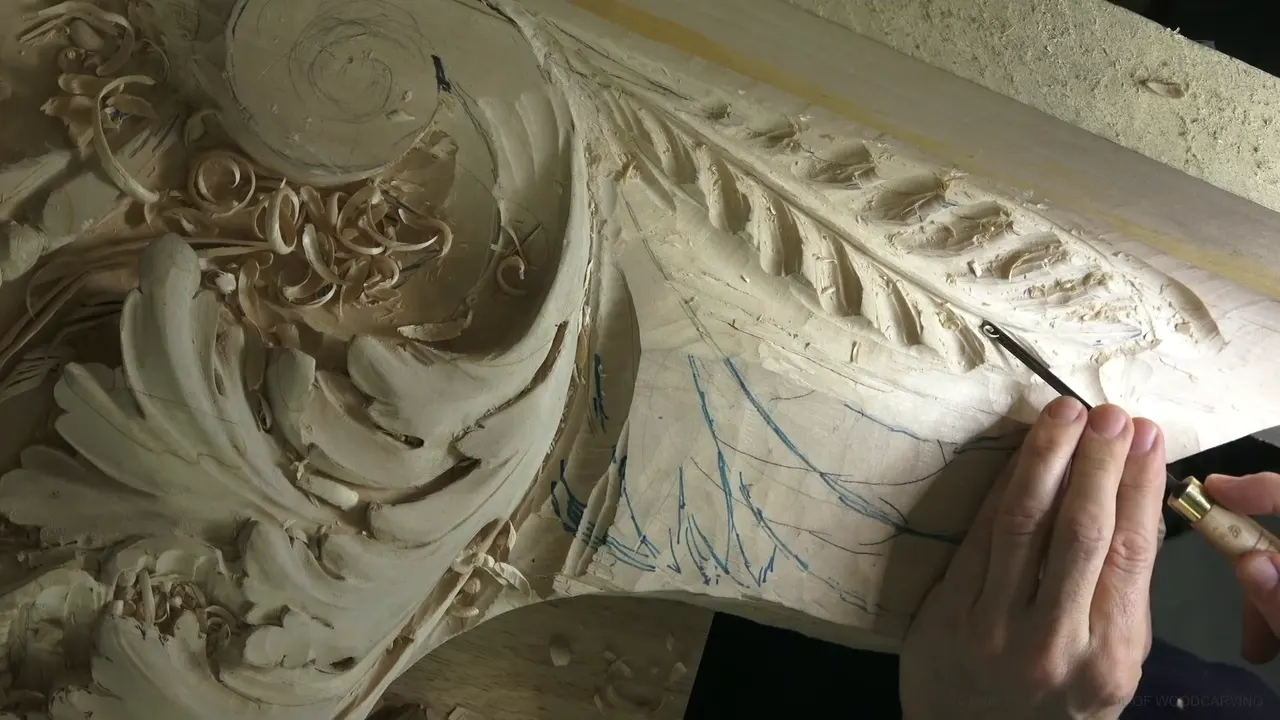

In Venice Room 61, part 7, I looked at the finish I was getting from tool marks and said "I like them personally." Then I said maybe I should leave them like that, because the piece will be paint grade. Other lessons use the same word about tools, color, ridges and movement.
Have you looked at a row of marks your gouge left and wondered whether to reach for sandpaper? Does a carving have to be smooth before you call it done? My words from this part come first, and the other lessons where I said what I like follow, each one linked.
What was I working on when I said it?
I said "And now I can bring everything to that cut, all the way." Next I said "All of those cuts to the center and flow them together," and "get even more shadow somewhere."
"Beautiful shadow," I said, and I asked "Can you see that shadow? How it casts?" One word more: "Gorgeous." I told you "no, I don't want to overdo it. But on the other hand, I don't want to underdo it too." And "I really need that shadow because it's all about the lights and shadow," I said.

"That is good. So we got it." And a bit later: "That is wonderful."
How did I plan the other side?
My plan was to do the opposite side probably "off camera," because my head and the light will be in the way. But you should be able to get an idea what I'm doing. I would finish this side, and "the opposite side you'll see a little later, already more developed, I would say."
Which tool did I name for the shaving?
"But I'll take a backbend now, and I give final shaving or semi-final shaving." The tool was a number five sweep, "which is the curvature," at 6 millimeters, and I added "quarter inch" (6 mm is about 0.24 in).

"All right. Let me get little better clean up job right here at the vein with the number 11."
Which tools do I love?
"I love English-made tools, and I also love German-made tools, and Swiss-made, and Austria-made." I wanted just to solve the problem, I said, because right now in the United States, "you almost can't buy some of the tools."
A couple of other companies from Europe reached me, "and they want to actually do the whole line of tools for me." As for the steel, "we're looking to use German or Austrian steel." All of it depends on price and so on, I said, and on the conditions and the time.

Do I need to do that? "No. Absolutely not. From business perspective, not." I'm busy enough, I said, with no wish to create more busyness than I have to. About doing it at all: "I don't know even if I'm going to do it, okay? I'm just telling you maybe too soon."
Why did I think of leaving the tool marks?
"But see how it develops? It develops absolutely beautifully." My one problem: "I can't get to this side to clean it." To get in, I said, "I have to be somehow using some of the tools."
"I like the line work. I'm talking about what finish I'm getting from those tool marks. I like them personally. Maybe I should leave it like that because it's anyway going to be paint grade and not to worry about too much about perfection."

Last: "But see the idea, development of this idea? Although I need to knock down the ridges of those pipes because it's not good." The ridge is too sharp, I said, and should not be sharp.
Which ridges and marks do I like in other lessons?
Byzantine Acanthus Leaf 10, part 4, has me asking you to take a look at the effect: "Take a look, the effect. It looks really nice, right?" You can leave it like this, I said, or give a little smoother finish with a flatter gouge, maybe number three, riding on top of those ridges. "And you can take those ridges out, some of them at least." As for me: "personally, I like to keep it like that, and just glue it, okay?"

Over in the scrapers lesson of my tools course I said that when you look from above, there are a lot of ridges, and not everyone is really happy about it. On a project of mine then, I had to make the surface smooth because the piece would be gold leafed. "I doubt you're gonna gold leaf grapes, but anyway." And then: "Sometimes it's a good idea to just get rid of some of those facets." Then: "Personally, I kinda like them, okay?" They create the veins, I said, "and they look more natural." And "it looks like, you know, it's hand done."
Cleaning my background is the goal in Roman Acanthus 16, part 2. "Although there is a lot of people who actually like look like that, a really rough background look." Next I said "I think personally, it's actually looking okay. Just like that. Leave all those marks and so on." People actually like it, I said, and "we have to take care of all those facets if you really like to make it clean."

Which tools are my own choice?
A back bend gets its own words in Roman Acanthus 7, part 3. A straight gouge could probably do it in some cases, I said, but sometimes I have a limitation with it. The back bend raises my handle higher, and with its gooseneck, "I can actually control much better and make my cuts much cleaner and nicer." Getting by without one is possible, I said. And then: "But personally, I use a lot of back bends."

In Grape Onlay 2, part 1, I called the tool "pretty much just a skew." It's about an inch, I said (25 mm), and "it's a good one." I liked how "you could quickly block the thing." I told you "You could do that with just a normal gouge, you don't have to have like a skew for this operation." Still, "personally I really like it."

Hazelnuts, part 1, has me drawing a line by eye. The final line, I said, would be about five millimeters or three-sixteenth of an inch (about 0.2 in). For now I would draw all around at about six millimeters (a little under 1/4 in). "Obviously, if you feel uncomfortable just eyeballing it, you could use some kind of tool like a gouge and stuff like this." Still, "personally, I have no problem."

What did I say about the look of a leaf and its color?
In Modern Acanthus 8, part 3, I said "Please do not put stripes," and "I don't like stripy acanthus." Those lines are okay: "There's a lot of people doing it. But I don't like those lines. I mean personally just looks not natural to my eyes." My plan was a flatter tool, maybe number seven.

Color follows the result in Vase with Grape Leaves 3, part 7, on the vase. "Okay, here is the result. Okay, I could actually elaborate a lot more, but I'm happy with what I see, and the next step would be just give some color." On color: "Personally, I prefer just the natural color of wood." This one was a request, I said, so I really have to color it and blend it nicely. I'm not the biggest fan of acrylic or other artificial colors. "I really like tints."

How do I put it about where a line should go?
Where to place my lines correctly is the question in Venice Room 57, part 4. Should I tie the movement to this section, I asked, or to the lower section? "What is going to be the most logical?" And: "I think personally, the only thing I don't like about moving that direction is this triangle." It creates, I said, the "off" look from that line. The other way would look "a lot more organic," I said, if I were to create my movement like that, but then I have to change everything pretty much.

Venice Room 10, part 8: I said "I'm just thinking of what is going to look better." And: "There's a couple ways I could approach it." This one could be a single movement going all the way, just to connect it to the upper part, or I could connect that part to the bottom part. My pick was the second, personally, and I think it is going to give me "a lot more interesting idea." I am going to create this one as a lower part, I said, and I would get my number nine to start outlining preliminarily.
In workshop 61, part 11, I said it's golden ratio, if you wish: "To be exact, it's 62 parts out of 100." Easiest way for me, I said, is 4 of 10. "Or I should say 6 out of 10." Another way is to divide it in eight parts, and it becomes a 5:3 ratio. "But personally, I like 6 out of 10. It gives me a little more-- Well, actually, it's about the same." I shouldn't say a little more, I said, but "just how I used to."

Over in Venice Room 70, part 5, I said I think I can take this part and get that part on the inside of the movement, and it would grow from inside of the cavity. I also said "Personally, I think it's going to give me a beautiful movement." I added: "I still have doubts, of course. I still have doubts, but the goal is actually to use this area. I don't want an empty spot."

Along a molding in Floral and Molding for the Panel 9, part 2, I said I have a volute on both sides, just a small one. "I think personally, it's just really such a nice detail, actually, to have that small volute."

What did I think of a piece seen whole?
In part 4 of Venice Room 54 I said "Beautiful development. Beautiful." And: "Don't pay attention. It looks chunky right now, but I'll fix it just in a moment." I said I need to sharpen my pencil. "Look again in the overall how it looks, and I think it looks really nice." After that: "Personally, I think it looks really beautiful." Next: "Now I need to get this movement the right direction."

In Venice Room 42, part 5, I said I'm going to use number seven "and give that shape I'm after." Then: "And clean again. Let's see how deep a shadow I just created. And personally, I love it."
Venice Room 46, part 10: "Beautiful development. Really beautiful development." And: "yes, I guess that is my opinion. You really don't have to agree with me. But I like it, personally."
Furniture Panel 20, part 4: I said "let me show the overall picture, how it looks." Next: "Here you go. So I think personally it looks really, really good."

Lily Box 11, part 13: I said that is how it will look in an overall composition. Then: "And personally, I really, really like it. Okay?" Once we establish all the finishes, I said, it will look even better. Of the flower: "I'm happy with the choice I chose for this lily flower."
Which lessons carry this word?
Ten of them, with the line from each, in one table.
| Lesson | Subject | Taste |
|---|---|---|
| Byzantine Acanthus 10 | Ridges that a flatter gouge could ride over | keep it as it is |
| Scrapers lesson | The ridges and facets on grapes, seen from above | I kinda like them |
| Roman Acanthus 16 | A rough background with all the marks left in | it's actually looking okay |
| Roman Acanthus 7 | A back bend with a gooseneck, for better control | I use them a lot |
| Grape Onlay 2 | A skew I did not have to use for that job | a good one |
| Modern Acanthus 8 | Stripes between the lines of an acanthus leaf | not natural to my eyes |
| Grape Leaves Vase 3 | The color a request asked me to add to the vase | I prefer natural wood color |
| Venice 57 | A line that could tie to one section or the other | this triangle, the one thing I don't like |
| Venice 54 | A chunky piece that I looked at again overall | really beautiful |
| Lily Box 11 | The overall composition of the lily flower in the box | happy with my choice |
Where can you watch them?
The video behind every line above is inside one of my courses. All of workshop 61 is inside the Venice Room 61 lesson, and workshops 50 to 61 sit in Venice Room Part 5. Every other wood carving lesson is linked where I named it. To watch the full videos, start here.
How it's done
- Bring the cuts together. I could bring everything to that cut and flow all of those cuts to the center.
- Look at the shadow. Even more shadow somewhere, and a real need for it, because it's all about the lights and shadow.
- Finish one side first. This side first, and the opposite side you'll see a little later, already more developed.
- Take a back bend. A backbend for final shaving or semi-final shaving.
- Clean the vein. Let me get a little better clean up job right here at the vein with the number 11.
Frequently asked questions
Which marks did I like in that part?
Those marks gave me the finish I was getting, and the line work is what I like. Maybe they stay as they are, I said, since this one is paint grade and there is no need to worry too much about perfection.
Which number sweep did I name in that part?
A number five sweep, which I called the curvature, at 6 millimeters, quarter inch (6 mm is about 0.24 in). I also named number 11, for the vein.
Which tool do I use a lot in the Roman acanthus lesson?
Back bends. The handle sits higher and the gooseneck gives me more control, I said, with much cleaner and nicer results. I added that you can get by without one, but I use plenty of them.
What to carve next
- Venice Room 61 lesson
- Venice Room Part 5 course
- Carving Byzantine Acanthus Leaf 10
- Scrapers for Wood Carving
- Carving Roman Acanthus 16
- Carving Roman Acanthus 7
- Carving Grape Onlay 2
- Carving Hazelnuts
- Carving Modern Acanthus 8
- Carving Vase with Grape Leaves 3
- Venice Room 57
- Venice Room 10
- Venice Room 70
- Carving Floral and Molding for the Panel 9
- Venice Room 54
- Venice Room 42
- Venice Room 46