

Alexander Grabovetskiy, woodcarver, School of Woodcarving · Published 2020
What does a wood carver mean by "carried away"?
Quick answer: Part 9 of Venice Room 61 has me apologizing for being quiet and admitting I had forgotten to say something. In other lessons the same two words went with a line made too big, a mistake I shouldn't do and a really deep excavation.
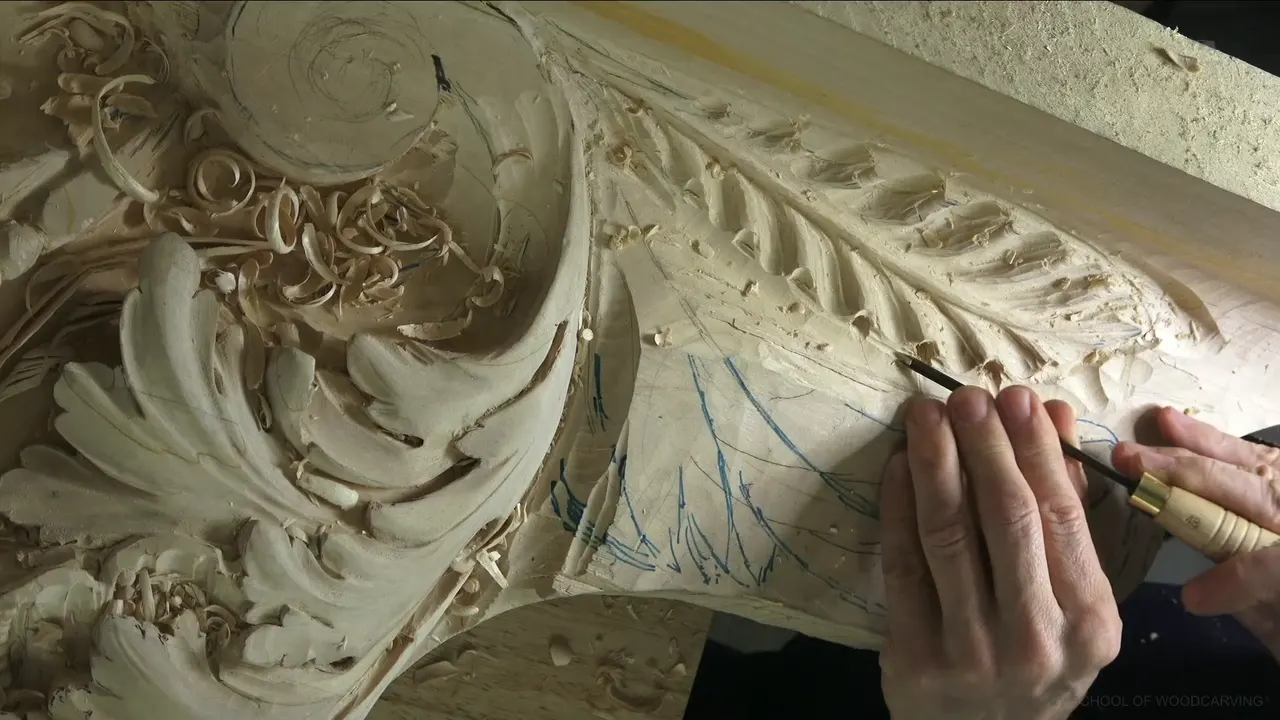

In Venice Room 61, part 9, I said I was sorry I kept quiet, and that a moment ago I forgot completely to say something. In other lessons I used the words "carried away" about a line I made too big, a deep excavation I called a huge mistake, and blowing on the work.
Have you ever been so deep in the work that you forgot to say a word to the person beside you? Did you ever look up and see that one line had gone further than you planned? My ridge, the hole I meant to enlarge and my favorite knife are all in part 9. After them come the lessons where I used the same words, and you can match each one to a spot on your own board.
What did I say when I got carried away in part 9?
"I'm sorry that I kept quiet. I just got carried away with my thoughts." Everywhere it is supposed to look like that, I said, and most of it would go "off-camera because really no need to, especially now, I'm getting tired."
Next I said: "I'm talking about talking because I'm filming and talking pretty much all day long today." And "a moment ago, I carried away, forgot completely to say something."

Which tool worked in along the ridge?
"But see, I do have a pronounced ridge, really beautiful ridge going all the way." With the number 11, I said, "I can actually work my way in and also undercut," and I could probably do "a preliminary cut like this."
On size I said: "number 11, in this case, I took one-eighth of an inch, like three millimeters." And: "everything's supposed to go to the hole like that." With a "maybe" in front: "I should just turn this direction and go this way, and also undercut."

Why did I keep away from the true ridge?
"And that's exactly how it's supposed to look. Even if it's not finished yet, because I left on purpose, I kept away from the true ridge."
For later, "ready to clean 100%," my plan was to take my gouge, like number five, and bring it all to the edge. Until then, with a lot of excavations around, I planned not to risk it, and not to take it "that extreme."

The goal, I said, is "actually everything, even right here, bring to the edge." And: "keep it strong, okay?" And how: "Use the same tool, but carefully enlarge, make my hole bigger."
How did I plan to make the hole bigger?
"That would be done after I undercut the concave side." With the number nine: "Maybe I can use this number nine around, but not too deep because I still have a development going underneath."

"So that would be a big mistake for me if I were just to rush it. I do not want to rush it." Then I said that "the word Russian doesn't mean all Russians are rushing," and that "not all Russians are bad guys, by the way." Later: "let me go this direction."
Which knife did I name for the edge?
"By the way, one of the methods how to bring everything to the edge, you can use just a knife. Pretty much any carving knife will work. Of course, my favorite is number 12 as of now, at least." Next: "Maybe there's better knives, and I've no doubt. But I really love that for many years it's never failed me."

"I can bring everything to the edge, and I create beautiful transition because I really need smooth transition. I don't want to see those sharp transitions. Really smooth transition."
Then: "That is probably the method I should use to clean those walls, just to use a knife and clean it." And: "see how beautiful it is, how gorgeous it is. And yes, I can get now to the edge." Once everything is cleaned and shaved to the final, I said, "that's going to look absolutely gorgeous."

Can you ask questions about this lesson?
Most of it would be off-camera, I said again. Next: "Now, if you do have any questions, please feel free to ask them. I really appreciate those questions and comments." Then: "It's really important." Also: "I do read all the comments, and I'm trying to answer all of them. So please do."
How did part 9 end?
"That is one of the most beautiful movements you can imagine in a 15th, 16th century development." Later: "I guess it's enough for now." And: "I just made a mistake." The rest would be done off camera, I said, "because I'm going to stick my head up, and it's going to be in the way, and it's not going to look nice."

I said I will do something off camera too, and I will show how it looks overall: "an overall picture." After that: "I'm not sure if it's too dark." The last lines: "But I guess you can see it's a beautiful and deep shadow. And nice detail, which is like I said, repeats busyness of this area. Okay, here is the result."

What happened in the parts next to part 9?
Part 8 of this lesson has me saying that this side would be developed off-camera, and that what I wanted on the camera was "the outside formation." A little later in that part: "Well, actually, I forgot to knock down one more."
Part 10 begins with both sides done "to a certain point." Cleaning inside waits, I said, "because I still have to develop upward movement."
Where else do my lessons say carried away?
Here are passages from other courses, each marked with its lesson and part. The link opens the full lesson.
What did I say in two other Venice Room lessons?
Over in Venice Room 14, part 5, I said: "Okay, let me leave it for just now. I can get carried away and lose focus, and I'm going to lose time. Okay? I don't want to do that." Then: "Okay, let me finish this one. And yes, I need to make sure I'm finishing that the right way." I added: "I would like to be more careful this time." Also: "I can create a couple separations. Nice ones like that. That is going to give me some curliness."

The next stop is Venice Room 64, part 6: "Again, do I have to? No, I don't." I weighed a tool: "Maybe I can just use a 1 millimeter now. Number 11, 1 millimeter" (0.04 in). I planned to stop now, "because, again, I can get carried away, but I really don't have to."
Also: "I'm really happy actually right now with the outcome." I would create the divisions: "Because without the divisions, it doesn't make any sense."

What followed in the other lessons?
Next, in Venice Room 13, part 11: "Maybe I just got too carried away," I said, "and made that too big." I went on: "I think I need to move this line this way a little bit because it's just outside of main movement, main curvature. That should not be outside." Then: "it is still a little too big, I would say." And: "Let me get a bigger tool. Like number eight."
Further on: "I'm checking and rechecking and fixing stuff. For example, I don't like what I did right here, and I could probably excavate a little more and get rid of the previous cut." And: "That is much better, except now I need to make it look good and long cuts."

Roman Acanthus 15, part 2: "So we have to repeat that." "I got too close to the edge," I said, and "I got too excited." Then: "But if it happened, like I said before, it happened on purpose." For a case like that, we could create an extra notch and repeat it on this side, "or extra subdivision, I should say." I planned on "just the number 12 carving knife and make that extra subdivision because I messed up." And: "carried away, too much."
A little later: "Got too close to the edge. Like that." Then: "It looks absolutely fine." Also: "Get closer to that edge also." Next: "This one is 10 millimeters" (0.4 in), "Number 11," and "Clean cut is how I call it."

Furniture Panel 29, part 3, has me saying: "with my flute to about two o'clock or so, I'm gonna get really deep excavation right there." Then: "That is a huge mistake." Another line: "carried away, but that's okay," and "I have meat and I can fix it."
Somewhere else it would be a big mistake, I said: "But not here. Here, it's all right. Lesson learned, don't exaggerate, which you don't have to exaggerate." Then: "I'm gonna grab number five and make sure this edge, it's still gonna be raised up." Later: "It looks all right."

In Venice Room 35, part 9, the words are: "Go deeper and deeper and even deeper." Then: "Oops, that is bad. Got too carried away," I said, "and I've done mistake what I shouldn't do. And if you didn't catch it, if you didn't see it, that's okay. Which means I didn't do the mistake."
Later in that part: "I could actually go all the way to the edge." I also said: "I wouldn't do that in another case, but in this case, I think it's wise to do," because people would see what's going on inside. Then: "let me use again 10 millimeters, number 11, and try clean all that mess out." In inches, that is 0.4.

Same lesson, part 6: "Maybe I've got too many separations in one spot." Then: "My apologies for thinking out loud, but I think that is a good problem to be solved. For example, I've got too much carried away and I got too many separations which I should not have. I love those separations, but too many, it's no bueno."
After that: "all I'll do, that is going to be just the one single part. Okay? And that's it." I'd chop out this section, I said: "Otherwise, it just doesn't look too organic." A good thing, I said, "that I have extra material." Then: "I think it's much better." And: "Okay, I didn't lose too much."
Later: "I created the problem, and my problem was overthinking, overdoing it."
Why did I apologize for blowing on the work?
An apology sits in Venice Room 23, part 1: "I apologize again when I'm just blowing. In some of the workshops, I'm cutting this out when I'm editing, the moments of blowing away those chips." Then: "I'm filming right now just live pretty much." And: "I'm switching the cameras on the fly."
Sometimes I forget to turn off, I said, and "carried away with the work, and I blow on it. But I know it's not too pleasant to the ear. Sorry." Then: "you probably see how deep the excavation I got, and you see the shadow right there."

Which lessons say carried away?
Here they are in one table, with what I said and the step beside it.
| Lesson | What I said about it | Next step |
|---|---|---|
| This lesson, part 9 | Kept quiet, and forgot to say something | Number 11, to work in and undercut |
| Venice Room 14 | Let me leave it for just now | Finish this one |
| Venice Room 64 | Going to stop now, and I'm really happy with the outcome | Maybe number 11, 1 millimeter (0.04 in) |
| Lesson 13 of Venice Room | Too big, maybe, and need to move this line | Let me get a bigger tool, like number eight |
| Roman Acanthus 15 | Extra notch, or an extra subdivision, because I messed up | Going to use the number 12 carving knife |
| Furniture Panel 29 | A huge mistake, and I have meat to fix it | Gonna grab number five |
| Workshop 35 of Venice Room | Oops, that is bad, and a mistake I shouldn't do | Again 10 millimeters (0.39 in), number 11 |
| Workshop 35, part 6, Venice Room | Separations I should not have, though I love them | Chop out this section |
| Lesson 23 of Venice Room | I forget sometimes to turn off, and I blow on it | None named |
Where can you watch the full video of each lesson?
Every lesson named above is inside one of my courses. This lesson holds all of workshop 61, and workshops 50 to 61 are in Venice Room Part 5. Workshops 13 to 25 sit in the second Venice Room course, 26 to 37 in the third, and 62 to 73 in the sixth. The wood carving lessons on a Roman acanthus leaf and on a furniture panel are in Carving Roman Acanthus Leaf and Carving Furniture Panel. To watch the full videos, start here.
How it's done
- Look at the ridge. A pronounced ridge runs the whole length, and the number 11 lets me work in and undercut.
- Stay clear of the true ridge. I left it alone on purpose. When I'm ready to clean 100%, I plan a number five gouge to get it all to the edge.
- Enlarge the hole carefully. Widen the hole with the same tool, once the concave side is undercut. A number nine, maybe, kept shallow with a development underneath.
- Try a knife at the edge. A knife will do for the edge, I said, and a number 12 is the one I love.
- Hold back the rush. Rushing it is not what I want, I said: a big mistake for me, with a development still going underneath.
Frequently asked questions
Which knife did I call my favorite?
My favorite, as of now, at least, is number 12, I said in part 9. A knife can bring all of it to the edge and any carving knife works, but of this one I said, "for many years it's never failed me."
What was my plan for the hole in part 9?
I'd enlarge the hole carefully with the same tool, after undercutting the concave side. A number nine around was a maybe, kept shallow because a development still runs underneath.
Did a slip ruin the carving?
In the furniture panel lesson I said I have meat and I can fix it. In workshop 35 I said I didn't lose too much, and in the Roman acanthus lesson I said it looks absolutely fine.
What to carve next
- Venice Room 61 lesson
- Venice Room Part 5 course
- Venice Room 14
- Venice Room 64
- Venice Room 13
- Carving Roman Acanthus 15
- Carving Furniture Panel 29
- Venice Room 35
- Venice Room 23
- Venice Room Part 2 course
- Venice Room Part 3 course
- Venice Room Part 6 course
- Carving Roman Acanthus Leaf course
- Carving Furniture Panel course