
Alexander Grabovetskiy, woodcarver, School of Woodcarving · Published 2020
What does a wood carver mean by "big movement"?
Quick answer: In Venice Room workshop 62, part 1, I wanted a really massive concave, named a 30 millimeter (1 3/16 in) number 11, and said I wanted to see that big movement. Other lessons of mine use the same two words, each in its own place. Each is below, with its lesson.
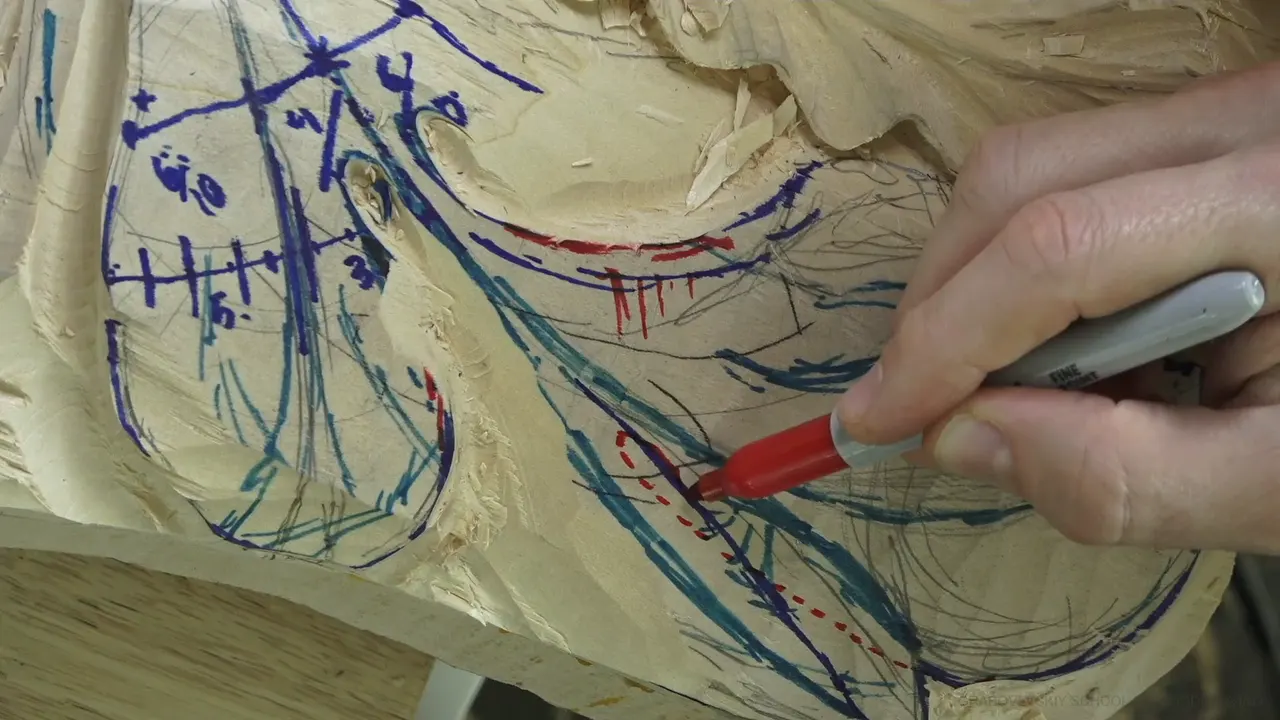

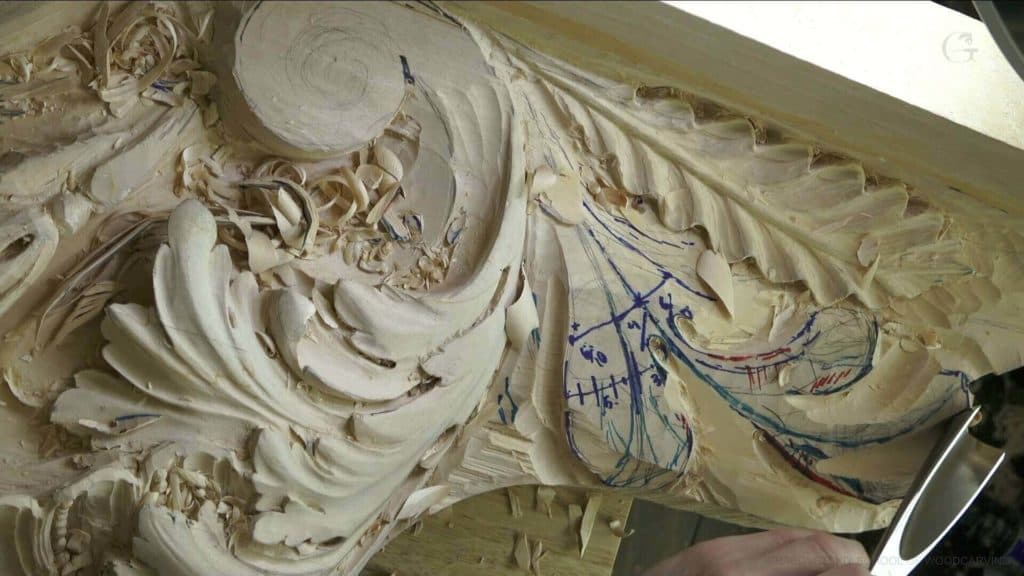
In Venice Room workshop 62's first part, I named a 30 millimeter (about 1.2 in) number 11, and asked for a concave I wanted to be really massive. Other lessons of mine use the words "big movement," each in its own lesson.
Ever looked at a carved leaf and wondered how far it should rise and fall? Here is each place, lesson by lesson.
What did I say about a big movement in workshop 62?
The first part opens with "I need to change something," and then "Logically, this line is supposed to go somewhere underneath." I did not like how that line looked. Then my plan was to get the ridge higher and let the other part go underneath.
I said I had to be careful when approaching. Next, it was "logically better" this higher, a chance to "shave this section a little lower," and that way I could get "really close to the two inches" (50.8 mm). My words were "That's exactly what I'm after."

At the ridge I still left "about approximately five millimeters, 3/16 of an inch," and added "We're going to need that." The decision, I said, was which side would be higher. I believed it would look much better with this side higher, "okay? And the main part going to go underneath."
Which concave and convex did I want?
The next words were "Now I need to create my concaves and convexes." The main movement was "going uphill," and logically I was supposed to have another division somewhere. I planned to take a main concave and remove all of that.
My wish was plain. I wanted the concave "really massive" because "I really, really, really want to see some movement, some shadows."

The tool was a number 11, 18 millimeters veiner, "Maybe actually bigger." Then "I'll use 30 millimeters right here." So 18 mm is 0.71 in, and 30 mm is about 1 3/16 in. My reason: I really wanted to "exaggerate everything."
A goal came too: the same idea, "concave, convex, concave, okay?" And "I have to be really wise from what position I am attacking it."

Then came "And yes, like I said, I really want to see that big movement, okay?" Near the end of part 1 I said "I've got that concave," and then "convex or close to the convex, I should say." And I said I could probably do the same thing "this way also with the skew chisel."
Did the next parts of workshop 62 carry it on?
Part 2 has "I need to create exactly the same in this one," and the main idea is the same. Then it was "Let me do also massive, really massive movement," followed by "But I need to attack from the right position."
Over in part 3 I could probably use 18 millimeters, number 11, "about three-quarter of an inch," and then "A little less than three-quarter of an inch, but about." Put in inches, 18 mm is about 23/32 in. Also in part 3 come "A little bit chop my edge," then "I really love that movement."

Late in part 3 I planned a pipe, and I really wanted to exaggerate those pipes again.
A reason comes in part 5. As I put it, "I don't have a lot of depth to give a frame, but I still need to get about the same amount of shadows." "Just exaggerate those pipes," I said, and "They're going to cast some shadows." The same part has "Really big movements, okay?" and "I'm not afraid of doing it." Then "Even if I have to lower down my middle lines, that's okay, too."

Which early Venice Room workshops say it too?
The line "Big movements." sits in workshop 2, part 14. The next words are about tools, a number seven at three inches (76 mm), and cleaning "that mess."
One more is in workshop 4, part 3, where I was "approximately inch and a quarter to the lowest part," which is about 32 mm. The words were "Not acanthus, but this big movement," with a deep background to follow. One way I could work was to take care of the overall first, make it a big concave, and then make a deeper area inside, which would be "much easier for me."

A detail in workshop 11, part 12, is "big detail, but it's not the final detail," and I said it was just going to be a big movement. After that, "I need to clean up upward," and I would go to a smaller tool, "two millimeters or so" (0.08 in). My limit was depth, for the sake of the paint: "I have to paint that later."

A part would grow from underneath in workshop 25, part 11, and I called that "a big movement like that." In the same part I said "This is the main movement, so I have to knock down that side."
Where does a big movement show up in workshops 34 through 60?
A movement "readable a lot more" comes up in workshop 34, part 4, and then the spaces between points, which "doesn't look right." My words were "So which gradually, the law of rhythm, I have to make this one a little smaller." The widest space is followed by a less wide one, and one even less wide.

Over in workshop 46, part 2, I was "not too far from big number seven," and I could "give a big movement right away pretty much," going around and around. On depth I said "got to keep an eye how deep I'm cutting," and "It's not pierced work."

For workshop 50, part 2, the big movement had to be "really beautiful." A huge eye was in the plan, and also a really big eye, with a number 11 veiner at seven millimeters (0.28 in) for them. It is a veiner and not the gouge, I added.
A long stretch in workshop 58, part 4, is about one piece, and the words I used for it follow. The piece "is like a piece of molding," I said. It hides and then sticks out, and "this is one big movement," even with "some stuff above." By the way, "this is a solid piece, so nothing glued on." About carving the form I said "It's not the hardest. The hardest is design." Then "You really have to think in 3D."

A middle line was going to the center in workshop 60, part 1, which "right now makes sense and is going to become a part of" the big movement. A moment later, "I think now it makes a lot of sense."

What do the later Venice Room workshops add?
In part 5 of workshop 65 I said "I know it's a big movement. Big, but I think it's beautiful movement." Later in part 5 I said "let me try upside down the same tool," and "Maybe I'll be able to establish at least some of the movement." On depth I said going too deep would be "a big mistake."
By workshop 81, part 7, I had "a couple big movements." The plan was three main parts of one movement on a side, and "three or maybe" the same on the other. I could treat one more as a big movement, I said, with some small detail underneath.
In part 3 of workshop 91 I said "That was the first big movement." The second one would start from a point I could only call approximate and run "all the way up," with, as I said, "a somewhat deep cut" to make.

How did I describe the Byzantine style?
Take part 6 of workshop 65, where I said "beautiful shadow" and then "please understand, that is not always." In this particular case, Venetian-style wood carving, "they had those really exaggerated pipes."
I went on with "it's not too accurate also, because those exaggerated pipes, they inherited, okay, from Byzantine style." "Byzantine, they developed those really big movements for the gold leafing," I said. "That was the idea." The gold, I said, is "a yellow-brownish color, and they needed to get those shades, those shadows, and so on." And "It's a beautiful style."
Those are my words from the video. If you want the style itself, the Carving Byzantine Acanthus course is mine, and Wikipedia has pages on Byzantine art and on gilding.
Do my other courses use the same words?
Take Furniture Panel, Design, lesson 14, part 3, where I was thinking how to finish a section "because it's a big movement and that's kind of overwhelming movement." I wanted to make sure it looks organic, and for that, I said, another acanthus is needed.
In Furniture Panel 19, part 6, I said "It's going to be quite big movement, by the way," with "really nice undercutting effect" and "really good shadow."

Hashemi Flowers, in lesson 48, part 5, shows a curl, "really big curl, just like that." Then came "Big movement." The idea stayed "as deep as possible."
A question in Byzantine Acanthus 10, part 1, was about an eye at a black marker. I answered "We can do a micro eye right there," and then it would become another pipe "inside of" the big movement.
Vase with Grape Leaves 1, part 6, has "If you want to do calipers, golden ratio calipers, just do that." My center line would be "dying underneath of the big movement."
Lily Box 7, part 4, has me saying a smaller detail has to repeat the movement of the bigger one, so the big movement carries onto the smaller parts.
A flower in Lily Box 12, part 3, was "almost done." Of the flower I said "So that is the big movement." It can be detected from a side view. "I kind of like that movement." Then "I know I really didn't have to do that," but "I really liked it."

Grape Onlay 7, part 1, starts with a plan to keep working on the big movement, to "concentrate" on it.
In the April 8, 2020 livestream I talked about butternut. "I love butternut. The only thing I don't like about butternut, the grain." It "depends on the job," I said. If you work on big movements like that, and you see too many stripes, and the butternut has a pronounced grain, "that would not be too nice." I added that it is my opinion, and "if it's not involving movements like that, a lot of details, butternut is a really great wood."
When did I say a movement was not big?
One doubt comes up in workshop 16, part 12: "I could say it's a mistake, a design mistake. So maybe this is a little too big movement, okay?" And maybe I would stop it somewhere there.
In workshop 36, part 11, "I don't really need the big movement, just little bit." What I did need was "a really nice movement on this side," but "not too big because I don't want to lose overall feel of it." The tool: "Number five. That's what I used. Number five and one inch" (25 mm).
The plan in workshop 97, part 5, was that the movements in and out would not be really big. I meant how deep the concave and convex would be. So it is "more subtle but still readable." And "it would help me if I would just attack it from the right position."
Grape Onlay 8, part 2, includes "It's not a big movement, but still it's kind of really nice." The Grinling Gibbons class in Maine, lesson 12, part 2, includes "It's not really big movement. I know pencil mark looks huge."
Which lessons did I list?
Each row below gives a lesson, my words for the big movement there, and my next words.
| Lesson | Where I said big movement | What came next in my words |
|---|---|---|
| Venice 62.1 | A really massive concave, for movement and shadows | The number 11, 18 millimeter (0.71 in) veiner |
| Workshop 62.5 | Pipes I made really exaggerated | Not afraid of doing it |
| Room 46.2 | A big movement right away, going around and around | Keep an eye on how deep |
| Venice 34.4 | Readable a lot more | The law of rhythm, then a smaller one |
| Workshop 50.2 | One we have to make really beautiful | Number 11 veiner at seven millimeters (0.28 in) |
| Lesson 65.5 | Big, but beautiful | Not too deep, or a big mistake |
| Room 91.3 | The first one, then a second one | A somewhat deep cut, I said |
| Lily Box 7.4 | A big movement repeated on the smaller parts | Maybe number seven, or even five |
| Hashemi 48.5 | A really big curl | The same idea, as deep as possible |
Where can you watch the full videos?
Most lessons above show me at the bench with a gouge or a chisel in hand, and they sit in my wood carving courses. All twelve parts of workshop 62 are there, and workshops 62 to 73 are in Venice Room Part 6. To watch the full videos, start here.
How it's done
- Change the line. I said I needed to change something, and my plan was to get the ridge higher and let the other part go underneath.
- Choose the higher side. I had a decision to make about which side would be higher, and I believed it would look much better with one side higher and the main part going underneath.
- Set the goal. My goal was concave, convex, concave, after I said I needed to create my concaves and convexes.
- Pick the tool. A number 11 at 18 millimeters (about 0.7 in), maybe bigger, and then 30 millimeters (1.18 in).
- Choose your position. I have to be really wise from what position I am attacking it, I said.
Frequently asked questions
What did I ask for in the first part of workshop 62?
A massive concave, so I could see movement and shadows. I named 18 millimeters (about 0.7 in), maybe bigger, then 30 millimeters (1.18 in).
Which tools did I name in workshop 62?
Part 1 names the number 11, then later the skew chisel as something I could probably use. Part 3 names 18 millimeters, number 11, a little less than three-quarters of an inch.
What warnings came with a big movement?
A plain one sits in workshop 65, part 5: going too deep is a big mistake. Workshop 46, part 2, adds that it's not pierced work, so I do not want to go all the way.
What to carve next