
Alexander Grabovetskiy, woodcarver, School of Woodcarving · Published 2020
What does a wood carver mean by "swirl"?
Quick answer: Venice Room 62, part 10, has me tracing an element to Greek culture and then saying it is swirl. Next I said I was not going too extreme to the bottom yet. Other lessons use the word beside volute and scroll.
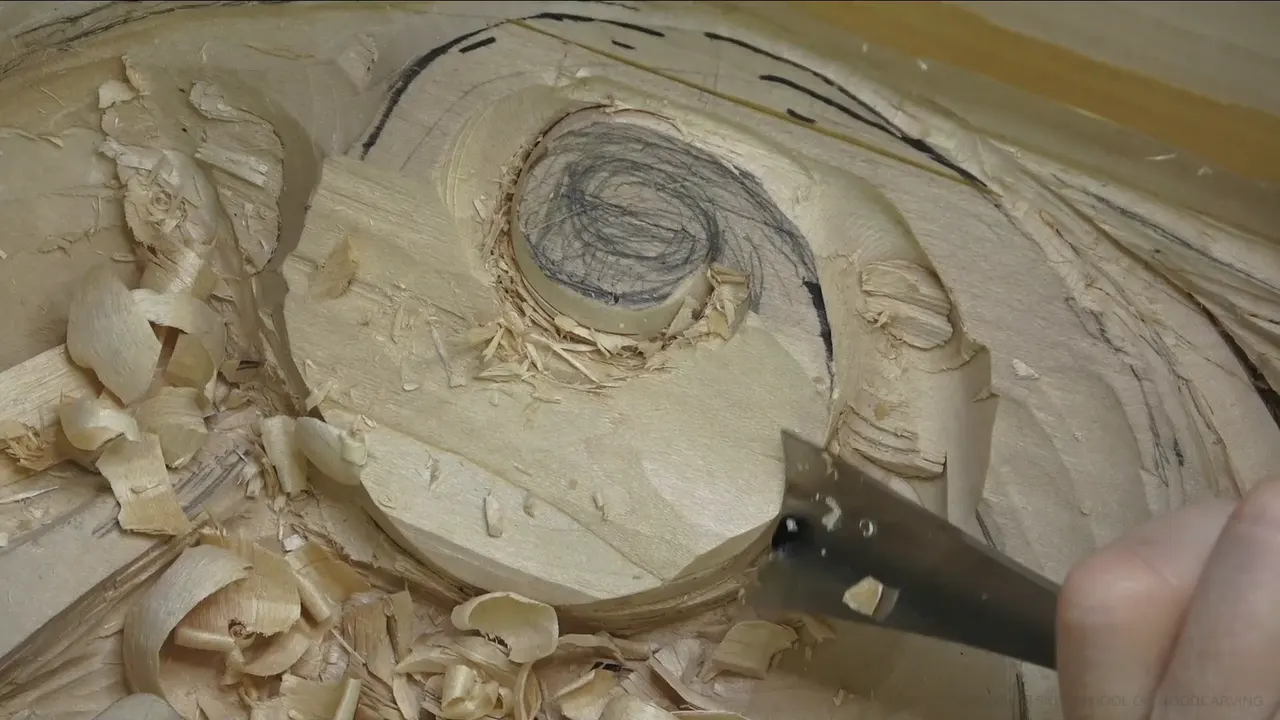

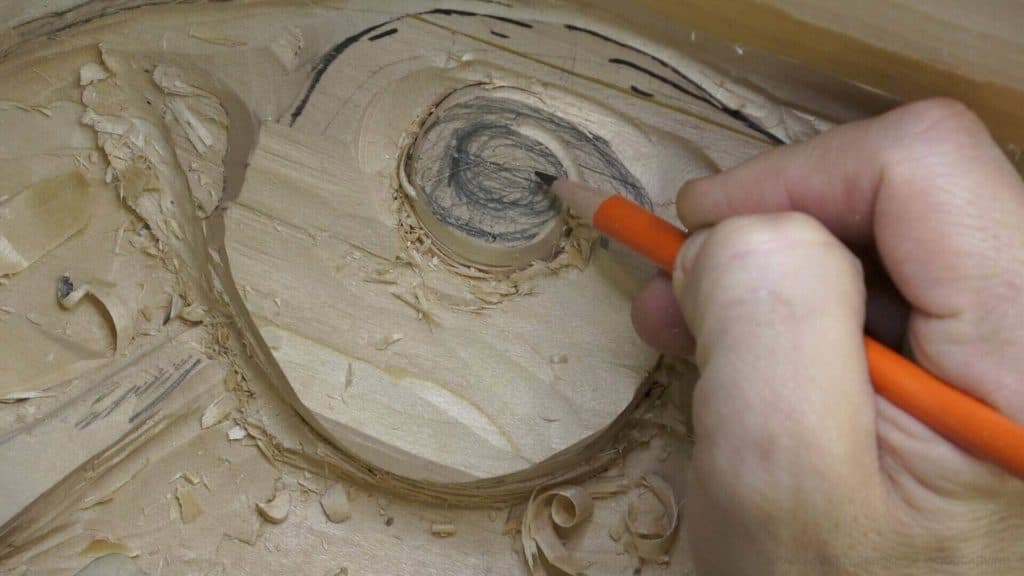
In Venice Room 62, part 10, I called a volute on a slope "swirl," and then: "It is swirl. It's exactly what it is." Other lessons of mine use the same word for a drawn line, a carved scroll and a cut, and this page reads them beside the part.
Ever wondered if a scroll in a carving has one right name? Does it matter whether you say volute or swirl at the bench? Workshop 62 gave both words for one element, and other lessons give the same pair about other work.
What did I say about a swirl in part 10?
The line sits in part 10. "Let me remove some of the excess material," I said. Next: "And that element actually was inherited from Greek culture, from ancient Greek culture. They first actually developed volutes or voluta." The line this page is named for followed: "I call it just a swirl."
After it came "I'm not going too extreme yet to the bottom because I don't want to make mistake." Number 11 was my plan, to "go around this element on inside." That pass was "just for me not to lose feel of it," and "it doesn't make too much sense yet." I called it "preliminary," not my final cut.

A little earlier I had named the tool: "I believe we're going to need the big number six, like one inch or so" (about 25 mm), and "start creating some outlining right here." The volute comes after that.
How did part 10 start the slope?
The part opens with "And yes, I could go slightly deeper and readjust my future slopes." Then a plan: "Let me now knock down this barrel." About that word, "not the technical word for this. It's the way I call it." I planned number one "pretty much," to "create that slope."

"Maybe I could actually go a little deeper. I mean, more pronounced sloping." Then "I have to somewhat repeat on this side about the same movement." Later, "So now it slopes about the same degree." And: "So I know you still don't see it," then "I know you still don't see how it's supposed to look."
How far did I push it?
"Maybe I have to do a little more extreme and just take out a lot more of this part." Then: "That's all about how it feels in overall design, and sometimes I have to change mine and excavate deeper, but I'm not doing it from jump number one. So I just look at it, and I see what is going to look better." I also needed to "expose that inner part."

The tool was number five: "I'm using number five." Then "now I can actually exaggerate that slope a little more," and "Exaggerate that slope even more." A look at the wood followed: "Right now, it's just pretty much like a relief carving almost." One spot stood out: "looks like I've got this one really high, which doesn't make too much sense because I have a lot of material on the backside, but that's okay."
Which cut went deeper beside it?
"I need to kind of remove some of the extra material around this side. And I'm going to use number 11 again." I started to name a size and fixed it: "Number 11 and 11 millimeters. No, 18 millimeters" (about 0.7 in). The aim was to "excavate much deeper in this area," and "Because I really need that movement."

Afterward, "Maybe I got too aggressive, but it's okay." And "Wonderful." That cut left "a starting point. Really, really good starting point." From there I planned to "start developing from inside out," "little by little without rushing too much."

Why is the oval not a true round?
Near the end of the part I said "it's not full three-dimensional carving right here," and "It's a high relief." Of the shape, "it's not fully like a true round right now," and "It's not going to look good." I called it more like an oval, "looking more organic to the human eye."

Two parts of the same lesson hold more of the piece. Part 9 has "The problem with this volute is it's on a slope," and in part 11 comes "Take your time. If you're going to do those volutes, take your time. They can be really frustrating."
Is swirl the same word as volute?
Carving Roman Acanthus 16, part 6, has the clearest line: "I call it swirls. Sometimes I call it volutes, but let's call it volutes." Before it, about a picture I found online: "It's actually not the true volutes, but still it's volutes."

Part 3 of the same lesson names a cut for them: "separate those volutes or swirls, whatever you prefer to call them." One cut would "create extra shadow line." In part 5, "more on those swirls or volutes," and "if you want to leave it like that, I think it looks great."
The Curly Kitchen Cutting Board lessons use both words as well. Workshop 5 has "Another volute, or another swirl. I like to call it swirl," while workshop 4 has me cutting a wing: "same element. You can call it swirl, or you can call it volute, which you're going to see a lot in this carving."

The first lessons for beginners start there too. In First Cuts for Beginners 2, part 2, my plan was "some kind of swirl," and "I'll repeat that on this side." I went on: "it's common later on it would be called a volute style, but it's not necessarily true volute. It was in the history even before any volutes."

Part 4 has a cut "around this swirl or volute, if you wish to call that, although it's not true volute."
Grinling Gibbons Maine class 17, part 2, shows me unsure about a name: "Maybe maybe I'll just do that swirling thing. I'm not sure if it's gonna be a legit name for that." Part 1 of that lesson pairs a swirling effect with "layers on top of layers like almost like onions."

Acanthus Leaf Introduction 1, part 1, has me showing drawings: "it's still Acanthus leaf with all the swirls and stuff like this."
In Venice Room 2, part 13, an opening gets "a couple swirls you could call it."
Part 4 of Furniture Panel 11 has a plan that runs "all the way to the swirl detail or to the volute, I should say. To the volute."
Lily Box 12 changes the word the other way, in part 4: "Not a swirl, but scroll. Okay? Let's call it scroll." A scroll there is one half of a pair that turns opposite ways.
In Carving Vase with Grape Leaves 1, part 9: "And a couple swirls, or whatever you call them." Part 10 adds "like vines."

Greek Acanthus Leaf 1, part 1, holds "the main idea of Greek acanthus leaf, introduction of swirl or volute movement." About the first curl, I said "Probably the better way to describe it" is the volute movement.

How does a swirl show up in a drawing?
Start with the drawings. In Furniture Panel 6, part 2, "if I'm doing swirls, I just try to move like this and do the energy move that's bigger and bigger and even more bigger." Of the small movements, "they actually are really important for me," I said. Part 1 has "another swirl in this area. Or maybe I can just do a small acanthus."
A complaint sits in part 4 of the fourth lesson: "I'm not too happy with this swirl," and then "this one should be bigger and this one should be smaller swirl."

Furniture Panel 7 makes a plan: "I'll probably hit from this swirl all the way this direction."
Some swirls never show. In Furniture Panel 9, part 1, "I would continue this swirl, which is invisible," and "it's going to feel like everything is just connected, in my opinion."

Furniture Panel 14, part 6, has "I don't really want to see any symmetry in it," and "maybe just get a little uneven swirl."
The design lessons talk about it too. Design Principles 4 has "Every movement has a swirl," and "Arabesque, it's a law of swirls around, if you wish." On the Fibonacci sequence, Design Principles 3 gives the opposite line a swirl, "more like a swirl going like this," and the number I gave was 1.61.
The golden ratio gets a swirl in two more parts of Lily Box 12. Part 2 says "the golden swirl, it's like a half of the heart," and part 4 says "there's going to be a swirl just like that."

How deep is the cut around a swirl?
Depth gets a figure in Furniture Panel 21, part 11: "those two swirls, they also have to go almost to the background." The height was "no more than 16th of an inch above" (about 1.6 mm), "1.5 millimeters above my background."

A plan sits in Furniture Panel 17, part 1: "about 1/16 of an inch of this area" (about 1.6 mm), and "I can always go deeper if I need to." And "I just don't want to lose the overall feel how I wanted to make that swirl."
The Greek Acroterion 5 lesson works on a swirl part over several parts. Part 5 reads "slice by slice until I create a consistent depth, consistent everywhere around the swirl. Sixteenths of an inch. All around." Part 6 closes with "Looks like it is consistent. Sixteenth of an inch everywhere."

A knife did the separating in Greek Acroterion 4: "Let me separate this swirl from the center, and I'll use, again, just a knife since it's the quickest way to do that." Part 5 of that lesson has a gentle hand: "I barely create any pressure right now," and "This part and that part is actually fragile."

Greek Acroterion 1 names the plinth job: the plinth has to be separated "from the two swirls and the palmetto part."
Over in Hashemi Flowers 3, part 5, "this is supposed to grow from the same swirl. And what I'll do, I'll take a V tool and just carefully make my cut downward." Then "I'll take number 16 and 3 millimeters, or 1/8 of an inch."

In the second Hashemi lesson, part 5, my idea was a twist toward "that swirl," with a warning: "Just be careful. Don't press too much."
Grain pulls two ways in Kitchen Board 12: "I have to make a deeper cut around the swirl itself and meet those two grains." The place where they meet has a name of its own, "marriage line, when those two grains meet together." And it "has to be from two sides."
Back in the beginner workshop, part 5, "this is the second swirl," with a plan for "a really low angle" and "multiple cuts, and I am okay with that."
A repair job is in the dining table apron lesson. "So now I have to make that looking like a swirl." On the original carver: "Our original carver didn't have good luck with those swirls right here. Some of them he snapped, and some of them still remaining." Mine was a plan, "to keep them all without any snapping."

Later Venice Room workshops keep the word. In workshop 93, part 10, two concaves are planned so that it looks "really swirling." Workshop 139, part 3, has my question "See how I just swirl it?" And workshop 150, part 1, follows a rise: "rising up, rising up, and that is the highest, and then it goes and swirls down."

How did the live stream describe the slope?
My April 2020 live stream has a detail I called "volute," and then "that's called swirl."

Then: "But the difficulty of this, it's a sloping. Okay? Because it's going from horizontal, vertically." I added "That is a ceiling part." For it I said "I'm going to film it today for my school." And of the slope: "It's really difficult, actually, to get the design for it would be visually good from all the points."
What came after those words, in one table?
The table lists each place, one word from my mouth, and the other word.
| Where | First word | The word it was set beside, or put in its place |
|---|---|---|
| Roman acanthus, part 6 of lesson 16 | swirls | volutes |
| Part 3 (same lesson) | swirls | volutes, with the choice left to you |
| Curly Kitchen Cutting Board, workshop 5, part 1 | swirl | volute |
| Beginner workshop 2, part 4 | swirl | "it's not true volute" |
| Panel lesson 11, the fourth part of the lesson | swirl detail | volute |
| Lily box workshop 12, 4th part | swirl | scroll |
| Greek Acanthus, part 1 | swirl | the volute movement, in place of curl |
| Live stream | volute | swirl |
Where can you watch the lessons?
Every line above comes from one of my wood carving courses. This lesson holds all of workshop 62, and workshops 62 to 73 sit in Venice Room Part 6. The Venice Room begins in Part 1. The other lessons are in First Cuts for Beginners, the cutting board course, Carving Roman Acanthus, the Greek acanthus course, the Greek acroterion course and the furniture panel design course.
How it's done
- Name the element. The element came from Greek culture, and I name it a swirl.
- Slope it. Number one was named to create the slope, and number five was named to exaggerate it a little more.
- Expose the inner part. Number 11 at 18 millimeters (about 0.7 in) was named for a much deeper cut beside it.
- Outline lightly. A number 11 goes around the inside as a preliminary cut, and only part of the way.
- Keep it an oval. Because it is a high relief, I called the shape more like an oval.
Frequently asked questions
Is it a swirl or a volute?
I gave both words for one element in workshop 62, and in the Roman acanthus lesson I chose volutes.
Which tool outlined the element in part 10?
A number 11 was my plan for going around the inside, as a preliminary cut. A big number six, about one inch (25 mm), had been named before that.
Why was the oval in part 10 not a true round?
It is a high relief and not full three-dimensional carving, and I said the shape is not fully a true round right now.
How deep did I want the swirls in Furniture Panel 21?
What to carve next