
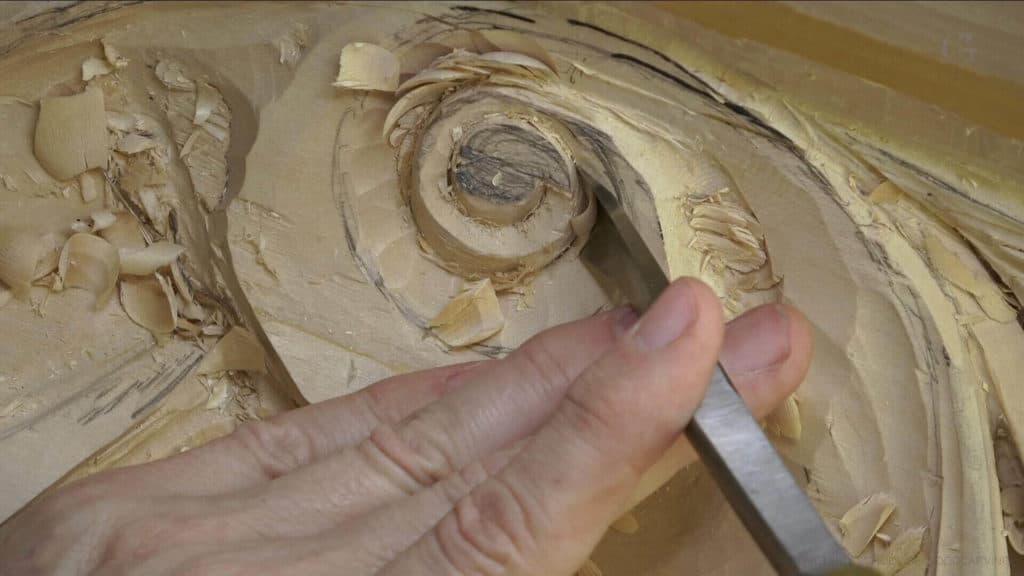
Alexander Grabovetskiy, woodcarver, School of Woodcarving · Published 2020
What does a wood carver mean by "I have no idea"?
Quick answer: At the end of workshop 62, I said I could not explain why my number six is in the drawer of the 11s. Other lessons carry the same kind of words about a lost tool, shadows, marks on the board and flowers.
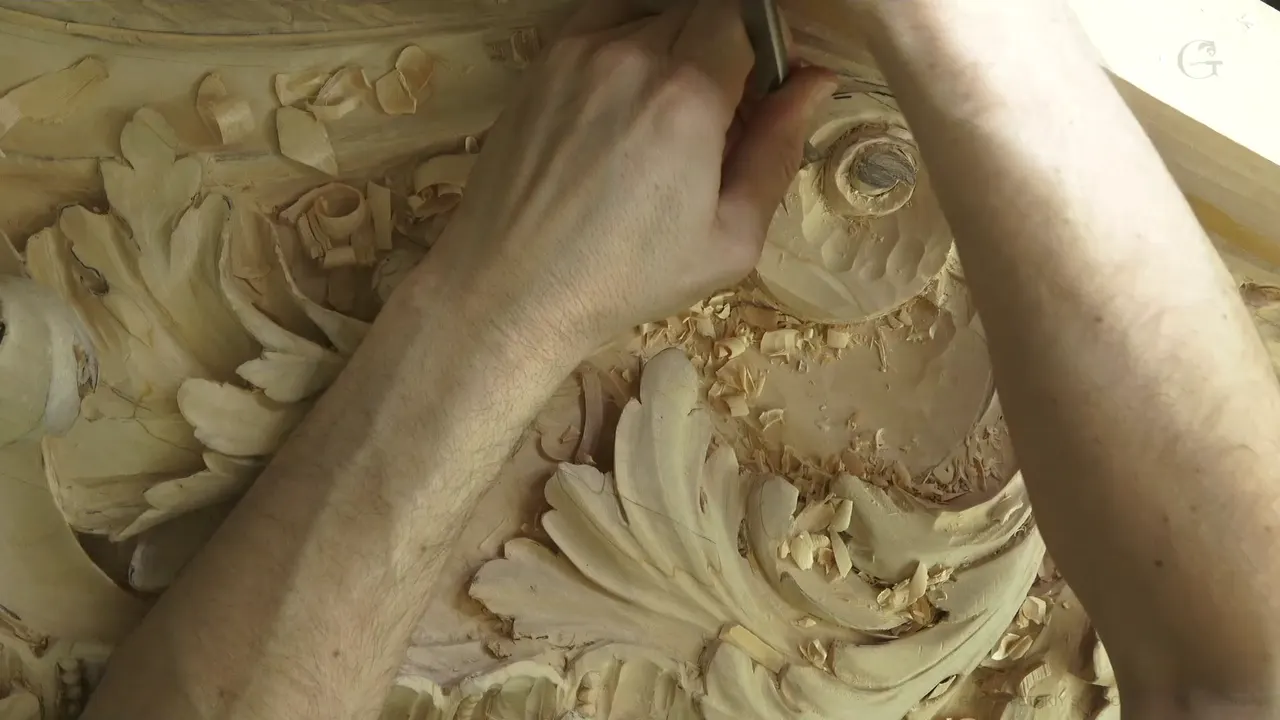

Near the end of Venice Room 62, part 12, I said I could not tell why a number six sits in the drawer with the 11s. Other lessons of mine carry words like those about a lost gouge, shadows, marks and flowers, and this page reads them beside that part.
Ever lost a gouge on your own bench? Does a line on a board ever make you wonder why you drew it? Workshop 62 gives one small case, and lessons from other courses give the rest.
What is the line at the end of part 12?
My words were "let me get the big number seven, 80 millimeters, 3 inches and 1/8 and create some better movement right here." Eighty millimeters is about 3.15 in, close to the 3 1/8 I said. Next came "giving me the right outline."

The last lines of the part go like this. "Okay. Again, without pushing too hard. It's always better to clean that with the number 11, it's always, always better to be more careful. Extra careful, I should say. And let me think. I have no idea why number six ends up in the drawer with the number 11s. All right."

What had I said about confusing movements?
Early in the part I said: "What I was trying to communicate to you, it's confusing at the beginning, okay, at the beginning when you start. It was confusing for me also when I started to carve those."
I named them: "complicated movements, like when it's sloping and it still has to be visible from all of the points." And then: "It's not that easy when you just start, okay?" It is "not that easy, even if it looks simple."

A moment before that, in the same part, I had said "More organic sloping." After it came "Now I can develop more or less how it's supposed to look. Okay? It didn't take long time."
Which tool cleaned the high spots?
A number three. "I'm using just number three and create a better transition upward or more cleaning, I would say." How: "Barely just arising on the hills, on the high spots without creating too much pressure."
About the cleaning: "I need just a canvas. I need to clean up before I can draw." Next, "That is good," and "Now I can probably develop somewhat much better idea."

How did I describe the concave that dies?
I told you what I was going to do: "just like that, and that is going to be concave part of my movement, and it's going to die." Then came "narrow right here," and a start from "almost nothing, wider, even wider, even more wider."
After that: "widen, widen, widen." About a second concave I said "so that is also the same concave," and it would "go, go, go and die inside of that volute."
The slope was next. "This part has to slope this way, and maybe some of it, I going to do a concave inside." Over all of it: "I still have to give a slight shape of sloping, and then I'm going to develop an inner part."

What were the encouraging words?
The words were "look awesome, actually," and then "really awesome." A question to myself followed: "Am I trying to say that to myself? Just kind of encouraging words to myself."
Next: "Alex, you can do it." And then: "I know I can do it because I've done it, and more than a couple times I've done it."
A plan came before the spoon veiner: "Let me take care of a little bit of this area. And now I need to take care of that and maybe start sloping."
Which gouge did I plan for the concave?
"The main idea is this chunk because we really want to see it develops beautifully." My plan was to create "that concave, okay, before I go further."
For the tool, I said "no better tool than a spoon," and that a "spoon veiner or spoon gouge will work." I was going to take "just the veiner," a "number 11 and seven millimeters," which is about 0.28 inch. A new thought came right after: "Or actually, you know what? Maybe I even don't have to, maybe I don't have to, maybe I can take just number six or seven. Let me do it and see if it's going to be appropriate right here."

Next: "And dig toward the main barrel, just like this, okay?" The rest: "little by little, and then we create the clean cut." I called it a "preliminary cut," and said "later on, we're going to create a clean cut."
Why stop short of the wall?
"And yes, I am on purpose not pushing all the way. It is on purpose because I really want to preserve wall of this element." About the cleaning I said "hard to clean," and then "It can become really hard to clean."

Do other lessons carry the same words?
They do. The lines fall in different places, so I sorted them by the thing I could not explain: why I drew something, a shadow, a missing tool, what a mark was, which flower it was, and a question about history.
Which drawing could I not explain?
In Furniture Panel 19, part 4, I had just said "Really good and the same height." Next I said I had no idea "why I did what I did right here, but I think it looks really good in overall design."

A little later in that part: "I'll just leave it like that, okay? If I don't like it, I'll do something else with that, but for now, I'll just leave to my original idea."
Then: "But I did something anyway." Next came the line about designing. "It happens sometimes when you're just designing something and it makes all the world of the sense. But later on, when you just look at it and you think, 'Why did you do that?' And you don't remember."
Part 2 of Furniture Panel 26 has a plan for a plug cut with "two millimeters, number nine," about 0.08 in. I did not want to go too deep, since it was "supposed to be about the same depth as here." I asked "So why did I design that?" and had no idea, then asked "Why did I do that?" My thought was "overcomplicated but not really."

Furniture Panel 38, part 2, has a close cousin. After "to be honest," I could not recall my own thinking there. A need came next: "what I have to do, I have to lower down slightly this side."
Over in Furniture Panel 28, part 2, I did not know what I designed there. It looked like I wanted "some kinda overlapping motion, which goes from underneath and overlaps this way," and then "I can start undercutting."

One more sits in Furniture Panel 35, part 1: "Now let me see what I have done right here." About a part: "I don't know, where is it coming from?" Then a decision: "but I'll keep it, okay, keep it like that, I'm not gonna redo it."
Next: "with the same number 11, I'll just outline it first." That would be "two and a half millimeters," roughly 0.1 in, a number 11.

What was wrong with the shadow?
Take Venice Room 59, part 11, for a plain case. "I still don't like how sharp this area looks. It doesn't look too appealing." And: "The shadow is too straight." I could not say why, "because I do have a curved cut, but it casts a wrong shadow."

My next words: "I have to fix that shadow." And: "Let me think. Maybe number seven I should use." Then the plan: "Number seven and 14 millimeters I'll try first and just get a little more pronounced arc" (about 0.55 in). A doubt followed: "But it could be just my light also."
Where did my gouge go?
The gouge in the drawer has a cousin in Venice Room 58, part 7. There I said "I have to switch to 3 millimeters" (about 0.12 in), and "it's got to be a spoon." Then: "A spoon, but I have to find it first."

Then came the plain line: "no idea what I've done with that, but let me use 2 millimeters and I'll just widen it." Next: "For some reason, my 3-millimeter tool is not there." That 2 mm size is about 0.08 in, and my plan was to "carefully marry those two cuts."
What is that mark on the board?
These are about a line or a part. In Venice Room 2, part 9, on the acanthus: "No idea what that line is, but anyway, let me cut the acanthus line." In part 5 of the same lesson, I planned "Let me cut this out, and that's going to help me to figure out what is going on."
Furniture Panel 26 shows it again in part 2, with "some kind of interesting movement," a double line I did not explain. Then: "So I don't wanna lose it." In part 1 of that lesson, a part went "underneath somewhere," and "no idea where it's supposed to end."
Take Grape Onlay 9, part 2. Before it: "Clean up little bit, those grapes." I called something good, yet I could not identify one bunch. "Actually get rid of it."

In the twelfth Lily Box lesson, part 8, I stopped to inspect the wood. "What's that orange stuff? I see some kind of orange stuff on the side of the wood." I did not know what that was, and then "But now I probably should take sandpaper again."
What kind of flower is it?
Look at Furniture Panel 14, part 1, for one flower. Before it: "if I should do movement uphill. I think I should." Then: "Don't ask me what type of flower that is. No idea." After that: "organic to the overall design."
Venice Room 136, part 3, gives a source. I drew a flower whose kind I could not name, "but I've got the idea of this flower from a 15th century building in Venice."

Why was it chosen?
The Greek Acroterion course has a question about an acroterion. I put it this way: "why this acroterion, they chose as a symbol of victory." "I tried to research it," I said, and I could not give a reason. Then: "Maybe they had some reasons." And: "Most likely, whatever the spiritual meaning they placed in them." The same part has a sound I could explain: "just in case, if you wonder what that sound is, that is actually because I'm cutting through the glue layer underneath of my paper, and that makes that squeak sound."
What about a failed recorder?
In the eleventh Lily Box lesson, part 1: "I lost some of my video again." I could not tell what happened to the recorder. I explained what I had done to the shiny piece: "let me explain what I've done." Then: "What I did, I just took a piece of wood and I burnished that nicely."
Where did each gap fall, in one table?
The table lists each place, the gap in my words, and what came next.
| Place | The gap, in my own words | Around it |
|---|---|---|
| Workshop 62, part twelve | why number six sits among the 11s | "extra careful" |
| Part seven of Venice Room 58 | what I had done with my 3 mm tool, which was not there | a 2 mm tool |
| Part eleven of Room 59 | why the shadow came out too straight with a curved cut | number seven first |
| Part four of Furniture Panel 19 | why I drew it that way, though it looked good overall | my original idea |
| Part two of lesson 26, furniture panel | why I designed that part, which I called overcomplicated but not really | "look good" |
| Panel 35 (furniture), part one | where a part was coming from, though I said I would keep it | not redo it |
| Lily Box 12, part eight | what the orange stuff on the side of the wood was | sandpaper again |
| Greek Acroterion 2, part one | why they chose this acroterion as a symbol of victory, though I tried to research it | maybe some reasons |
| Grape Onlay 9, part two | what a bunch was, right after I called it good | "get rid of it" |
| Panel 14 in the design course, part one | what type of flower it was, though it fit the overall design | organic, I said |
Where can you watch the lessons?
Every line above comes from one of my wood carving courses. This lesson holds all of workshop 62, and workshops 62 to 73 sit in Venice Room Part 6. The Venice Room begins in Part 1. The other lessons are in the furniture panel course, the Lily Box course and Carving Greek Acroterion.
How it's done
- Clean the high spots lightly. Number three gave a better transition upward, barely arising on the hills, without too much pressure.
- Plan the concave. My plan: narrow at first, from almost nothing to wider, and then dying inside the volute.
- Pick the tool in the open. A spoon veiner, a number 11 at 7 mm (about 0.28 in), then maybe a six or a seven instead.
- Make a preliminary cut. The clean cut comes later, after the preliminary one.
- Stop short of the wall. On purpose, to preserve it, since cleaning it later would be difficult.
- Press lightly, then think. Light pressure with an 11, extra careful, and then a question about a six among the elevens.
Frequently asked questions
Which gouge was in the drawer of the elevens?
Number six, I said last in the part, next to the number 11s. It comes after "without pushing too hard."
What happened when my 3 mm tool went missing?
In workshop 58, part 7, I said I would use a 2 millimeter tool (about 5/64 in) and widen it. My 3 millimeter tool, I said, was not there.
How did I treat a part of unknown origin?
In Furniture Panel 35, part 1, I asked where it was coming from. I would keep it, I said, and not redo it, and I planned to outline it first with a number 11.
Did I know why a shadow came out too straight?
What to carve next