

Alexander Grabovetskiy, woodcarver, School of Woodcarving · Published 2020
What does a wood carver mean by the "spine" of a carving?
Quick answer: The spine is my word for the middle line of a leaf or a movement. In workshop 62 I said it with a doubt about the word, then planned to give one up for a convex and bring it back. In the panel course I aimed to put it off center.
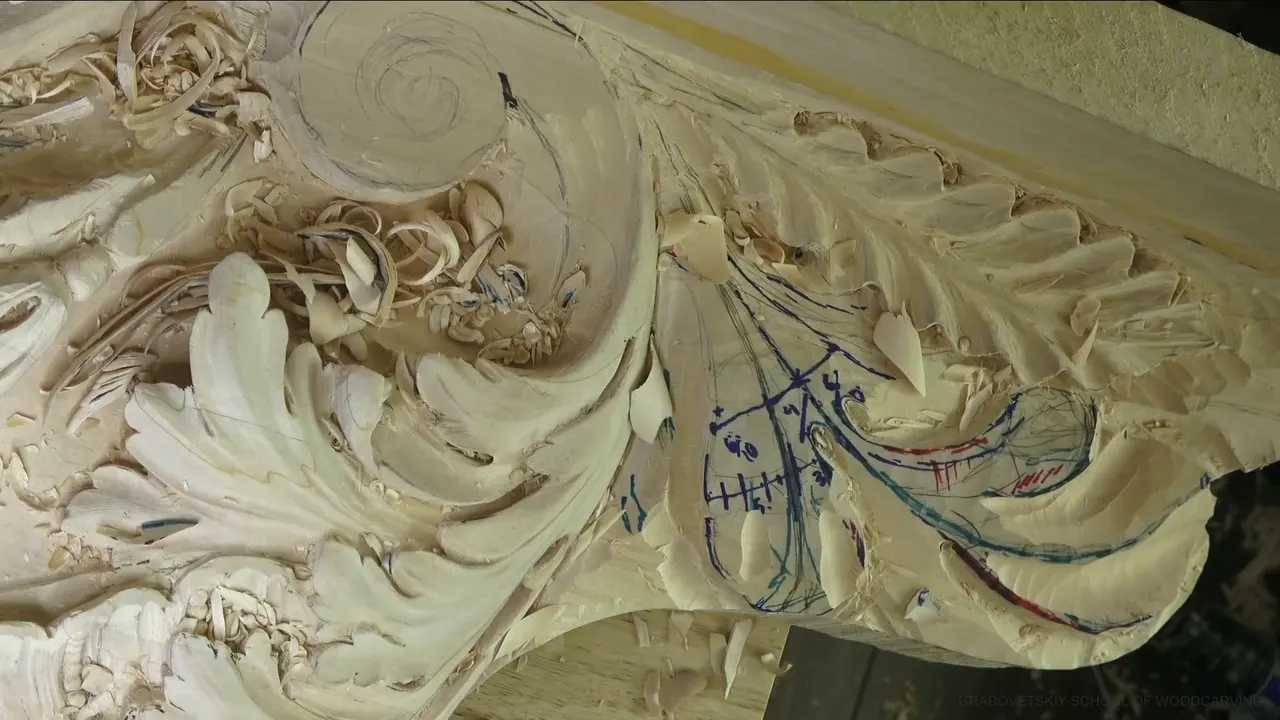

The spine is my word for the middle line of a leaf or a movement. In part 2 of workshop 62, I said "my middle line or middle spine," and a little later I said I might give one up to win a convex and then reestablish it. The Furniture Panel and Lily Box lessons carry the same word.
Have you ever drawn a line down the middle of a leaf and asked yourself whether it should stay? Do you want a hollow on one side and a raised round on the other, with that line in the way? This video has me working through it with a gouge in my hand. Later lessons bring the word back.
Which spine words open part 2 of workshop 62?
"So that is the main shape of it. I like that." I needed to create exactly the same in the next one, I said, "So the main idea is going to be exactly the same."
Then came the line that gave this page its word, "That is my middle line or middle spine." Soon after, I asked, "I'm not sure. Can I say that?" My plan was a really massive movement, and I needed to attack "from the right position." I added that my light was in my way.
Why would I give up a spine to get a convex?
I had lost the convex. "I really want to see the spine, but on another hand, I lost the convex," I said, and then I weighed it out loud, "Maybe okay, maybe not. But just because I don't have a convex on the other hand, I can see really good shadow." And a moment on, "Not authentic. I got to have some convex."
My plan used a back bend, "and I'll try to establish some convex even if I have to get rid of a spine and then reestablish it." It ended on a firm line, "I really need convex at least on one side."

A little later, "let me reestablish my spine or middle line, and I'll try to establish also convex on another side. Not sure if I'll be able to." Then the result. "And yes, I was able to. It's a convex and convex." Little bit of convex, I said, "but still convex. Not the biggest convex, but it's still convex, and that's what I'm after."
Which tools came after the convex in part 2?
"Number seven in my hands, and I'm just cleaning, just cleaning again, transitioning to concave." Then a doubt, "maybe this number seven is slightly too big, maybe not slightly, maybe more than slightly, so I got to use little smaller tool."
Next I would use a number six and try "to hit inside and get rid of some of the tool marks." Those passes were preliminary, since more were coming. At one point I called a tool maybe a little too small, and I named number 11 at seven millimeters (0.28 in). Then, "Okay, that is good, I'm going to leave it at that."

Which side did I not like in part 2?
"I'm still not too happy about this side, but I am happy about that side." I had to be really careful there about how deep I went, I said, because I did not want to go too deep. I would undercut it, and it would be visible, "but I still have about three millimeters right there" (about 1/8 in), "and I'm keeping it. For now, at least."

Later, "Still doesn't make too much sense. Of course, I'm just telling you my opinion. But on another hand, I'm the one who's actually developing it." Near the end I said maybe I had to get this part going uphill and make this eye much smaller.

What did part 1 say about the center line?
In this first video I wanted a massive concave, and I planned a number 11, 18 millimeters (0.7 in). Then, "Maybe actually bigger. I'll use 30 millimeters right here" (about 1 3/16 in), "because I really want to exaggerate everything."
Later I said this about the spine, "I'm not going to touch the center line, a spine. Could you say spine, I guess?" Then, "I have to be really wise from what position I am attacking it." Near the end of that video I said, "All right, so I've got that concave, and that is going to be, of course, convex or close to the convex, I should say. Right now, I can just knock down to the center line."

What did part 3 say about the spine?
I was looking at a raised part and asking what else I could do. "That was a spine originally. Originally, that was a spine, and this movement's supposed to be all the way right here, and I messed that up." I took it back right away, "I did not mess it up, but for some reason, I chopped this way, so I need to lower this down." A pipe followed, and I said I wanted to exaggerate those pipes again.

What happened to the spine in part 4?
One movement was a little too long for my taste, I said, even with a middle spine right there. Further on I was carving along the grain, and I said, "I have to be really mindful about how deep I'm carving and how much shavings I'm taking out." Rushing was not what I wanted, and maybe I needed to take this spine even lower. I thought it would make sense. I promised, too, that it would look really good.

Why was I not afraid of a lower middle line in part 5?
Two pipes were meant to pop out, and I said the middle section had to go lower for that, otherwise it would not look as nice. I added that I was not afraid of the line being a little lower, and that this was absolutely okay.

With two pipes exaggerated, I could reestablish the line with no problem, and then I asked, "Spine? Line? I don't know what's the best way to say that." Of the depth I said, "I don't have a lot of depth to give a frame, but I still need to get about the same amount of shadows." And one more time, a lowered middle line was "okay, too."
Where else does workshop 62 name a middle?
In part 5 the early words are "my middle ridge," and I said I was going to need to soften it. I slipped on a word, "Let me do some concaving. Convexing. I apologize," and then, "Convexing it actually helped a lot." The same part has "here's a middle line," with "a couple small lines just to indicate the movement."
A back bend can hit "the center of it" on a ridge, in part 6. The seventh video says, "Everything's supposed to go to the center line, and here is my center line." It names a problem, "I've got two eyes pretty close to each other, and there is a center line," with a plan beside it, "maybe I'll just destroy it and then reestablish my center line."

Where does the spine sit in the Furniture Panel lessons?
Off to one side. In Furniture Panel 19, part 8, my plan was to go with my golden ratio and put my spine "not right in the middle, but if you divide this part in 10 parts," at "the six out of 10 towards that edge."
The sixth video of that lesson has the same idea, with a "middle spine, if you wish" to be moved "slightly to this side and about 6 out of 10 parts."

Finding that spot is a matter of the eye, in part 11. By eye, the spine would be "somewhere right here." I also said, "Again, I'm just eyeballing, really, I don't need to measure it. There's no reason for that." A second line had to be shifted to match the first, in part 12.
How deep is a ridge spine?
Really shallow. I wanted a movement that casts some shadow, I said in part 8, with a small concave here and maybe a convex kept there, "a spine, like a ridge spine, but it has to be really, really shallow. It should not be deep."

The tool I named was "probably just the number five and the quarter inch" (about 6 mm), with a goal "not to touch this edge." The sixth video gave two ways to attack a middle part, "I could create that part as a raised part and then lowering down on both sides. Or I could actually just attack it with not the V cut, but like a veiner cut on the inside," and then the part is "convex, convex, okay, going downhill just like that."
Can a leaf do without a spine?
It can, I said in part 12, "I could just leave it like that with just concave without the middle spine, but I think it's going to look better with the middle spine."

What I'd do is "create extra concave cut on the side of the spine. A little deeper, I should say." I could take number 11 and 3 millimeters (0.12 in), "just create the shadow, okay?" I also said, "keep an eye this line right here," and, "in visual, it has to be parallel. Again, law of repetition."
What is the difference between a spine and a stem?
Midway through part 9 I caught the word. "I know that spine--" and then, "the stem, I should say. It's the same height as the highest spots." I wanted it "more pronounced, I mean, that stem, middle stem."

Further on I said, "I don't want to see that middle part really thick," and, "I have to repeat that, so I made a mistake." My fix was to clean it, "and I move slightly my spine." Then, "Law of repetition. So now it repeats." And, "It makes this leaf a little smaller." Later in part 9, "I also need to lower down this side to the spine," and in part 10 I saw something in the spine that was not where I wanted it.
Did I say spine in the Lily Box lesson too?
I did, and I corrected the word again. In Lily Box 8, part 8, I was deciding where a concave should go, here, or a concave to the overall movement with this one left "a little higher."

Then I picked a spot, "I'm going to cut right here, that's my middle point, by the way, not middle point, but middle spine." Number four was the one I named, a small gouge.
Which lessons say spine?
Here they are in one table, with what I said and the next step beside it.
| Lesson | What I said about it | Next step |
|---|---|---|
| This video, workshop 62, part 2 | Let me reestablish my spine or middle line | Something smaller than number seven |
| Part 1 of workshop 62 | I'm not going to touch the center line, a spine | Be wise about the position I attack from |
| Workshop 62, third video | I did not mess it up, but for some reason, I chopped this way | Chop out that section |
| Fourth video of workshop 62 | Maybe I need to take this spine even lower | Carefully go around |
| Fifth part, same workshop | Spine? Line? I don't know what's the best way to say that | Seven millimeters (0.28 in), number 11 |
| Part 6 of lesson nineteen in the Furniture Panel course | Middle spine, if you wish, off to one side | My initial cut, number 11 |
| The eighth video of lesson nineteen, Furniture Panel | A ridge spine, and it should not be deep | A small concave with number five |
| Lesson 19, ninth video | I move slightly my spine, and I repeat the movement | So I need to clean it now |
| Lesson nineteen, part eleven of the Furniture Panel course | Somewhere right here, just eyeballing it | Cut that detail right here |
| Part twelve of the same lesson, Furniture Panel | I think it's going to look better with the middle spine | I could take number 11 and 3 millimeters (0.12 in) |
| Lily Box 8.8 | Not middle point, but middle spine | A small gouge, number four |
Where can you watch the full video of each lesson?
Venice Room 62 holds all twelve parts of workshop 62, and the workshops 62 to 73 are in Venice Room Part 6. The next workshop is Venice Room 63. Venice Room 61, the one before it, sits in Venice Room Part 5, and Venice Room 64 comes after 63. The panel lessons live in Carving Furniture Panel, lesson 19 among them, and lesson 21 is in the same course. The Lily Box is its own course. All of these are wood carving lessons, and to watch the full videos you can start here.
How it's done
- Name the middle line. I named it the middle spine in the second video of workshop 62, and asked if I could say that.
- Move it off center. In lesson 19 I planned to put my spine off center, eyeballing it.
- Make one side concave, one convex. My eighth video of lesson 19 plans a small concave on a side and maybe a convex opposite, a ridge spine.
- Give it up for a convex. Giving the spine up to win a convex was my plan in part 2, then I would bring it back.
- Lower it when pipes need room. For two pipes to have room, the middle section needed to be lower in part 5.
Frequently asked questions
Is spine the right word for a middle line?
I was not sure. Part 5 of workshop 62 has me asking out loud which word fits, spine or line. In the Lily Box I fixed myself from middle point to middle spine.
Where did I place the spine on a leaf in lesson 19?
I planned to split the leaf in ten parts and put the spine at six, off the middle, and I said I was eyeballing it. Lesson 19 says so in parts 6, 8, 11 and 12, and in part 11 I said there is no reason to measure it.
Did I bring the middle line down in workshop 62?
Weighing a lower spine came in part 4. Next, part 5 wanted the pipes to pop out as the middle section came down, and a line a little lower was called absolutely okay.
What to carve next