

Alexander Grabovetskiy, woodcarver, School of Woodcarving · Published 2020
What does a wood carver mean by "is that even a word"?
Quick answer: In part 3 of workshop 62 I said "Blends it" and then "Just doesn't sound right," before going on with "I need to blend." In other lessons of mine I wondered aloud about roundy, curliness, motion and "super awesome," and this page sets each passage next to its lesson.
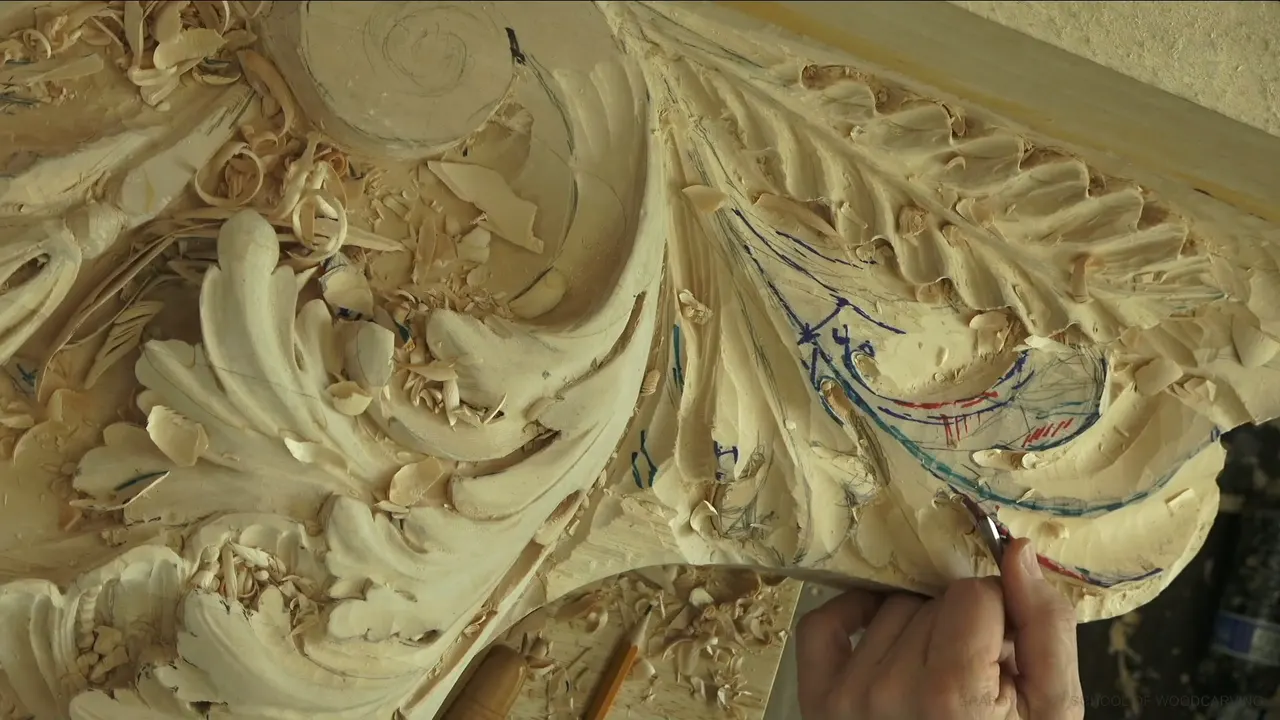

In part 3 of workshop 62 I asked out loud if I can say a word, and then carried on with the cut. Other lessons of mine have the same doubt about roundy, curliness, motion and a few more words, and this page sets those passages side by side.
Have you ever heard a word leave your mouth at the wood carving bench and wondered if it is a word at all? Part 3 has that moment near its end. Before it come a number 5, a letter S and an acanthus eye. After it come a spine I want to lower and a pipe I want to exaggerate. The lessons further down carry the same doubt beside other words, each marked with its course and linked.
How did the word fit into part 3?
Near the end I said "this needs to be blended also," and then "Blends it. Can I say that?" The next words were "Just doesn't sound right." Afterward came "I need to blend." Then, "Okay. That is good." My next question was "But what else I could do?", and I turned to a raised part and a pipe.
Which work came before the question?
The part opens with "go completely uphill with this movement." The space between the upper point and this point, I said, is about the same as the one right here, "so that makes much more sense." I don't have any ability to show that from the angle you see, I said. "I really don't want to change the camera position because I have a rack above me right now."
Next came "I thought I created the problem. I did not." Afterward came "I can actually take a little bit this edge this way and reveal that movement." That, I said, "is going to be the movement," and "I'm going to leave it like that."

Number five is named here: "Let me get number five", and the tool I named was "Number five and about 10 millimeters" (0.39 in), for "a line like that" and to "cut right inside." Then: "now you should be able to detect that movement," and "Now it is good."
How did I plan the extra separations and the letter S?
My plan was to create extra separations "everywhere pretty much, because I need some curliness," and "you already saw that hundreds of times, so you don't have to watch it." A jump to the other side followed: "let me jump on this side." The eye was there, and I needed "a separation or division, whatever is the best to call it," and it had to be "somewhat curly."
The curve I named was "S curvature, letter S curvature," and "I think it's going to give me a good beginning." Tool talk goes on: "I can use probably 18 millimeters" (0.71 in), number 11, "a little less than three-quarter of an inch, but about."

Outlining stayed a plan: "I can outline this way, too." There would be "a deeper excavation," and "that is somewhat I want to see." The edge: "Now I can chop. A little bit chop my edge", though "I have to be careful how I do it." Of the movement itself: "I really love that movement."

Where did the eyes come in?
"I need to establish my acanthus' eyes again," I said. I would check the "best position for it." I needed number 11 again, and next I would "go to the eye." My remark on the way of working: "if I would do it right way, it would help a little more," and "that would be the right way." My reason was "how the grain goes and how it feels."
This side, I said, can take "the same cut this way." Then: "Okay, really deep," and said that was "just because of the idea of shadows."

Where did the spine and the pipes go after the word?
A part I raised is "going to cast really well," but "I need to do something else." About the spine: "that was a spine originally," and the movement is "supposed to be all the way right here, and I messed that up." A correction came in the same breath: "I did not mess it up, but for some reason, I chopped this way." My need is to "lower this down." Then the pipes. "There's going to be a pipe, and I really want to exaggerate those pipes again," I said, with "another pipe" to follow, and "for that, I really need to chop out that section."
Do the other parts of workshop 62 carry the same doubt?
Part 2 does. Early on I said "That is my middle line or middle spine." In the next breath I was unsure if it was OK to say. Then came "Let me do also massive, really massive movement." I needed to attack "from the right position," and "my light is in my way."

That part goes on to a convex. "I lost the convex," I said. Then: "Not authentic. I got to have some convex." I said "let me use a backbend, and I'll try to establish some convex even if I have to get rid of a spine and then reestablish it." Result: "I was able to. It's a convex and convex." With "Number seven in my hands," I doubted it: "maybe this number seven is slightly too big. Maybe not slightly, maybe more than slightly." I said "I got to use little smaller tool," and "Let me use number six."
On the S I said "I could actually use a curvature like that, letter S. In this case, it's pointing outside." On depth, "I still have about three millimeters" (0.12 in) "right there, and I'm keeping it." Late in the part I said "It's still bugging me, this area," and maybe I have to "get this part going uphill and make this eye much smaller like that."
Part 4 is about other things. "Please forgive me that you don't really see the full development," I said. Next: "I kept the extra thickness of this upper layer. I did not hit the glue yet." It does not really matter, I said, because the piece will be paint grade, and "So it's okay." I also said I am breaking the rule and carving toward myself, because I don't have a better position "without sticking my head to a camera."

Where else did I ask whether it is a word?
The rest of this page comes from my other lessons. Each passage says where it sits, and each lesson is linked to its page.
Did I ask about the word roundy?
Workshop 53, part 12, has me using number 11 and a 4 millimeter (0.16 in) veiner, with "I'm going to make this part roundy." Next, a doubt: "I'm not sure if I can say that." Then "If there is no word, now there is a word, because it is roundy." My comparison was "If you can say curly based on a curl, then you can say roundy based on a round." Later in the part: "I am carving against the grain, but if I have a really sharp tool, I'm okay." And: "it's not the final cut, not the cleanest cut."

Over in Furniture Panel 22, part 9, I was using number three, "a quarter inch, six millimeters." The cut came with "Yes, I am breaking my rule. I'm not supposed to cut against the grain, but it's okay." The word came back too: "Like I said before in another lesson," I wasn't sure roundy is a word, "but I use it." What I wanted next was "another cut right here just to give that detail a little pop."

Workshop 69, part 5, gives it again. "I want to make sure it's kind of round-y," I said. Next: "There is no such a word as round-y." Then: "I made that word up." The plan was to "take number 11 and get a little bit undercut done," and I said "Ten millimeters, about three-eighths of an inch." A word someone makes up is called a neologism.

Did curliness get the same doubt?
The Byzantine Acanthus 10 lesson, part 4, has me saying "everywhere we can do another layer of detailing," with a warning to "be careful not to break it." And: "Now it becomes more fragile." Then: "those extra details are going to add some curliness. Can I say that word, curliness?" Next: "It's going to look more curly." I went on to "extra layer of detail," and having done one I planned to add them "everywhere."

Lily Box 10, part 5, names a knife. "I'll use a knife, kind of clean little bit this movement," I said. Also: "I actually can create some curliness right here, too." Whether the word exists, I wasn't sure: "But anyway, that's what I want to see." Plans followed: "cut on the inside right here, concave," and with the knife "pre-establish the backside of it."

What about motion, slant and super awesome?
In Modern Acanthus 6, part 1, I said "this part flips a little bit backward." And: "Can you see how I'm creating that motion?" I asked if motion was a good word to use. I wanted to "bring that little closer," and "drop almost almost all the way to the background," and to leave "maybe about 1/8 of an inch" (3.2 mm).

Venice Room 61, part 6, was about a really thin tool. It is "really good tool for a softer wood, like, in this case, lime wood or basswood," while "for harder wood, you can break, if it's a thinner tools, easily." Of this operation I said "it's just super awesome," and asked "Is that even a word?" Then: "I've got a spot where I stopped," and "now it casting some shadow."

My Furniture Panel 37 lesson, part 2, has "with the same tool, let me clean it," then "I can just scrape slightly and I got my slant." Of that word I wasn't sure, and "let me get the second one," which is "actually the same, but it's gonna go in opposition." Some of you, I said, don't pay attention to "design rules and golden ratio proportions, but for me it is a big deal," and "the 60 40 rule or 62%, 38% rule, you can find it here."
Which other words did I doubt?
Hashemi Flowers 11, part 6, is the same cut from the opposite direction: "it's exactly the same but from opposite direction." Then "this part of the leaf is going to look like it's really deep underneath, and this is just flipping above." My doubt there was "I'm not sure," about whether I could say that even, and then came "probably more accurate way to say that." Later I said "I'll use just number 11, one millimeter first" (0.04 in), and "I'll do exactly the same."

In Greek Acanthus Leaf 6, part 2, a number seven at 14 millimeters (0.55 in) could make a V "more roundish V." I wondered aloud whether I can say that. Next: "keep an eye on your grain, because here the grain changes the direction."
Workshop 89, part 7, shows a green area. "Which means it's water damage." On tools: "So sharp tools must, otherwise, this area is a little too mushy." Later: "it's just really mushy. I don't even know if there is a word. Maybe I made that word myself, but it's exactly what it feels like."

Workshop 119 has "Simple movement, but still it's a somewhat acanthacy." Whether acanthacy is a word, I don't know, and "it's just like a frame, okay?" And: "just pretty much the edge of this acanthus."

Workshop 109, part 2, begins with "One millimeter, and of course it would be number 11" (0.04 in), and "I could live with two-millimeter cut" (0.08 in), "but I think it would give me better pop." "I hope you can," I said of saying it that way, "Or maybe I just invented a new word, better pop, better shadow," and "I'll take number seven and roll."

Lily Box 4, part 7, has "there's a little ridge" and I wasn't sure there was a word for ridge. There I planned "number five" for "a blending cut." Then Lily Box 10 again, part 13: I said I'll use "number 11, one millimeter again" (about 1/25 in), and I was "not too happy about this small detail." I added that it did not sound right. Then: "Of course, you can't say that to the wood, but what I try to communicate, it doesn't look really good."
Which lessons ask whether it is a word?
The table has each lesson, the word, and what I did next.
| Lesson | Word I doubted | Next step |
|---|---|---|
| Lesson 62, part 3 (Venice Room) | blends | On to the blend, and the verdict that it was good |
| Lesson 62, part 2 (Venice Room) | middle spine | A really massive movement, from the right position, with my light in my way |
| Hashemi Flowers, lesson 11, part 6 | flipping above | Number 11 first |
| Byzantine Acanthus, lesson 10, part 4 | curliness | Extra details, everywhere |
| Modern Acanthus, lesson 6, part 1 | motion | A little closer, and about 1/8 in (3.2 mm) to leave |
| Lesson 61, part 6 (Venice Room) | super awesome | Where I stopped |
| Lesson 53, part 12 (Venice Room) | roundy | A sharp tool |
| Lesson 69, part 5 (Venice Room) | round-y | Number 11 for a little undercut, then maybe a bigger one for a cleaner, quicker cut |
| Furniture Panel, lesson 37, part 2 | slant | A second cut |
| Lesson 89, part 7 (Venice Room) | mushy | Sharp tools, otherwise the area is a little too mushy and every cut is not clean |
| Lesson 119, part 3 (Venice Room) | acanthacy | Like a frame |
| Lesson 109, part 2 (Venice Room) | better pop | Number seven |
Where can you watch the full video of each lesson?
Every lesson named above is inside one of my courses. This lesson holds all of workshop 62, and workshops 62 to 73 are in Venice Room Part 6. Workshops 50 to 61 sit in Part 5, 86 to 97 in Part 8, 98 to 109 in Part 9 and 110 to 121 in Part 10. The courses named besides those are Carving Hashemi Flowers, Carving Byzantine Acanthus, Carving Modern Acanthus, Carving Greek Acanthus Leaf, the Lily Box course and Carving Furniture Panel. To watch the full videos, start here.
How it's done
- Open the movement. Taking a little bit off this edge, this way, shows the movement. I would leave it like that.
- The line. Use number five for it.
- Plan the separation. A separation or division has to be somewhat curly, with an S curvature.
- A tool for the S. A number 11, probably.
- Take number 11 to the eye, again. Number 11 goes to the eye again, really deep, "just because of the idea of shadows."
- Bring the raised part down. The movement was a spine originally, and I need to lower this down. A pipe is going to follow.
Frequently asked questions
Which tool did I name for the line in part 3?
About 10 mm (0.39 in), with number five. The plan was a line, then a cut right inside it.
Which curve did I plan for part 3?
A letter S curve on the new separation, with a number 11 of probably 18 mm (0.71 in), a little under three-quarter of an inch.
What was my line on roundy?
In lesson 53 I compared curly, from a curl, with roundy, from a round. In lesson 69 I called it a word of my own.
Which words followed curliness?
What to carve next